August 25, 2026
The Battery Energy Storage System Is Not Just a Battery
Most conversations about grid-scale energy storage reduce the technology to a single question: which cell chemistry wins? Lithium iron phosphate versus nickel manganese cobalt, two-hour versus four-hour duration, Chinese suppliers versus Western alternatives. These are legitimate debates, but they systematically miss a structural reality that shapes project costs, equipment lead times, and long-term supply chain resilience in ways that cell chemistry comparisons never capture.
A Battery Energy Storage System is not a battery. It is an electrochemical storage plant. The cells are one subsystem among many, and the surrounding architecture, power conversion hardware, thermal management equipment, protection systems, sensors, and controls, determines whether the plant actually delivers on its contractual obligations. That distinction matters enormously when mapping where rare earths in grid-scale battery storage actually appear, because they do not appear inside the cathode chemistry of dominant technologies. They appear in the industrial machinery that keeps the entire plant operating reliably.
Furthermore, understanding the battery raw materials market dynamics is essential context for any developer or financier evaluating equipment sourcing risk across a utility-scale project.
When big ASX news breaks, our subscribers know first
Where Rare Earths Actually Enter the BESS Architecture
The Auxiliary Systems That Define Commercial Performance
The commercial performance of a BESS facility is governed as much by its auxiliary systems as by its cell specifications. Uptime obligations in tolling agreements, capacity contracts, and grid operator availability targets create financial exposure whenever any subsystem fails, regardless of whether that failure involves cells or cooling fans.
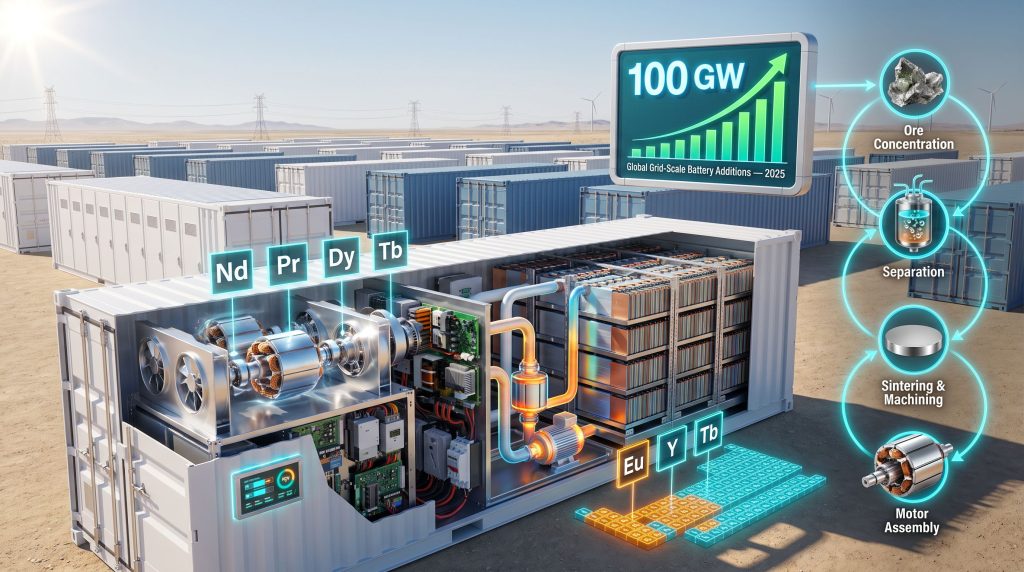
Rare earth elements concentrate in three functional areas within a typical BESS installation:
- Permanent magnet motors driving cooling fans, HVAC systems, and liquid cooling pumps
- Switchgear actuators and protection mechanisms requiring fast, repeatable mechanical action
- Phosphor materials in status displays, indicator lighting, and certain sensing components
- Optical polishing compounds containing cerium and lanthanum for inspection and monitoring equipment lenses
The element-level mapping looks like this:
| BESS Subsystem | Primary REEs | Function | Magnet or Material Type |
|---|---|---|---|
| Cooling fans and HVAC motors | Nd, Pr, Dy, Tb | High-torque thermally stable rotation | NdFeB sintered |
| Liquid cooling pumps | Nd, Pr | Compact efficient fluid movement | NdFeB |
| Switchgear actuators | Nd, Pr, Sm | Fast repeatable mechanical action | NdFeB or SmCo |
| High-heat high-duty motors | Dy, Tb, Sm | Coercivity retention at elevated temperature | NdFeB Dy/Tb-enhanced or SmCo |
| Status displays and indicator panels | Eu, Y, Tb | Stable legible colour emission | Phosphor compounds |
| Optical inspection components | Ce, La | Lens and sensor surface polishing | Polishing powders and catalysts |
Why LFP Chemistry Reshapes the REE Conversation
The dominance of lithium iron phosphate chemistry in 2025 and 2026 deployments has a specific implication for rare earth analysis. LFP cathodes contain lithium, iron, and phosphate. There is no rare earth content at the cell level. According to BloombergNEF Energy Storage Market Outlook data and Wood Mackenzie energy storage research, LFP accounts for the substantial majority of new grid-scale battery installations in this period, with two-hour and four-hour duration configurations representing the most common project structures.
The practical consequence is that rare earth demand from grid storage scales with the population of auxiliary motors and actuators deployed across a project, not with total megawatt-hour capacity installed. A 500 MWh facility and a 200 MWh facility with similar HVAC and thermal management configurations may have comparable rare earth footprints at the equipment level.
This framing is rarely modelled explicitly by procurement teams or project financiers, yet it has real implications for schedule risk and spare-parts strategy. Consequently, understanding the broader rare earth supply chains across global industrial equipment markets is increasingly relevant for BESS developers.
The Neodymium-Praseodymium Foundation and the Heavy REE Problem
NdFeB Magnets as the Primary REE Exposure Point
Neodymium and praseodymium form the backbone of NdFeB permanent magnets, which deliver exceptional magnetic flux density relative to their physical size. This allows motor designers to achieve high torque output in compact frames, a significant advantage in containerised BESS designs where enclosure space is constrained.
According to technical guidance from magnet manufacturers including Arnold Magnetic Technologies and Vacuumschmelze, and consistent with IEC motor efficiency standards, a single high-efficiency permanent magnet motor may contain roughly 0.5 to 3 kilograms of NdFeB magnet material, depending on motor frame size and design specification.
A large utility-scale BESS project may incorporate:
- Dozens of HVAC fan motors for container thermal management
- Multiple liquid cooling pump motors for active cell temperature control
- Switchgear actuator mechanisms across protection and isolation equipment
- Auxiliary motors in ancillary systems throughout the facility
Aggregated across a large installation, this translates into kilogram-class magnet volumes that represent a meaningful and often underestimated rare earth exposure embedded in project equipment procurement.
The Temperature-Sensitivity Problem: Why Dy and Tb Matter More Than Most Analysts Expect
Magnet coercivity, meaning the resistance of a magnet to losing its magnetisation under thermal or opposing-field stress, degrades predictably with rising temperature. For a BESS sited in a desert climate or a constrained enclosure where ambient heat is already elevated, this degradation can become operationally significant.
When coercivity falls sufficiently, fan or pump motors begin losing torque. Cooling performance drops. Cell temperatures rise. In a system operating under performance guarantees tied to availability and cycling targets, this cascade can trigger financial penalties before any physical component actually fails.
Engineers address this problem through two primary approaches:
- Dysprosium and terbium addition to NdFeB: These heavy rare earths improve coercivity at elevated temperatures. Modern grain-boundary diffusion techniques concentrate Dy and Tb at magnet grain boundaries rather than distributing them uniformly through the bulk material, achieving comparable high-temperature performance while reducing total heavy REE consumption. This is described in DOE critical materials research summaries and manufacturer technical documentation from Vacuumschmelze.
- Samarium-cobalt magnet substitution: SmCo magnets offer superior thermal stability without requiring Dy or Tb additions, but they carry different supply chain exposure through samarium and cobalt, and they cost more per unit of magnetic performance.
Heavy rare earths dysprosium and terbium are significantly more supply-constrained than their light counterparts neodymium and praseodymium. BESS projects deployed in high-ambient-temperature environments carry elevated exposure to Dy and Tb availability conditions, a distinction that procurement teams and project financiers rarely model when evaluating equipment sourcing risk.
In addition, the rare earth processing challenges associated with heavy rare earth separation make these elements particularly vulnerable to any disruption at the refinery or separation stage.
From Mine to Installed Motor: The Eight-Stage Value Chain
The journey from rare earth ore to a functioning NdFeB magnet inside a BESS cooling fan involves eight distinct production stages, each with its own geographic concentration profile and potential chokepoint:
- Mining and ore concentration involving extraction of rare earth-bearing minerals including bastnäsite, monazite, and xenotime
- Chemical separation using solvent extraction circuits to isolate individual rare earth oxides
- Metal conversion reducing rare earth oxides to metals and master alloys
- Strip casting and jet milling producing fine NdFeB alloy powder with controlled particle size distribution
- Pressing and sintering compacting powder into solid magnet blanks under controlled heat
- Heat treatment and machining optimising magnetic properties and cutting magnets to specification
- Coating and quality testing providing corrosion protection and performance verification
- Motor assembly and BESS integration installing magnets into motor rotors and motors into auxiliary systems
The USGS 2026 Mineral Commodity Summaries confirm that rare earth processing remains geographically concentrated, with China producing the majority of separated rare earth oxides and finished NdFeB magnets globally. This concentration affects every stage from step two onward. For a detailed assessment of how China's export restrictions are reshaping equipment procurement timelines, the policy context is increasingly difficult to ignore.
Where the Chokepoints Concentrate
| Supply Chain Stage | Primary Risk Factor | Heavy REE Impact |
|---|---|---|
| Chemical separation | Specialised equipment, tight process control | Dy and Tb more complex than light REEs |
| Sintering capacity | IP-intensive, geographically concentrated | Qualifying new facilities takes years |
| Traceability documentation | Grid customers require chain-of-custody records | Adds testing steps and lead time |
| Trade policy | Export controls and licensing requirements | Affects price and availability expectations |
Deployment Scale and What It Means for REE Demand
The Numbers Behind the 2025-2026 Buildout
Global grid-scale battery additions have accelerated sharply. According to the IEA's mineral requirements for clean energy transitions and BloombergNEF Energy Storage Market Outlook data, grid battery additions in 2025 exceeded 100 GW of new capacity, with China, the United States, and Europe leading regional deployment. BloombergNEF's 2026 projections indicate continued annual installation growth as interconnection queues clear and project pipelines mature.
IEA Sustainable Development Scenario modelling projects utility-scale battery storage growing approximately 25-fold between 2020 and 2040, representing a structural demand expansion that extends well beyond current deployment cycles.
The "intensity down, volume up" dynamic is the critical concept for understanding how this translates into REE demand. Per-unit rare earth content in motors may decline as grain-boundary diffusion and motor redesign reduce heavy REE requirements. However, the total installed population of motors, actuators, and auxiliary equipment grows alongside storage buildout. As both IEA and DOE critical materials outlooks have noted, total demand for rare-earth-enabled equipment can still rise even as per-unit intensity falls. This is consistent with broader critical minerals demand projections across the global energy transition.
Grid-Level Value Streams Driving the Buildout
The operational services that justify BESS deployment are also the services that impose the most demanding performance requirements on auxiliary systems:
- Frequency regulation responding in milliseconds to grid frequency deviations
- Energy arbitrage shifting generation value across hours based on price spreads
- Renewable curtailment absorption capturing excess solar and wind output during transmission-constrained periods
- Capacity and resource adequacy providing firm committed capacity in markets where gas turbine buildouts face permitting or financing barriers
- Contingency reserves responding to sudden generator trips or transmission outages
NERC reliability publications and market monitoring reports from CAISO, ERCOT, PJM, National Grid ESO, and AEMO each document how fast-frequency response contributions from battery storage are reshaping system reliability metrics. These performance obligations create the commercial context in which auxiliary system reliability is as financially critical as cell performance. The solar and storage industry's reliance on rare earth elements further reinforces why supply chain visibility matters across interconnected clean energy sectors.
Motor Technology Trade-offs for BESS Auxiliary Systems
Not every application requires NdFeB magnets, and engineers have developed a range of strategies for reducing rare earth dependence where performance constraints allow:
| Motor Technology | REE Content | Power Density | Temperature Performance | Cost Sensitivity |
|---|---|---|---|---|
| NdFeB Permanent Magnet | High (Nd, Pr, Dy, Tb) | Highest | Good with Dy/Tb addition | Moderate-High |
| SmCo Permanent Magnet | Moderate (Sm, Co) | High | Excellent | High |
| Ferrite Permanent Magnet | None | Low-Moderate | Limited | Low |
| Induction Motor | None | Moderate | Good | Low-Moderate |
| Switched Reluctance | None | Moderate | Good | Low-Moderate |
Ferrite magnets contain no rare earths and offer substantially lower cost, but their lower magnetic flux density requires larger motor frames to achieve equivalent torque. In containerised BESS designs where enclosure space directly constrains thermal performance, that physical footprint penalty can be commercially significant.
Switched reluctance and synchronous reluctance motors eliminate permanent magnets entirely but typically sacrifice power density, which creates similar spatial constraints. The practical outcome is that rare earth reduction strategies require case-by-case engineering evaluation rather than blanket substitution.
The most thermally demanding applications, those operating in hot climates under high cycling obligations, remain the hardest to decontent without performance consequences. This is a key consideration for any project assessing how rare earths in grid-scale battery storage interact with equipment specification and procurement risk.
The next major ASX story will hit our subscribers first
Supply Risk Hierarchy for Project Developers
For BESS project developers and financiers, rare earth supply disruptions most commonly manifest as motor or actuator lead-time problems rather than battery cell shortages. This distinction has direct implications for procurement scheduling, spare-parts strategy, and force majeure planning.
Tier 1 risks with highest near-term probability:
- Heavy REE availability constraints affecting motor lead times for thermally demanding applications
- Trade policy disruptions affecting magnet and motor supply chains from geographically concentrated producers
- Sintering and magnet manufacturing capacity limitations during periods of simultaneous demand growth across electric vehicles, wind turbines, and grid storage
Tier 2 risks with medium probability and medium-term impact:
- Interconnection queue delays extending project timelines, which already represent the primary schedule risk in most markets
- Long-lead electrical equipment shortages in transformers and switchgear compounding motor and actuator lead-time issues
- Quality and traceability documentation requirements adding procurement complexity for grid-connected industrial equipment
Tier 3 structural risks over a longer horizon:
- Failure to qualify new non-China magnet supply at commercial scale within the next five to seven years
- Recycled REE supply failing to ramp at projected rates due to logistics and economics of motor stream separation from end-of-life equipment
- Conversely, design-for-substitution advances reducing REE intensity faster than demand growth, a positive scenario that would meaningfully reduce supply concentration risk
Disclaimer: The scenario frameworks and risk hierarchies presented here represent analytical perspectives based on publicly available data from IEA, USGS, DOE, BloombergNEF, and NERC publications. They do not constitute investment advice, and actual market outcomes will depend on policy developments, technology trajectories, and supply chain decisions that involve material uncertainty.
The Recycling Gap and the Decade-Long Timeline Problem
One structural insight that rarely surfaces in mainstream energy storage analysis involves the mismatch between cell recycling infrastructure and magnet recycling logistics. BESS end-of-life recycling today is organised primarily around cell materials, with lithium, cobalt, and nickel recovery representing the economic justification for most recycling operations.
Magnet recycling requires entirely separate recovery streams. NdFeB magnets are embedded inside motor rotors, which are components of larger equipment assemblies that may be located within containerised systems or permanent infrastructure. Separating, identifying, and extracting magnet material from end-of-life motors involves logistics that differ fundamentally from cell pack dismantling.
Pilot and early commercial magnet recycling programmes are tracked in DOE and IEA critical minerals reporting, but the timeline to meaningful recycled REE supply contribution from grid-storage-specific motor streams is likely beyond the current decade. For projects being financed and built in 2025 and 2026, recycled supply is not a near-term risk mitigation tool.
Supply chain diversification through new mining, separation, and sintering capacity outside of current concentration geographies remains the primary structural response available over the relevant project planning horizon. Ultimately, the exposure that rare earths in grid-scale battery storage creates is not theoretical; it is embedded in the auxiliary equipment of every project being commissioned today.
Want to Know Which ASX Companies Are Positioned for the Critical Minerals Boom?
Discovery Alert's proprietary Discovery IQ model delivers real-time alerts the moment significant rare earth and critical mineral discoveries are announced on the ASX, transforming complex geological data into actionable investment insights — explore historic discovery returns on Discovery Alert's discoveries page to understand the scale of opportunity, then begin a 14-day free trial at discoveryalert.com.au to position yourself ahead of the broader market.