
July 24, 2026
The Hidden Rare Earth Goldmine Buried in Aluminium's Waste
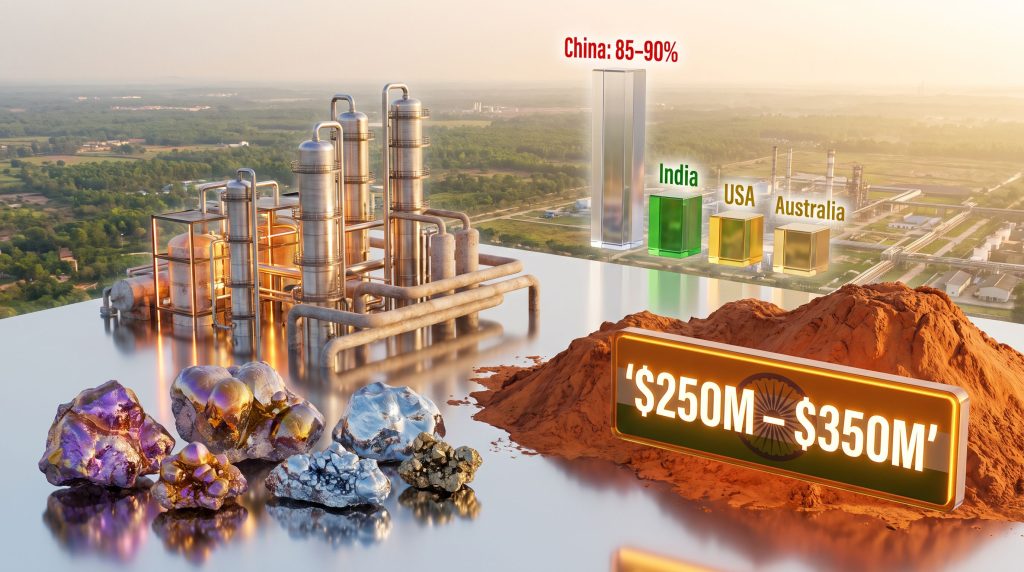
The global race to build rare earth supply chains outside of China has produced a wave of exploration projects, policy announcements, and strategic partnerships across five continents. Yet one of the most compelling opportunities has sat largely unnoticed for decades, not buried deep underground, but piled in vast red lakes across industrial sites in eastern India. Bauxite residue, more commonly known as red mud, has long been treated as one of the aluminium industry's most stubborn liabilities. A growing body of evidence, and now a $250 million to $350 million commercial proposal, suggests it may instead be one of the sector's most undervalued assets.
When big ASX news breaks, our subscribers know first
Why India's Rare Earth Processing Gap Is a Structural Problem, Not a Policy Oversight
The Reserve-Refining Paradox
India possesses rare earth oxide reserves estimated at approximately 6.9 million tonnes, placing it among the top six countries globally in terms of geological endowment. Yet its contribution to global rare earth processing output remains negligible. The country's sole significant processor, IREL (India) Limited, operates at a scale that represents only a fraction of what India's reserve base could theoretically support.
This is not a recent development. The gap between India's geological wealth and its processing capacity has persisted for generations, shaped by a combination of factors including underinvestment in hydrometallurgical infrastructure, regulatory complexity, and the historical availability of cheap Chinese-processed material that made domestic investment economically unattractive.
The result is a structural paradox: a nation rich in the raw inputs for the energy transition minerals sector remains almost entirely dependent on foreign-processed rare earths to supply its own manufacturing ambitions.
The China Processing Concentration Risk
China currently controls an estimated 85 to 90 percent of global rare earth refining capacity. This concentration gives a single nation decisive influence over supply chains that underpin electric vehicle motors, wind turbine generators, advanced defence electronics, and consumer technology. Furthermore, for countries seeking to build domestic manufacturing capabilities in any of these sectors, dependence on Chinese-processed rare earths introduces both cost uncertainty and geopolitical exposure. Understanding China rare earth strategy is therefore essential for any nation planning its own processing infrastructure.
Rare earth elements are not simply commodities in the conventional sense. Their processing requires highly specialised hydrometallurgical knowledge, significant capital infrastructure, and management of chemically complex waste streams. This technical barrier has historically reinforced China's dominance far more effectively than any trade policy.
India's vulnerability in this context is compounded by its manufacturing ambitions. As the country seeks to expand EV production, defence electronics, and renewable energy capacity, its critical minerals demand for processed rare earths is projected to grow substantially, making the absence of domestic refining capacity an increasingly acute strategic liability.
The Enervoxa Rare Earth Processing Project in India: What Is Actually Being Proposed
Turning Industrial Waste Into Strategic Minerals
The Enervoxa rare earth processing project in India represents a fundamentally different approach to rare earth supply than conventional mining. Rather than extracting ore from new deposits, Canada-based Enervoxa is evaluating a facility that would recover rare earth elements from red mud, the iron-rich residual waste generated in bulk quantities whenever bauxite is refined into alumina through the Bayer process.
This feedstock distinction is commercially significant. Red mud is not a scarce resource requiring exploration expenditure. It already exists in enormous stockpiles at aluminium refineries across India, and continues to be generated continuously as a production byproduct. The challenge is not finding the feedstock; it is extracting value from a chemically complex matrix that has historically been managed as a liability rather than an asset.
Project Parameters at a Glance
The following table summarises the key parameters of the proposed facility as currently understood:
| Project Parameter | Detail |
|---|---|
| Developer | Enervoxa (Canada-based) |
| Feedstock | Red mud (bauxite residue) |
| Estimated Capital Cost | $250M to $350M (approximately C$352M to C$493M) |
| Financing Model | Equity combined with project financing |
| Target Location | Eastern India |
| Technology Development Period | Eight years |
| Processing Model Options | Full in-country processing or rare earth concentrate production |
| Identified Potential Partners | Vedanta, Hindalco Industries, NALCO |
The Eight-Year Technology Development Dimension
One aspect of this project that warrants closer examination is Enervoxa's claim of eight years spent developing its proprietary recovery process. In the critical minerals sector, this timeline matters considerably. Many companies announce rare earth extraction technologies at early laboratory stages and encounter severe scale-up challenges when attempting to move to commercial throughput.
Enervoxa's prior involvement in the ElementUS joint venture in Louisiana, which targeted rare earth and mineral recovery from bauxite residue in a North American context, provides a meaningful operational reference point. That precedent suggests iterative process refinement rather than purely theoretical development, which is an important distinction for investors and industrial partners assessing technical credibility.
That said, Indian red mud compositions will differ from North American feedstocks. The bauxite industry overview reveals that bauxite sourced from different geological formations produces residues with varying concentrations of rare earth elements, iron oxides, silica, and titanium compounds. Process adaptation for Indian conditions will consequently be essential, and this represents one of the project's key technical unknowns.
How Red Mud Rare Earth Extraction Works: The Technical Reality
Composition, Concentration, and the Recovery Challenge
Red mud is generated at a ratio of roughly one to one and a half tonnes per tonne of aluminium produced. Global aluminium output exceeds 65 million tonnes annually, meaning the world generates well over 100 million tonnes of this residue each year. India alone produces approximately seven to eight million tonnes of red mud annually based on its current alumina refining capacity.
The rare earth content within red mud is typically low by primary deposit standards, generally ranging from 0.05 to 0.1 percent total rare earth oxides by weight depending on the bauxite source. This concentration is significantly below what would be considered economic in a conventional mine. However, several factors offset this dilution challenge:
- The feedstock costs nothing to extract or transport from nearby stockpiles
- The material is already crushed and partially processed
- Multiple co-products can share the processing cost burden
- The scale of available material is enormous and continuously replenished
Co-Product Economics: The Multi-Revenue Model
Beyond rare earth elements, red mud processing can yield several commercially valuable co-products that materially improve the overall project economics. These include:
- Iron oxide recovered at high purity, suitable for pigment manufacturing and steelmaking inputs
- Titanium-bearing compounds applicable to titanium dioxide production and specialty alloys
- Coagulants with applications in water treatment processes
- Aluminium silicate materials with construction and industrial uses
- Pigments for industrial coatings and building materials
This multi-product recovery model is not merely a financial sweetener. It is structurally important to the project's commercial viability. Rare earth pricing is notoriously volatile, and a facility that distributes capital recovery across five or six revenue streams is far better positioned to service debt and deliver returns than one entirely dependent on rare earth oxide pricing.
Hydrometallurgical Processing: What the Extraction Actually Involves
Extracting rare earths from red mud requires a sequence of hydrometallurgical unit operations. The general process flow involves:
- Acid leaching to dissolve rare earth elements and other valuable components from the solid matrix
- Solid-liquid separation to remove the depleted residue from the pregnant leach solution
- Solvent extraction or ion exchange to selectively concentrate rare earth elements from the complex solution
- Selective precipitation to produce individual rare earth compounds or mixed concentrates
- Calcination or further refining to produce saleable rare earth oxides or metals
The complexity of this sequence at commercial scale, particularly managing reagent costs, waste acid recycling, and the treatment of the depleted solid residue, represents the core engineering challenge. Pilot-scale demonstration does not always translate cleanly to commercial-scale economics, and this remains a meaningful risk in any bauxite residue rare earth project.
India's Industrial Partners: Who Holds the Red Mud
The Aluminium Triad and Their Strategic Relevance
Enervoxa has identified three major Indian aluminium producers as potential industrial partners. Each brings a distinct profile:
| Company | Ownership Structure | Operational Relevance |
|---|---|---|
| Vedanta | Private (Vedanta Resources) | Major alumina refining in Odisha; substantial red mud accumulations |
| Hindalco Industries | Private (Aditya Birla Group) | India's largest aluminium producer; extensive integrated operations |
| NALCO | State-run (Government of India) | Eastern India operations; alignment with public sector policy objectives |
The inclusion of NALCO is strategically noteworthy. As a government-owned entity, NALCO's participation would carry a different character than a purely private partnership, potentially opening pathways to public sector support mechanisms. Notably, Hindalco has also been exploring e-waste recovery as part of a broader strategy to feed the critical minerals revolution, which signals strong alignment with Enervoxa's value recovery model.
Eastern India's concentration of alumina refining infrastructure, particularly in Odisha, makes it the logical geographic focus for the facility. Major refineries in this region generate the continuous red mud supply that any commercial-scale recovery operation requires, and co-location or pipeline access to these stockpiles would substantially reduce feedstock logistics complexity.
Building an Integrated Value Chain
Enervoxa's partnership ambitions extend beyond aluminium producers. The company has indicated intentions to engage engineering and construction firms for facility design, steel manufacturers as potential offtakers for iron oxide co-products, and critical minerals processors to provide downstream refining connectivity.
This multi-stakeholder approach reflects a deliberate attempt to construct an integrated value chain rather than a standalone processing asset. In the critical minerals sector, integrated projects with locked-in feedstock, co-product offtake, and downstream connectivity are substantially more financeable than isolated processing facilities dependent on spot market conditions.
The Policy Dimension: NITI Aayog and India's Rare Earth Corridor Strategy
Institutional Recognition of Red Mud's Potential
India's policy planning apparatus has not been inactive on this topic. The NITI Aayog think tank has facilitated research into rare earth and metal extraction from bauxite residue through the Jawaharlal Nehru Aluminium Research Development and Design Centre and associated research stakeholders. This institutional engagement reflects a policy-level acknowledgment that red mud contains recoverable strategic value, even as commercial-scale deployment has remained elusive.
Enervoxa has stated its intention to seek Indian government support for the project. What form that support might ultimately take, whether land allocation assistance, regulatory facilitation, concessional financing, or other mechanisms, remains subject to negotiation and the broader policy environment. Furthermore, India's growing engagement with international partners — as evidenced by India-Australia rare earth collaboration frameworks — suggests the geopolitical conditions for this kind of project are increasingly favourable.
It is important to note that no formal government backing, funding commitment, strategic project designation, or accelerated permitting has been confirmed for this specific project. Policy interest and institutional research are not equivalent to project-specific government support.
The next major ASX story will hit our subscribers first
Risks That Investors and Industrial Partners Must Weigh
Technical Scale-Up Risk
The transition from demonstrated pilot technology to a $250 million to $350 million commercial facility is one of the most hazardous steps in the critical minerals development cycle. Reagent costs at commercial throughput, waste stream management at scale, process reliability, and feedstock composition variability across different red mud sources can all produce unit economics that diverge significantly from pilot projections.
Rare Earth Price Volatility
Rare earth element pricing is among the most volatile in the commodities sector. Chinese export policy, demand fluctuations from EV manufacturers, and periodic supply disruptions have produced extreme price swings across neodymium, praseodymium, dysprosium, and other key elements. A project requiring hundreds of millions in capital must consequently demonstrate robust returns across a realistic range of price scenarios, not just at peak pricing.
Environmental Regulatory Complexity
Red mud is classified as a hazardous industrial waste in many jurisdictions due to its strongly alkaline chemistry, with pH levels typically ranging from 10 to 13. Any large-scale processing facility handling this material in India will require comprehensive environmental impact assessments, waste management approvals, and clearances from multiple government agencies. These processes can extend project timelines significantly and introduce cost uncertainty.
Partnership and Capital Formation Uncertainty
As of mid-2026, the Enervoxa rare earth processing project in India remains at the assessment and discussion stage. No binding agreements with Vedanta, Hindalco, or NALCO have been announced. No capital structure has been finalised. The history of the critical minerals sector is filled with projects that announced compelling assessments and promising partner discussions, then stalled before binding commitments were secured.
Where This Project Sits in the Global Rare Earth Supply Realignment
India's Position in the Ex-China Refining Build-Out
The broader effort to construct rare earth supply chains that bypass Chinese processing dominance has progressed most visibly in Australia, the United States, Canada, and parts of Europe. India has remained largely peripheral to this realignment despite holding geological endowments that would justify a far more prominent role. Indeed, as the World Energy Council has noted, India has huge potential in rare earths but needs to focus urgently on processing capabilities to realise it.
| Country | Rare Earth Reserves | Processing Status | Key Constraint |
|---|---|---|---|
| China | Large | Dominant globally (85–90%) | Geopolitical concentration risk |
| Australia | Significant | Growing capacity | Limited domestic downstream refining |
| USA | Moderate | Actively developing | High capital costs |
| India | Substantial | Minimal commercial scale | Absence of refining infrastructure |
| Brazil | Large | Early stage | Infrastructure and logistics gaps |
India's combination of large reserves, an existing aluminium industry generating continuous rare earth-bearing feedstock, and growing domestic demand for processed rare earths makes it a structurally compelling location for processing investment. The Enervoxa rare earth processing project in India represents one of the more technically differentiated attempts to capitalise on this opportunity.
Two Processing Models and What Each Means Strategically
The choice between full in-country processing and concentrate production for downstream export is not merely technical; it is a strategic decision about India's positioning in the rare earth value chain.
Full in-country processing captures the maximum value within India but requires greater capital, more sophisticated infrastructure, and downstream manufacturing customers capable of consuming separated rare earth oxides or metals domestically. Concentrate production for export, however, reduces upfront capital requirements and simplifies the processing challenge, but leaves a substantial portion of value creation to be captured in other jurisdictions.
The eventual model chosen will likely reflect the degree of downstream rare earth processing capacity that India can develop or attract in parallel with this project, and the appetite of government and private partners to underwrite the more ambitious full-processing pathway.
Frequently Asked Questions
What is the Enervoxa rare earth processing project in India?
Enervoxa, a Canada-based company, is evaluating the development of a facility in eastern India that would extract rare earth elements from red mud, the primary waste product generated by aluminium refining. The project is at the assessment and partner engagement stage with an estimated capital requirement of $250 million to $350 million.
Why is red mud used as a rare earth feedstock?
Red mud contains measurable concentrations of rare earth elements including scandium, lanthanum, cerium, and neodymium. It is generated in continuous, large-scale quantities by India's aluminium industry, making it a cost-effective secondary feedstock that eliminates conventional exploration and mining costs.
Who are Enervoxa's potential partners in India?
The company has identified Vedanta, Hindalco Industries, and the state-run National Aluminium Company as potential industrial partners. These entities operate major alumina refineries and generate the red mud feedstock the proposed facility would process.
Has Enervoxa operated a similar facility elsewhere?
The company has prior involvement in the ElementUS joint venture in Louisiana, which applied a comparable methodology to bauxite residue in a North American context. This provides a reference point for the technology's real-world application, though Indian feedstock conditions will require site-specific process adaptation.
What is the current status of the project?
As of mid-2026, the project remains in the feasibility assessment and partner discussion phase. No binding commercial agreements or confirmed financing arrangements have been announced.
Want to Be First When the Next Major Mineral Discovery Hits the ASX?
Discovery Alert's proprietary Discovery IQ model delivers real-time alerts on significant ASX mineral discoveries — turning complex mineral data into actionable insights for both new and experienced investors. Explore historic discoveries and their extraordinary returns, then begin your 14-day free trial to position yourself ahead of the market.