July 24, 2026
The Geopolitics of Ground: Why What Lies Beneath Sweden Now Shapes Western Security
Rare earth supply chains have rarely commanded the attention of defence ministries, foreign policy councils, and industrial strategists simultaneously. Yet that is precisely the situation unfolding across the Western world as policymakers come to terms with a structural vulnerability that decades of globalisation quietly embedded into the foundations of modern economies. The minerals that power fighter jet guidance systems, wind turbine generators, and electric vehicle motors are overwhelmingly controlled by a single nation, and that nation has demonstrated, with increasing confidence, that it is willing to use this control as a geopolitical instrument.
Against this backdrop, Sweden critical minerals national security policy, formalised through a July 2026 declaration, represents far more than a domestic policy adjustment. It reflects a fundamental reordering of how allied nations conceptualise resource access, strategic sovereignty, and economic resilience in an era of accelerating great-power competition.
When big ASX news breaks, our subscribers know first
China's Grip on the Critical Minerals Value Chain
Understanding why Sweden critical minerals national security has become a policy priority requires grasping the full architecture of Chinese dominance across the rare earth sector. This dominance is not confined to mining. China controls an estimated 85 to 90 percent of global rare earth processing and refining capacity, meaning that even ore extracted outside Chinese territory frequently flows back through Chinese facilities before it can be used in finished products.
The materials at stake span a remarkably wide industrial range:
- Rare earth elements used in permanent magnets for EV motors, wind turbines, and missile guidance systems
- Gallium and germanium, where China accounts for roughly 80 percent of global supply, now subject to export licensing requirements introduced in 2023
- Graphite, with China controlling approximately 65 percent of natural graphite mining and an even larger share of processed spherical graphite for battery anodes
- Magnesium, where Chinese production represents over 85 percent of global output
- Antimony and tungsten, both critical for defence applications, with Chinese supply dominance exceeding 60 percent in each case
What makes this concentration particularly consequential is the layered nature of the dependency. Western nations face vulnerability not just at the mining stage but at the refining, separation, and processing stages as well. These downstream steps are technically demanding, capital-intensive, and environmentally complex, which is why non-Chinese capacity has remained limited even as awareness of the risk has grown.
Furthermore, China's escalating use of export controls illustrates how this structural position translates into active geopolitical leverage. Restrictions on gallium and germanium exports were introduced in August 2023. Graphite export controls followed in October 2023. Restrictions on rare earth processing technology and equipment emerged through 2024 and into 2025. Each wave accelerated policy responses in Washington, Brussels, and allied capitals, but the fundamental supply imbalance remains largely intact.
The rare earth processing challenges that underpin this imbalance are often underappreciated in public debate. A nation could theoretically achieve complete self-sufficiency in ore extraction and still remain wholly dependent on Chinese processing infrastructure to convert that ore into usable materials. Both layers of the supply chain require independent development to achieve genuine strategic autonomy.
What a National Security Designation Actually Changes
Sweden's formal declaration that critical minerals extraction constitutes a national security interest is not merely rhetorical. The designation carries concrete administrative and legal implications that distinguish it from standard economic or environmental policy frameworks.
Under this classification, the Swedish government gains access to a broader toolkit for accelerating project development:
- Expedited permitting pathways that compress what would otherwise be multi-year environmental review processes into streamlined strategic assessments
- Enhanced state authority to assign land to mining projects, a significant shift from Sweden's historically restrictive land management framework
- The potential creation of a state-owned investment company specifically designed to co-invest in strategically critical mining projects where private capital alone is insufficient
- Tightened foreign direct investment screening for acquisitions in the critical minerals sector, protecting strategic assets from hostile takeover
Deputy Prime Minister and Enterprise Minister Ebba Busch was direct in articulating the rationale behind these measures. She described European industrial dependence on Chinese mineral supply as a systemic risk to the defence capabilities of Sweden, the EU, and NATO collectively, and framed the new framework as a necessary tool to attract and accelerate investment in projects of continental strategic significance.
The proposal to establish a state-owned investment vehicle is particularly notable. It acknowledges a market failure that has long plagued critical minerals development: private investors, deterred by long development timelines, commodity price volatility, and processing complexity, often decline to fund projects that carry clear public strategic value. A government co-investment mechanism would change that calculus. This approach mirrors the European critical raw materials strategy adopted at the bloc level, which similarly emphasises state coordination to close investment gaps.
| Policy Lever | Standard Mining Regime | National Security Designation |
|---|---|---|
| Permitting Timeline | Multi-year environmental review | Expedited strategic review |
| Land Assignment Authority | Limited state intervention | Direct state allocation powers |
| Investment Attraction Tools | Market-led | State co-investment mechanisms |
| Foreign Ownership Screening | General FDI rules | Enhanced critical sector screening |
Per Geijer: Europe's Most Consequential Rare Earth Deposit
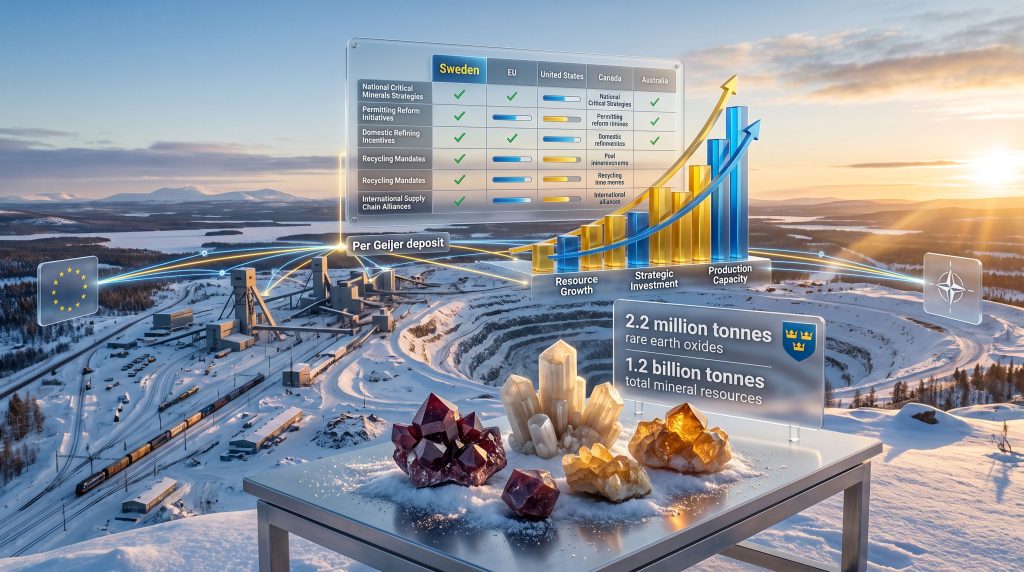
At the centre of Sweden's strategic mineral ambition sits the Per Geijer deposit, located adjacent to LKAB's existing Kiruna iron ore operation in northern Sweden. The numbers associated with this deposit are striking by any measure:
- Total mineral resource base: 1.2 billion tonnes
- Rare earth oxide content: 2.2 million tonnes
- Location: Northern Sweden, co-located with established deep-mining infrastructure
- Status: EU flagship project under the Critical Raw Materials Act
To appreciate the significance of these figures, consider that Europe currently imports virtually all of its rare earth oxide requirements, primarily from China. The EU's Critical Raw Materials Act, adopted in 2024, sets a target of sourcing at least 10 percent of annual rare earth consumption from domestic extraction by 2030. Per Geijer's scale positions it as the single most important asset in achieving that ambition.
The co-location advantage with Kiruna deserves particular attention. LKAB has operated the Kiruna mine for over a century, developing world-class underground mining expertise, substantial processing infrastructure, established rail connections to the northern Swedish port network, and a trained workforce. These assets dramatically reduce the capital cost and development risk associated with bringing Per Geijer into production compared with a greenfield development in an undeveloped location.
LKAB has publicly stated its ambition to evolve from an iron ore producer into a critical minerals company, with Per Geijer representing the cornerstone of that strategic transformation. The company's existing technical capabilities in sublevel caving, one of the world's most productive underground mining methods, are directly applicable to the hard rock environment of the rare earth deposit.
With 2.2 million tonnes of rare earth oxides, Per Geijer represents one of the most significant rare earth discoveries outside of China. It sits at the heart of the EU's ambition to source at least 10% of its annual rare earth consumption domestically by 2030 under the Critical Raw Materials Act, making it a deposit of genuine continental importance rather than merely national interest.
Sweden's Broader Critical Minerals Portfolio
Per Geijer commands the most attention, but Sweden's strategic resource position extends across multiple critical mineral categories that underpin both the clean energy transition and defence industrial supply chains.
| Critical Mineral | Swedish Deposit Status | Primary End-Use Sectors |
|---|---|---|
| Rare Earth Elements | Large identified reserves (Per Geijer) | Defence, EVs, wind energy |
| Graphite | Known deposits | Battery anodes, steel production |
| Cobalt | Identified occurrences | Battery cathodes, aerospace |
| Tungsten | Documented resources | Defence applications, industrial tooling |
This portfolio breadth positions Sweden as a potential anchor for a northern European critical minerals cluster. Finland and Norway possess complementary resource bases, and together these three Nordic nations could form the nucleus of a regionally integrated critical minerals supply chain. Consequently, this cluster could serve both EU industrial demand and NATO defence requirements simultaneously.
The NATO Dimension: Why Defence Drives the Urgency
Sweden's accession to NATO in March 2024 fundamentally altered the strategic context within which its critical minerals policy operates. As a NATO member, Sweden now carries defence industrial obligations that require access to the rare earth elements and specialty metals embedded throughout modern weapons systems, radar arrays, precision guidance technologies, and communications equipment.
Neodymium, praseodymium, dysprosium, and terbium, all rare earth elements found in Per Geijer's ore body, are irreplaceable components of the high-performance permanent magnets used in electric motors for defence platforms. The link between defence critical materials and allied security has never been more explicit.
The alliance-level implications of Chinese rare earth export restrictions are not theoretical. A sustained supply disruption during a period of elevated geopolitical tension could constrain the production rates of defence systems across multiple NATO member states simultaneously. This is precisely the systemic risk that Sweden's Deputy Prime Minister identified as the driving logic behind the national security declaration.
The next major ASX story will hit our subscribers first
The Obstacles That Cannot Be Wished Away
The Sami Land Rights Challenge
The most politically complex obstacle facing Sweden's critical minerals expansion is the geographic overlap between mineral-rich northern territories and the traditional reindeer-herding lands of the Sami people. Sweden's indigenous Sami community has consistently argued that expanded industrial mining activity in northern Sweden would cause irreversible damage to their traditional land use practices, migration routes, and cultural continuity.
The new state authority to assign land to mining projects creates direct legal tension with existing Sami land rights frameworks. International precedents from Canada and Australia, where resource development has proceeded on indigenous territories, demonstrate that projects advanced without meaningful consent processes typically face prolonged legal challenges, reputational damage, and operational disruptions. Sweden's approach to this tension will be closely watched by allied nations navigating similar conflicts between resource ambitions and indigenous rights.
The Processing Capacity Gap
Perhaps the most technically significant obstacle is one that receives insufficient public attention: rare earth mining is only the first step in a complex industrial process. Before rare earth oxides can be used in permanent magnet manufacturing, they must be separated into individual elements through a chemically intensive hydrometallurgical process, then refined to high-purity metals, then alloyed and formed into magnet material. Each step requires specialised expertise and facilities that barely exist outside China.
Europe is making progress. Estonia hosts a rare earth separation facility operated by Neo Performance Materials. France's Solvay has rare earth processing capabilities. The UK has announced ambitions to develop domestic rare earth processing. However, the aggregate capacity of these facilities remains a fraction of what would be required to process significant volumes of Swedish ore into finished materials for European industry.
Building this processing capacity is arguably the more urgent investment priority than the mining expansion itself, and it is likely to require substantial capital commitments, patient timelines, and coordinated industrial policy across multiple EU member states.
The Timeline Reality
Even with accelerated permitting under the new national security framework, the gap between Sweden's July 2026 policy declaration and commercially significant rare earth production from Per Geijer is measured in years, not months. The journey from identified resource to operating mine in complex underground hard rock environments typically spans 10 to 15 years under normal conditions. Permitting acceleration can compress some phases but cannot eliminate the engineering, feasibility, financing, construction, and ramp-up periods that characterise major mining projects.
This timeline reality places Sweden critical minerals national security strategy in a somewhat uncomfortable position. The geopolitical urgency driving the policy declaration is immediate, but the supply security benefits it aims to deliver are necessarily distant. Bridging this gap requires not only domestic policy action but also coordinated allied investment in processing capacity, recycling infrastructure, and demand-side efficiency to reduce overall rare earth consumption rates in the interim.
The Allied-Nation Architecture Taking Shape
Sweden's national security designation does not exist in isolation. It is one component of an accelerating allied-nation movement to construct parallel critical mineral supply chains outside Chinese control. Furthermore, the role of critical minerals and energy security in shaping these national strategies cannot be overstated.
| Country/Bloc | Policy Instrument | Key Asset | Primary Risk Addressed |
|---|---|---|---|
| Sweden | National security designation + state investment | Per Geijer REE deposit | Rare earths, defence materials |
| EU (bloc-wide) | Critical Raw Materials Act | Diverse member-state deposits | Rare earths, lithium, cobalt |
| United States | IRA + Defence Production Act | Domestic lithium, REE projects | Rare earths, battery materials |
| Canada | Critical Minerals Strategy | Lithium, cobalt, nickel | Battery supply chain |
| Australia | Critical Minerals Strategy + bilateral partnerships | Lithium, rare earths, cobalt | Battery and defence materials |
The Minerals Security Partnership, a grouping of allied nations including the United States, Canada, Australia, Japan, South Korea, the United Kingdom, and EU member states, provides an emerging institutional framework for coordinating investment and development across these national strategies. Sweden's unique combination of EU membership, NATO membership, established deep-mining infrastructure, and large identified critical mineral deposits gives it a distinctive value proposition within this architecture that extends well beyond its relatively small economy.
The strategic logic of concentrating critical mineral sourcing among geopolitically aligned nations, often described as friend-shoring, is gaining traction precisely because the cost of supply chain vulnerability has become so visible. Whether this allied architecture matures into a genuine alternative to Chinese supply dominance within a strategically meaningful timeframe remains the central open question of the critical minerals era.
Disclaimer: This article is intended for informational purposes only and does not constitute financial or investment advice. Forecasts, timelines, and policy outcomes discussed herein involve significant uncertainty and should not be relied upon as predictions of future events. Readers should conduct independent research before making any investment decisions related to mining, critical minerals, or related sectors.
Ready to Capitalise on the Next Major Critical Minerals Discovery?
Discovery Alert's proprietary Discovery IQ model instantly identifies significant ASX mineral discoveries — including rare earths, graphite, and other critical minerals driving Western strategic sovereignty — translating complex data into actionable investment insights for both short-term traders and long-term investors. Explore how historic mineral discoveries have delivered substantial returns and begin your 14-day free trial today to position yourself ahead of the market.