July 24, 2026
The Industrial Waste Stream That Could Reshape Global Rare Earth Supply Chains
For decades, the global rare earth industry has operated under a structural paradox: the minerals most critical to modern technology are geographically abundant but commercially concentrated. China controls an estimated 85 to 90 percent of global rare earth processing capacity, a dominance that has persisted not because other nations lack resources, but because building the chemical infrastructure to refine these elements to industrial purity is extraordinarily capital-intensive and technically complex. The result is a supply chain vulnerability that cuts across electric vehicle manufacturing, defence procurement, consumer electronics, and renewable energy generation simultaneously.
What makes the current moment different is not just geopolitical pressure, but the emergence of an entirely unconventional feedstock category: industrial waste. Specifically, the alkaline sludge left over from aluminium refining, commonly known as red mud, is drawing serious investment attention as a rare earth source that bypasses many of the most difficult barriers to entry in the conventional mining sector.
The Enervoxa India rare earths project sits at this intersection of geopolitical urgency and industrial innovation, representing one of the more technically sophisticated attempts to build a non-Chinese rare earth processing pathway using existing industrial infrastructure rather than greenfield mining investment.
When big ASX news breaks, our subscribers know first
Understanding Red Mud: From Environmental Liability to Strategic Asset
The Bayer Process and Its Byproduct Problem
Every tonne of alumina refined through the Bayer process generates between one and two tonnes of bauxite residue. This residue, characterised by its deep red-orange colouration from iron oxide content, accumulates in storage impoundments near alumina refineries across the world. Global red mud stockpiles are estimated to exceed 4 billion tonnes, with approximately 150 to 180 million tonnes added annually, according to research published in environmental and materials science literature.
Historically, this material was treated as a waste management challenge. Its high alkalinity makes it environmentally sensitive, and the cost of long-term storage represents a significant liability for aluminium producers. The shift in perspective now occurring across the industry is that red mud is not simply waste to be contained. It is a low-grade polymetallic resource sitting adjacent to existing processing infrastructure, with rare earth element concentrations that, while modest compared to dedicated rare earth ore deposits, become commercially viable when processing costs are distributed across multiple recoverable products. Furthermore, global bauxite production continues to expand, meaning the volume of this residue will only increase in coming years.
What Can Be Recovered from Bauxite Residue?
The commercial case for red mud processing rests heavily on a multi-product recovery model. Rather than targeting rare earth elements alone, the processing pathway extracts several co-products simultaneously, each serving a distinct industrial market.
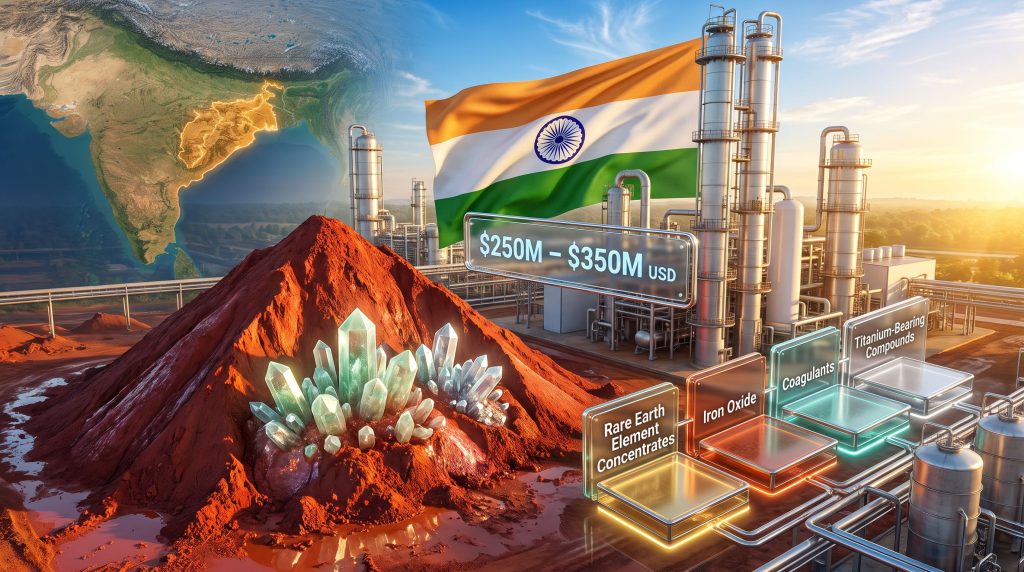
| Recoverable Material | Primary Industrial Application |
|---|---|
| Rare earth element concentrates | EV motors, defence systems, consumer electronics |
| Iron oxide | Steel manufacturing, pigments |
| Coagulants | Water treatment and purification |
| Titanium-bearing compounds | Aerospace components, coatings |
| Aluminium compounds | Secondary aluminium production |
This multi-stream revenue model is critical to project economics. A facility that recovered only rare earth elements from red mud would struggle to justify its capital expenditure at current concentrate prices. Distributing processing costs across iron, titanium, and water treatment co-products fundamentally changes the financial architecture of the operation, improving bankability and reducing dependence on rare earth price cycles.
"The multi-product recovery model from red mud processing is structurally similar to the economics of polymetallic base metal mines, where primary metal revenues are supplemented by by-product credits. This approach reduces single-commodity price risk and can sustain project viability even during rare earth price softness."
Enervoxa's Proprietary Technology: Eight Years to Commercial Viability
Why Red Mud Processing Has Historically Been Difficult
Separating rare earth elements from bauxite residue is technically more challenging than processing conventional rare earth ores for several reasons. The alkaline chemistry of red mud creates interference with standard hydrometallurgical leaching circuits. Rare earth concentrations in red mud are typically lower than in dedicated rare earth deposits, requiring higher throughput volumes. The co-presence of iron, aluminium, silicon, and titanium compounds necessitates precise separation chemistry to avoid cross-contamination of product streams, adding considerably to the rare earth processing challenges that developers must overcome.
Enervoxa has spent eight years developing a proprietary process designed to address these specific technical challenges. The company's methodology focuses on achieving commercial-grade rare earth concentrate recovery from bauxite residue while simultaneously capturing the iron oxide and other co-product streams that improve overall project economics.
The Louisiana Proof-of-Concept: ElementUS Joint Venture
The primary validation point for Enervoxa's technology is the ElementUS joint venture, a partnership between Enervoxa and DADA Holdings at the Noranda Alumina facility in Gramercy, Louisiana. This project, currently progressing through front-end engineering and design (FEED), represents a commercial-scale deployment of the red mud processing methodology with a reported capital investment in the vicinity of $800 million USD.
The FEED stage is a critical milestone in project development. It translates conceptual process design into detailed engineering specifications, enabling accurate cost estimation and providing the technical foundation required for a final investment decision (FID). The Louisiana project reaching FEED signals that Enervoxa's technology has moved beyond laboratory and pilot-scale validation into serious commercial development.
For the India project, the Louisiana operation serves as both a proof-of-concept reference and a demonstration of the model's geographic replicability. If the core processing technology works in Louisiana with Gulf Coast alumina refinery residue, the fundamental chemistry should be adaptable to bauxite residues from Indian alumina plants, though local mineralogical variations would require site-specific process optimisation.
India's Structural Advantage: Where Aluminium Capacity Meets Rare Earth Scarcity
The Paradox at the Core of India's Critical Minerals Position
India holds the world's fifth-largest rare earth reserves by estimated resource size, yet possesses virtually no industrial-scale capacity to process these minerals to the purity levels required by EV motor manufacturers, defence contractors, or electronics producers. This gap between resource endowment and processing capability represents one of the most significant structural inefficiencies in global rare earth supply chains.
Compounding this is India's position as the world's second-largest aluminium producer and its third-largest consumer, a dual status that generates enormous volumes of bauxite residue each year. The concentration of alumina refining infrastructure in eastern India, particularly in states like Odisha and Jharkhand, creates a natural geographic focus for any red mud processing initiative.
Target Partners: Private Sector and State-Owned Enterprises
Enervoxa's approach to the Indian market involves parallel engagement across both private-sector majors and state-owned enterprises, a strategy that reflects the different risk profiles and motivations of each counterparty type.
- Vedanta: India's largest integrated metals producer with diversified aluminium operations, offering substantial red mud feedstock volumes and commercial sophistication in project structuring.
- Hindalco Industries: A global aluminium major with significant domestic refining capacity, part of the Aditya Birla Group, with both the financial scale and technical infrastructure to engage with complex processing partnerships.
- NALCO (National Aluminium Company): The state-owned enterprise whose participation could create alignment with national critical minerals policy objectives and potentially facilitate access to government financing instruments.
Beyond aluminium producers, Enervoxa is also targeting engineering firms, steel manufacturers, and critical minerals processing companies to construct an integrated value chain that can absorb all co-products from red mud processing at commercial scale.
Capital Structure and Project Economics
What Would a Commercial Plant in India Cost?
Enervoxa has indicated a capital expenditure range of $250 million to $350 million USD for a commercial-scale Indian processing facility. This figure is substantially lower than the approximately $800 million associated with the Louisiana ElementUS operation, reflecting differences in plant scale, local construction costs, and potentially the scope of processing activities.
The proposed financing structure combines strategic equity participation from industrial partners with project-level debt, a structure common to mid-scale industrial infrastructure projects in emerging markets.
| Project | Location | Estimated Capex | Development Stage |
|---|---|---|---|
| ElementUS JV | Louisiana, USA | ~$800M USD | FEED underway |
| India Project | Eastern India (TBD) | $250M–$350M USD | Partner discussions |
Risk Factors Investors and Analysts Should Monitor
Several factors will determine whether the India project advances from commercial discussions to a final investment decision:
- Feedstock agreements: Securing long-term red mud supply contracts with aluminium producers is the foundational prerequisite for project finance eligibility. No lender will commit capital without demonstrated feedstock security.
- Offtake arrangements: Rare earth concentrate buyers and co-product purchasers need to be identified and contracted before construction financing can be arranged.
- Processing pathway selection: The choice between full in-country rare earth processing versus concentrate production for overseas refining has significant implications for capital requirements, technology licensing, and product value.
- Currency and regulatory risk: Project finance in India involves exposure to rupee-dollar exchange rate dynamics and navigating environmental and industrial permitting requirements.
"Projects at the partner engagement stage carry substantial execution risk. The gap between announced intent and financial close in complex industrial infrastructure projects can span several years, and announced capital cost estimates at early stages frequently require revision as engineering progresses."
India's Policy Environment and Institutional Research Activity
Existing Research and Institutional Frameworks
India's institutional interest in red mud valorisation predates Enervoxa's approach to the market. The Jawaharlal Nehru Aluminium Research Development and Design Centre (JNARDDC), operating under NITI Aayog's broader critical minerals coordination framework, has been actively conducting research into rare earth element enrichment from bauxite residue. This existing research activity means Enervoxa would be entering a market where the technical concept is already understood at an institutional level, potentially accelerating engagement with government counterparties.
India's downstream policy environment is also building demand-side infrastructure for rare earth end-products. The ₹7,280 crore Rare Earth Permanent Magnet (REPM) scheme represents a significant policy commitment to developing domestic rare earth magnet manufacturing capacity, which would create an internal market for domestically produced rare earth materials. Additionally, the development of Dedicated Rare Earth Corridors across multiple states signals long-term infrastructure planning for rare earth processing and logistics. Consequently, the broader critical minerals demand driven by the global energy transition is only intensifying the urgency of these domestic policy commitments.
What India Still Needs to Build
| Capability Area | Current Status | Key Gap |
|---|---|---|
| Rare earth reserves | Substantial | Underutilised |
| Aluminium production | World #2 | Limited REE co-processing |
| High-purity separation | Minimal | Critical bottleneck |
| Magnet manufacturing | Early-stage | Scaling investment needed |
| Export-ready concentrate | Nascent | Dependent on upstream investment |
The next major ASX story will hit our subscribers first
The Geopolitical Backdrop: Why This Matters Beyond India
China's Processing Dominance and the Search for Alternatives
China's position in rare earth processing reflects decades of deliberate industrial policy investment, not simply geological advantage. The country possesses significant rare earth reserves, but its processing dominance extends well beyond its own resource base. Chinese facilities refine rare earth materials sourced from multiple countries, creating a processing chokepoint that affects global supply chains regardless of where the raw materials originate.
China's rare earth export restrictions and recent shifts in trade policy have accelerated the commercial urgency of developing alternative processing geographies. The rare earth elements most affected by these dynamics are the heavy rare earths and magnet-grade materials, including neodymium and praseodymium, which are central to the neodymium-iron-boron (NdFeB) permanent magnets used in EV traction motors and wind turbine generators. For a broader perspective on US-India rare earth cooperation, the strategic dimensions of this relationship continue to evolve considerably.
Why Red Mud Processing Could Give India a Differentiated Entry Point
Unlike greenfield rare earth mining projects, which require new exploration, resource delineation, mine permitting, and processing plant construction, red mud processing leverages industrial infrastructure that already exists. This distinction carries several practical advantages:
- Feedstock is continuously generated by operating alumina refineries, eliminating mining production risk
- Permitting complexity is substantially lower than for new mine development
- Processing facilities can be co-located with existing industrial sites, reducing infrastructure costs
- The circular economy framing of converting waste into strategic materials aligns with environmental, social, and governance priorities increasingly important to institutional investors and project financiers
End-Use Demand: The Markets Driving the Commercial Rationale
The rare earth elements recoverable from bauxite residue are not niche industrial chemicals. They feed directly into the highest-growth segments of the global economy.
Electric vehicles represent the single largest demand growth driver for rare earth permanent magnets. Each EV traction motor typically requires between one and two kilograms of NdFeB magnet material, and global EV production volumes are projected to scale dramatically through the remainder of this decade.
Defence and aerospace applications consume rare earth elements in radar systems, precision guidance electronics, and communications equipment. The strategic sensitivity of this demand category means government procurement agencies in the United States, European Union, and allied nations have strong incentives to support the development of non-Chinese supply chains.
Renewable energy infrastructure, particularly large-scale wind turbines using direct-drive generators, represents another major demand vector. The compounding effect of simultaneous growth across EV, defence, and renewable energy markets is creating supply tightening dynamics that fundamentally support the long-term economics of new rare earth processing capacity. Indeed, India's rare earth ambitions are increasingly attracting international commercial interest as a result.
Frequently Asked Questions: Enervoxa India Rare Earths Project
What is the Enervoxa India rare earths project?
The Enervoxa India rare earths project refers to plans by Enervoxa, a Canadian climate technology developer, to establish a rare earth processing facility in India that would extract rare earth elements and multiple co-products from bauxite residue generated by Indian aluminium producers. The company is in early-stage commercial discussions with major industry participants to secure feedstock partnerships.
How much will the India plant cost to build?
Enervoxa has indicated a capital cost range of approximately $250 million to $350 million USD, to be financed through a combination of strategic equity from industrial partners and project-level debt financing.
Why is eastern India the geographic focus?
Eastern India hosts a concentration of aluminium refining and bauxite processing facilities, making proximity to continuous red mud feedstock streams a practical driver of location selection.
What distinguishes full processing from concentrate production?
Full processing extracts and refines rare earth elements to end-use purity grades entirely within India. The concentrate pathway produces an intermediate rare earth-enriched material in India for further refining at a separate downstream facility, potentially in another country. The two models carry different capital requirements, technology licensing implications, and in-country value creation profiles.
How does the Louisiana project relate to the India initiative?
The ElementUS joint venture at the Noranda Alumina facility in Gramercy, Louisiana represents the primary commercial-scale deployment of Enervoxa's proprietary red mud processing technology. The India project would apply the same core methodology to Indian bauxite residue streams, with site-specific process adaptation.
What role might the Indian government play?
Enervoxa has indicated its intention to seek Indian government support for the project. India's NITI Aayog and the JNARDDC are already conducting research in this domain, and the country's downstream rare earth policy frameworks provide institutional context for potential government engagement, though no specific government commitment to the project has been announced.
Want to Track the Next Major Critical Minerals Discovery Before the Market Does?
Discovery Alert's proprietary Discovery IQ model delivers real-time alerts on significant ASX mineral discoveries — including those across the critical minerals and rare earth sectors driving the global energy transition — instantly translating complex data into actionable investment insights. Explore Discovery Alert's discoveries page to understand how major mineral discoveries have historically generated substantial returns, and begin your 14-day free trial today to position yourself ahead of the broader market.