
July 24, 2026
The Five-Stage Trap: Why Building a Rare Earth Supply Chain Outside China Is Harder Than It Looks
Most industrial supply chains have weak links. The rare earth supply chain outside China has an entire missing section. Understanding why requires moving beyond the familiar headlines about mining projects and deposit discoveries, and instead examining the full five-stage architecture that transforms ore in the ground into a functioning permanent magnet inside an electric vehicle motor or a defence guidance system.
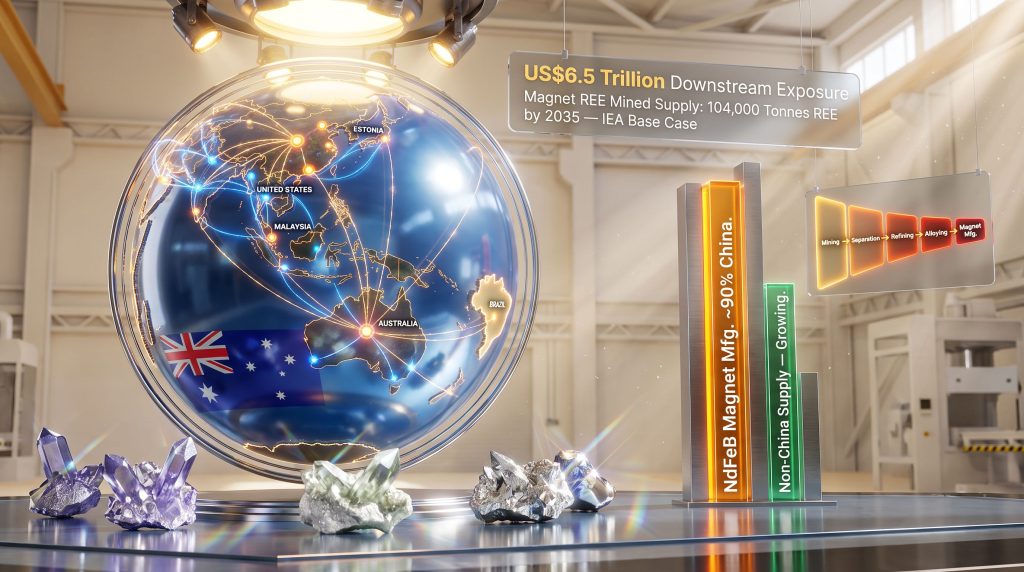
Those five stages are mining, separation, refining, alloying, and magnet manufacturing. Each stage requires distinct infrastructure, specialised chemistry, and decades of accumulated technical knowledge. The uncomfortable truth that has become impossible to ignore in 2025 and 2026 is that Western nations and their allies have made meaningful progress at stage one while stages three, four, and five remain structurally underdeveloped outside China's integrated industrial ecosystem.
Controlling a mine without controlling the downstream processing pipeline creates what industry strategists increasingly describe as a false sense of supply security. The ore still needs to go somewhere.
When big ASX news breaks, our subscribers know first
The Scale of What Is Actually at Risk
The International Energy Agency's Global Critical Minerals Outlook 2026, a 372-page report released this year, placed a concrete number on the downstream exposure created by rare earth supply concentration. According to the IEA, US$6.5 trillion in downstream production across the automotive, electronics, defence, aviation, transport, and data centre sectors is vulnerable to rare earth supply disruption, with primary exposure concentrated in the United States, Europe, Japan, and South Korea.
That figure deserves a moment of consideration. The entire global rare earth market by contrast generates revenues measured in the low tens of billions of dollars annually. The asymmetry between the value of the minerals themselves and the value of the industries that depend on them is the defining structural characteristic of this supply chain challenge. Furthermore, the rare earth supply chain dynamics that underpin this asymmetry have become a central concern for policymakers across allied nations.
Structural Asymmetry: The IEA's US$6.5 trillion downstream exposure figure dwarfs the actual market value of rare earth minerals, illustrating why supply disruption carries consequences far exceeding what commodity prices alone would suggest.
IEA executive director Fatih Birol framed the issue clearly in the report, noting that vast amounts of economic value rest on relatively small volumes of critical minerals whose supply chains remain highly concentrated and therefore vulnerable. The observation has moved from academic concern to boardroom crisis management.
A concrete example underlines what vulnerability actually looks like in practice. Ford's Detroit manufacturing operations were forced to halt vehicle production at one point due to constraints in accessing rare earths. A carmaker producing some of the world's most recognisable vehicles was stopped not by a lack of steel, rubber, or semiconductors, but by the absence of materials that most consumers have never heard of and that represent a fraction of the finished vehicle's total cost.
China's Position Across Each Stage of the Value Chain
To understand the problem, the data needs to be examined at each stage rather than as a single aggregate figure.
| Supply Chain Stage | China's Estimated Share | Key Non-China Players |
|---|---|---|
| Mining (ore extraction) | ~60% (declining) | Australia, Brazil, USA, India |
| Separation and refining | ~85-90% | Malaysia (Lynas), Estonia, France |
| Metal and alloy production | ~90%+ | Japan (limited), USA (emerging) |
| NdFeB magnet manufacturing | ~90% of global supply | Japan, Europe (nascent) |
The table illustrates the tapering effect clearly. As you move downstream, China's grip tightens. Mining diversification, while genuinely progressing, does not automatically translate into processing independence. The broader rare earth geopolitics at play here have accelerated the urgency of building alternative capacity at every stage.
China's April 2025 export controls on rare earths and magnets, issued through the Ministry of Commerce (MOFCOM), functioned as a structural stress test for global procurement strategies. What the controls exposed was not merely a volumetric problem but a strategic leverage problem. Even modest restrictions at the processing and magnet stages created disproportionate disruption across defence, energy, and automotive supply chains globally. The IEA's analysis of supply concentration risks reinforces just how consequential these controls have been for allied-nation industrial planning.
Abigail Hunter, Executive Director of the SAFE Center for Critical Minerals Strategy in Washington, captured the procurement shift that followed in remarks at a recent forum. She observed that many companies in the energy, defence, and manufacturing sectors fundamentally changed their approach to supply chain planning after the MOFCOM controls, recognising that the cost of rare earth minerals within their finished products is small but that missing that component entirely is catastrophically expensive.
Hunter also highlighted a less discussed dimension of the problem: the sheer volume of rare earth content embedded in finished goods already imported by Western economies. The challenge is not simply securing future supply but understanding and ultimately redirecting an existing embedded material flow that has been structured around Chinese processing capacity for decades.
Where Non-Chinese Supply Is Being Built
Australia: The Primary Mining Anchor
Australia's Mount Weld deposit in Western Australia, operated by Lynas Rare Earths, holds the distinction of being the world's highest-grade rare earth deposit and the most significant single source of non-Chinese rare earth feedstock. The strategic importance of this asset cannot be overstated within the context of allied-nation supply chain development.
Lynas reported rare earth sales of approximately A$550 million in fiscal year 2025, with that figure rising to nearly A$950 million in FY2026, driven primarily by higher neodymium-praseodymium (NdPr) production and sales volumes. The company has committed A$1.3 billion in cumulative investment across Mount Weld and its Kalgoorlie facility, which is Australia's first rare earth separation plant.
Arafura Rare Earths' Nolans project in the Northern Territory represents a significant pipeline asset currently moving toward financing completion. It is one of the more advanced development-stage projects in the non-Chinese pipeline and features a vertically integrated mine-to-NdPr oxide design.
Brazil and the Heavy Rare Earth Distinction
Serra Verde occupies a unique position in global rare earth supply: it is currently the only operating mine outside Asia producing the full spectrum of both light and heavy rare earth elements. This matters enormously because heavy rare earths, particularly dysprosium and terbium, are required for high-performance permanent magnets used in electric vehicles and defence systems, and China's dominance is most acute at this end of the product spectrum.
Processing Hubs: The Separation Bottleneck
Three facilities outside China deserve particular attention in any analysis of ex-China processing capacity:
- Malaysia (Lynas Kuantan): The most significant non-Chinese rare earth separation plant in the world and currently the only commercial producer of separated heavy rare earths outside China.
- Estonia: A growing European processing hub contributing to the continent's supply security architecture.
- France (La Rochelle): The only facility outside China currently capable of processing all 17 rare earth elements. This makes it a uniquely strategic asset within the European industrial base, though its capacity relative to global demand remains limited.
The geographic separation between where mining is occurring and where processing infrastructure exists creates a vulnerability that is easy to underestimate. An Australian mine feeding a Malaysian processing plant feeding a Japanese or European magnet manufacturer involves multiple jurisdictional and logistical dependencies, each of which represents a potential disruption point.
What the IEA's Projections Actually Show
The IEA's supply projections through 2035 are simultaneously encouraging at the mining stage and sobering at the downstream stages. In addition, the surge in critical minerals demand from the technology and defence sectors is compressing the timelines within which meaningful supply diversification must be achieved.
Mined supply outlook:
- Base case: Global magnet rare earth mined supply rises 30% to reach 104,000 tonnes REE by 2035
- High-production case: An additional 21,000 tonnes REE added through projects at earlier development stages
- Refined supply reaches 125,000 tonnes REE in the high-production case by 2035
- China's share of global magnet rare earth mine output potentially falling below 50% for the first time in decades
The IEA identifies Australia and the United States as leading the new mine supply response, with Brazil, Laos, Tanzania, and India also making contributions.
Then the pipeline narrows sharply.
Critical Supply Gap: Cumulative planned production of metals, alloys, and finished NdFeB magnets from projects announced as of early 2026 amounts to approximately 57,000 tonnes of NdFeB by 2035, equivalent to only 18,000 tonnes of magnet rare earth content. This is significantly below the diversified mining and refining capacity being built upstream, and represents a profound structural gap in the ex-China supply chain.
The IEA describes this as a "pronounced tapering" of diversified projects from upstream mining to downstream magnet manufacturing. The pipeline of projects is led by the United States, with notable but insufficient contributions from Europe, Japan, South Korea, and Vietnam. Even in optimistic scenarios, the midstream and downstream capacity being built outside China falls well short of what the mining and refining capacity would suggest should be possible.
The Five Structural Barriers That Explain the Gap
Understanding why downstream capacity is lagging requires engaging with five distinct structural barriers:
-
Geological complexity: Many non-Chinese deposits have lower grades or more complex mineralogy than Chinese ionic clay deposits. China's ionic clays, particularly in Jiangxi province, can be processed using relatively simple heap leaching methods. Non-Chinese hard rock deposits require far more energy-intensive and chemically complex processing.
-
Processing infrastructure deficit: Rare earth separation uses solvent extraction chemistry that requires highly specialised engineering capacity, proprietary process knowledge, and significant capital investment. China spent decades building this expertise; allied nations are attempting to rebuild it on compressed timelines.
-
Historical price manipulation: Chinese producers have at various points suppressed rare earth prices strategically to undercut the investment economics of competing projects. This created a structural disincentive for private capital to fund ex-China supply chain development, a dynamic that governments are now attempting to counteract through floor pricing mechanisms.
-
Deindustrialisation legacy: Western economies spent several decades offshoring rare earth processing capacity, dismantling institutional knowledge, engineering expertise, and physical infrastructure in the process. The SAFE Center's Hunter noted that it took decades to deindustrialise, making the path back structurally challenging and slow.
-
Recycling limitations: End-of-life rare earth recovery rates remain very low globally, estimated below 5% for most elements. Collection infrastructure, processing technology, and economic viability at current mineral prices all constrain recycling as a near-term supply supplement.
The next major ASX story will hit our subscribers first
Policy Mechanisms Attempting to Bridge the Gap
Government-Backed Floor Pricing: A Structural Response to a Dysfunctional Market
The most significant policy development in non-Chinese rare earth supply security during 2025 and 2026 has been the deployment of government-backed pricing floors. The US Government's multi-year, US$140 million rare earth supply agreement with Lynas, structured around a US$110 per kilogram floor price for NdPr, represents a landmark mechanism designed to insulate non-Chinese producers from the price manipulation that has historically made private investment uneconomic.
Japan's long-term supply agreements with Australia through the Japan Australia Rare Earths framework employ equivalent pricing mechanisms, reflecting a shared understanding among allied nations that the market alone cannot price rare earth supply security appropriately. These developments closely parallel the broader strategy of using energy transition minerals policy to anchor clean energy industrial ambitions.
Lynas market development general manager Alex Logan described this approach as essential to addressing what he characterised as a dysfunctional market, where the combination of Chinese price suppression and the strategic importance of supply had made normal investment economics impossible.
The Policy Toolkit at a Glance
| Policy Instrument | Purpose | Key Implementing Regions |
|---|---|---|
| Strategic offtake agreements | Guarantee revenue for new producers | USA, Japan, Australia |
| Government-backed floor pricing | Insulate projects from price manipulation | USA, Japan |
| Project financing and grants | Reduce capital barriers for mine-to-magnet development | USA, EU, Australia |
| R&D investment | Advance processing technology and recycling | EU, USA, Japan, South Korea |
| International bilateral partnerships | Create allied-nation supply networks | USA-Australia, EU-Canada, Japan-Australia |
| Export control frameworks | Protect domestic supply and leverage trade negotiations | China (offensive), USA, EU (defensive) |
The Allied-Nation Coordination Question
Hunter raised a provocative proposition at the Washington forum: that nations collectively representing approximately two-thirds of global GDP could potentially replicate China's model of anchoring large downstream demand to drive investment in upstream and midstream supply. The logic is compelling. China's processing dominance was built in part because Chinese industrial policy created reliable, large-scale domestic demand for processed rare earth materials, making investment in processing infrastructure economically rational.
Whether allied nations can replicate that demand-anchoring model through cooperative procurement frameworks remains the central unanswered question of rare earth supply chain policy. The US rare earth supply chain strategy, in particular, is being watched closely as a bellwether for whether government-led demand coordination can substitute for the integrated industrial policy that underpins China's position. The political intent is increasingly clear. However, the operational mechanisms for coordinating demand across multiple jurisdictions, each with different industrial bases, procurement rules, and strategic priorities, remain underdeveloped.
The M&A Signal: Rare Earths as Strategic Infrastructure
Capital markets are beginning to price rare earths differently. In the first half of 2026, rare earths accounted for more than 9% of total mining and metals transaction value during a period when the sector's total deal flow reached US$102 billion, implying rare earth transaction values exceeding US$9.2 billion for the period.
Energy Fuels' A$450 million acquisition of Australian Strategic Materials represents a landmark cross-border consolidation, reflecting a broader trend of larger, better-capitalised players acquiring development-stage assets to build integrated supply chains. Arafura Rare Earths' Nolans project financing process represents a major project-level capital event at the development stage.
The pattern suggests that sophisticated investors are increasingly treating rare earths not as a commodity play subject to normal cyclical logic, but as strategic infrastructure with asymmetric risk profiles driven by geopolitical factors rather than simply supply and demand fundamentals. CSIS analysis of rare earth export restrictions confirms that this reframing has accelerated sharply since the MOFCOM controls came into force.
Frequently Asked Questions: Rare Earth Supply Chain Outside China
What are the most critical rare earth elements for supply chain security?
The four magnet rare earths command the most attention: neodymium (Nd), praseodymium (Pr), dysprosium (Dy), and terbium (Tb). Neodymium and praseodymium are typically sold together as NdPr oxide and are the primary inputs for the neodymium-iron-boron (NdFeB) permanent magnets that power electric vehicle traction motors, wind turbine generators, and consumer electronics. Dysprosium and terbium are heavy rare earths added to NdFeB magnets to maintain magnetic performance at high temperatures, which is critical for EV motor applications. China's dominance is most acute for heavy rare earths, where alternative supply sources remain extremely limited.
Which countries are leading non-Chinese rare earth supply chain development?
Ranked by current contribution and near-term potential:
- Australia – Primary mining base, most advanced non-Chinese separation capacity
- United States – Leading downstream investment and policy architecture
- Japan – Processing partnerships, demand anchoring, and long-term offtake frameworks
- France and Estonia – European processing hubs
- Brazil – Uniquely positioned as the only non-Asian producer of the full light and heavy rare earth spectrum
How long will building a self-sufficient rare earth supply chain outside China realistically take?
The consensus view among industry analysts and policymakers points to a 10 to 15 year horizon for meaningful structural progress, not near-term replacement of Chinese capacity. Realistic milestones include meaningful midstream capacity expansion by 2028 to 2030, and integrated mine-to-magnet chains by 2033 to 2035 in optimistic scenarios. China's structural advantages in processing and manufacturing will remain significant even as mining diversification accelerates.
Can rare earth recycling reduce dependence on Chinese supply?
Not in the near term. Current recycling rates for rare earths are estimated below 5% globally for most elements. The barriers are significant: collection infrastructure for end-of-life products containing rare earth magnets is largely absent, processing technology for recovering rare earths from complex finished goods remains expensive, and economic viability at prevailing mineral prices is challenging. With sustained investment, recycling could contribute meaningfully to supply by 2035 and beyond, but it is not a solution for the current supply security challenge.
A Three-Phase Framework for Genuine Supply Chain Diversification
Phase 1 (2025-2028): Securing the Mining Base
- Finalise financing for major non-Chinese projects including Nolans, Mount Weld expansion, and Serra Verde scale-up
- Expand government-backed offtake and floor-price mechanisms to a broader range of producers
- Accelerate permitting processes in allied nations to compress development timelines
Phase 2 (2028-2032): Building Midstream Capacity
- Invest in separation and refining infrastructure across the US, Europe, and strategically located allied nations
- Develop cooperative procurement frameworks to anchor downstream demand across allied economies
- Establish additional rare earth processing capacity in partner nations to reduce single-point dependencies
Phase 3 (2032-2035+): Integrating the Downstream
- Scale NdFeB magnet manufacturing outside China to commercially competitive levels
- Build rare earth recycling infrastructure to supplement primary supply flows
- Achieve a genuinely multi-nodal global supply chain capable of operating independently of Chinese processing at critical junctures
The irreducible strategic reality, as Hunter's framework suggests, is that the objective is not autarky but resilience. Building sufficient alternative capacity to prevent supply disruption from becoming an existential industrial risk is the achievable near-to-medium term goal. Full replication of China's integrated, subsidised, and decades-deep rare earth industrial ecosystem outside its borders within a single decade is not.
Government support, allied-nation cooperation, and private capital alignment are each necessary. None of them is sufficient alone. The ship has many holes, and getting to shore requires plugging them in the right sequence.
This article contains forward-looking projections and supply/demand forecasts sourced from the IEA Global Critical Minerals Outlook 2026 and related industry commentary. These projections involve significant uncertainty and should not be relied upon as investment advice. Readers should conduct independent research before making any investment decisions related to the rare earth sector.
Readers seeking additional context on the evolving rare earth supply landscape can explore related industry coverage and analysis available through Mining Beacon at miningbeacon.com, which tracks developments across the rare earth value chain, critical minerals policy, and global mining investment.
Want to Identify the Next Major Critical Minerals Discovery Before the Broader Market Does?
Discovery Alert's proprietary Discovery IQ model scans ASX announcements in real time, instantly transforming complex mineral data — including critical minerals and rare earth discoveries — into actionable investment insights for both short-term traders and long-term investors. Explore historic examples of major mineral discoveries and their exceptional market returns, then start your 14-day free trial to position yourself ahead of the market.