July 23, 2026
The Processing Gap at the Heart of America's Rare Earth Dilemma
Aclara US Department of Energy funding for AI-driven heavy rare earth processing represents one of the most consequential developments in domestic critical minerals policy in recent years. Decades of underinvestment in domestic mineral processing have left the United States in a structurally precarious position. While the country possesses meaningful rare earth mineral resources in the ground, the ability to separate, refine, and commercialise those materials at scale has remained almost entirely offshore. This is not a mining problem. It is a chemistry, engineering, and technology problem, and federal policymakers are now treating it with a level of urgency that is reshaping how Washington directs capital into the sector.
The distinction between light and heavy rare earth elements is central to understanding why this urgency has reached a tipping point. Light rare earth elements such as cerium, lanthanum, and neodymium are relatively more abundant and, while still processing-intensive, have attracted more commercial attention in recent years. Heavy rare earth elements, by contrast, including dysprosium, terbium, holmium, and yttrium, are rarer, chemically more difficult to separate, and concentrated in a far smaller number of processing facilities globally.
Their applications, however, sit at the intersection of the most strategically sensitive industries imaginable. Furthermore, the rare earth supply chains that underpin these industries remain fragile and heavily exposed to offshore concentration risk.
"Dysprosium and terbium additions to neodymium-iron-boron (NdFeB) permanent magnets are not engineering preferences. They are physical requirements for maintaining magnetic performance at the elevated temperatures found in electric vehicle motors and aerospace systems. No commercially viable substitute currently exists."
This combination of irreplaceability and geographic processing concentration creates a risk profile that has moved heavy rare earth supply chain security from trade policy discussion into national security planning.
When big ASX news breaks, our subscribers know first
Understanding the DOE Genesis Mission: Structure, Scale, and Selection Logic
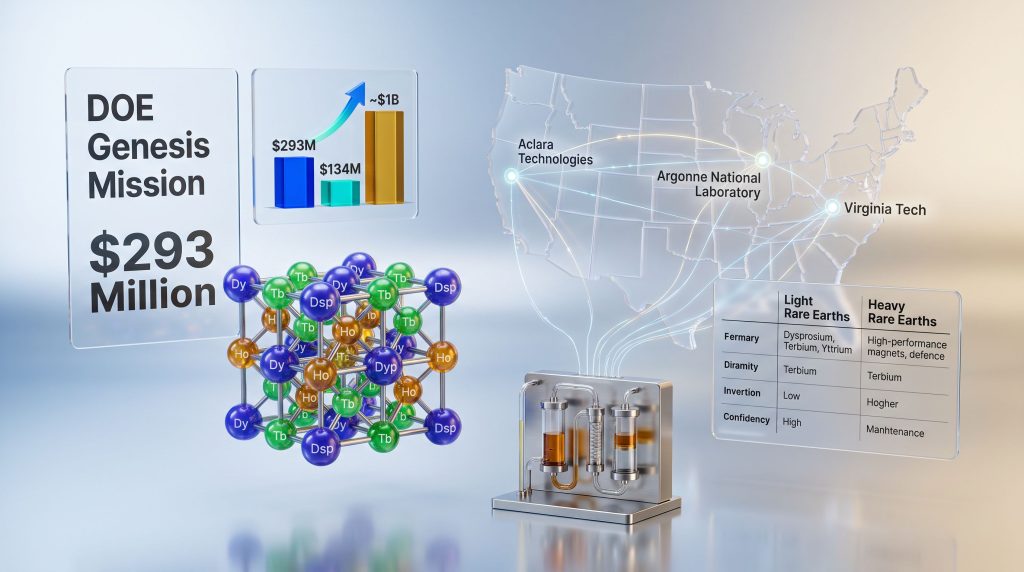
The U.S. Department of Energy's Genesis Mission represents one of the more architecturally sophisticated federal funding mechanisms to emerge from the current wave of critical minerals policy. With a total program scale of approximately $293 million, it is not simply a grant program but a structured technology acceleration vehicle. It is designed to advance artificial intelligence-enabled extraction and processing from demonstration stage toward commercial readiness.
The program operates across two phases with distinctly different mandates:
- Phase I requires applicants to demonstrate AI-enabled processing workflows at meaningful technical scale, proving that machine learning integration can deliver measurable efficiency gains in separation or extraction operations.
- Phase II provides scaled federal co-investment for Phase I projects that meet performance thresholds, functioning as a conditional pathway from validated demonstration to deployment-ready technology.
This two-stage architecture is deliberate. By requiring demonstrated technical performance before committing larger capital, the DOE reduces the risk of funding projects that succeed on paper but stall during scale-up. It also creates a competitive dynamic that rewards technical differentiation rather than simply proposal quality.
The Genesis Mission sits within a broader DOE critical minerals portfolio that has issued funding notices approaching $1 billion across programs targeting extraction, processing, and recycling. Understanding where Genesis Mission fits within this landscape helps clarify its specific mandate:
| Funding Program | Approximate Scale | Primary Focus |
|---|---|---|
| DOE Genesis Mission | $293 million | AI-enabled extraction and processing |
| DOE REE Supply Chain Enhancement | $134 million | Domestic rare earth supply chains |
| Broader DOE Critical Minerals Actions | ~$1 billion (notices) | Full value chain: extraction to recycling |
The challenge area governing Genesis Mission eligibility centres on securing America's critical minerals supply through advanced extraction and processing technologies. Consequently, AI integration is not framed as an enhancement option but as a foundational design requirement. Projects that apply conventional optimisation to existing processes without meaningful machine learning architecture are unlikely to meet the technical bar the program is designed to advance.
Multi-feed separation capability is another differentiating criterion worth understanding. Most conventional rare earth processing circuits are calibrated for relatively consistent feedstock compositions. The ability to process variable or unconventional feedstocks is technically demanding and commercially significant. It broadens the range of ore sources a processing facility can handle, which directly affects economic viability and supply chain flexibility.
How Aclara's AI Processing Project Maps to Federal Priorities
Aclara US Department of Energy funding for AI-driven heavy rare earth processing has been confirmed through the Genesis Mission framework, with a project focused on AI-enabled process optimisation for multi-feed rare earth separation. The project's technical scope addresses one of the most persistent engineering challenges in the sector: maintaining separation efficiency when the chemical composition of input feedstocks changes. In addition, the rare earth processing challenges that have historically plagued domestic operators are precisely what this project aims to resolve.
The centerpiece of the technical approach is the deployment of digital twin technology applied to solvent extraction circuits. A digital twin, in this context, is a computational replica of a physical processing circuit that mirrors its chemistry, fluid dynamics, and operating parameters in real time. Rather than conducting physical trial-and-error to optimise separation conditions, engineers can run thousands of simulated configurations within the digital model, identifying optimal parameter combinations before implementing any changes in the physical plant.
"In solvent extraction, where the interactions between organic solvents, aqueous phases, pH levels, and temperature gradients are deeply nonlinear, the optimisation search space is enormous. Conventional process control systems navigate this space using rule-based logic. Machine learning models can identify correlations across dozens of simultaneous variables that no human operator or traditional algorithm would detect."
The project is structured as a public-private-academic consortium, a model the DOE has consistently preferred for technology-stage critical minerals programs. This structure distributes technical risk across institutions with complementary capabilities:
- Aclara Technologies leads the project as the commercial technology developer, bringing processing expertise and the commercialisation pathway.
- Argonne National Laboratory, one of the DOE's flagship applied research institutions, contributes computational modelling capacity, materials characterisation tools, and institutional familiarity with federal reporting requirements.
- Virginia Tech contributes academic research depth in mineral processing and chemical engineering, supporting process design and analytical rigour.
This consortium structure mirrors the approach that has accelerated technology readiness levels in other DOE-backed programs. Institutional diversity tends to compress the timeline between laboratory discovery and deployable technology by enabling parallel workstreams that a single organisation could not sustain.
AI in Solvent Extraction: A Technical Breakdown for Investors and Industry Observers
For those outside the chemical processing sector, understanding why AI in minerals is being applied specifically to rare earth solvent extraction requires some technical grounding.
Rare earth separation by solvent extraction involves moving dissolved rare earth ions between an aqueous phase and an organic solvent phase across a series of mixer-settler stages or pulse columns. Because rare earth elements have nearly identical ionic radii and chemical behaviours, achieving high-purity separation requires precise control of dozens of interdependent variables simultaneously. Small deviations in pH, temperature, reagent concentration, or flow rate can cascade into significant purity losses or yield reductions downstream.
How Does AI Optimisation Work Step by Step?
The step-by-step flow of AI optimisation in this environment works as follows:
- Data ingestion: Sensors distributed across extraction stages capture real-time measurements of process variables including pH, temperature, phase ratio, and organic loading.
- Model training: Historical operational data, combined with experimental datasets, trains machine learning models to recognise efficiency-determining patterns that conventional control systems cannot resolve.
- Digital twin simulation: The trained models are embedded in a virtual circuit that replicates physical behaviour, allowing engineers to test parameter adjustments before any physical changes are made.
- Closed-loop control: Validated AI recommendations feed directly into process control systems, enabling continuous, automated optimisation rather than periodic manual adjustment.
- Outcome tracking: Purity yields, reagent consumption rates, and waste stream volumes are benchmarked against pre-AI baselines to quantify efficiency gains.
The practical implications extend beyond operational efficiency. Reagent consumption in rare earth solvent extraction represents a significant cost component, and Argonne National Laboratory's digital twin research confirms that AI-driven optimisation reducing over-dosing of extractants can materially improve processing economics. Similarly, minimising waste stream generation has regulatory and environmental compliance implications that affect a project's social licence to operate.
The HREE Demand Equation: Why These Elements Cannot Be Ignored
The structural demand case for heavy rare earth elements is not speculative. It is built on the physics of the applications they serve.
NdFeB permanent magnets are the dominant magnet type used in electric vehicle traction motors and direct-drive offshore wind turbine generators. At operating temperatures, the coercivity of a pure NdFeB magnet degrades rapidly. Adding dysprosium and terbium stabilises this coercivity, maintaining magnetic performance across the temperature ranges encountered in real-world operation. This is not a design preference that engineers can optimise away. It reflects fundamental materials science.
| Characteristic | Light Rare Earths (LREEs) | Heavy Rare Earths (HREEs) |
|---|---|---|
| Representative elements | Cerium, lanthanum, neodymium | Dysprosium, terbium, yttrium, holmium |
| Relative crustal abundance | More common | Significantly rarer |
| Separation complexity | Moderate | High |
| Primary applications | Catalysts, polishing compounds, some magnets | High-performance magnets, defence electronics |
| U.S. processing capacity | Limited but developing | Critically underdeveloped |
| Global processing concentration | Heavily offshore | Extremely concentrated offshore |
Demand forecasts for dysprosium and terbium through 2030 consistently project supply-demand imbalances that cannot be resolved through mining expansion alone. The bottleneck is not ore availability. It is the processing infrastructure required to convert ore into separated, refined oxide products at the purity levels required by magnet manufacturers.
This distinction matters enormously for policy and investment analysis. A country that mines rare earth ore but ships it offshore for processing has not achieved supply chain security. It has simply relocated one dependency for another. Processing capability is the strategic asset, and it is precisely what programs like Genesis Mission are specifically designed to develop domestically.
From Technology Sovereignty to Commercial Positioning
The broader policy context surrounding Aclara US Department of Energy funding for AI-driven heavy rare earth processing extends well beyond a single funding announcement. It reflects a deliberate shift in how the U.S. federal government conceptualises critical minerals strategy. The framing has moved from resource nationalism toward technology sovereignty, owning the processing knowledge and infrastructure that converts raw materials into high-value refined products.
This shift aligns with the framework established by the CHIPS and Science Act, which identified advanced manufacturing and materials processing as domains where domestic technological capability is a national security prerequisite. Furthermore, a coordinated critical minerals coalition approach across allied nations is increasingly shaping how processing investments are structured and prioritised.
What Are the Plausible Outcomes by 2030?
For the competitive landscape, the implications are significant. AI-enabled processing efficiency has the potential to narrow the cost gap between domestic rare earth separation and lower-cost offshore processing operations. However, three scenarios frame the plausible range of outcomes for U.S. HREE processing capacity development by 2030:
| Scenario | Key Conditions | Projected Outcome |
|---|---|---|
| Accelerated Buildout | Multiple Genesis Mission projects advance to Phase II; private capital follows federal validation signal | Meaningful domestic HREE processing capacity operational by 2029-2030 |
| Moderate Progress | Selected projects succeed but face commercialisation gaps; partial capacity emerges | Domestic processing covers a portion of demand; import dependency persists for HREEs |
| Stalled Development | Technical or funding barriers prevent Phase II advancement | U.S. remains heavily reliant on offshore processing; strategic vulnerability continues |
Successful completion of Phase I also creates optionality that extends beyond the project itself. A validated AI-driven separation platform could be licensed to other domestic processors, multiplying the program's impact across the broader sector. It also creates credibility for offtake discussions with defence contractors and clean energy manufacturers who are increasingly requiring supply chain provenance assurances in procurement agreements. A broader rare earth strategy at the international level further illustrates how competitive this domain has become.
Disclaimer: Scenario projections and forward-looking statements regarding market development, processing capacity, and program outcomes involve inherent uncertainty. They should not be construed as financial advice or guarantees of future results.
The next major ASX story will hit our subscribers first
Frequently Asked Questions
What is the DOE Genesis Mission and how large is its funding pool?
The DOE Genesis Mission is a federal technology acceleration program with a total scale of approximately $293 million. It operates through two phases, with Phase I targeting AI-enabled demonstration projects and Phase II providing scaled co-investment for projects that meet Phase I performance criteria.
Why are heavy rare earths considered higher-risk than light rare earths?
Heavy rare earth elements are rarer, more chemically complex to separate, and processed in a far more geographically concentrated set of facilities globally. Their applications in high-performance permanent magnets and defence electronics make supply chain disruption particularly consequential.
How does a digital twin improve solvent extraction performance?
A digital twin creates a computational replica of a physical processing circuit, allowing engineers to simulate thousands of parameter configurations and identify optimal separation conditions without physical trial-and-error. This reduces cost, operating risk, and the time required to optimise processes for new feedstock compositions.
Why is Argonne National Laboratory a strategically significant partner?
Argonne brings DOE-recognised computational modelling infrastructure, materials characterisation capabilities, and an established track record of federal co-development work. Its involvement strengthens both technical execution and the credibility of project reporting to federal stakeholders.
What happens if Aclara successfully completes Phase I?
Successful Phase I completion makes the project eligible for Phase II federal co-investment, providing additional capital to scale from demonstration toward commercial deployment. It also creates the potential to licence the AI processing platform more broadly and supports offtake discussions with manufacturers requiring domestically processed HREE supply.
Want to Know Which ASX Explorers Are Uncovering the Next Critical Minerals Opportunity?
Discovery Alert's proprietary Discovery IQ model delivers real-time alerts the moment significant mineral discoveries — including rare earth and critical minerals plays — are announced on the ASX, transforming complex data into actionable insights for investors at every level. Explore historic discoveries and their extraordinary returns or start your 14-day free trial today to position yourself ahead of the market.