
July 23, 2026
The Hidden Bottleneck Reshaping Global Industry: Why Refining Capacity Matters More Than Mining Rights
Consider a scenario that plays out more often than most investors realise: a nation holds world-class mineral deposits, secures the mining permits, extracts the ore, and then ships it thousands of kilometres away to be refined into usable materials by a foreign competitor. The extraction economy captures perhaps 10 to 15 percent of the total value chain. The refining economy captures the rest. This fundamental imbalance, replicated across decades of Western industrial policy, explains why the current wave of critical minerals refinery planned announcements represents something far more consequential than routine infrastructure investment.
The race to build domestic refining capacity is not simply a supply chain story. It is a reckoning with a structural vulnerability that accumulated quietly across three decades of offshoring, and which is now colliding with the most demanding critical minerals demand in modern industrial history.
When big ASX news breaks, our subscribers know first
How Decades of Offshoring Created a Processing Chokepoint
The concentration of critical minerals refining in China did not happen through aggressive policy alone. It was, in large part, enabled by Western complacency. Through the 1990s and 2000s, mining companies in the United States, Australia, Canada, and Europe progressively exited the complex, capital-intensive business of chemical processing and separation, gravitating instead toward the comparatively simpler economics of ore extraction and concentrate export.
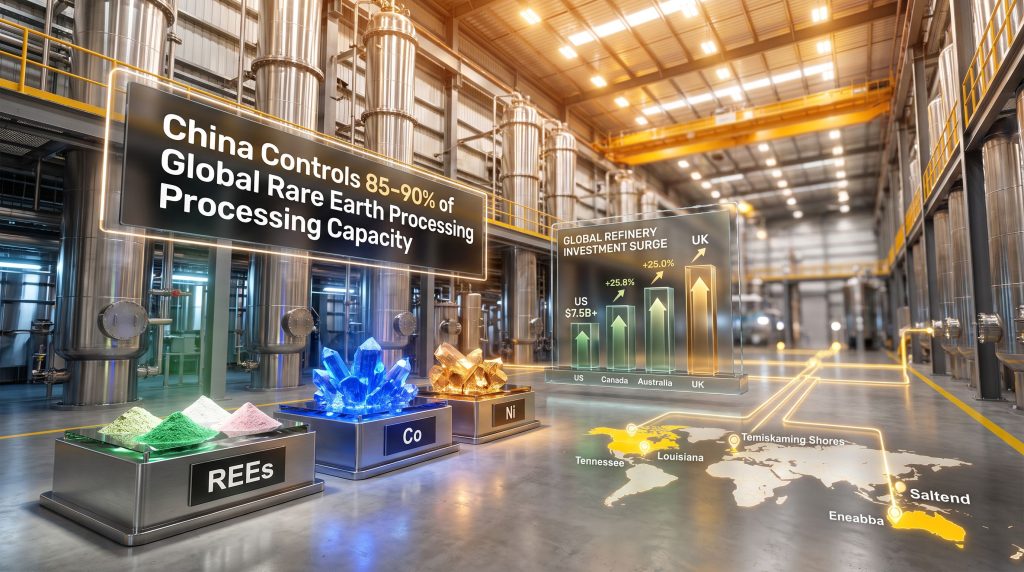
China absorbed this capacity gap methodically, investing in processing infrastructure at a scale that Western governments chose not to match. Today, independent analysts estimate that China controls somewhere between 85 and 90 percent of global rare earth element processing capacity, a figure that represents not just market dominance but systemic leverage over the entire downstream manufacturing stack.
The consequences of this concentration are not theoretical. China's rare earth export restrictions have been deployed as a geopolitical instrument, with controls on gallium, germanium, and graphite processing technologies introduced in recent years serving as escalating proof of concept. Each restriction has functioned as a real-world stress test of allied supply chain resilience, and the results have consistently revealed the same weakness: owning mineral rights without owning refining infrastructure leaves entire industries structurally exposed.
The critical insight that many commodity investors miss is the distinction between the extraction value and the processing value. A tonne of rare earth ore concentrate may be worth a few hundred dollars. The separated oxides derived from that concentrate can be worth tens of thousands of dollars per tonne. The refinery is where the economics actually live.
What makes the current moment different from previous policy cycles is the convergence of three distinct demand vectors, each accelerating independently and each requiring refined critical minerals at scale:
- Defense manufacturing, which requires certified domestic sources of refined antimony, tungsten, rare earth oxides, and specialty metals for electronics, guidance systems, and munitions.
- Electric vehicle production, where permanent magnet motors require neodymium and praseodymium oxides refined to strict purity specifications, and battery cathodes require cobalt sulfate and nickel sulfate at 99.9 percent or higher purity.
- Renewable energy infrastructure, where each megawatt of offshore wind capacity requires meaningful volumes of separated rare earth elements for direct-drive turbine generators.
What Critical Minerals Processing Actually Involves: A Technical Taxonomy
One of the most common misconceptions in public discourse around critical minerals is treating them as a homogeneous category. In practice, each mineral category presents fundamentally different refining challenges, cost structures, and purity requirements.
| Mineral Category | Key End Uses | Primary Refining Challenge |
|---|---|---|
| Rare Earth Elements (REEs) | EV magnets, wind turbines, defense electronics | Multi-stage separation complexity |
| Cobalt | Battery cathodes, aerospace alloys | Ethical sourcing and processing concentration |
| Nickel | Battery-grade nickel sulfate, stainless steel | Purity thresholds for battery applications |
| Antimony | Flame retardants, military munitions | Limited Western processing infrastructure |
| Manganese | Battery precursors, steel production | Refining scale economics |
The rare earth separation process is particularly instructive. These elements sit adjacent to one another on the periodic table, sharing nearly identical chemical properties, which makes separating them into individual high-purity oxides extraordinarily difficult. The dominant industrial method, solvent extraction (SX), requires dozens of sequential mixer-settler stages, significant reagent volumes, and sophisticated process chemistry expertise accumulated over years of operational learning. China's dominance in this space is not merely a function of investment; it reflects decades of accumulated technical knowledge that cannot be replicated quickly through capital alone.
Emerging alternatives such as direct lithium extraction and membrane-based separation processes offer the potential to compress both costs and environmental impact relative to conventional SX circuits. However, these technologies remain largely at pilot or demonstration scale, meaning that the near-term refinery buildout will still depend heavily on proven, if incumbent, process chemistry.
Battery-grade purity requirements for cobalt sulfate and nickel sulfate introduce a separate set of challenges. Achieving 99.9 percent or higher purity demands fundamentally different process chemistry than conventional smelter-grade metallurgical refining. This is precisely why the construction of facilities like Electra Battery Materials' Temiskaming Shores cobalt sulfate refinery in Canada represents a genuinely distinct class of infrastructure, not simply a scaled-up version of existing smelting operations.
A Global Map of Critical Minerals Refinery Projects
United States: A Dual-Track Refinery Strategy
The United States has moved more aggressively than any other allied nation in constructing the policy and financial architecture for domestic refinery development. The U.S. Department of Energy has committed $140 million toward a first-of-its-kind full-scale rare earth element extraction and separation facility using unconventional feedstocks, including coal ash and mine tailings, as feedstock sources. Furthermore, this approach addresses a supply chain vulnerability that goes beyond the mine-to-refinery pipeline: it creates a processing pathway for domestically abundant secondary resources that have historically been treated as waste streams.
Separately, the U.S. Army has advanced its own small-scale military refinery development program, beginning with antimony in defense applications and targeting an expansion pathway to include tungsten, boron, and rare earth elements, potentially sited on government or military-controlled land. This represents a qualitatively different model from commercial refinery investment, prioritising speed of deployment and sovereign control over production cost optimisation.
On the commercial side, the U.S. refinery landscape includes several flagship projects at different stages of development:
- Ucore's Louisiana Strategic Metals Complex employs a staged construction approach targeting separated rare earth oxides for EV drivetrain motors, wind energy systems, and defense applications. The phased model is designed to distribute capital deployment and technology risk across multiple development stages rather than committing to a single large capital event.
- Korea Zinc's proposed Tennessee refinery, at an estimated $7.4 billion, represents one of the largest single-site investments in critical minerals processing infrastructure announced anywhere in the world. Its strategic objective is to establish a processing network specifically designed to reduce dependence on Chinese-controlled refining.
- Precision Periodic's Florida facility offers a modular refinery concept targeting battery-grade nickel, cobalt, and manganese. The decentralised, replicable production model is designed to compress deployment timelines and reduce the capital barrier to entry compared with large integrated facilities.
The U.S. is effectively running two parallel refinery strategies simultaneously: large-scale allied-capital commercial facilities targeting long-term supply chain rebalancing, and smaller defense-linked processing units designed for sovereign deployment speed. Each addresses a different dimension of the processing vulnerability.
Canada: Closing the Cobalt Sulfate Gap
Electra Battery Materials' facility at Temiskaming Shores in Ontario is positioned to become North America's first dedicated cobalt sulfate refinery, with commissioning targeted for 2027. The significance of this project extends beyond its production volumes. Cobalt sulfate at battery grade cannot be produced through conventional smelting pathways; it requires hydrometallurgical processing specifically engineered to achieve the purity specifications demanded by lithium-ion battery cathode manufacturers. Building this capacity domestically represents a qualitative shift in Canada's position within the battery supply chain, not merely a quantitative one.
Australia: Integrated Rare Earth Oxide Production
Iluka Resources' Eneabba rare earths refinery in Western Australia is designed to produce separated rare earth oxides suitable for permanent magnet manufacturing, making it the first integrated facility of its kind on Australian soil. The distinction between a monazite cracking and leaching operation and a true separated oxide refinery is technically significant and often underappreciated in general coverage.
A monazite processing facility produces a mixed rare earth carbonate, which still requires further separation chemistry before it can be used in magnet manufacturing. A separated oxide refinery completes that entire processing chain, delivering a product that magnet manufacturers can use directly. Eneabba is designed to accomplish the latter, which is a meaningfully more complex and strategically valuable infrastructure asset. According to Australia's critical minerals opportunity, this shift from commodity exporter to technology enabler is precisely the strategic repositioning that nations like Australia must pursue.
United Kingdom: Magnet Materials at an Established Industrial Site
Pensana's Saltend project in East Yorkshire targets the UK's first dedicated magnet materials refinery, co-located within an established chemicals park infrastructure. The strategic logic of this co-location is worth examining. Chemical processing facilities require access to industrial reagents, utilities, port infrastructure, and specialised waste management systems. Greenfield refinery development must build all of this from scratch. By integrating into an existing chemicals park, Pensana accesses shared infrastructure that would otherwise require years and hundreds of millions of dollars to replicate independently, while positioning the UK as a critical minerals processing hub with genuine post-Brexit supply chain significance for European manufacturers.
The Demand Architecture Driving Refinery Investment
EV and Clean Energy Trajectories
Global electric vehicle sales are projected by multiple industry forecasters to exceed 40 million units annually by 2030, each requiring permanent magnet motors that depend on separated neodymium and praseodymium oxides refined to exacting specifications. Wind energy expansion targets across the European Union, United States, and Asia-Pacific add further demand pressure, with direct-drive offshore turbines consuming rare earth oxide volumes that scale directly with installed gigawatt capacity.
An often-overlooked dynamic in refinery investment planning is the impact of battery chemistry evolution on demand signals. The ongoing transition between nickel-manganese-cobalt (NMC) and lithium-iron-phosphate (LFP) battery chemistries creates divergent refinery investment signals. LFP adoption reduces cobalt and nickel demand per vehicle but introduces lithium processing requirements at different purity thresholds. Refinery projects that lock into a single chemistry assumption carry meaningful technology risk if market chemistry preferences shift faster than expected.
Policy Mechanisms Enabling Commercial Viability
The Inflation Reduction Act, CHIPS Act, and Defense Production Act have collectively created a financial architecture in which refinery investment that would previously have been commercially marginal is now viable. Domestic content requirements for EV tax credits create guaranteed offtake demand for allied-nation-processed materials. Defense procurement regulations requiring certified domestic mineral sources create contractual revenue floors for qualifying refinery operators.
Loan guarantee programs and direct grants function as first-loss capital, reducing the risk premium that private capital must absorb. Allied coordination through frameworks like the Minerals Security Partnership extends this logic across G7 and Five Eyes nations, distributing refinery investment geographically in ways that reduce single-point vulnerability while enabling each participating nation to develop processing capacity suited to its mineral endowment and industrial base. The critical raw materials transition underway globally means this policy momentum is unlikely to stall in the near term.
Financing Structures and Design Philosophies
The capital architecture of critical minerals refinery development has evolved considerably beyond simple debt-equity structures. Contemporary refinery finance typically involves layered capital stacks:
- Government loan guarantees and direct grants functioning as first-loss capital to attract private co-investment.
- Strategic equity from sovereign wealth funds and defense-adjacent investors with long return horizons.
- Offtake-backed project finance, where guaranteed purchase commitments from automakers or defense contractors underpin debt service coverage ratios.
The design philosophy of the refinery itself carries significant implications for risk distribution:
| Design Approach | Representative Project | Capital Intensity | Scalability | Risk Profile |
|---|---|---|---|---|
| Large integrated refinery | Korea Zinc Tennessee ($7.4B) | Very High | Low (fixed) | High upfront, stable long-term |
| Staged construction | Ucore Louisiana SMC | Medium-High | High (phased) | Distributed across stages |
| Modular/decentralised | Precision Periodic Florida | Low-Medium | Very High | Lower per-unit, replicable |
| Government-anchored demo | DOE REE demo refinery ($140M) | Medium | Pilot-to-scale | Subsidised, technology de-risking |
The modular refinery approach is gaining traction as a hedge against capital concentration risk. By enabling faster deployment, geographic flexibility, and iterative technology improvement, modular designs avoid the all-or-nothing capital commitment that large integrated facilities require, while generating operational data that can inform future scale-up decisions.
The next major ASX story will hit our subscribers first
Technical and Operational Challenges That Determine Project Success
Feedstock Complexity and Multi-Source Resilience
One of the most underappreciated design challenges in refinery development is feedstock variability. Ore chemistry differs significantly across deposit types, geographic regions, and processing histories. A refinery designed around the chemical profile of a single ore source becomes operationally fragile if that source is disrupted. Building multi-feedstock flexibility into refinery design adds upfront engineering complexity but substantially improves long-term operational resilience.
Environmental Permitting Realities
Chemical processing facilities face a fundamentally different regulatory burden than conventional mining operations. Water management systems, reagent handling and storage, atmospheric emissions controls, and process waste streams each attract independent regulatory scrutiny. Siting a new refinery near communities or on land with Indigenous cultural significance adds social licence requirements that can extend permitting timelines by years. Projects that underestimate the complexity of environmental approvals for chemical processing have historically been among the most common sources of refinery development delays.
Comparative National Buildout and the Nations Lagging Behind
| Country | Key Projects | Target Minerals | Estimated Investment | Timeline |
|---|---|---|---|---|
| United States | DOE demo, Army antimony, Ucore, Korea Zinc TN, Precision Periodic | REEs, antimony, Ni, Co, Mn | $7.5B+ combined | 2025 to 2030 |
| Canada | Electra Battery Materials | Cobalt sulfate | Undisclosed | 2027 commissioning |
| Australia | Iluka Eneabba | Separated REE oxides | Government-backed | Mid-2020s |
| United Kingdom | Pensana Saltend | Magnet materials | Undisclosed | Mid-2020s |
The European Union presents a notable gap in this landscape. The Critical Raw Materials Act has established ambitious mining targets but has not generated equivalent momentum in domestic processing infrastructure. Europe's refinery gap means that even if European mines are developed on schedule, processed outputs may still depend on non-European refining capacity for the foreseeable future.
Japan and South Korea represent a different model: both nations have developed sophisticated processing capabilities over decades, but their strategies increasingly involve overseas refinery investments rather than purely domestic buildout, reflecting their resource-constrained geographies and established industrial trade relationships.
Investment Signals and Supply Chain Implications
Refinery-stage critical minerals companies are attracting valuation premiums relative to pure-play miners in the current environment, reflecting investor recognition that processing capacity is the actual strategic bottleneck. The emergence of a refinery premium — the price differential between Chinese-processed and allied-nation-processed critical minerals — is creating a new pricing dynamic in which geographic origin of processing is itself a value-add for downstream manufacturers subject to domestic content requirements.
EV manufacturers are increasingly seeking to lock in long-term offtake agreements with allied-nation refineries, recognising that IRA compliance and supply chain resilience objectives cannot be met through Chinese-processed inputs regardless of cost competitiveness. Defense contractors face even more stringent requirements, with procurement regulations mandating certified domestic or allied sources for refined specialty metals used in sensitive applications. Consequently, the critical minerals supply chain from mine to refinery to end-use manufacturer is becoming as strategically significant as the minerals themselves.
Three Scenarios for the Global Refinery Buildout
Scenario 1: Accelerated Buildout. Allied-nation refineries reach meaningful production scale by 2030, reducing China's processing dominance from approximately 85 percent toward 60 percent across key mineral categories. Sustained policy support, strong offtake markets, and successful technology maturation enable on-time project delivery across the pipeline.
Scenario 2: Partial Rebalancing. Several flagship projects reach production but encounter cost overruns, permitting delays, or feedstock constraints. China's processing share declines modestly to the 70 to 75 percent range, with allied nations capturing marginal demand growth rather than displacing existing capacity.
Scenario 3: Structural Stagnation. Capital constraints, regulatory complexity, and geopolitical volatility slow timelines significantly. Chinese processing dominance remains entrenched, and the volume of critical minerals refinery planned announcements substantially outpaces actual commissioning through the decade.
The historical pattern in critical minerals supply chain policy is instructive: announced projects consistently outnumber commissioned facilities by a wide margin. The primary variable determining whether this buildout succeeds is not strategic intent, policy frameworks, or announced capital. It is execution, specifically the ability to move from feasibility study to first production within a commercially viable timeframe and budget.
Key milestones worth monitoring through 2030 include Electra's 2027 cobalt sulfate commissioning target, Ucore's production ramp at the Louisiana Strategic Metals Complex, Korea Zinc's Tennessee permitting and construction timeline, and the performance data emerging from the DOE's demonstration refinery program, which will materially influence subsequent commercial-scale investment decisions.
Frequently Asked Questions: Critical Minerals Refinery Projects
What distinguishes a critical minerals refinery from a conventional mine?
A mine extracts raw ore from the earth. A refinery applies chemical and metallurgical processes to that ore, or to intermediate concentrates, to produce high-purity refined materials meeting the specifications of end-use manufacturers. The refinery is where the majority of the supply chain's economic value is created, and where the processing expertise that generates durable competitive advantage actually resides.
Why is battery-grade purity so difficult to achieve?
Battery cathode manufacturers require cobalt sulfate and nickel sulfate at purity levels of 99.9 percent or higher. Conventional smelting and metallurgical refining processes cannot reliably achieve these thresholds. Dedicated hydrometallurgical circuits, specifically engineered for battery-grade output, are required, which is why battery materials refineries represent a distinct and more complex infrastructure category than conventional smelters.
How long does it typically take to bring a new refinery into production?
Depending on scale, feedstock complexity, and regulatory jurisdiction, critical minerals refinery construction timelines generally range from three to seven years between feasibility study completion and first commercial production. Modular designs can compress this timeline at smaller initial scales, while large integrated facilities such as Korea Zinc's proposed $7.4 billion Tennessee operation require extended permitting, engineering, and construction phases.
Is recycling a viable alternative to new primary refinery capacity?
Recycling is an increasingly important secondary supply source, particularly for cobalt and rare earth magnet materials. However, current recycled volumes are insufficient to meet projected demand growth through the 2030s. Primary refinery capacity and recycling infrastructure are complementary investment priorities rather than competing alternatives, and most credible supply chain models require meaningful growth in both simultaneously. For further context on Australia's expanding project pipeline, eight key critical minerals projects illustrate the breadth of investment currently under consideration.
This article contains forward-looking projections and scenario analysis drawn from publicly available industry data and policy documentation. Such projections involve inherent uncertainty and should not be interpreted as investment advice. Independent research and professional financial guidance are recommended before making investment decisions related to any companies or projects referenced herein.
Want to Know Which ASX Companies Are Positioned at the Heart of the Critical Minerals Boom?
Discovery Alert's proprietary Discovery IQ model delivers real-time alerts the moment significant mineral discoveries are announced on the ASX, cutting through the complexity of over 30 commodities to surface actionable opportunities — whether you're tracking rare earth explorers, battery metals plays, or the upstream miners feeding tomorrow's refineries. Explore historic discoveries and the returns they generated, then start your 14-day free trial at Discovery Alert to ensure you're positioned before the broader market catches on.