July 21, 2026
The Hidden Architecture That Determines Whether Critical Minerals Reach the Factory Floor
Every conversation about energy transition, defence manufacturing, and technology supply chains eventually arrives at the same destination: critical minerals. Yet the public debate has become disproportionately focused on one end of the value chain. Governments announce mine permitting reforms. Investment funds target exploration plays. Geopolitical commentary dissects who controls which orebody. What receives far less scrutiny is the intricate system of operational decisions, metallurgical trade-offs, and integrated coordination that determines whether a mineral ever makes it from the ground into a usable refined product.
The reality is that critical mineral supply chains from mine to refinery are not linear pipelines that flow automatically once the ore is found. They are complex, interconnected systems where decisions made at the mine face ripple through every subsequent stage, and where value is created or permanently destroyed at multiple points along the way.
When big ASX news breaks, our subscribers know first
What a Critical Mineral Supply Chain Actually Involves
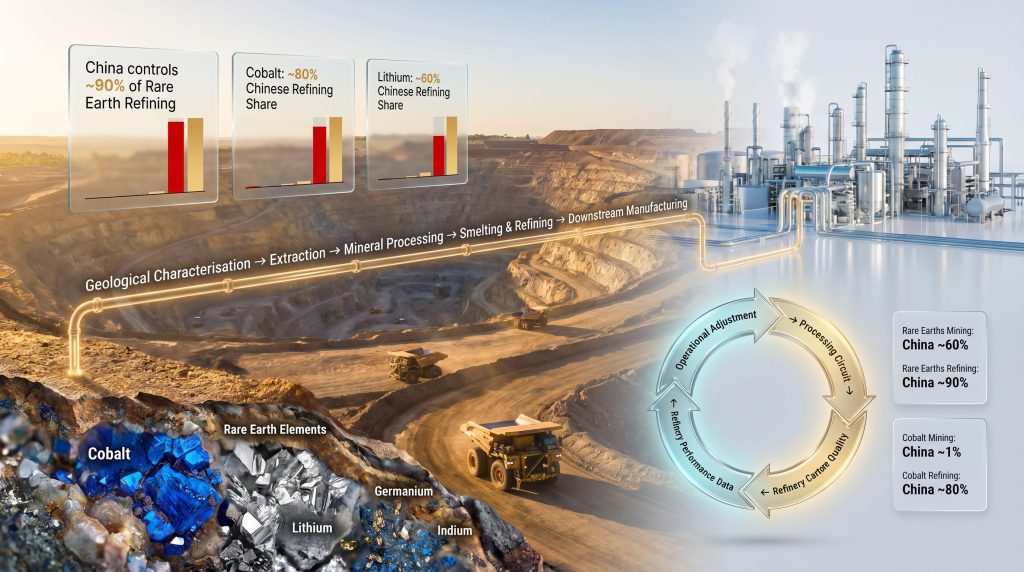
Strip away the policy language and a functional critical mineral supply chain moves through five interdependent phases:
- Geological characterisation — orebody modelling, grade estimation, and detailed mineralogical mapping to understand what is in the ground and how it behaves
- Extraction — open-cut or underground mining, blasting, and haulage from the mine face to the processing facility
- Mineral processing — crushing, grinding, flotation, and leaching to produce concentrates suitable for smelting
- Smelting and refining — pyrometallurgical or hydrometallurgical conversion of concentrates into refined metals
- Downstream manufacturing — integration of refined materials into batteries, permanent magnets, semiconductors, fibre optic systems, and defence components
Each stage introduces distinct vulnerabilities. However, the most structurally significant of these is the refining stage, where global processing capacity is extraordinarily concentrated. The critical minerals demand surge driven by the energy transition has only intensified pressure on this bottleneck.
The Refining Bottleneck: Where Geography Diverges from Geology
Mining geography is relatively diversified. Refining geography is not. This asymmetry sits at the heart of Western supply chain vulnerability.
| Mineral | Primary Mining Nations | China's Share of Refining |
|---|---|---|
| Cobalt | DRC (~70% of global supply) | ~80% |
| Rare Earth Elements | Australia, China, Brazil | ~90% |
| Lithium | Australia, Chile, Argentina | ~60% |
| Germanium | USA, China, Russia | Dominant share |
| Indium | China, South Korea, Canada | Highly concentrated in Asia |
The pattern is consistent across mineral classes: China's share of the value chain increases dramatically at the processing and refining stage, regardless of where the ore originates. Nations with substantial mining output can remain entirely dependent on Chinese processing infrastructure to convert their resources into industrially usable materials.
Structural Reality: A nation that mines critical minerals but lacks domestic refining capacity does not control a supply chain. It controls the first chapter of one.
How Ore Quality at the Mine Shapes Refinery Performance
One of the most underappreciated dynamics in critical mineral supply chains is the degree to which operational decisions made at the mine face directly determine what a refinery can and cannot recover. These are not isolated technical choices confined to a single site. They propagate through the entire downstream system.
Chris Kormendy, superintendent of operations and maintenance execution at Teck Resources' Red Dog zinc-lead-silver-germanium mine in Alaska, has held leadership roles across both Red Dog and Teck's Trail Operations refinery in British Columbia. That rare experience spanning the full mine-to-metals value chain has produced a perspective the industry rarely encounters: genuine systems-level thinking grounded in practical execution on both sides of the mine-smelter interface.
Kormendy's view, developed through years of working across both upstream and downstream processes, is that value is not created at a single point in a supply chain. It is the product of alignment — specifically between orebody knowledge, processing design, concentrate quality, and refinery constraints. Optimising any one stage in isolation will consistently underperform a coordinated system approach.
Key upstream variables that affect refinery outcomes:
- Grind size — Insufficient liberation of host minerals leaves valuable elements locked in gangue; excessive fineness increases slime losses and reduces flotation selectivity
- Flotation chemistry — Reagent selection governs which minerals report to concentrate and which are rejected, with direct implications for both primary and secondary metal capture
- Blending strategy — Mixing ores from different geological zones affects concentrate grade, impurity profiles, and the downstream circuit flexibility available to refiners
- Moisture and particle size distribution — Affects transport logistics, smelter feed behaviour, and energy consumption at every subsequent stage
When concentrate quality fluctuates, secondary metal recoveries are typically the first casualties. In the words of Kormendy's operational experience, consistency in concentrate production is not a logistical preference. It is a strategic imperative for retaining value throughout the system. Furthermore, advances in critical minerals processing technology are beginning to offer new tools for managing this variability more effectively. (Metal Tech News, May 2026)
What a Metallurgically Sound Concentrate Looks Like
A high-quality concentrate is defined by three properties that determine how well it performs in downstream circuits:
- Consistency — Stable grade and impurity profile across shipments, enabling smelters to maintain circuit stability without continuous reactive adjustment
- Cleanliness — Low concentrations of penalty elements such as arsenic, antimony, and fluorine that disrupt smelter chemistry and reduce recoveries
- Predictability — Mineralogical uniformity that allows refiners to plan circuit configurations in advance rather than responding to feed variability after it arrives
When these properties are maintained, smelters can optimise circuits for both primary metal recovery and secondary mineral capture simultaneously. When they are not, reactive management replaces proactive planning, and recoveries suffer across the board.
Where Critical Minerals Are Permanently Lost in the Chain
Understanding where minor critical minerals disappear from the value chain is essential for designing systems that retain them. Three stages carry the highest and most irreversible loss risk.
Stage 1: During Mineral Processing (Upstream)
Minor metals such as germanium, indium, and gallium do not form independent mineral phases in most orebodies. They substitute into the crystal lattices of primary minerals, predominantly zinc and copper sulphides. If a processing flowsheet is not designed to preserve these elements through to the concentrate, they are dispersed into tailings and permanently lost.
Typical flotation recoveries for primary minerals range from 85 to 95 percent, but for minor metals travelling within those host phases, recoveries can fall significantly lower without deliberate circuit design. Germanium recovery from zinc flotation circuits varies widely, with poorly configured operations losing a substantial portion of available germanium before it ever reaches a smelter.
Stage 2: During Concentrate Blending and Transport
When concentrates from multiple sources are blended — whether at the mine, at a port, or at a smelter — the dilution of minor metal concentrations below economically recoverable thresholds is a genuine operational risk. Once a blend falls below the processing economics threshold, those elements cannot be selectively recovered.
A high-germanium concentrate blended aggressively with low-grade material may arrive at a smelter at concentrations that no longer justify circuit-level capture, destroying value that existed at the mine but was eliminated through blending decisions.
Stage 3: At the Smelter Before Refining Begins
Many smelters globally are not configured to capture minor metals even when they arrive in the concentrate feed. Of approximately 120 primary zinc smelters operating globally, fewer than 30 have dedicated circuits for recovering germanium, indium, or gallium. At facilities without these circuits, 40 to 80 percent of arriving minor metal content may report to slag or other waste streams.
Critical Warning: The opportunity to recover minor critical minerals is often lost upstream, at the processing or blending stage, long before ore reaches a refinery. Policy responses focused solely on refinery capacity cannot recover value that was destroyed earlier in the chain.
Kormendy's operational experience at both Red Dog and Trail confirms this dynamic. He notes that small changes in grind size, flotation chemistry, or blending strategy can shift where minor metals report, and that once diluted or rejected, many of those elements become effectively unrecoverable. (Metal Tech News, May 2026)
Why China's Refining Dominance Is a Structural Issue, Not a Diplomatic One
The framing of China's critical mineral position as a geopolitical problem obscures a more fundamental driver: decades of deliberate investment in hydrometallurgical and pyrometallurgical refining infrastructure, combined with vertically integrated supply chains and lower operating costs, created a structural advantage that cannot be reversed through policy declarations alone.
| Mineral | China's Share of Mining | China's Share of Processing/Refining |
|---|---|---|
| Cobalt | ~1% | ~80% |
| Rare Earth Elements | ~60% | ~90% |
| Lithium | ~15% | ~60% |
| Aluminium | ~21% | ~59% |
| Titanium | ~34% | ~69% |
The consistent pattern is clear: China's role in the supply chain expands dramatically at the processing stage. Nations with significant geological endowment remain structurally exposed because ore in the ground requires transformation, and that transformation capacity resides predominantly outside their borders.
Recent events have made this structural vulnerability quantifiable. China's implementation of rare earth export controls in 2025 created downstream disruptions in Western manufacturing within weeks of taking effect, with automotive production lines among the early casualties. These were not theoretical risks playing out in modelling exercises. They were operational disruptions affecting physical production schedules.
Export restrictions on germanium and gallium, progressively tightened between 2023 and 2025, demonstrated that minor critical minerals produced as byproducts of zinc and aluminium refining are particularly vulnerable to targeted controls. Consequently, these events confirm what supply chain practitioners have understood for years: mining investment without commensurate refining investment does not create supply chain resilience. It creates the first step of a chain that still terminates in someone else's facility. The IEA's analysis of critical minerals has similarly underscored this structural dependence across multiple commodity classes.
The Case for Mine-to-Refinery Integration as a System Design Principle
The conventional approach to mining investment treats each asset as an independently optimised unit. A mine targets ore recovery and throughput. A concentrator targets concentrate grade. A smelter targets primary metal recovery. A refinery targets purity and yield. Each is measured, managed, and often owned separately.
This model is structurally inadequate for critical mineral supply chains from mine to refinery where minor metal behaviour is governed by system-wide decisions rather than single-point operations.
The integration model that Teck Resources operates between Red Dog and Trail provides a practical demonstration of what coordinated mine-to-refinery management looks like. Trail's requirements around concentrate quality, impurity tolerances, and feed consistency directly inform how Red Dog designs its mining, blending, and processing operations. In return, Trail provides structured feedback on smelter performance and circuit constraints, allowing Red Dog to make real-time adjustments before problems compound. (Metal Tech News, May 2026)
The case for integrated mine-to-refinery coordination:
- Smelter requirements around concentrate quality and impurity tolerances should directly inform how mines design processing circuits, not be communicated reactively after problems emerge
- Refineries should provide structured, continuous feedback to upstream operations on how concentrate characteristics are affecting circuit performance and minor metal recoveries
- Blending strategies should be planned jointly across the supply chain to preserve minor metal concentrations above recovery thresholds
- Shared data environments should replace periodic reporting cycles, enabling coordinated real-time decision-making between geographically separated sites
Systems Principle: Value in a critical mineral supply chain is the product of alignment, not the sum of individual asset performance. Optimising any one stage in isolation will consistently underperform a coordinated system approach.
The Feedback Loop That Prevents Compounding Loss
In integrated operations, performance data flows continuously in both directions between mine and refinery. Smelter recovery rates, impurity behaviour observations, and circuit stability data flow back to the mine and processing plant, enabling adjustments before suboptimal concentrate reaches the smelter. The result is a system that improves iteratively over time, rather than one that repeatedly encounters the same bottlenecks without the information needed to resolve them.
Kormendy identifies integration as the greatest source of improvement opportunity in the industry, ahead of better geology and better processing in isolation, precisely because alignment between prediction and execution delivers more dependable gains than either element alone. (Metal Tech News, May 2026)
The next major ASX story will hit our subscribers first
The Byproduct Problem: How Secondary Critical Minerals Travel Through the Chain
Secondary critical minerals occupy a uniquely challenging position. They do not drive the economics of a mining operation, but their strategic importance has grown substantially as demand from clean energy infrastructure, semiconductor manufacturing, and defence applications has expanded.
Germanium, used in fibre optic cables, infrared optics, and semiconductor substrates, is produced almost exclusively as a byproduct of zinc refining. Indium, essential for thin-film photovoltaic panels and flat-panel display manufacturing, follows the same path through zinc-copper processing circuits. Gallium is similarly tied to aluminium and zinc refining. None of these elements can be selectively mined. Their recovery depends entirely on the design of circuits built for primary metals.
Design parameters that determine minor metal recovery outcomes:
| Design Parameter | Impact on Minor Metal Recovery |
|---|---|
| Grind size optimisation | Determines liberation of host minerals carrying substituted minor metals |
| Selective flotation circuit design | Can concentrate or dilute minor metals depending on reagent choices and circuit configuration |
| Impurity management protocols | Controls whether minor metals are preserved through the circuit or rejected upstream |
| Smelter circuit flexibility | Determines whether arriving minor metals can be captured or report to waste streams |
| Cross-site data integration | Enables proactive adjustment before losses occur rather than investigation after the fact |
A particularly underappreciated trade-off exists between primary and secondary metal recovery optimisation. Aggressive zinc recovery parameters may achieve 93 percent zinc extraction while losing a disproportionate share of germanium. A more conservative configuration accepting 88 percent zinc recovery could improve germanium capture by 30 to 50 percent. Whether this trade-off is economically justified depends on the relative prices of zinc and germanium at any given time, and on whether the downstream refinery has circuits capable of processing the preserved germanium content. This is precisely the kind of cross-system decision that cannot be made effectively without integration between mine and refinery.
Operational Challenges That Determine Whether Supply Chains Deliver
Ore variability is the operational constant that never stabilises. No orebody is geologically uniform, and the feed entering a processing plant differs from one shift to the next in ways that propagate directly into concentrate quality and downstream refinery performance.
Practical implications of ore variability for critical mineral supply chains:
- Recovery rates fluctuate when processing parameters are not continuously adjusted to match changing feed characteristics
- Concentrate quality can drift outside smelter acceptance specifications, triggering penalty charges or outright rejection of shipments
- Minor metal distributions shift unpredictably across geological transitions, making recovery planning difficult without comprehensive orebody characterisation
- Logistics and blending strategies must accommodate changing feed profiles while maintaining the consistency downstream refiners require
Environmental extremes compound these challenges at remote critical mineral operations. Teck's Red Dog mine experienced temperatures below minus 40 degrees Fahrenheit during the 2025-2026 winter, while Trail Operations exposes workers to temperatures exceeding 120 degrees Fahrenheit in furnace environments during summer months. These are not background conditions. They become defining operational factors that shape every decision from equipment specification to workforce management.
| Operating Condition | Primary Risk | Required Mitigation |
|---|---|---|
| Arctic winters below -40°F | Equipment failure, reduced dexterity, frostbite | Cold-weather engineering standards, PPE protocols, warm-up procedures |
| Furnace environments above 120°F | Heat stress, equipment overheating, fluid loss | Hydration management, exposure limits, thermal monitoring systems |
| Remote logistics with seasonal access | Supply disruption, maintenance delays | Inventory buffering, predictive maintenance, workforce rotation planning |
The discipline and planning culture developed under these conditions translates directly into supply chain reliability. Operations that treat extreme environments as background variables rather than defining operating factors are systematically more vulnerable to the disruptions that cascade through integrated supply chains.
Technologies That Are Improving Critical Mineral Supply Chain Performance
The most impactful technological advances in critical mineral processing are not occurring primarily in extraction hardware. They are in the analytical and decision-support tools that enable faster, more accurate operational responses to the variability that pervades every stage of the supply chain.
Technology categories delivering measurable improvement:
- Advanced process control (APC) — Real-time adjustment of flotation, leaching, and smelting parameters based on continuous feed analysis, reducing the lag between feed change and circuit response
- Ore characterisation analytics — Rapid mineralogical assessment tools that allow processing parameters to be adjusted before ore reaches the plant, shifting from reactive correction to proactive configuration
- Predictive maintenance systems — Sensor-based condition monitoring that identifies equipment degradation before failure occurs, reducing unplanned downtime that disrupts concentrate production consistency
- Cross-site data integration platforms — Shared operational data environments allowing mines and refineries to coordinate in real time rather than through delayed reporting cycles that leave problems unaddressed for weeks
- Advanced separation technologies — Including molecular recognition technology and solvent extraction innovations improving selectivity in refining minor and rare earth metals at concentrations that previously made recovery uneconomical
Furthermore, the rare earth processing challenges associated with separation and refinement at scale remain a key barrier that these emerging technologies are beginning to address. Kormendy's perspective from operational experience at both Red Dog and Trail is that the greatest value from these technologies comes not from the tools themselves but from how they are applied. (Metal Tech News, May 2026)
Rebuilding Western Refining Capacity: Progress, Barriers, and Timelines
Policy frameworks in the United States, European Union, Canada, and Australia have progressively recognised that mining investment without corresponding refining capacity produces stranded assets rather than supply chain security. Resources that exist in the ground but cannot be converted into usable materials without foreign processing infrastructure are not strategically secure.
Key policy and investment responses active through 2025-2026:
- The US Inflation Reduction Act's domestic content requirements have created demand anchors for domestically refined critical minerals, providing revenue visibility that partially de-risks refinery investment
- US Export-Import Bank financing has expanded to support critical mineral processing projects developed with allied nations, addressing the capital cost barrier that has historically deterred greenfield refinery development in Western jurisdictions
- The EU Critical Raw Materials Act has established benchmarks for domestic processing capacity across strategic mineral categories, strengthening European critical raw materials supply by creating regulatory pressure to develop domestic refining infrastructure
- State-level strategies in the United States, including Oklahoma's focus on aluminium, rare earth magnet materials, and battery material refining, are targeting commercial production in the 2027-2028 timeframe
Progress against these objectives faces substantial structural barriers that investment and policy alone cannot rapidly overcome.
| Barrier Category | Specific Challenge |
|---|---|
| Economic | Direct price competition from subsidised Chinese refining capacity with decades of infrastructure depreciation |
| Technical | Shortage of metallurgical engineering expertise in Western nations after decades of industry contraction |
| Regulatory | Permitting timelines under NEPA and equivalent frameworks averaging 7-10 years for new processing facilities |
| Financial | Investor hesitancy without long-term offtake agreements that provide revenue certainty across multi-decade asset lives |
| Infrastructure | Limited existing processing infrastructure outside established hubs requiring substantial parallel investment |
From permitting application to commercial production, greenfield refinery development in Western jurisdictions typically requires between 7 and 15 years depending on mineral type, technology complexity, and jurisdiction. The strategic implication is direct: investment decisions being made in 2025 and 2026 will determine supply chain security in the 2035-2040 decade. Delay has a compounding cost that is not always visible in near-term budget cycles. Research on fragile supply chains and the role of advanced refining technology consistently reinforces this conclusion.
The Human Factor: Why Execution Determines Supply Chain Outcomes
Supply chain resilience is discussed in policy forums primarily in terms of investment volumes, regulatory frameworks, and geopolitical positioning. These inputs matter. However, none of them convert ore into refined metal. That conversion is the product of daily execution by experienced people managing complex systems under difficult conditions.
Kormendy's summation of what actually builds or breaks critical mineral supply chains from mine to refinery is unambiguous: it is not the presence of a resource or the existence of refining capacity on paper. It is the daily reliability of converting that capacity into a saleable product, consistently, across varying conditions and inputs. Every tonne processed depends on equipment performance, informed decision-making, tight process control, and the technical depth to manage variability when it appears. (Metal Tech News, May 2026)
This is what remains invisible in most supply chain security analyses. The complexity of simultaneously managing recovery rates, concentrate quality, workforce safety, regulatory compliance, and cost efficiency — often in remote and extreme environments — requires a depth of operational expertise that cannot be replicated quickly or imported on short notice.
In addition, the connection between critical minerals and energy security underscores why execution quality at the operational level carries genuine strategic weight. The minerals that move through these systems have destinations that carry that weight directly: fibre optic networks, electric vehicle drivetrains, renewable energy infrastructure, and defence electronics.
The operational discipline that delivers them consistently is not incidental to that purpose. It is the mechanism through which strategic objectives are realised or frustrated, one shift at a time.
This article contains analysis of industry trends and operational dynamics for informational purposes only. It does not constitute investment advice. Readers should conduct independent research before making investment or business decisions related to critical mineral supply chains or associated companies.
Want to Track the Next Major Critical Mineral Discovery Before the Market Does?
Discovery Alert's proprietary Discovery IQ model delivers real-time ASX alerts the moment significant mineral discoveries — including critical minerals driving the energy transition — are announced, transforming complex geological data into actionable investment insights for traders and long-term investors alike. Explore historic discoveries and their remarkable returns to understand the opportunity, then begin your 14-day free trial to position yourself ahead of the broader market.