May 12, 2026
The Chokepoint That Changed Everything: Energy, Diplomacy, and the Strait of Hormuz
Every few decades, a single geographic feature transforms from a logistical detail into the central variable of global politics. The Strait of Hormuz, a narrow waterway barely 33 kilometres wide at its tightest point, has become exactly that in 2026. The crisis surrounding it has forced two of the world's most powerful nations into a high-stakes diplomatic encounter in Beijing, where the agenda nominally covers everything from artificial intelligence to nuclear arms, yet where energy runs as the dominant undercurrent through every conversation.
Understanding why the Trump Xi talks on Iran oil and Strait of Hormuz carry such outsized consequence requires grasping something that rarely receives adequate attention: the structural fragility baked into the global energy system when roughly one-fifth of all crude oil and LNG trade flows through a single, narrow corridor with no viable large-scale alternative.
When big ASX news breaks, our subscribers know first
A Supply Shock Without Historical Precedent
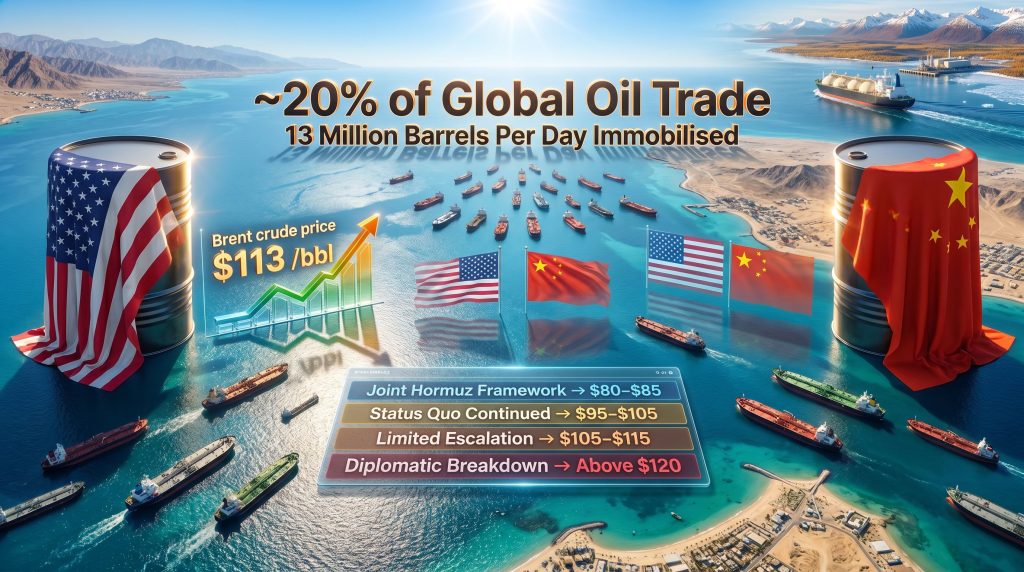
The International Energy Agency has formally designated the current Strait of Hormuz disruption as the largest supply shock in the recorded history of global oil markets. That is not rhetorical flourish. At peak disruption, an estimated 13 million barrels per day of crude supply were effectively immobilised, according to reporting by OilPrice.com. The scale exceeds the 1973 Arab Oil Embargo, which removed roughly 5% of global supply, and dwarfs the disruptions of the 1980s Iran-Iraq War tanker conflict.
The mechanics behind the blockade follow a recognisable escalation pattern: U.S. and Israeli strikes on Iran in late February 2026 triggered retaliatory enforcement action by Iran's Revolutionary Guard, which began imposing shipping restrictions across the waterway. What began as selective interdiction has evolved into near-total operational paralysis for commercial tanker traffic.
The human and logistical dimensions are staggering. Furthermore, the oil trade and geopolitics surrounding this crisis have added layers of complexity that extend well beyond the waterway itself:
- Approximately 20,000 seafarers remain stranded aboard roughly 2,000 vessels in and around the Strait, according to the International Maritime Organization
- More than 40 India-bound vessels have been trapped near the chokepoint
- South Korea received its first tanker passage through the Strait since hostilities began only in recent days
- Oil tankers have been operating in what maritime analysts call dark mode, disabling their transponders to navigate covert exit routes, a tactic that signals extreme operational risk in the corridor
- Japan received its first Central Asian crude cargo since the war began, reflecting active emergency supply diversification
The price consequences have been equally dramatic. Brent and WTI futures have surged approximately 65% since the conflict began, with Brent recently trading above $113 per barrel. The World Bank projects a full-year average Brent price of $86 per barrel, with upside scenarios ranging between $95 and $115 depending on how quickly shipping lanes can normalise, according to the Bank's published analysis.
Morgan Stanley has warned that existing strategic oil buffer stocks across major importing nations could be exhausted before Hormuz shipping lanes fully reopen, adding a time pressure dimension to diplomatic efforts that markets are increasingly pricing into forward curves.
China's Exposure: Dependent Buyer, Reluctant Intermediary
No major economy has more at stake in Beijing this week than China itself. Approximately one-third of China's total oil imports transit the Strait of Hormuz under normal operating conditions, making it categorically the most exposed large economy to the current disruption. The broader geopolitical market landscape has consequently shifted in ways that touch commodity markets well beyond crude oil.
China's Hormuz Dependency at a Glance
| Metric | Estimate | Source |
|---|---|---|
| Share of China's oil imports via Strait of Hormuz | ~33% | OilPrice.com, May 2026 |
| Strategic petroleum reserve stockpile (Dec 2025) | ~360 million barrels | U.S. Energy Information Administration |
| Pre-conflict reserve build rate (2025) | ~1.1 million barrels per day | U.S. Energy Information Administration |
| Iranian crude import channel | Independent teapot refineries | OilPrice.com, May 2026 |
Beijing did not enter this crisis unprepared. Throughout 2025, China ran an accelerated strategic reserve build programme, adding an estimated 1.1 million barrels per day to stockpiles, accumulating approximately 360 million barrels by December 2025 according to U.S. Energy Information Administration estimates. That buffer, while substantial, now faces a test that Morgan Stanley analysts suggest could exceed its capacity if the blockade persists.
The Teapot Refinery Mechanism
A detail that receives insufficient mainstream coverage is how Beijing has continued absorbing Iranian crude despite U.S. sanctions. The mechanism involves directing Iranian oil through smaller independent processors, commonly called teapot refineries, rather than routing it through major state-owned energy companies. This structure limits the direct sanctions exposure of China's largest energy enterprises while maintaining import volumes.
The arrangement reflects a sophisticated understanding of how secondary sanctions enforcement operates and where its practical limits lie. Goldman Sachs analysts have noted that Beijing's decision to host Iranian Foreign Minister Abbas Araghchi in the days preceding the summit positions China as a potential intermediary between Washington and Tehran, giving it unusual negotiating leverage at the table in Beijing.
The paradox is structurally important: China is simultaneously the world's largest buyer of sanctioned Iranian crude and arguably the only power with sufficient influence over Tehran to pressure it toward a negotiated resolution. In addition, concurrent data — including surging Chinese consumer prices and slumping domestic car sales — confirms that sustained supply disruption is producing measurable inflation pressure inside China, reinforcing why Beijing has a structural incentive to pursue resolution rather than prolonged standoff.
Iran's Demands and Washington's Rejection
Any framework for Hormuz reopening must pass through Tehran, and Iran's stated conditions have so far proven incompatible with Washington's redlines. Iran's war negotiations with the U.S. have reached a significant stalemate, with Iran presenting a formal counterproposal outlining four core demands:
- Formal management authority over Strait of Hormuz transit governance
- A 30-day suspension of oil export sanctions as a confidence-building measure
- Cessation of naval blockade operations
- Release of frozen sovereign assets held in overseas accounts
The Trump administration characterised all four demands as unacceptable. The rejection was particularly firm on the question of Strait management authority, which Washington views as an attempt by Tehran to institutionalise strategic leverage over the world's most critical maritime chokepoint. Granting any formal governance role over the waterway would, in Washington's reading, permanently alter the balance of power in the Persian Gulf in ways no U.S. administration could accept.
The market reacted immediately following Washington's public rejection of Iran's proposal, with Brent prices jumping sharply, illustrating how precisely energy traders are calibrating every diplomatic signal from this conflict in real time.
The dynamics reveal something important about the negotiating architecture. Iran's demand for chokepoint authority is not simply a position from which it is expected to negotiate down; it reflects Iran's understanding that control of the Strait is its primary strategic asset. Washington's flat rejection narrows the diplomatic space considerably, which is precisely why the Trump Xi talks on Iran oil and Strait of Hormuz have assumed such critical importance.
Five Scenarios: What Beijing Could Produce
Energy markets are not waiting for a communiqué. Traders are already pricing a distribution of outcomes based on the perceived probability of each scenario materialising. Analyst consensus as of mid-May 2026 maps roughly as follows:
| Scenario | Probability (Analyst Consensus) | Brent Price Implication |
|---|---|---|
| Joint U.S.-China Hormuz reopening framework | Low | Sharp correction toward $80-$85 |
| China commits to reducing Iranian crude purchases | Moderate | Gradual easing; $95-$100 range |
| Energy trade deal only (LNG + agriculture) | Moderate-High | Neutral to slightly bearish |
| Summit concludes without new escalation (base case) | High | Prices stabilise; no directional move |
| Diplomatic breakdown; fresh sanctions on China | Low-Moderate | Spike above $120 |
Analysts at the Brookings Institution and the Peterson Institute have both argued that expectations for structural breakthroughs should be substantially tempered. The realistic success metric for this summit is that both leaders depart Beijing without triggering a new crisis. That outcome, modest as it sounds, would itself represent meaningful diplomatic progress given the volatility of the current environment.
BCA Research chief strategist Matt Gertken has highlighted an underappreciated complication: even a constructive summit carries a secondary risk. If China commits to large-scale purchases of U.S. oil and natural gas, the additional demand injected into already-stressed global commodity markets could push prices higher rather than providing relief. The asymmetry of outcomes is notable, with downside scenarios generating substantially more price volatility than the best-case upside scenarios generate relief.
The Alaska LNG Thread and Energy Trade Agenda
Beyond the Iran question, a parallel energy negotiation has been quietly building since October 2025, when Trump and Xi met in South Korea and China signalled interest in large-scale American energy purchases, with Alaska LNG specifically raised as a candidate transaction. Those discussions stalled when the Iran war interrupted the diplomatic calendar. The Hormuz disruption has, however, renewed Beijing's strategic interest in diversifying away from Middle Eastern supply dependency, creating a convergence of commercial and geopolitical incentives for an Alaska LNG agreement.
The LNG market context is important. LNG markets entered 2026 already operating under elevated political pressure, with the European Union's major U.S. energy purchase framework frozen amid separate transatlantic trade tensions. China re-entering as a significant U.S. LNG buyer would materially reshape global supply allocation and provide long-term revenue certainty for American LNG developers. U.S. officials have indicated that formal announcements of Chinese purchases covering energy, Boeing aircraft, and agricultural commodities are anticipated as summit deliverables.
The Rare Earth Minerals Dimension
A separate but strategically significant item concerns the rare earth minerals truce struck in autumn 2025. That agreement has kept critical mineral flows to American manufacturers intact, underpinning supply chains across the U.S. defence and clean energy manufacturing sectors. The agreement faces a renewal decision, and while U.S. officials have expressed confidence in eventual extension, a formal announcement at this summit is not guaranteed. The strategic significance of continuity here extends well beyond energy, touching semiconductor manufacturing, advanced weapons systems, and the broader industrial competition between the two powers.
The next major ASX story will hit our subscribers first
The Sanctions Architecture: Washington's Leverage Over Beijing
Washington's approach to the summit reflects a deliberate use of the Iran conflict as structural pressure on China's commercial choices. The oil market trade impacts of this pressure campaign are already visible in forward pricing and shipping data. U.S. Trade Representative Jamieson Greer confirmed ahead of the visit that Trump would raise China's continued purchases of Iranian crude directly with President Xi, characterising those purchases as providing the financial oxygen sustaining the conflict responsible for shutting down global energy flows.
The framing is strategically constructed. By linking Beijing's oil buying directly to the Hormuz blockade, Washington attempts to make the cost-benefit calculation of continued Iranian crude purchases visible and uncomfortable for Chinese leadership, rather than presenting it solely as a sanctions compliance question.
Supporting this approach, Washington executed a calculated tactical manoeuvre: a short-term easing of pressure on approximately 140 million barrels of Iranian crude already loaded on tankers. This temporary relief preserved oil market stability without surrendering the broader sanctions architecture or undermining negotiating leverage ahead of the summit.
A parallel campaign targets third-country routing, with U.S. pressure on Iraq-Iran oil linkages designed to close off overland and indirect maritime channels used to move sanctioned Iranian crude to market. The simultaneous headline, Iraq Denies U.S. Claim Deputy Minister Helped Iran's Oil Sales, reflects the active friction this enforcement campaign is generating at a regional level.
One layer of complexity that analysts have flagged deserves explicit attention: the US-China trade tensions surrounding China's long-term strategic objective of reducing dollar dominance in global commodity trade add a second dimension to these negotiations. Iranian crude transactions have historically been structured to bypass dollar-denominated settlement systems. U.S. pressure on Chinese Iranian crude purchases is therefore not simply an energy policy question but intersects with a deeper contest over the architecture of international financial flows.
Who Else Is Absorbing the Shock
The ripple effects of Hormuz disruption extend far beyond the bilateral U.S.-China dynamic. The crisis is producing cascading impacts across the global economy:
- India: More than 40 vessels trapped near the Strait; Prime Minister Modi has publicly urged domestic fuel conservation as inflation accelerates from surging energy import costs
- Japan: Has pivoted to emergency supply diversification, receiving its first Central Asian crude cargo since hostilities began
- Germany: Seeking Israeli jet fuel supplies as Hormuz disruptions cascade into European aviation fuel markets, contributing to global jet fuel exports at a ten-year seasonal low in April
- Asia-Pacific plastics sector: An oil crunch is generating a downstream manufacturing crisis in petrochemical-dependent industries across the region
- Global coal demand: Surging as energy-importing nations seek alternatives to disrupted oil and LNG flows
- Pakistan: Rejecting LNG bids as its own energy crisis deepens, unable to clear offers at prevailing crisis-elevated prices
The United States, however, occupies a structurally different position. U.S. fuel exports have reached record highs as the Hormuz crisis reshapes global energy trade flows, with American LNG and crude producers emerging as the primary alternative supply source for markets cut off from Middle Eastern volumes. Shell, BP, and TotalEnergies have all reported substantial trading windfalls driven by war-related price volatility and arbitrage opportunities created by the dislocation between regional crude benchmarks.
What the Summit's Real Stakes Reveal About the New Energy Order
The Trump Xi talks on Iran oil and Strait of Hormuz expose something that pre-conflict energy market frameworks consistently underestimated: the degree to which oil supply security, great-power competition, sanctions enforcement, and financial system architecture have become inseparable in the modern energy geopolitical order.
The summit was originally scheduled for March 2026. It was delayed by the U.S. and Israeli strikes on Iran. Consequently, the context for these talks has been shaped in real time by the very crisis they are meant to address, adding an urgency that more routine bilateral meetings do not carry.
Forward indicators that will determine whether Beijing produces any lasting energy market consequence include:
- Strait of Hormuz shipping volume data in the weeks following the summit
- Chinese crude import figures and any changes in Iranian crude purchase volumes
- U.S. LNG export contract announcements tied to Alaska or existing Gulf Coast terminals
- Any joint communiqué language specifically addressing Iran, which would be the clearest signal of substantive progress
- Rare earth agreement renewal confirmation, reflecting the broader health of the bilateral commercial relationship
The threshold for what constitutes success at this summit has shifted profoundly from earlier eras of U.S.-China diplomacy. The realistic measure is not a breakthrough but stability — not resolution but the absence of new catastrophe. That recalibration is itself a testament to how fundamentally the Hormuz crisis has redrawn the terrain on which these two powers interact.
Whether this moment accelerates a permanent restructuring of global energy trade routes or whether normalisation eventually restores something resembling the pre-conflict order remains the central unanswered question of 2026. Beijing this week will not resolve it. But it may determine how much longer markets must wait for an answer.
This article is intended for informational purposes only and does not constitute financial or investment advice. Projections, scenario analyses, and price forecasts cited reflect analyst consensus estimates at the time of writing and are subject to rapid change given the volatile geopolitical environment. Readers should conduct independent due diligence before making any investment decisions related to energy markets or commodity exposure.
Want to Stay Ahead of the Next Major Commodity Disruption?
When geopolitical shocks like the Strait of Hormuz crisis send commodity markets into turmoil, Discovery Alert's proprietary Discovery IQ model delivers real-time alerts on significant ASX mineral discoveries, transforming complex market data into actionable investment insights — explore historic examples of major discoveries and their returns to see why positioning early matters, then begin your 14-day free trial to secure a market-leading edge before the next major opportunity emerges.