May 12, 2026
When Markets Lack a Price Signal, Supply Chains Fly Blind
Specialty metals have long operated in a pricing twilight zone. Unlike copper or aluminium, which benefit from deep exchange-traded markets and daily price discovery, metals such as tungsten have historically relied on a patchwork of upstream benchmarks that only partially illuminate what buyers are actually paying for finished material. For procurement teams sourcing high-purity tungsten metal bar in Europe, the United States, or Japan, this opacity is not merely an inconvenience. In a period of acute supply stress, it is a structural liability.
The emergence of a formal tungsten unwrought metal bar price assessment is therefore more than a technical upgrade to commodity market infrastructure. It reflects a recognition that the existing toolkit for tungsten price discovery has a meaningful blind spot at the point where supply chain risk is most acutely felt: the landed cost of finished, high-purity metal in Western consuming markets. Understanding the strategic role of tungsten in global industry makes this gap all the more significant.
When big ASX news breaks, our subscribers know first
Why Existing Tungsten Benchmarks Leave a Critical Gap
Tungsten's pricing infrastructure has historically been organised around three reference points: tungsten concentrate (assessed at 50-70% WO₃ purity), ammonium paratungstate (APT), and ferro-tungsten. Each captures a distinct position in the tungsten value chain, and each serves a specific subset of market participants.
However, none of these benchmarks directly answers the question that matters most to a defence contractor purchasing radiation shielding material or an aerospace supplier sourcing high-temperature components: what is the all-in landed cost of 99.8%-purity tungsten metal bar delivered to my port?
The Value Chain Disconnect
The gap between upstream benchmarks and finished metal pricing is not trivial. Consider the production stages involved:
- Tungsten ore is mined and concentrated into a WO₃-bearing product
- Concentrate is chemically processed into ammonium paratungstate
- APT is reduced and consolidated into tungsten metal powder
- Powder is compacted and sintered into unwrought metal bar form
- Unwrought bar may then be further fabricated into wire, rod, or machined components
Each stage involves processing costs, yield losses, energy inputs, and time lags. A price at the concentrate level reflects none of the value added through sintering and consolidation. An APT price captures the intermediate chemical phase, not the finished metal product. Using either as a proxy for unwrought bar pricing introduces a compounding layer of uncertainty that grows with each stage of separation.
What the Market Has Been Missing
Fastmarkets, a leading cross-commodity price reporting agency serving over 14,000 global customers, identified this gap and launched a CIF global tungsten concentrate price assessment in December 2025 as a first step toward comprehensive tungsten price coverage. The proposed tungsten unwrought metal bar price assessment represents the logical extension of that effort into the finished metal segment.
Price transparency at the finished metal level is where procurement decisions are actually made. Without a credible CIF benchmark for unwrought bar, Western buyers negotiate from a structurally weaker information position than their counterparts in markets closer to Chinese production.
The Supply Shock That Changed Everything
To understand why the timing of this benchmark matters, it is necessary to understand what has happened to tungsten supply conditions since late 2025. The broader critical minerals demand surge has amplified these pressures considerably across multiple strategic metals.
China accounts for approximately 80% or more of global tungsten mine production, a concentration of supply that has no meaningful parallel among other industrial metals of comparable strategic importance. Non-Chinese primary production from operations in Canada, Portugal, Australia, and elsewhere provides meaningful supply diversity but cannot, in the near term, offset significant Chinese volume reductions.
Beginning in late 2025, China's export licensing framework for tungsten products tightened materially, affecting not only concentrates but intermediate and finished forms including APT. The downstream consequence was swift and severe.
A Price Surge With Few Historical Precedents
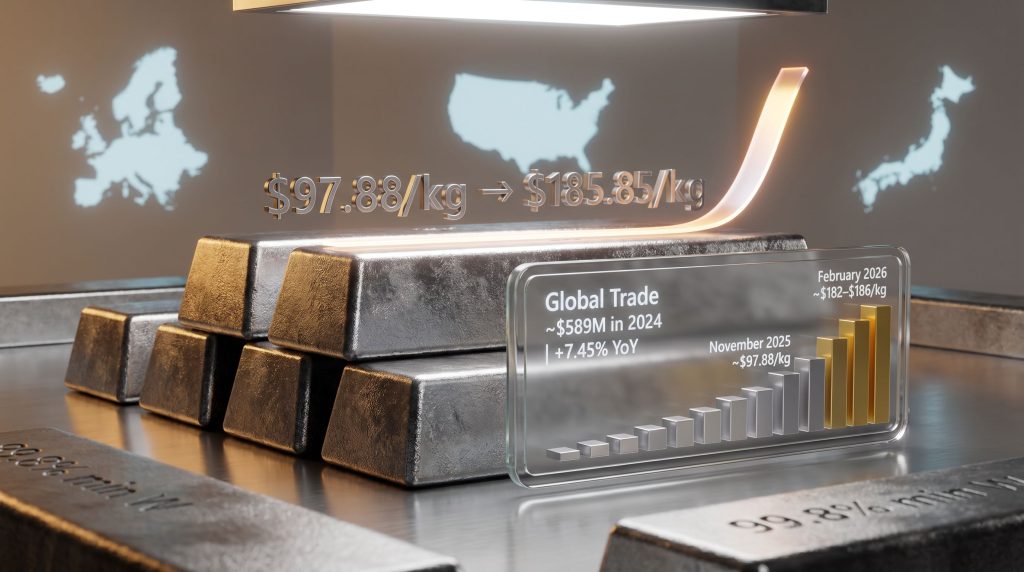
High-purity tungsten bar pricing underwent one of its most dramatic repricing events in recent memory during the period from late 2025 into early 2026:
| Period | Approximate Price (USD/kg) | Month-on-Month Change | Key Driver |
|---|---|---|---|
| November 2025 | ~$97.88 | Baseline | Pre-restriction market conditions |
| December 2025 | ~$128.03 | +30.8% | China export curb announcements |
| January 2026 | ~$135.45 | +5.8% | Supply chain adjustment |
| February 2026 | ~$182-$186 | +34-38% | Acute tightness, Western restocking |
Note: Data reflects 99.9% min W grade assessments used as a directional proxy for the proposed 99.8% min W benchmark. Figures are indicative and subject to revision. This does not constitute financial advice.
The price appreciation of nearly 90% in under four months exposed the absence of a formal finished metal benchmark with painful clarity. Buyers attempting to assess whether they were paying a fair price for physical material had no CIF anchor to reference, no weekly publication to consult, and no independent editorial process to detect outlier quotes. Furthermore, the defense metal supply risks emerging across other critical metals have reinforced how exposed Western supply chains remain without transparent pricing infrastructure.
Why Substitution Is Not a Near-Term Solution
Western buyers facing this supply squeeze cannot easily redirect purchasing away from Chinese-origin material. The structural barriers are significant:
- Mine production concentration: Global tungsten ore output remains overwhelmingly dominated by Chinese operations, with limited near-term capacity additions elsewhere
- Processing infrastructure: Smelting, chemical processing, and sintering facilities capable of producing high-purity unwrought bar to aerospace standards are concentrated in China and cannot be replicated at scale quickly
- Recycling limitations: Secondary recovery of tungsten from carbide scrap provides a partial supply offset but cannot absorb the full volume gap created by export restrictions
- Qualification timelines: Defence and aerospace end-users typically require new material sources to undergo qualification testing lasting months to years before commercial procurement can begin
Inside the Proposed Assessment: Specifications That Reflect Real Market Practice
Fastmarkets formally launched its consultation on the tungsten unwrought metal bar price assessment on April 8, 2026, with the consultation period subsequently extended to May 26, 2026, and a final decision expected by May 29, 2026. The specifications were developed to reflect actual transactional conditions in Western consuming markets.
Technical Specifications at a Glance
| Parameter | Specification |
|---|---|
| Full assessment name | Tungsten unwrought metal bar, 99.8% min W, spot price, CIF main ports Europe, US, Japan |
| Minimum purity | 99.8% tungsten (W) |
| Maximum oxygen content | 1,000 parts per million (ppm) |
| Minimum trade lot | 1 tonne |
| Delivery basis | CIF main ports: Europe, United States, Japan |
| Timing | Spot material arriving within three months |
| Pricing unit | USD per kilogram |
| Standard payment terms | 30 days (other terms normalised into the assessment) |
| Publication day and time | Every Friday, 2:00-3:00 pm London time |
| Market segment | Part of Fastmarkets' ores and alloys package |
Why 99.8% Purity and 1,000 ppm Oxygen?
The 99.8% minimum tungsten purity threshold is not an arbitrary specification. It reflects the quality floor for material used in aerospace, defence, and precision electronics applications, where even trace impurity levels can compromise performance characteristics such as density uniformity, high-temperature strength, and electrical conductivity.
The 1,000 ppm maximum oxygen tolerance addresses a specific contamination pathway relevant to powder metallurgy production. Tungsten metal produced via hydrogen reduction of APT carries residual oxygen that, if not adequately controlled, introduces porosity into sintered forms. For kinetic energy penetrators, radiation shields, and semiconductor interconnect targets, this is a critical performance parameter, not a secondary specification.
The CIF Architecture and What It Captures
The decision to price on a CIF basis to main ports in Europe, the United States, and Japan reflects where Western buying activity is concentrated and what those buyers actually need to know. A CIF assessment incorporates:
- The cost of the metal itself
- Insurance coverage for the shipment
- Freight charges from the point of origin to the named destination port
This stands in sharp contrast to EXW (Ex-Works) pricing, which reflects only the cost at the producer's facility, or FOB (Free on Board) pricing, which includes loading costs but excludes ocean freight and insurance. For a European aerospace manufacturer importing material from Asia, an EXW or FOB price is essentially meaningless without a separate freight and insurance calculation layered on top. A CIF assessment eliminates that calculation and provides a directly comparable landed cost.
How This Benchmark Sits Within the Tungsten Pricing Landscape
| Price Assessment | Product | Launch | Frequency | Delivery Basis |
|---|---|---|---|---|
| Tungsten concentrate | 50-70% WO₃ | December 2025 | Weekly | CIF global |
| Tungsten unwrought metal bar (proposed) | 99.8% min W | Proposed May 2026 | Weekly | CIF Europe/US/Japan |
| Ferro-tungsten | Various grades | Established | Periodic | Various |
| APT | Ammonium paratungstate | Established | Weekly | Various |
The progression from concentrate to finished metal bar coverage represents a deliberate effort to construct a complete price signal stack for the tungsten value chain. This enables market participants to track margins across production stages and identify where value is being captured or eroded under current supply conditions. In addition, the broader tungsten offtake agreements being structured by Western producers will benefit directly from a credible finished metal benchmark as a reference point for long-term contract pricing.
How Price Reporting Agencies Construct Credible Benchmarks
For market participants unfamiliar with the mechanics of price reporting agency methodology, understanding how an assessment is constructed is important for evaluating its reliability and usefulness.
The Data Collection and Normalisation Process
A PRA-led assessment operates fundamentally differently from exchange-traded price discovery. Rather than a central order book matching buyers and sellers, a PRA assessment aggregates market intelligence from multiple participants and applies editorial judgement to produce a representative price. The process typically involves:
- Data submission: Producers, traders, and consumers submit transaction data or market indications to pricing editors during a defined window
- Normalisation: Submitted data is adjusted to account for variations in payment terms, incoterms, lot sizes, and timing
- Editorial review: Pricing editors evaluate submissions for market representativeness, flag outliers, and cross-reference against corroborating market intelligence
- Assessment publication: A final assessed price is published at the specified time, accompanied by editorial context where relevant
- Methodology governance: Published methodology documents and stakeholder consultation processes provide transparency and accountability
Why Tungsten Is Well-Suited to PRA-Led Discovery
Tungsten is a thinly traded specialty metal with transaction frequencies far below those of base metals. This characteristic makes exchange-traded price discovery impractical. A weekly PRA assessment is calibrated to match the realistic pace of market activity, ensuring each data point is supported by sufficient market intelligence rather than extrapolated from sparse transaction records.
In opaque commodity markets, the PRA model provides the most practical mechanism for achieving price transparency. The alternative, bilateral negotiation without any benchmark reference, systematically disadvantages buyers relative to suppliers who have broader market visibility.
Governance and the Consultation Process
Fastmarkets' extended consultation period, running until May 26, 2026, reflects standard PRA governance practice. Formal consultation windows exist to:
- Allow market participants to assess whether specifications align with their actual trading activity
- Provide a channel for suggesting amendments before launch, reducing post-launch recalibration
- Build market confidence in the benchmark's representativeness prior to formal publication
- Enable participants to register as ongoing data submitters, strengthening the benchmark's statistical foundation
Participants may indicate confidentiality preferences when submitting feedback. Comments not marked as confidential may be made available to other stakeholders upon request, supporting the transparency principles that underpin PRA credibility.
The next major ASX story will hit our subscribers first
The Industries With the Most at Stake
Aerospace and Defence
Tungsten's physical properties make it genuinely irreplaceable in several defence and aerospace applications. The expanding role of tungsten in defence and aerospace procurement has further elevated the need for reliable finished metal price signals. With a density of approximately 19.3 g/cm³ (roughly 2.5 times that of steel) and a melting point near 3,422°C, tungsten has no commercially viable substitute in kinetic energy penetrator cores, radiation shielding assemblies, or high-temperature aerospace components.
Electronics and Semiconductor Manufacturing
Tungsten's role in semiconductor fabrication is less widely understood but equally critical. Its use as a contact fill material and interconnect layer in chip manufacturing creates structural demand that tracks the global semiconductor production cycle. Price volatility at the unwrought bar level affects the input cost structure for tungsten target manufacturers who supply the chip fabrication sector, with downstream implications for consumer electronics supply chains.
Industrial Tooling and Carbide Production
High-purity tungsten bar serves as the primary feedstock for tungsten carbide production, which dominates cutting tool, drilling, and wear-resistant applications in industrial manufacturing. Pricing disruptions at the unwrought bar level therefore propagate directly into carbide component costs, affecting capital equipment manufacturers, mining operations, and machining industries globally.
A Step-by-Step Guide to Engaging With the Consultation
Market participants who transact in, or have commercial exposure to, tungsten unwrought metal bar should consider active engagement with the consultation process. The process for engaging is structured as follows:
- Review the proposed specifications to determine whether the purity grade, oxygen tolerance, lot size, incoterm, and geographic scope reflect your actual trading activity or procurement requirements
- Assess your transaction data to determine whether your organisation has sufficient qualifying trades to function as a data submitter
- Prepare your feedback addressing specification accuracy, market representativeness, or structural modifications that would improve the benchmark's utility
- Submit comments before May 26, 2026 with the subject heading: re: tungsten unwrought metal bar, 99.8% min W, spot price, CIF main ports Europe, US, Japan, $ per kg
- Indicate confidentiality preferences clearly, since non-confidential comments may be made available to other stakeholders upon request
- Register as a data submitter to contribute to ongoing price discovery after the formal launch, strengthening the benchmark's representativeness over time
What This Benchmark Could Mean for Tungsten Market Infrastructure
The launch of a formal tungsten unwrought metal bar price assessment carries implications that extend well beyond weekly price publication.
Scenario Analysis: Where Prices Could Move From Here
| Scenario | Key Assumption | Likely Price Direction | Market Impact |
|---|---|---|---|
| Supply normalisation | China eases export restrictions; Western inventory builds | Moderate correction toward $130-$150/kg | Reduced urgency for alternative sourcing |
| Sustained restriction | Export controls remain or tighten further | Continued elevation above $180/kg | Accelerated Western mine investment |
| Demand shock | Defence procurement surge in NATO economies | Price spike beyond $200/kg | Benchmark adoption accelerates; financial hedging tools emerge |
| Recycling scale-up | Secondary tungsten recovery increases materially | Gradual softening over 2-3 years | Reduced Chinese supply leverage over time |
Disclaimer: The scenarios above are speculative projections based on publicly available market dynamics and should not be construed as investment advice or price forecasts. Actual market outcomes will depend on a range of factors that cannot be predicted with certainty.
The Foundation for Financial Risk Management
Formal price benchmarks are the prerequisite for financial risk management tools. Without a credible published reference price, index-linked contracts, financial swaps, or forward pricing agreements cannot function. The tungsten unwrought metal bar assessment could, over time, provide the reference point needed for these instruments to emerge, significantly improving the ability of Western manufacturers to hedge their tungsten cost exposure.
The parallel with rare earth elements is instructive. For years, the absence of formal rare earth price benchmarks systematically disadvantaged Western buyers relative to Chinese suppliers who controlled both production and market intelligence. The gradual formalisation of rare earth pricing contributed to better-informed procurement decisions and improved financing conditions for non-Chinese projects. A similar dynamic could unfold in tungsten if the benchmark achieves sufficient market adoption. Consequently, Fastmarkets' proposal to launch this price assessment represents a structural turning point for Western tungsten market participants.
Transparent Pricing as a Supply Chain Resilience Tool
Regulatory frameworks in the European Union and the United States have increasingly focused on critical mineral supply chain resilience. Formal price benchmarks for finished metal forms could support procurement policy design, inform strategic reserve decisions, and provide a basis for monitoring the cost impact of supply disruptions over time. This represents a longer-term institutional function that extends the benchmark's significance beyond commercial price discovery alone.
Frequently Asked Questions
What exactly is "unwrought" tungsten metal bar?
Unwrought tungsten refers to metal that has been processed from ore-derived intermediates into a consolidated metallic form through powder metallurgy and sintering, but has not yet been shaped or fabricated into finished components such as wire, rod, sheet, or machined parts. It represents the stage between refined metal powder and industrial end-products, serving as the primary input material for downstream fabricators.
Why does the 1,000 ppm oxygen limit matter?
Oxygen is a key impurity indicator in sintered tungsten bar. Elevated oxygen content typically signals incomplete reduction during powder processing or surface oxidation during handling, both of which introduce microstructural defects that degrade mechanical performance. The 1,000 ppm ceiling reflects the quality boundary between general-purpose material and the higher-purity specification required by aerospace, defence, and electronics applications.
How does a CIF price differ from what producers typically quote?
Producers based in China frequently quote prices on an EXW or FOB basis, reflecting costs only up to the factory gate or point of export. A Western buyer receiving an FOB China quote must independently calculate ocean freight, insurance, port handling, and import duties to determine their actual landed cost. A CIF assessment to main European, US, or Japanese ports bundles these cost layers into a single reference price, enabling direct comparison across suppliers and over time.
Why is the assessment published weekly rather than daily?
Tungsten unwrought metal bar is a specialty product with a relatively modest transaction frequency compared to base metals. Publishing daily would risk producing assessments based on insufficient data, reducing statistical reliability and increasing vulnerability to single-transaction distortions. A weekly cadence aligns with the realistic pace of market activity in this segment and ensures each assessment reflects a meaningful cross-section of market intelligence.
How does this assessment relate to APT and ferro-tungsten pricing?
APT is an intermediate chemical compound produced from tungsten concentrate and serves as the primary feedstock for tungsten metal powder production. Ferro-tungsten is a tungsten-iron alloy used primarily as an alloying agent in steel production. Neither product reflects the cost of producing, consolidating, and shipping high-purity metal bar to Western consumers. The unwrought bar assessment captures a distinct product at a later stage of the value chain, serving different end-markets and carrying different pricing determinants.
Readers seeking additional detail on price reporting methodology and assessment governance can access Fastmarkets' published methodology documentation at fastmarkets.com/methodology. This documentation covers the ores and alloys segment, including the principles applied to tungsten assessments.
Want to Track the Next Major ASX Mineral Discovery Before the Market Moves?
Discovery Alert's proprietary Discovery IQ model scans ASX announcements in real time, converting complex mineral data across 30+ commodities into clear, actionable insights for investors at every experience level — explore historic discoveries and their returns to see what's possible, then start a 14-day free trial at Discovery Alert to position yourself ahead of the next significant find.