July 26, 2026
When the Risk Premium Becomes the Price: Understanding Oil Markets Under Geopolitical Stress
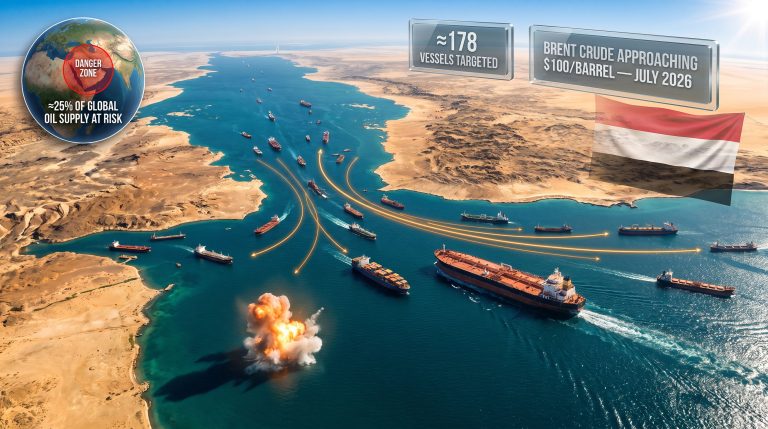
Commodity markets are built on the assumption that price discovery reflects reality. In practice, crude oil markets have long defied this principle during periods of geopolitical tension, pricing not what is happening to supply, but what might happen. This forward-looking sensitivity is what transforms a diplomatic statement into a three percent intraday price move, and it is precisely what is unfolding across global energy markets as U.S.-Iran negotiations fracture in 2026.
The oil supply risk premium from Iran tensions is not a new concept, but the current iteration carries structural features that distinguish it from prior geopolitical episodes. The shock is transmitting differently through the supply chain, creating a divergence between crude oil prices and refined product prices that is, in many respects, more economically significant than the headline Brent number itself.
When big ASX news breaks, our subscribers know first
What Separates Geopolitical Pricing From Fundamental Supply-Demand Economics
In a functioning commodity market, price reflects the balance between physical supply and physical demand. A geopolitical risk premium operates on a different logic entirely. It reflects the probability-weighted cost of a potential supply disruption rather than an actual one, and it can persist indefinitely as long as uncertainty remains elevated.
This distinction matters because it explains why oil can trade well above its fundamental clearing price without any barrels actually going missing. Buyers and traders embed the cost of insurance, route diversification, freight escalation, and demand-side planning adjustments into prices before any physical disruption materialises. As Naeem Aslam, Chief Investment Officer at Zaye Capital Markets, explained in a market analysis published via Rigzone on May 11, 2026, oil can move sharply even before physical supply data changes. Understanding crude oil price trends helps contextualise just how dramatically this dynamic plays out.
The asymmetry embedded in this pricing behaviour is critical. Undersupply creates immediate, cascading economic damage across transportation, manufacturing, logistics, and consumer spending. Oversupply, by contrast, is manageable over time through inventory drawdowns and production adjustments. Markets therefore price geopolitical risk on an asymmetric basis: the cost of underestimating disruption is far higher than the cost of overestimating it.
The result is a structural tendency for oil markets to embed a forward-looking premium during periods of geopolitical uncertainty, even when storage data, production figures, and demand indicators appear stable. This is not irrational behaviour; it is rational insurance.
The Strait of Hormuz: A Chokepoint That Prices Entire Energy Markets
Why Hormuz Carries Disproportionate Market Weight
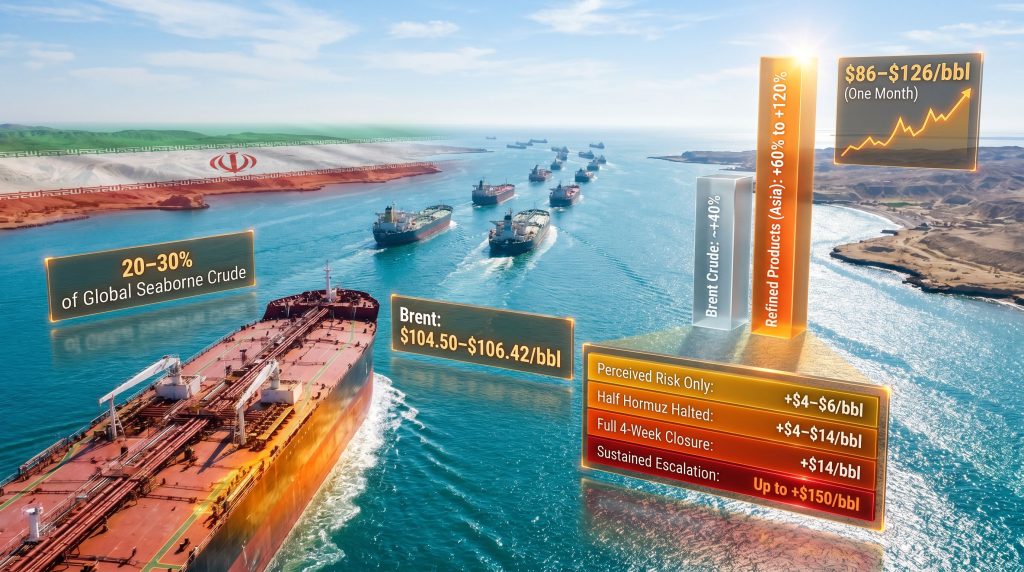
No single geographic feature shapes global energy pricing dynamics more powerfully than the Strait of Hormuz. Approximately 20 to 30 percent of global seaborne crude and refined product flows pass through this narrow waterway connecting the Persian Gulf to the Gulf of Oman. Around 19 percent of global liquefied natural gas exports also transit the same corridor, meaning a single disruption event can simultaneously tighten crude, product, and gas markets.
The Strait's strategic weight is amplified by the absence of fully adequate alternatives. Saudi Arabia's East-West Pipeline and the UAE's Habshan-Fujairah Pipeline provide partial bypass capacity, but neither system can fully absorb the volume of flows that transit Hormuz daily. Pipeline infrastructure requires time to reroute, lacks the flexibility of maritime logistics, and carries its own operational constraints.
Any credible threat to Hormuz transit, including naval exercises, proxy attacks on tankers, or blockade signalling, immediately elevates war risk insurance premiums for vessels operating in the Persian Gulf. Furthermore, this creates a secondary transmission mechanism: higher delivered costs for crude even when headline spot prices appear contained. For a broader perspective on these risks, Iran's conflict-driven oil supply disruption analysis provides additional context on how Hormuz vulnerabilities translate into market outcomes.
Disruption Scenarios and Their Estimated Price Impacts
The range of potential Hormuz disruption outcomes spans an enormous price spectrum, reflecting both the chokepoint's centrality and the difficulty of predicting the political and military dynamics of escalation:
| Disruption Scenario | Estimated Brent Price Impact |
|---|---|
| Perceived risk only, no physical supply loss | +$4 to $6 per barrel |
| Half of Hormuz flows halted for one month | +$4 to $14 per barrel |
| Full four-week closure accounting for pipeline offsets | +$14 per barrel |
| Sustained escalation or prolonged blockade | Potentially up to +$150 per barrel |
The table above illustrates a key insight: even in scenarios where no physical supply is lost, the risk premium itself adds several dollars per barrel to effective crude costs. This is the mechanism through which diplomatic statements, social media posts from world leaders, and proxy conflict activity translate directly into consumer fuel prices.
How U.S.-Iran Diplomatic Breakdown Repriced the Oil Supply Risk Premium
From Optimism Compression to Sharp Reversal
For a period prior to May 2026, market optimism around the possibility of a negotiated settlement between the United States and Iran had functioned as a natural suppressant of the geopolitical risk premium. As peace talks appeared to gain traction, traders who had built geopolitical risk positions began unwinding them, reducing exposure and allowing Brent crude to drift lower from its upper trading range.
This compression dynamic illustrates an underappreciated feature of how geopolitical risk is priced: the market does not require actual resolution to reduce the premium; it requires only credible progress toward resolution. Conversely, the reversal of that progress can reprice the premium faster than it was originally built.
On May 10, 2026, U.S. President Donald Trump posted on his Truth Social account that he had reviewed Iran's negotiating response and found it completely unacceptable. Iran's embassy in Yerevan, Armenia responded on X, clarifying that Iranian decisions are driven by national interests and national dignity rather than by external approval or disapproval. According to Yahoo Finance reporting, oil prices climbed sharply in the immediate aftermath of Trump's rejection.
The market response was immediate. Brent crude rose more than three percent, trading at approximately $104.50 per barrel on May 11, 2026, according to Rigzone's reporting. Aslam at Zaye Capital Markets noted that earlier optimism around a peace path had pushed prices lower, but the diplomatic rejection reversed part of that move and reminded traders that oil is still being priced more by geopolitical risk than by normal demand trends. The trade war oil impact on sentiment has similarly demonstrated how political developments can override supply-demand fundamentals in the short term.
The Headline Sensitivity Window: $86 to $126 Per Barrel in One Month
Perhaps the most striking illustration of current market conditions is the trading range Brent crude has occupied over the preceding month: approximately $86 to $126 per barrel. This range, spanning $40 per barrel, reflects a market that is not anchored to fundamental supply-demand equilibrium but is instead oscillating around a geopolitical sentiment cycle.
Every Iran-related headline, every tanker movement report, every shift in diplomatic tone is capable of moving crude through several dollars of this range within hours. Aslam specifically identified the variables oil prices are likely to track: geopolitical developments, dollar strength, tanker movement data, and supply guidance from major producers. He identified $100 per barrel as the critical threshold for Brent, noting that sustained trading above that level signals geopolitical risk as the dominant pricing variable, while de-escalation or demand deterioration could unwind the premium rapidly.
The Largest Supply Disruption on Record: Why Crude Prices Tell an Incomplete Story
J.P. Morgan's Framing of the Shock's True Scale
One of the most analytically significant contributions to understanding the current energy market environment comes from J.P. Morgan's global commodities strategy team, led by Natasha Kaneva. In a report circulated in mid-May 2026, Kaneva's team posed a question that reframes the entire pricing debate: how should markets interpret Brent averaging around $100 per barrel in the two months since the conflict's onset, given that the disruption may represent the largest supply shock on record?
The J.P. Morgan team's answer challenges conventional interpretations. Rather than reading the $100 average as evidence of market complacency or limited disruption impact, their analysis concludes that the shock's scale is so large that the crude market alone cannot absorb it. The team's precise framing was that there is simply not enough elasticity on the crude side of the system to accommodate a disruption of this magnitude.
The implication is counterintuitive: a contained crude price response during an historically large supply shock may not signal stability, but rather the redirection of adjustment pressure toward a different part of the energy value chain.
The Downstream Transmission Mechanism: Where the Real Shock Is Being Felt
The J.P. Morgan analysis identifies the refinery sector as the primary transmission channel for the current disruption. When crude availability tightens, refiners face a binary choice: pay elevated prices for available crude or cut processing rates. Across Asia and Europe, refiners have been forced into the latter option at historically large scale.
- Refinery run cuts in March 2026: approximately 2.1 million barrels per day
- Refinery run cuts in April 2026: approximately 3.8 million barrels per day
- Combined March-to-April escalation in run cuts represents a substantial acceleration in downstream adjustment
- Simultaneously, the market has lost an estimated 4.7 million barrels per day of refined product exports from the Middle East itself
The combined effect is a tightening not just in crude balances but in the availability of the fuels that consumers and industries actually purchase: gasoline, diesel, jet fuel, liquefied petroleum gas, and naphtha. These are the products that power road transport, aviation, shipping, heating, and petrochemical manufacturing.
Refined Products Are Repricing Faster Than Crude
The divergence between crude and refined product price performance from January through April 2026 is one of the most important and underreported aspects of the current supply shock:
| Asset Class | Price Increase (January to April 2026) |
|---|---|
| Brent Crude | Approximately +40% |
| Refined Products in Asia | +60% to +120% |
Products are repricing at 1.5 to 3 times the pace of crude, and the J.P. Morgan team notes that refined products have, to date, shouldered twice the adjustment burden. The practical significance of this divergence is substantial: consumers do not purchase crude oil. They purchase fuels, and it is the refined product market where the economic impact of this disruption is being transmitted to households, businesses, airlines, and freight operators.
The J.P. Morgan team's forward scenario suggests this pattern could continue. In their analysis, crude could plausibly stabilise around $100 per barrel even as product crack spreads widen sharply, creating conditions where the next phase of the shock resembles a refining and end-user fuel crunch more than a classic crude price spike. This is a structurally different type of energy crisis, one that headline crude prices will not fully capture. Consequently, monitoring WTI and Brent futures alongside refined product spreads has become essential for a complete market picture.
Macro Data Is Sending Conflicting Demand Signals
Labour Market Strength Supporting the Consumption Baseline
While geopolitical risk dominates oil pricing in the short term, macro data shapes the demand half of the equation and introduces scenarios where the risk premium's upside becomes capped by deteriorating consumption fundamentals. The most recent U.S. economic releases present a genuinely split picture. On the labour market side, conditions remain stronger than anticipated:
- Nonfarm payrolls rose by 115,000, significantly exceeding the consensus estimate of 65,000
- Unemployment held steady at 4.3 percent
- Average hourly earnings rose 0.2 percent month on month
- Annual wage growth stood at 3.6 percent
Aslam characterised these figures as supportive of oil demand, noting that they demonstrate an economy still capable of sustaining driving, freight, air travel, logistics, and industrial fuel consumption. Strong employment typically anchors consumer spending on transport-related energy products.
Consumer Sentiment and Inflation Expectations: A Warning Signal
The consumer confidence picture, however, tells a different story. Preliminary consumer sentiment fell to 48.2 from a prior reading of 49.8, a level that signals meaningful pessimism about economic conditions. One-year inflation expectations remain elevated at 4.5 percent, while longer-run expectations sit at 3.4 percent.
| Economic Indicator | Reading | Oil Demand Implication |
|---|---|---|
| Nonfarm Payrolls | +115,000 (beat estimate) | Bullish, supports fuel consumption |
| Unemployment Rate | 4.3% stable | Neutral to bullish |
| Consumer Sentiment | 48.2 declining | Bearish, signals demand vulnerability |
| One-Year Inflation Expectations | 4.5% elevated | Bearish, expensive fuel may slow consumption |
| Annual Wage Growth | 3.6% | Mildly bullish |
The analytical tension between these indicators is real and unresolved. Strong labour markets support fuel consumption through employment income and business activity. But weak consumer confidence and persistent inflation expectations introduce the possibility that elevated fuel prices eventually become self-limiting, reducing demand enough to erode the geopolitical risk premium from below.
The International Energy Agency has previously flagged the potential for elevated fuel prices to drag on demand by approximately 80,000 barrels per day in 2026. If sentiment weakness translates into measurable demand destruction, the ceiling on the risk premium could prove lower than supply-side dynamics alone would suggest.
The next major ASX story will hit our subscribers first
Forces Working Against the Risk Premium
Strategic Reserve Releases and Spare Capacity as Partial Offsets
The current supply disruption has not gone uncontested. U.S. Strategic Petroleum Reserve releases totalling approximately 172 million barrels, combined with coordinated releases from allied nations, have provided a partial buffer against physical supply tightening in crude markets. These releases are a deliberate policy tool designed to moderate the pace of price escalation rather than eliminate it.
OPEC's market influence through spare capacity continues to exist as a theoretical ceiling on extreme price spikes. However, the effectiveness of spare capacity as a market stabilisation tool is fundamentally limited when the disruption pathway runs through a geographic chokepoint rather than through a shortfall in production. Spare production capacity in Saudi Arabia or the UAE does not resolve a Hormuz transit problem; the barrels still need to reach buyers via the same congested waterway.
Multi-Actor Conflict Complexity and Its Structural Implications
The current geopolitical environment involves multiple overlapping disruption vectors that collectively make clean de-escalation scenarios harder to achieve:
- Houthi activity in the Red Sea continues to function as a secondary disruption vector, adding freight cost pressure to global shipping lanes independent of Hormuz tensions
- Potential strategic alignment between China and Iran introduces uncertainty about sanctions enforcement and the flow of Iranian crude to key consuming nations
- Multi-actor conflict environments create a situation where progress on one diplomatic front does not necessarily resolve pressure on another
These factors compound the difficulty of achieving the rapid risk premium unwind that would occur under a simple two-party de-escalation scenario. According to Wood Mackenzie's Middle East conflict analysis, the more actors involved in sustaining conflict dynamics, the longer any resolution process tends to require. In addition, approaches to commodity volatility hedging have become increasingly relevant for market participants navigating these conditions.
Three Scenarios for How the Oil Risk Premium Evolves
Scenario 1: Escalation Deepens
If diplomatic channels collapse entirely and proxy conflict activity intensifies, Hormuz transit disruptions could shift from theoretical to operational. Under this scenario, Brent crude would likely sustain above $110 per barrel while refined product prices continue to outpace crude. Global inflationary pressure would accelerate, placing central banks in a stagflationary dilemma where fighting inflation requires rate increases that simultaneously suppress growth.
Scenario 2: Prolonged Stalemate (Base Case)
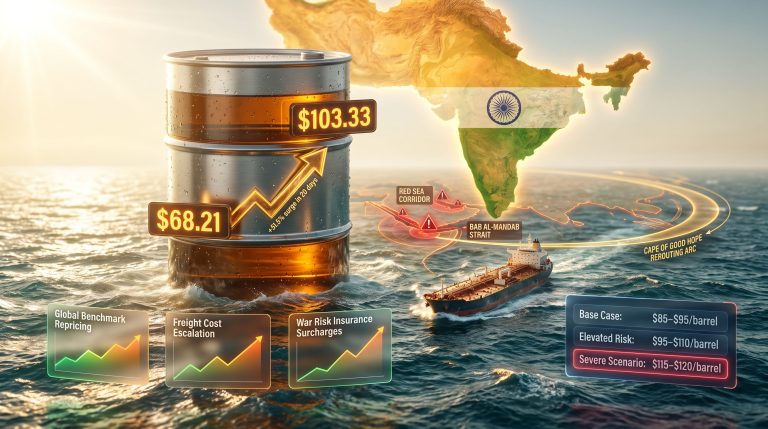
The most probable near-term outcome involves continued elevated tension without a major physical supply disruption materialising. Brent would oscillate in the $95 to $110 per barrel range, driven by headline flow rather than fundamental shifts. Refined product tightness would persist, consumer fuel costs would remain elevated, and demand destruction would gradually build, eventually capping the risk premium's upside.
Scenario 3: De-escalation and Risk Premium Unwind
If credible diplomatic progress emerges, the risk premium could unwind rapidly. Brent could retreat toward the $85 to $90 per barrel range as traders who rebuilt geopolitical risk exposure reverse those positions. Refinery run rates would recover, product crack spreads would normalise, and consumer sentiment would stabilise modestly.
Critically, the asymmetry of outcomes matters for investors. Escalation scenarios produce larger price spikes than de-escalation produces price declines, because the risk premium buildup occurs faster than its unwinding during periods of genuine optimism. This asymmetry means energy exposure carries a structurally positive skew as long as the conflict remains unresolved.
Frequently Asked Questions: Oil Supply Risk Premium and Iran Tensions
What is an oil supply risk premium?
An oil supply risk premium is the additional price crude oil commands above its fundamental supply-demand value, reflecting market concern that geopolitical events could disrupt physical supply. It can persist even when no disruption has occurred, as long as uncertainty about future supply availability remains elevated.
Why are refined product prices rising faster than crude?
Because the supply shock is being absorbed downstream rather than at the crude level. Refinery run cuts across Asia and Europe totalling approximately 5.9 million barrels per day between March and April 2026, combined with the loss of approximately 4.7 million barrels per day of Middle Eastern refined product exports, have created a tighter market for usable fuels than for crude itself. The J.P. Morgan global commodities team has characterised this as the primary transmission mechanism for the current shock.
Could oil prices fall sharply if peace talks succeed?
Yes. The risk premium is structurally reversible. Credible diplomatic progress would likely trigger rapid position unwinding among traders who rebuilt geopolitical risk exposure during the optimism window's reversal. The speed of any price decline would depend on the credibility and durability of any agreement reached.
What does U.S. economic data mean for oil prices during a geopolitical crisis?
Macro data shapes the demand side of the pricing equation. Strong labour market readings support fuel consumption expectations and lend fundamental backing to elevated prices. Declining consumer sentiment and elevated inflation expectations introduce demand destruction risk that can cap the risk premium's upside. During active geopolitical crises, supply-side risk typically dominates short-term pricing, but sustained demand deterioration can erode the premium from below over time.
The Structural Shift in How Energy Supply Chains Are Being Priced
The oil supply risk premium from Iran tensions in 2026 represents more than a headline-driven crude price event. The downstream transmission of the shock into refined products, the divergence between crude and fuel price performance, and the J.P. Morgan team's framing of the disruption as potentially the largest supply shock on record collectively point to a market that is undergoing a structural repricing of geopolitical risk across the entire energy value chain.
For investors, the key analytical question has shifted from whether a risk premium exists to how durable it will prove as diplomatic, military, and macroeconomic dynamics continue to evolve. For consumers and businesses, the more immediately relevant question is not what Brent crude is trading at, but what refined products are costing, and the data increasingly suggests that gap between crude prices and fuel prices will remain the defining feature of this energy market cycle.
This article draws on market analysis published by Rigzone on May 11, 2026, expert commentary from Naeem Aslam at Zaye Capital Markets, and commodity strategy research from J.P. Morgan's global commodities team. All forecasts, scenario projections, and price estimates referenced in this article represent analytical views and market opinions only. They do not constitute financial advice. Commodity markets are inherently unpredictable, and actual price outcomes may differ materially from any scenario described above. Readers should conduct their own due diligence before making investment decisions.
Want to Stay Ahead of Major Commodity Discoveries Driving Market Moves?
While geopolitical risk premiums dominate oil markets, significant mineral discoveries on the ASX can generate equally transformative returns — and Discovery Alert's proprietary Discovery IQ model delivers real-time alerts the moment these opportunities emerge, turning complex data across 30-plus commodities into clear, actionable insights. Explore historic discovery returns on Discovery Alert's dedicated discoveries page and begin a 14-day free trial to position yourself ahead of the broader market.