May 11, 2026
The Governance Gap at the Heart of Europe's Critical Minerals Crisis
Across the global mining industry, a quiet but consequential shift has been underway for several years. The strategic calculus around which minerals matter most has been fundamentally rewritten, not by geologists or commodity traders, but by defence planners, export control architects in Beijing, and a new generation of industrial policymakers in Washington. The EU critical minerals supply chain antimony Slovakia dynamic now sits at the centre of a far more urgent conversation: which nations control the materials that keep weapons systems functional, communications infrastructure operational, and national defence capabilities intact.
Antimony sits at the heart of this reclassification. It is not a mineral that commands headlines the way lithium or cobalt did during the battery metals supercycle. It does not appear in consumer electronics. Its annual global demand is modest by industrial standards. And yet, among defence procurement officials, metallurgists, and geopolitical analysts, antimony has rapidly acquired a reputation as one of the most strategically sensitive materials on the planet.
The combination of extreme supply concentration, irreplaceable military utility, and growing demand from both defence and clean energy systems has created precisely the kind of vulnerability that is easiest to ignore until it is too late to address. The antimony shortage risks this creates for Western nations are becoming increasingly difficult to downplay.
For the European Union, that moment of reckoning is now arriving.
When big ASX news breaks, our subscribers know first
Why Antimony's Strategic Value Cannot Be Measured in Volume Alone
Understanding why antimony matters requires moving beyond the conventional framework of commodity analysis. Unlike most industrial metals, antimony's strategic weight is not driven by the volume of demand it generates. Defence applications account for up to 15% of total global antimony consumption, a meaningful but minority share that would appear unremarkable in isolation. What makes that 15% decisive is the nature of the applications it supports.
What Does Antimony Actually Do for Defence?
Antimony's military applications are foundational to modern capability across every NATO member state. Antimony compounds are essential inputs in munitions manufacturing, night vision goggle components, and infrared sensor systems. An armed force without functioning night vision or infrared targeting equipment operates at a catastrophic disadvantage in contemporary conflict environments.
The civilian applications of antimony, which include fire retardants, nuclear systems, and renewable energy components, are similarly difficult to substitute at scale.
Antimony exemplifies a category of materials where modest volume requirements generate disproportionate strategic consequences. It is not the quantity consumed that determines strategic risk; it is the irreplaceability of the function it performs.
This dual-use profile creates an asymmetry that conventional commodity pricing fails to capture. Antimony trades as an industrial metal but functions as a defence-critical material. When supply chains are intact, the distinction barely registers. When they fracture, the consequences cascade directly into military readiness and national security infrastructure.
A key but less widely understood characteristic of antimony is that it often occurs alongside gold deposits. This geological association means that primary antimony projects can carry dual revenue potential, an attribute that is financially significant but rarely foregrounded in policy discussions focused on supply security rather than project economics.
The Architecture of Global Supply Concentration
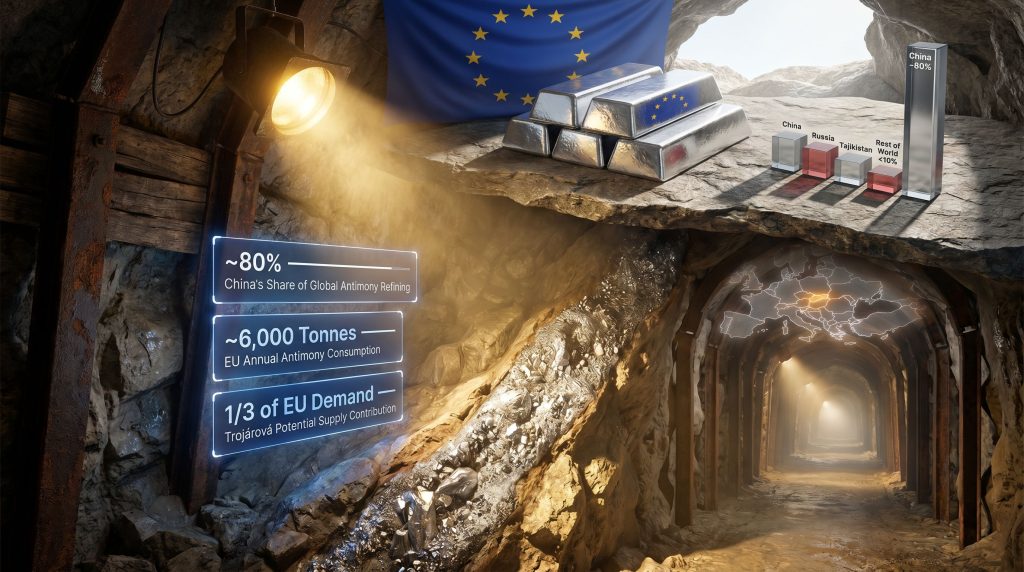
The geographic distribution of antimony supply is among the most concentrated of any industrial mineral. Production is overwhelmingly centred in China, Russia, and Tajikistan, three nations whose current geopolitical relationships with the European Union range from complicated to adversarial. Beyond these three, the rest of the world collectively accounts for a small fraction of primary output.
| Geography | Primary Role | Concentration Level |
|---|---|---|
| China | Mining and refining | Approximately 80% of global processing capacity |
| Russia | Primary mining | Significant producer |
| Tajikistan | Primary mining | Significant producer |
| Rest of World | Mining and limited processing | Less than 10% combined |
China's dominance, however, does not end at the mine gate. It extends into refining and downstream processing, and this is where the strategic exposure becomes most acute. Sabrina Schulz, Germany Director at the European Initiative for Energy Security, has characterised this clearly: China controls almost 80% of global antimony processing capacity, making it pivotal not only as a source of raw material but as the dominant hub for converting ore into usable finished metal.
This distinction matters profoundly for supply chain policy. A European mining project that produces antimony ore but sends it to China for refining has not achieved supply independence. It has merely added one domestically controlled step to a supply chain that still terminates in Chinese-controlled processing infrastructure. True supply chain resilience requires both extraction and refining capacity within allied jurisdictions.
China's imposition of sweeping export controls on critical minerals and rare earths in the period spanning 2024 to 2025 brought this vulnerability into sharp relief. Furthermore, these measures demonstrated Beijing's willingness to deploy resource access as a geopolitical instrument, fundamentally altering the risk calculations of every Western industrial and defence planner who relies on Chinese-controlled supply chains.
The United States imports approximately 20,000 to 25,000 tonnes of antimony annually, the majority of which has historically originated from Chinese-controlled sources. Europe's annual consumption sits at approximately 6,000 tonnes per year. Both figures represent meaningful exposure to a supply chain that Beijing now controls with increasing deliberateness. The World Economic Forum's analysis of antimony supply has similarly highlighted this concentration risk as a major concern for allied nations.
How Europe's Policy Framework Left Defence-Critical Minerals Behind
The European Union's formal response to critical minerals vulnerability was encoded in the European Critical Raw Materials Act of 2023. The legislation established binding targets that were, on paper, ambitious: extract at least 10% of annual consumption of key materials domestically, and process at least 40% of them within the bloc.
In practice, the CRMA's implementation trajectory has been shaped by the political and industrial priorities that dominated its drafting. Battery metals, specifically lithium, cobalt, and nickel, were the conceptual centre of gravity. The Act was designed and enacted during the peak of the electric vehicle supply chain anxiety cycle, when battery feedstock security dominated policy discourse. Defence-relevant minerals including antimony, gallium, and germanium were not positioned as primary targets in the original framework.
The consequence has been a policy blind spot with material implications. While global competitors, including the United States, have pivoted to prioritise minerals with direct military utility, Europe's institutional machinery has continued to be oriented toward the battery metals framing that defined the political moment of 2023. Furthermore, Europe's critical minerals supply chain has consequently developed significant structural gaps in precisely the minerals that matter most for defence.
Where Has European Finance Fallen Short?
The financing gap is equally pronounced. Germany operates a dedicated raw materials fund capitalised at €1 billion (approximately $1.2 billion USD). As of mid-2026, that fund has supported only two projects, a dispiriting conversion rate that reflects the qualification barriers and administrative complexity that characterise the instrument.
Companies attempting to access European strategic finance describe an environment where the barriers to qualification frequently exceed the barriers to simply seeking private capital, even when private capital markets are themselves unreceptive to small-cap critical minerals projects.
The situation in Germany illustrates a wider EU problem: there is still no consensus between the economy ministry, the chancellery, and the foreign ministry about what a de-risking strategy in critical minerals actually requires in practice.
This institutional fragmentation is not a minor procedural obstacle. It represents a structural incapacity to mobilise capital and political will at the speed demanded by geopolitical competition. Frank Hartmann, the official responsible for Asia at the German Foreign Ministry, conveyed the urgency of this problem at a March 2026 event in Berlin. His assessment was that Europe is operating too slowly and at too limited a scale, and that without a genuine ten-year investment commitment backed by real capital, the bloc risks becoming permanently entrenched in a dependency that its stated policies are designed to eliminate.
By comparison, US bilateral deals with the same producer nations that European member states are approaching tend to be larger in funding scope and faster in operational timelines. The US government's investment arm committed $5 million to restart a dormant antimony mine in Northern Macedonia in April 2026, a concrete demonstration of capital deployment that EU institutions have not matched. The challenge of European critical raw materials supply is, however, increasingly acknowledged at the highest institutional levels.
Slovakia's Trojárová Project: A Cold War Asset for a New Geopolitical Era
Few examples illustrate Europe's critical minerals execution gap as clearly as the Trojárová antimony project in southwestern Slovakia. The deposit sits in the Little Carpathians, a wooded range of hills near Bratislava, in the vicinity of the town of Pezinok. Its origins are Cold War-era: Soviet geological surveys in the 1980s identified a significant antimony seam, and Soviet engineers developed the site into one of Europe's most consequential primary antimony deposits.
The physical legacy of that Soviet-era development remains intact:
- 1.7 kilometres of underground workings extending into the hillside
- 63 historical drill holes completed during the 1980s and 1990s
- An existing processing facility located on-site
When the Iron Curtain fell, the project was abandoned. For more than three decades, this geological resource sat dormant despite representing a potentially transformative asset for European supply chain independence. Canada-based Military Metals Corp acquired the project approximately two years ago and has been developing the case for a European-backed restart.
What Could Trojárová Supply to Europe?
The supply potential is significant. If reactivated, Trojárová is estimated to be capable of supplying approximately one-third of Europe's annual antimony consumption against a continental baseline of roughly 6,000 tonnes per year. Under a funded development scenario, the project could reach operational status within two to three years, a timeline that is unusually short for a greenfield mining development, primarily because the Soviet-era infrastructure substantially reduces the pre-production capital and time requirements.
The proposed supply chain model has two potential configurations:
- On-site ingot production for direct delivery to European defence clients, bypassing Chinese refining infrastructure entirely
- Ore or concentrate shipment to smelting partners in Germany and Sweden to establish a fully EU-internal processing chain from mine to finished metal
Both pathways would reduce or eliminate Europe's dependence on Chinese processing capacity for this mineral. However, neither can be executed without substantial capital and institutional commitment that has not yet been secured.
The Financing Bottleneck: Why Good Geology Is Not Enough
The Trojárová project's geological credentials are well established. Its infrastructure inheritance reduces development risk. Its proximity to Central European industrial corridors improves logistics economics. And its supply potential addresses a documented strategic vulnerability in the EU critical minerals supply chain antimony Slovakia context.
None of this has translated into a binding offtake agreement or sufficient development capital. Military Metals Corp, the project's owner, operates with a market capitalisation of under $30 million, an insufficient financial base to independently finance a mine restart at the required scale. The company is actively seeking institutional partners and European government engagement, but the response to date has been limited.
Several structural factors explain this disconnect:
-
Price volatility as a financing deterrent: Critical minerals markets are characterised by severe price cycles. The lithium market serves as a cautionary precedent, where multiple major projects stalled mid-development when commodity prices corrected sharply. Institutional investors have absorbed that lesson and apply elevated risk premiums to critical minerals projects without government-backed price guarantees.
-
Qualification barrier asymmetry: The financing instruments that do exist within European frameworks, including Germany's raw materials fund, impose qualification criteria that are difficult for small-capitalisation junior mining companies to satisfy. The result is a structural mismatch between the types of projects that need capital and the types of entities that qualify for it.
-
Absent offtake anchor: Without a long-term purchase agreement from a major buyer, typically a defence procurement agency or an industrial end-user with sovereign backing, lenders will not provide project finance at commercially viable terms.
-
Refining dependency even post-production: Because China controls approximately 80% of global antimony refining capacity, a producing mine in Slovakia without domestic EU smelting capacity would still require Chinese processing for a proportion of its output. This residual dependency limits the strategic value proposition that European institutional buyers would otherwise be willing to pay a premium to secure.
The next major ASX story will hit our subscribers first
The US-EU Accord and the Price Floor Mechanism
The April 2026 US-EU critical minerals coordination accord represents a meaningful shift in the diplomatic and institutional architecture surrounding European supply chain policy. The agreement was motivated in part by European anxiety about being excluded from any bilateral resource understanding that US President Donald Trump might reach with China during his upcoming Beijing summit.
The accord's most consequential mechanism is the proposed price floor system for critical mineral producers. A price floor operates as a minimum guaranteed price for a commodity, designed to prevent Chinese state-subsidised production from undercutting Western-backed projects during periods of deliberate market flooding. For projects like Trojárová, a credible price floor guarantee would fundamentally change the financing calculus. It would:
- Provide a revenue floor that supports project finance underwriting
- Reduce the commodity price risk premium that institutional lenders currently apply
- Enable European defence procurement agencies to justify long-term supply commitments at bankable price levels
- Create a competitive framework within which Chinese market manipulation is partially neutralised
EU member states have expressed hesitancy about price floor participation, citing sovereignty concerns and state-aid regulatory constraints. However, the trajectory of events may ultimately leave limited alternatives. As US capital continues to flow into European-adjacent antimony assets, and as Chinese export controls tighten further, the cost of non-participation in the US-led framework will become increasingly visible. Bloomberg's recent coverage of the US-China rivalry over critical minerals underscores just how much pressure Europe faces to act decisively.
Three Futures for EU Antimony Supply Security
The trajectory of the EU critical minerals supply chain antimony Slovakia will be determined by institutional choices made in the next two to three years. Three distinct scenarios frame the range of possible outcomes:
Scenario A: Continued Institutional Inertia
No binding offtake is secured for Trojárová or comparable EU assets. Germany's raw materials fund remains underdeployed. The CRMA mandate is not expanded to explicitly cover defence-relevant minerals. Europe remains structurally exposed to Chinese export control escalation, with no domestic antimony production buffer and complete dependence on Chinese refining infrastructure.
Scenario B: Bilateral US-EU Co-Investment
Joint funding mechanisms provide capital for brownfield project restarts. Price floor guarantees reduce private sector financing risk to bankable levels. EU defence procurement agencies commit as anchor offtake partners. Projects with inherited infrastructure, including Trojárová, reach production within three to five years. The supply chain remains partially dependent on non-EU smelting but achieves meaningfully reduced exposure to Chinese-controlled supply.
Scenario C: Full EU Industrial Strategy Integration
The CRMA mandate is formally expanded to include defence-relevant minerals including antimony, gallium, and germanium. EU strategic fund capital is deployed directly into upstream mining and domestic refining infrastructure. Central and Eastern Europe, and Slovakia in particular, is designated as a priority supply corridor under EU industrial policy. A full supply chain is established: Slovak mining feeding into German and Swedish smelting, with direct delivery to EU defence clients.
The World Economic Forum's November 2025 analysis identified Central and Eastern Europe, and Slovakia specifically, as a high-priority region for antimony supply diversification. The binding constraint is not geological but institutional: the absence of coordinated upstream capacity development backed by long-term commitment.
The distance between Scenario A and Scenario C is not primarily a function of geological endowment or project readiness. It is, consequently, a function of institutional architecture, capital mobilisation capacity, and political will.
What a Credible EU Response Actually Requires
Thomas Hüser, Chairman of Military Metals Corp and a former Glencore manager, has stated that what Europe lacks is not ambition but execution. This framing is accurate and diagnostic. The EU has produced strategic documents, enacted legislation, and articulated supply chain objectives that are, on paper, coherent. The gap between those stated intentions and operational outcomes reflects a set of specific institutional failures that can be addressed with targeted policy interventions.
A credible EU response to antimony supply chain vulnerability would need to incorporate the following structural elements:
-
CRMA mandate expansion: Formally extend the European Critical Raw Materials Act to explicitly designate defence-relevant minerals, including antimony, gallium, and germanium, as priority materials subject to the same extraction and processing targets as battery metals.
-
Long-term offtake frameworks: Establish structured, multi-year purchase agreements between EU defence procurement bodies and domestic or allied mining projects. Without sovereign offtake anchors, private project finance cannot be secured at viable terms.
-
Reduced qualification barriers: Redesign the qualification criteria for EU strategic finance instruments to accommodate the financial profile of junior mining companies, which are the most likely developers of brownfield assets like Trojárová.
-
Matched bilateral commitments: Scale EU memoranda of understanding with producer nations to match US equivalents in funding scope and operational timelines, ensuring that European diplomatic engagement translates into actual capital deployment.
-
Domestic refining investment: Address the refining dependency directly by investing in smelting capacity in Germany, Sweden, or other EU jurisdictions capable of processing antimony concentrate, eliminating the residual dependence on Chinese infrastructure even after domestic mining is established.
-
Ministerial coordination mechanisms: Establish formal interagency coordination frameworks at the member state level to resolve the administrative deadlocks that currently prevent coherent national de-risking strategies from being formulated, let alone executed.
Key Data: EU Antimony Supply Chain at a Glance
| Metric | Data Point |
|---|---|
| China's share of global antimony refining | Approximately 80% |
| Defence share of global antimony demand | Up to 15% |
| US annual antimony demand | 20,000 to 25,000 tonnes |
| EU annual antimony consumption | Approximately 6,000 tonnes |
| Trojárová potential supply contribution | Approximately one-third of EU annual demand |
| Underground workings at Trojárová | 1.7 kilometres |
| Historical drill holes on site | 63 (completed 1980s to 1990s) |
| Estimated time to production (funded scenario) | 2 to 3 years |
| Germany's raw materials fund size | €1 billion (approximately $1.2 billion USD) |
| Projects supported by Germany's fund to date | 2 |
| US investment in Northern Macedonia antimony restart | $5 million |
| Military Metals Corp market capitalisation | Under $30 million |
Frequently Asked Questions: EU Critical Minerals, Antimony, and Slovakia
What makes antimony a defence-critical mineral?
Antimony compounds are essential inputs in munitions production, night vision goggle assemblies, and infrared sensor systems. These applications represent up to 15% of total global demand and are extremely difficult to substitute with alternative materials. The combination of defence utility and extreme supply concentration in geopolitically hostile jurisdictions creates a strategic risk profile that distinguishes antimony from most conventional industrial metals.
Why is Slovakia significant for the EU antimony supply chain?
Slovakia hosts one of Europe's most significant known primary antimony deposits in the Little Carpathians region. The Trojárová site near Pezinok carries inherited Soviet-era infrastructure including 1.7 kilometres of underground workings and an on-site processing facility, substantially reducing the capital cost and timeline required to bring it into production. If developed, the project could supply approximately one-third of Europe's annual antimony consumption of around 6,000 tonnes.
What is the European Critical Raw Materials Act and what does it cover?
The CRMA, enacted in 2023, established binding targets requiring the EU to extract at least 10% and process at least 40% of its annual consumption of designated critical raw materials domestically. The Act's initial implementation focus centred on battery metals including lithium, cobalt, and nickel. Antimony and other defence-relevant minerals including gallium and germanium were not explicitly included in the original priority framework, a gap that is increasingly recognised as a policy vulnerability.
Why does China's control over antimony refining matter even if Europe develops domestic mines?
Because approximately 80% of global antimony processing capacity is located in China, a European mine producing raw ore or concentrate without access to domestic EU refining infrastructure would still depend on Chinese smelting to deliver finished metal. This means upstream extraction alone does not constitute genuine supply chain independence. Both mining and refining capacity must exist within allied jurisdictions to eliminate the strategic vulnerability.
What is a critical minerals price floor and how would it help European projects?
A price floor mechanism establishes a minimum guaranteed price for a commodity, protecting producers from being undercut by state-subsidised competitors engaged in deliberate below-cost pricing. For European antimony projects, a credible price floor would reduce commodity price risk to levels that support commercial project finance, enable long-term offtake contracts, and insulate Western-backed producers from Chinese market manipulation strategies.
What are the primary obstacles preventing Trojárová from reaching production?
The main barriers are financial rather than geological. Military Metals Corp, the project's owner, operates with a market capitalisation under $30 million and requires substantial external capital to fund a mine restart. No binding offtake agreement has been secured from a European buyer or government entity. Private capital markets apply elevated risk premiums to critical minerals projects without sovereign backing. Furthermore, the residual dependence on Chinese refining infrastructure, absent domestic EU smelting capacity, limits the strategic value that European institutional buyers would otherwise prioritise.
Europe's Mineral Vulnerability Is a Governance Problem, Not a Geology Problem
The evidence assembled around the EU critical minerals supply chain antimony Slovakia points to a conclusion that is both clarifying and uncomfortable: Europe's vulnerability is not primarily geological. Viable deposits exist within EU borders and in proximate candidate countries. The Trojárová project demonstrates that the technical and geological foundations for meaningful domestic supply capacity can be accessed within a two-to-three-year development window under the right funding conditions.
The binding constraint is institutional. Fragmented ministerial mandates, misaligned national priorities, underpowered and over-bureaucratised funding instruments, and the structural absence of long-term sovereign offtake commitments combine to create an execution environment where strategic intent consistently fails to translate into operational outcomes. Indeed, mining industry analysis of Military Metals Corp's European projects underscores precisely this tension between geological promise and institutional inertia.
The window for action is narrowing with measurable speed. US capital is already moving into European-adjacent antimony assets. The $5 million commitment to restart a dormant mine in Northern Macedonia in April 2026 is not an isolated data point; it is a signal of an active American strategy to lock in European-adjacent supply before EU institutions mobilise. One American company has already approached Military Metals to examine the Trojárová project directly, raising the prospect that Europe's most strategically significant domestic antimony asset could ultimately be developed under American rather than European industrial policy frameworks.
The Slovak antimony deposit in the Little Carpathians is, in a very practical sense, a diagnostic instrument for European ambition. Whether Trojárová ends up as a cornerstone of an integrated EU antimony supply chain, as a US-backed strategic asset on European soil, or as a continuing monument to institutional inertia will say something definitive about whether the bloc's critical minerals strategy has moved from paper to reality.
Disclaimer: This article contains forward-looking statements and analytical projections based on publicly available information. These do not constitute financial or investment advice. Supply forecasts, project timelines, and policy scenarios involve inherent uncertainty. Readers should conduct independent research before making any investment decisions related to companies, projects, or sectors mentioned herein.
Want to Know When the Next Major Mineral Discovery Hits the ASX?
Discovery Alert's proprietary Discovery IQ model delivers real-time alerts on significant ASX mineral discoveries — including critical minerals like antimony — turning complex geological and market data into actionable investment insights for both short-term traders and long-term investors. Explore historic examples of major discoveries and their returns, then start your 14-day free trial at Discovery Alert to position yourself ahead of the market.