July 23, 2026
The Hidden Economics of Rare Earth Processing and Why Africa Is Finally Paying Attention
The global rare earth industry is not built on the value of what comes out of the ground. It is built on the value of what happens next. For decades, the extractive model that shaped Africa's mineral sector meant that ore left the continent in its most basic form, with the economic multiplier effect of processing, refining, and manufacturing captured entirely overseas. That model is now under structural pressure, and the Namibia Lofdal rare earth processing programme offers one of the clearest signals yet that African resource strategy is beginning to shift in a meaningful direction.
When big ASX news breaks, our subscribers know first
Why Rare Earth Processing Commands Far Greater Margins Than Mining
Understanding what makes Namibia Lofdal rare earth processing strategically significant requires first understanding the economics of the rare earth value chain itself. Mining and extraction represent the entry-level position in a hierarchy that grows dramatically more profitable at each subsequent stage.
| Value Chain Stage | Approximate Per-Tonne Value Multiplier | Key Activities |
|---|---|---|
| Run-of-mine ore | Baseline (1x) | Drilling, blasting, hauling |
| Flotation concentrate | 3x to 5x | Crushing, grinding, flotation |
| Rare earth carbonate | 8x to 12x | Hydrometallurgical processing |
| Separated rare earth oxide | 15x to 25x | Solvent extraction, separation |
| Rare earth metal | 30x to 50x | Electrowinning, reduction |
| NdFeB permanent magnet | 60x to 100x | Alloy production, pressing, sintering |
The table above illustrates a structural reality that has defined the industry for generations: the extraction stage captures a small fraction of the total value that eventually reaches the magnet manufacturer. Most of the sector's profits are concentrated in the oxide-to-magnet stages, and those stages have historically been located almost entirely in China. The strategic importance of rare earths to the global economy cannot be overstated in this context.
What Beneficiation Actually Means in Practice
In-country beneficiation refers to the processing of raw mineral outputs within the jurisdiction where they are mined, rather than exporting unprocessed or minimally processed material for value addition elsewhere. For rare earths, the most achievable near-term beneficiation milestone for African producers is the production of rare earth carbonates, intermediate products that sit several stages above raw concentrate but several stages below the refined oxides and metals that feed magnet production.
Governments across the Global South are increasingly mandating or incentivising this shift. Indonesia's nickel export restrictions and Zimbabwe's lithium processing requirements reflect the same underlying logic: resource-rich nations are unwilling to remain at the low end of the value chain indefinitely. Namibia's domestic beneficiation strategy is firmly part of this broader trend, which is reshaping Africa's critical minerals future more broadly.
Key Insight: Moving from flotation concentrate to rare earth carbonate can multiply the per-tonne realised value by a factor of three or more, depending on product purity and market conditions. For a project targeting approximately 2,000 tonnes of total rare earth oxide equivalent annually, this difference is economically transformative at the national scale.
The Lofdal Project: Geology, Strategic Profile, and What Makes It Unusual
Located in north-western Namibia, the Lofdal heavy rare earths project occupies a geological setting that distinguishes it from the majority of rare earth projects globally. While most of the world's rare earth mining output is dominated by light rare earth elements such as lanthanum, cerium, and neodymium, Lofdal is enriched in heavy rare earth elements, a characteristic that elevates both its strategic importance and its technical complexity.
Light vs Heavy Rare Earths: A Critical Distinction
The rare earth elements are conventionally divided into two groups based on atomic weight. Light rare earth elements (LREEs) include lanthanum through gadolinium, while heavy rare earth elements (HREEs) span terbium through lutetium, plus yttrium. This distinction matters enormously in commercial terms because:
- HREEs are far less abundant in the Earth's crust and in known deposits
- HREE supply is more geographically concentrated in China's ionic clay deposits and a small number of hard rock deposits globally
- HREEs command significantly higher prices per kilogram, particularly dysprosium and terbium
- HREEs are functionally irreplaceable in high-performance permanent magnet applications that require thermal stability
Lofdal's HREE-enriched profile makes it one of the few advanced projects of its type operating outside China, a status that has attracted the attention of industrial nations with significant rare earth import dependencies.
Projected Annual Production Targets
| Output Metric | Estimated Annual Volume |
|---|---|
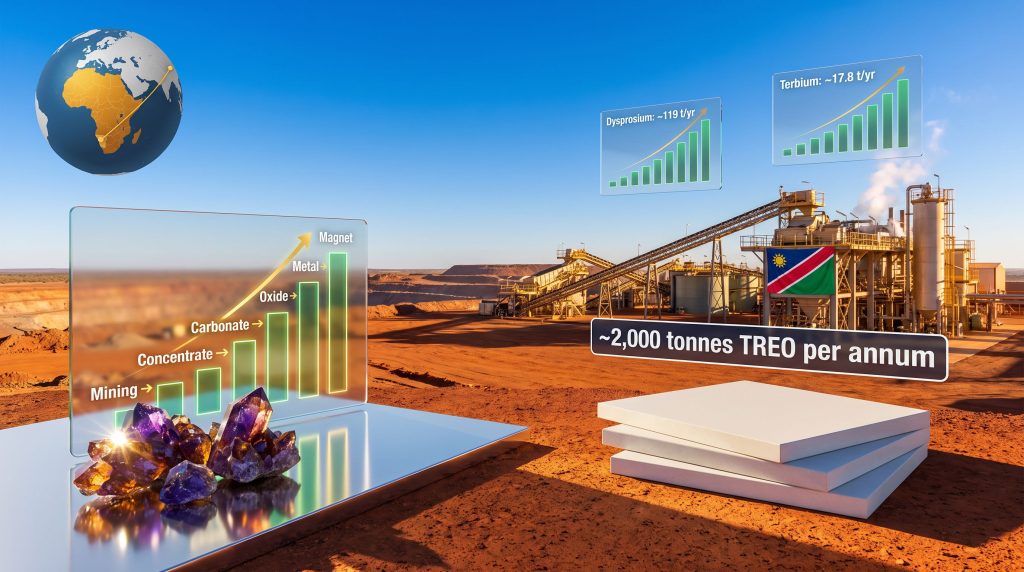
| Total Rare Earth Oxide (TREO) | ~2,000 tonnes per annum |
| Dysprosium | ~119 tonnes |
| Terbium | ~17.8 to 18 tonnes |
| Yttrium | ~841 tonnes |
These figures carry meaningful weight when contextualised against global HREE supply dynamics. Dysprosium and terbium are among the most supply-constrained critical minerals on the planet. Their primary end use is as performance enhancers in neodymium-iron-boron (NdFeB) permanent magnets, where they improve high-temperature coercivity — the magnet's ability to resist demagnetisation under heat.
Without dysprosium or terbium additions, NdFeB magnets used in electric vehicle drivetrains and wind turbine generators would fail under operational temperatures.
Ownership and Strategic Partnerships
Namibia Critical Metals operates as the project's primary development entity. The Japan Organization for Metals and Energy Security, known as JOGMEC, has a formal strategic partnership role in the project and has been involved across multiple development phases. Additionally, Toyota Tsusho, the trading and investment arm of the Toyota Group, committed an additional $32 million to the project, a signal that industrial offtake interest rather than speculative financial exposure is driving Japanese engagement.
How the Lofdal Processing Flowsheet Works
The Pre-Feasibility Study completed in December 2025 approved a three-stage plant architecture that integrates physical separation with chemical processing. Understanding the flowsheet helps clarify why this project represents a genuine step forward rather than an incremental improvement on conventional concentrate production. The rare earth processing challenges involved at each stage are considerable and worth examining in detail.
Stage One: Primary Crushing and XRT Ore Sorting
The first stage involves crushing run-of-mine ore and passing it through X-ray Transmission sorting equipment. XRT technology works by measuring the density differential between rare earth-bearing minerals and waste rock as material passes through an X-ray beam. Material with the density signature of rare earth minerals is accepted; waste rock is diverted before it enters the more expensive flotation circuit.
This pre-concentration step significantly reduces the volume of material that must be processed downstream, lowering reagent consumption, energy use, and overall operating costs. XRT ore sorting is increasingly adopted in critical mineral projects globally as operators seek to improve resource efficiency and reduce the environmental footprint of processing operations.
Stage Two: Flotation Concentrator
Material passing the XRT sorting stage enters the flotation circuit, where rare earth-bearing minerals are separated from gangue minerals using surface chemistry. Reagents are added to selectively attach air bubbles to target minerals, which float to the surface as a froth concentrate while gangue sinks. The output is a rare earth flotation concentrate with significantly higher TREO grade than the feed material.
Stage Three: Hydrometallurgical Refinery
The refinery circuit is where Lofdal diverges most sharply from concentrate-only projects. The four-step process converts flotation concentrate into rare earth carbonate products:
- Acid bake — the concentrate is mixed with sulphuric acid and heated to activate rare earth minerals for dissolution, breaking the crystal lattice structure that locks rare earths in place
- Leaching — water is added to dissolve the activated rare earth sulphates into an aqueous solution, separating them from insoluble residues
- Impurity removal — solution chemistry is adjusted to selectively precipitate iron, aluminium, phosphate, and other non-target elements, producing a purified rare earth liquor
- Precipitation — a carbonate reagent is added to the purified liquor, causing rare earth carbonate solids to form, which are then filtered, washed, and dried
Technical Note: The integrated hydrometallurgical route distinguishes Lofdal from the majority of African rare earth projects, which stop at flotation concentrate. Carbonate products require less additional processing at the downstream refinery stage, commanding higher prices and creating stronger offtake relationships with oxide producers.
The DFS Goal: Separating Light and Heavy Carbonate Streams
The current Definitive Feasibility Study phase is specifically assessing whether the flowsheet can produce separate Light Rare Earth Carbonate (LREC) and Heavy Rare Earth Carbonate (HREC) streams rather than a single mixed product. This separation adds value because HREE-dominant carbonates serve a different refinery and customer base than LREE-dominant carbonates, and command substantially different pricing.
Pilot-scale flotation and downstream metallurgical testwork are currently underway to validate this capability before final plant design and financing commitments are made.
What the $7.8 Million DFS Investment Is Actually Funding
The Joint Management Committee approved approximately C$11 million, equivalent to roughly USD $7.8 million, to advance the DFS phase. This capital is allocated across several workstreams:
- Additional metallurgical testwork at pilot scale to confirm LREC and HREC separation performance
- Engineering studies to develop sufficient detail for plant design and capital cost estimation
- Financial modelling to support project financing discussions with potential lenders and strategic investors
- Assessment of product specifications and market positioning for separate carbonate streams
A Definitive Feasibility Study represents the final major technical and economic validation step in the mining project lifecycle before a Final Investment Decision. DFS outcomes typically achieve a capital cost accuracy of plus or minus 15%, compared to plus or minus 35% at the Pre-Feasibility Study stage. It is the threshold at which project financing from banks, export credit agencies, and development finance institutions becomes accessible.
Callout: JOGMEC's continued financial participation through the DFS phase is significant. Government-backed entities of this type typically maintain strict investment criteria, and sustained involvement signals a level of confidence in technical and commercial viability that speculative financial investors cannot replicate.
How Lofdal Compares to Other African Rare Earth Projects
| Project | Country | Processing Stage Targeted | Key Elements | Status (2026) |
|---|---|---|---|---|
| Lofdal | Namibia | LREC + HREC carbonate | Dy, Tb, Y | DFS underway |
| Longonjo | Angola | Rare earth carbonates | LREE-dominant | Advanced development |
| Kangankunde | Malawi | Concentrate export | LREE-dominant | Production ~end 2026 |
| Songwe Hill | Malawi | Separated rare earth oxides | LREE-dominant | Development stage |
| Phalaborwa | South Africa | Separated rare earth oxides | Mixed REE | Development stage |
Several observations emerge from this comparison. First, Lofdal is the only project in the table specifically targeting HREE-enriched carbonate products. All other African projects either focus on LREE-dominant streams or have not yet advanced beyond concentrate production planning. Furthermore, the Longonjo rare earth project in Angola represents a notable parallel effort, though its LREE-dominant profile places it in a different market position to Lofdal.
Why HREE Projects Are Structurally More Valuable and More Complex
HREE markets are structurally different from LREE markets. The volumes traded are smaller, prices per kilogram are higher, supply sources are more concentrated, and downstream buyers are more technically sophisticated. Dysprosium, for instance, is priced by the kilogram rather than by the tonne, reflecting its relative scarcity and indispensability.
This also means that HREE projects face more demanding metallurgical requirements, since buyers of HREC products will specify tighter purity tolerances than buyers of bulk LREE concentrates.
The next major ASX story will hit our subscribers first
What Is Driving Demand for Dysprosium and Terbium Specifically
The end-use demand story for HREEs is anchored almost entirely in the permanent magnet supply chain. NdFeB magnets are the highest-performance permanent magnets commercially available, and they underpin the electrification and clean energy transition that is reshaping global industrial output. The specific demand drivers include:
- Electric vehicle traction motors, where dysprosium additions allow magnets to maintain performance at the elevated temperatures found in EV drivetrains
- Offshore and onshore wind turbine direct-drive generators, which use large-format NdFeB magnets and are a primary growth market for HREE demand
- Industrial robotics and automation systems, where compact high-torque motors rely on high-performance magnets
- Defence electronics, guidance systems, and directed energy applications, where thermal stability and miniaturisation requirements make HREE-enhanced magnets essential
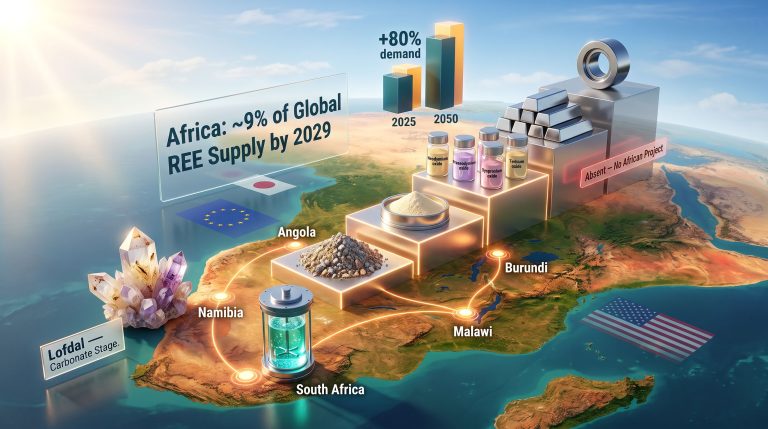
The International Energy Agency projects rare earth demand for permanent magnets to increase by approximately 25% between 2025 and 2030, driven by these converging end-use growth vectors. Against this backdrop, Benchmark Mineral Intelligence estimates that Africa could supply around 9% of global rare earth output by 2029, a figure that remains modest relative to the continent's known resource endowment and underscores the scale of processing investment still required.
Japan's JOGMEC and the Geopolitics of HREE Supply Security
Japan's involvement in Lofdal is not incidental. Japan is structurally one of the world's most exposed rare earth consuming nations: it operates a world-leading automotive and electronics manufacturing sector while possessing negligible domestic rare earth resources. JOGMEC's mandate is specifically to secure overseas supplies of strategic minerals for Japanese industry, and the organisation operates as a government-backed entity with both financial and technical resources to support project development.
Toyota Tsusho's position extends beyond financial participation. As a major Japanese trading house with direct connections to automotive manufacturing supply chains, its commitment to Lofdal reflects supply chain strategy rather than portfolio diversification. Industrial-grade offtake interest of this type provides a project with something that speculative equity financing cannot: a credible end-market connection that strengthens the case for project debt financing.
The geopolitical context amplifies this logic. China controls the overwhelming majority of global rare earth refining capacity and a dominant share of NdFeB magnet manufacturing. China's export restrictions on rare earth materials, introduced in 2023 and tightened in subsequent periods, have repeatedly demonstrated the vulnerability of supply chains that depend on a single jurisdiction. The coordinated response from Japan, the United States, Canada, and the European Union has created genuine institutional demand for non-Chinese HREE supply, and Lofdal's profile positions it squarely within that demand.
Key Challenges Between Current Status and Full Production
Technical Scaling Risks in Hydrometallurgical Processing
Scaling hydrometallurgical circuits from pilot to commercial scale is one of the most technically demanding transitions in the mining project lifecycle. Reagent behaviour, solid-liquid separation performance, and impurity management can all behave differently at commercial scale than at pilot scale.
The current metallurgical testwork programme is specifically designed to reduce these uncertainties before the project commits to a plant design, but it is important to recognise that DFS-level confidence does not eliminate execution risk.
Capital Intensity and Financing Complexity
Rare earth processing plants require substantially more capital per tonne of output than conventional open-pit mining operations. The integrated hydrometallurgical refinery at Lofdal adds capital and operating cost relative to a concentrate-only design, even as it improves the revenue profile.
Bridging this capital requirement typically involves a combination of equity, strategic investment from industrial partners, export credit agency financing, and development finance institution support. JOGMEC and Toyota Tsusho's involvement materially improves Lofdal's financing profile compared to a purely equity-funded junior mining company, but the capital intensity of the project remains a defining challenge.
Africa's Processing Infrastructure Deficit
Even if Lofdal successfully produces carbonate products, the oxide separation, metal production, and magnet manufacturing stages would still require overseas processing facilities. This reflects a continent-wide infrastructure gap that individual project decisions cannot resolve.
The absence of integrated rare earth processing infrastructure in Africa, including chemical reagent supply chains, skilled workforce availability, and power infrastructure, means that project-level ambition must be matched by national and regional infrastructure investment to reach its full potential.
Frequently Asked Questions: Namibia Lofdal Rare Earth Processing
What Rare Earth Elements Does the Lofdal Project Produce?
Lofdal's production profile is centred on heavy rare earth elements, principally dysprosium, terbium, and yttrium within the HREC stream. The LREC stream is expected to contain neodymium and praseodymium, the primary NdFeB magnet alloy elements, alongside other light rare earth elements.
What Is the Difference Between Rare Earth Concentrate and Rare Earth Carbonate?
Rare earth concentrate is the output of physical beneficiation processes such as flotation. It contains rare earth minerals mixed with residual gangue and requires significant further chemical processing before individual elements can be separated. Rare earth carbonate is a chemically processed intermediate product where rare earth elements have been extracted into solution and re-precipitated as carbonate solids. Carbonate products have higher purity, lower impurity burden, and command substantially higher market prices than concentrates.
What Is XRT Ore Sorting and How Is It Used at Lofdal?
X-ray Transmission sorting uses the differential X-ray absorption properties of minerals to identify and separate high-density rare earth-bearing material from lower-density waste rock on a conveyor belt. At Lofdal, XRT sorting is applied to crushed ore before it enters the flotation circuit, diverting waste material that would otherwise consume reagents and processing capacity without contributing to output. The result is a more efficient and lower-cost processing operation.
How Does the DFS Differ From the Earlier PFS?
The Pre-Feasibility Study established technical and economic viability at a conceptual level, typically with capital cost accuracy of plus or minus 35%. The Definitive Feasibility Study advances this to a higher level of engineering detail, targeting plus or minus 15% accuracy, and includes pilot-scale testwork validation, detailed plant design studies, and financial modelling sufficient to support project financing discussions. The DFS is the last major validation step before a Final Investment Decision.
Why Are Dysprosium and Terbium Considered Strategically Critical?
Both elements are essential additions to NdFeB permanent magnets used in high-performance applications. They improve the magnet's coercivity at elevated temperatures, preventing demagnetisation in electric motors and wind turbine generators. Their supply is geographically concentrated in China, with very few viable alternative sources globally. This combination of functional indispensability and supply concentration defines their strategic critical status.
Is Africa Close to Producing Rare Earth Metals or Permanent Magnets?
Honestly assessed, no. Africa's most advanced projects are targeting carbonate or oxide production, which are intermediate processing stages. Rare earth metal production requires electrowinning or metallothermic reduction facilities that do not currently exist on the continent at commercial scale. Permanent magnet manufacturing requires additional alloy processing, pressing, sintering, and magnetisation infrastructure. Africa is making genuine progress in moving beyond raw concentrate exports, but the highest-value manufacturing stages remain well beyond the continent's current industrial capacity.
The Bigger Picture: Africa's Long Road Up the Rare Earth Value Chain
From Concentrate to Carbonate: Incremental but Real Progress
Africa's movement up the rare earth value chain is genuine but incremental. The continent is gaining ground at the concentrate-to-carbonate transition, with projects including Lofdal and Longonjo targeting carbonate production rather than raw concentrate exports. Oxide separation is being planned at Songwe Hill and Phalaborwa. However, each step up the value chain requires additional capital, more sophisticated metallurgical infrastructure, and deeper technical expertise.
The policy levers available to governments include export restrictions on raw concentrates, processing mandates tied to mining licences, and investment incentives for downstream processing facilities. These mechanisms can accelerate in-country beneficiation when applied consistently, but they require matching investment in power infrastructure, water access, chemical reagent supply, and workforce development to be effective.
What a Successful Lofdal DFS Would Mean for the Broader Sector
A positive DFS outcome at Lofdal would demonstrate that Namibia Lofdal rare earth processing is commercially viable within an African jurisdiction, using African ore, and supported by credible industrial partners from a major rare earth consuming nation. This proof-of-concept value extends beyond the project itself. It would provide a replicable template for other African HREE projects and strengthen the investment case for downstream processing across the continent's critical minerals sector.
The gap between mining and the most profitable stages of the rare earth value chain remains the defining challenge for Africa's critical minerals ambitions. For further technical detail on the project's development trajectory, the Lofdal pre-feasibility study provides comprehensive engineering and economic context. Lofdal does not close that gap, but it is one of the most credible efforts currently underway to narrow it, and in an industry defined by long development timelines and geopolitical urgency, that progress carries real strategic weight.
Disclaimer: This article contains forward-looking statements, production estimates, and financial projections sourced from publicly available project disclosures and independent industry forecasts. These figures are subject to change and should not be construed as investment advice. Investors should conduct independent due diligence before making any investment decisions related to companies or projects referenced in this article.
For further coverage of Africa's critical minerals landscape and rare earth project developments, readers can explore related reporting from Business Insider Africa at africa.businessinsider.com.
Want to Stay Ahead of the Next Major Mineral Discovery?
Discovery Alert's proprietary Discovery IQ model delivers real-time alerts on significant ASX mineral discoveries — instantly converting complex geological and commodity data into actionable investment insights, much like the critical rare earth opportunities reshaping global supply chains. Explore how historic discoveries have generated substantial returns on Discovery Alert's dedicated discoveries page, and begin your 14-day free trial today to position yourself ahead of the broader market.