July 24, 2026
The Hidden Bottleneck Holding Back Western Rare Earth Ambitions
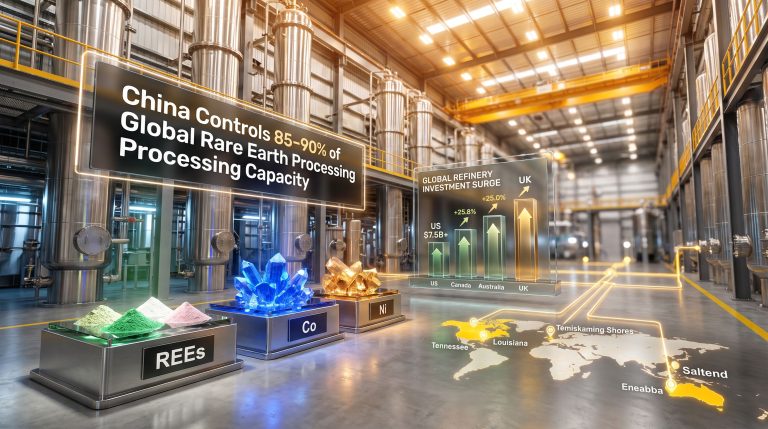
For decades, the global conversation around rare earth supply chain security has fixated on mining. Which country holds the largest reserves, which deposit has the best grade, which company will break ground first. Yet the mineral extraction phase, while important, is not where Western nations have struggled most profoundly. The true structural weakness sits downstream, in the chemistry laboratories and processing circuits where individual rare earth elements must be painstakingly separated from one another. Without mastery of this stage, a nation can dig up all the ore it wants and still remain dependent on foreign processors to turn that ore into usable material.
This is the gap that the Aclara rare earth separation AI digital twin program is designed to address, and understanding why it matters requires first appreciating just how technically unforgiving rare earth separation really is.
When big ASX news breaks, our subscribers know first
Why Rare Earth Separation Is the Real Supply Chain Chokepoint
Rare earth elements are notoriously similar to one another at the atomic level. Their ionic radii differ by only fractions of an angstrom across the lanthanide series, which means separating them requires not a single step but a cascade of repeated liquid-liquid extraction stages, each removing a fractional amount of one element relative to another. The dominant industrial method, solvent extraction (SX), exploits these tiny differences in chemical affinity between an aqueous phase and an organic solvent phase to gradually purify individual elements.
The challenge compounds significantly when dealing with heavy rare earth elements (HREEs) such as dysprosium and terbium, both of which are critical to high-performance permanent magnets used in electric vehicle motors and wind turbines. HREEs sit at the heavy end of the lanthanide series where ionic radii differences become even smaller, meaning the separation factors between adjacent elements approach unity. In practical terms, this translates to:
- A greater number of theoretical extraction stages required to reach commercial purity thresholds
- Higher sensitivity to fluctuations in feed composition, temperature, and organic-to-aqueous phase ratios
- Longer commissioning timelines before a new plant reaches stable, full-rate production
- Elevated risk of phase entrainment, where one liquid phase contaminates the other and degrades separation efficiency
For light rare earth elements (LREEs) like neodymium and praseodymium, the separation factors are more workable, though still demanding by the standards of conventional hydrometallurgy. This asymmetry helps explain why China, which has spent four decades refining its SX circuit knowledge base through thousands of operating hours across dozens of facilities, holds such a commanding position in global separation capacity. Furthermore, the rare earth processing challenges involved in replicating that accumulated knowledge in Western nations are not simply a matter of building the physical equipment; they require the operational intelligence that only comes from extensive real-world process experience.
The decisive strategic challenge for Western rare earth supply chains is not access to ore in the ground. It is access to the processing knowledge that converts ore into separated, high-purity material ready for magnet alloy production.
How the Aclara Rare Earth Separation AI Digital Twin Works
Defining the Digital Twin in an Industrial Processing Context
A digital twin, in the context of a rare earth separation plant, is a high-fidelity computational model that replicates the behaviour of a physical solvent extraction circuit in a virtual environment. Unlike conventional process simulation software, which operates on fixed parameters and produces static outputs, an AI-enabled digital twin is dynamic. It ingests real-time or near-real-time operating data, updates its internal representation of the system continuously, and uses machine learning algorithms to identify patterns, predict future states, and prescribe optimal adjustments.
The distinction matters enormously in practice. A static simulation can tell you what should theoretically happen under ideal conditions. A machine-learning-driven digital twin can tell you what is actually happening, why it is deviating from expectations, and what corrective action will most efficiently return the circuit to optimal performance, all before a human operator would conventionally detect a problem. For a deeper look at how AI in mineral exploration and processing is reshaping the sector, the parallels with this technology are striking.
The Data Architecture Behind the Model
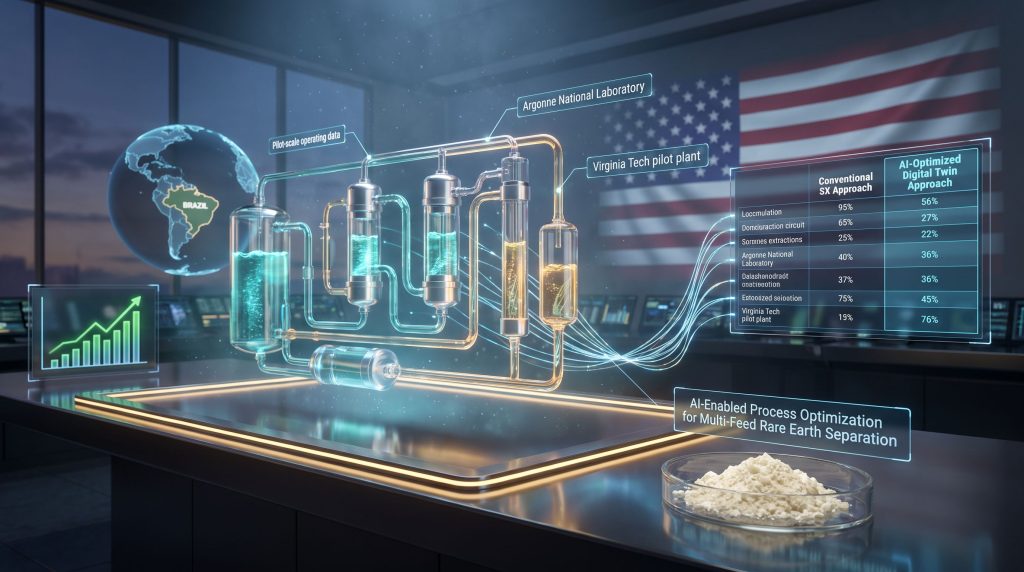
The strength of any machine learning model is determined largely by the quality and diversity of the data it learns from. For the Aclara rare earth separation AI digital twin, four primary data streams feed the model:
| Data Input Category | Source | Purpose in the Digital Twin |
|---|---|---|
| Pilot-scale operating data | Virginia Tech pilot plant | Model calibration and real-world validation |
| Feed composition variability | Rare earth carbonate feedstock from Carina | Multi-feed adaptability and robustness testing |
| Process simulation algorithms | Argonne National Laboratory | High-fidelity computational modelling backbone |
| AI/ML training datasets | Combined experimental and operational runs | Predictive optimisation and anomaly detection |
The Virginia Tech pilot plant is particularly important because it operates at a scale that sits between laboratory bench work and full industrial deployment. Laboratory-scale data is often too clean and controlled to capture the messy variability that industrial equipment encounters. Pilot-scale data, by contrast, introduces real process noise, equipment imperfections, and feedstock inconsistencies that make the trained model genuinely robust when applied at commercial scale.
Key Optimisation Variables the AI Monitors
Within a rare earth solvent extraction circuit, the digital twin tracks and optimises a suite of interdependent process variables:
- Separation factor between target element pairs, which determines how effectively the circuit distinguishes between chemically similar elements
- Organic loading, referring to the concentration of extracted rare earth in the organic phase, which affects both capacity and selectivity
- Phase disengagement rates in mixer-settler units, where incomplete separation of aqueous and organic phases directly degrades purity
- Strip efficiency, measuring how completely the rare earth is recovered from the loaded organic phase back into an aqueous strip solution
- Aqueous-to-organic phase ratios, which must be continuously adjusted as feed composition shifts
By modelling the interactions between these variables simultaneously, the AI can identify non-obvious optimisation pathways that a human operator working with conventional instrumentation would be unlikely to discover through trial and error.
The Research Partnership: Argonne, Virginia Tech, and Aclara's Carina Project
Why National Laboratory Involvement Changes the Technical Equation
Aclara Technologies Inc., the U.S.-based subsidiary of Canadian company Aclara Resources Inc., formalised its research relationship with Argonne National Laboratory through a cooperative research and development agreement signed in January 2026. This agreement gives Aclara access to Argonne's process-simulation infrastructure and AI computing capabilities, resources that would require hundreds of millions of dollars and years of institutional development for a private-sector company to replicate independently.
Argonne's role is not simply computational. The laboratory brings decades of experience modelling complex chemical systems, including nuclear fuel reprocessing circuits that share methodological DNA with rare earth solvent extraction. This deep institutional knowledge informs the mathematical frameworks underlying the digital twin's predictive algorithms, elevating its technical credibility well beyond what commercially available process simulation packages could deliver.
The Carina Deposit: Feedstock Chemistry That Shapes the Model
The feedstock driving the pilot plant work at Virginia Tech originates from Aclara's Carina ionic clay deposit in Brazil. Ionic clay rare earth deposits differ fundamentally in their mineralogy from hard-rock sources such as bastnaesite or monazite. In ionic clays, rare earth elements are not chemically bound within mineral crystal structures. Instead, they are adsorbed onto clay mineral surfaces and can be selectively leached using mild ammonium sulfate or similar solutions, producing a relatively clean rare earth carbonate product without requiring aggressive high-temperature cracking or roasting steps.
This has significant downstream implications. The rare earth carbonate produced from ionic clay leaching tends to have a different elemental distribution profile compared to hard-rock concentrates, often carrying a higher proportion of HREEs relative to total rare earth oxide content. This HREE-enriched composition is commercially valuable because HREEs command substantially higher prices per kilogram than LREEs, but it also makes separation more technically demanding. The Carina feedstock therefore represents an ideal, if challenging, training dataset for an AI model intended to handle complex HREE-rich compositions.
Ionic clay deposits, common in southern China and parts of South America, produce rare earth distributions that are disproportionately weighted toward the heavy end of the lanthanide series, making them strategically valuable but technically demanding to process.
The Genesis Mission Selection: What Federal Validation Actually Means
Understanding the DOE Initiative and Its Selection Criteria
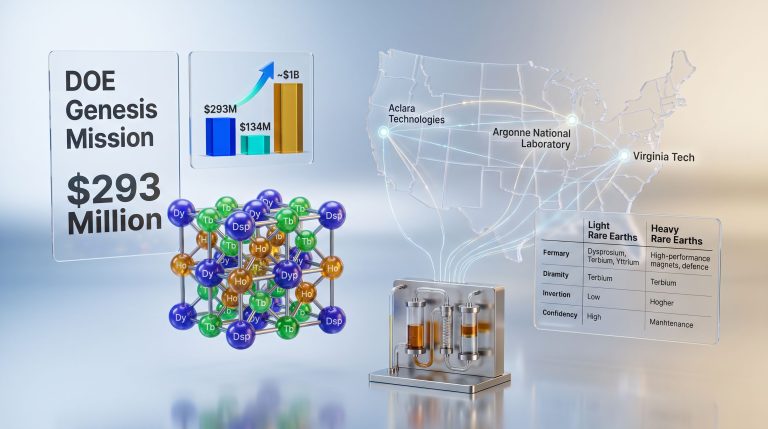
The U.S. Department of Energy's Genesis Mission is a national artificial intelligence initiative structured around the application of AI tools to problems of national strategic importance, spanning scientific discovery, energy security, and supply chain resilience. Aclara's project was selected under the initiative's critical minerals challenge area, formally titled Securing America's Critical Minerals Supply through Extraction and Processing Technologies. This aligns directly with broader efforts to strengthen critical minerals supply security across the Western world.
Selection under this challenge area signals that federal reviewers assessed the Aclara approach as technically credible and strategically aligned with national supply chain security objectives. It is worth noting that selection alone does not confirm final funding. The amount, terms, and timing of phase-one funding remain subject to award negotiations at the time of publication. However, the selection itself carries meaningful validation weight within the investment and research community.
Phase One Objectives and the Path to Phase Two
The phase-one programme focuses on developing and validating AI-enabled tools specifically designed to improve three measurable dimensions of rare earth separation circuit performance:
- Stability – reducing the frequency and severity of process upsets caused by feed variability or operating condition drift
- Efficiency – improving recovery rates and purity levels through dynamic optimisation rather than static operating setpoints
- Scalability – generating validated data and modelling frameworks that support the transition from pilot to commercial-scale operations
A second phase of funding may become available if the initial programme demonstrates what the Genesis Mission framework describes as transformative AI-enabled workflows. In practical terms, this means the digital twin would need to show evidence of autonomous or semi-autonomous process control capabilities, real-time optimisation loops that meaningfully outperform conventional operator-guided approaches, and predictive maintenance integration that reduces unplanned downtime.
Phase-two eligibility would represent a significant technical milestone, indicating that the AI framework has met independently reviewed performance benchmarks and substantially de-risked the path to commercial-scale deployment.
Conventional vs. AI-Optimised Separation: The Performance Gap
To appreciate what the Aclara rare earth separation AI digital twin could mean for processing economics, it helps to contrast the conventional approach to SX circuit management with what an AI-optimised system enables:
| Performance Dimension | Conventional SX Approach | AI-Optimised Digital Twin Approach |
|---|---|---|
| Process optimisation method | Manual adjustment, trial-and-error | Real-time predictive modelling |
| Response to feed variability | Reactive, often causing instability | Proactive, model-predicted adjustment |
| Scale-up risk management | High; empirical extrapolation | Reduced; virtual pre-validation |
| Commissioning timeline | Extended (months to years) | Potentially compressed significantly |
| Operator decision support | Experience-dependent | AI-assisted, data-driven |
| Multi-feed adaptability | Limited; requires reoptimisation | Designed for feedstock flexibility |
The commissioning timeline row in that table deserves particular attention. In the conventional approach, a new rare earth separation plant may require anywhere from 12 to 36 months of iterative adjustment before reaching stable full-rate production at specification purity. During this ramp-up period, product either fails to meet customer specifications or must be sold at a discount, creating a prolonged cash-negative phase that puts enormous financial pressure on project developers. An AI-optimised digital twin that compresses this timeline even by a third could represent tens of millions of dollars in preserved value across a typical commercial-scale project.
The next major ASX story will hit our subscribers first
Multi-Feed Design: Why This Technology Is Bigger Than One Project
Designing for Domestic Feedstock Diversity
One of the less-discussed but strategically significant aspects of the Aclara programme is its explicit multi-feed design objective. While Carina material serves as the primary training feedstock, the AI framework is being built to handle rare earth streams from diverse source types. Potential future feedstock categories in the U.S. context include:
- Ionic clay deposits in the southeastern United States, which carry HREE distributions broadly similar to South American and Chinese ionic clay sources
- Coal byproduct and coal ash rare earth streams, which the DOE has actively studied as a domestic REE resource base
- Recycled magnet material from end-of-life electric vehicles and wind turbine generators, which carries a concentrated NdFeB-type rare earth profile
- Byproduct streams from phosphoric acid production, where lanthanides are recovered from phosphogypsum waste
Each of these feedstock types carries a distinct rare earth distribution, impurity profile, and carbonate chemistry. Designing the digital twin to accommodate this diversity from the outset positions it as a platform technology rather than a single-project solution, consequently opening the door to licensing or deployment across multiple U.S. processing facilities.
Aclara's Full-Chain Digitalisiation Strategy
The separation digital twin does not sit in isolation within Aclara's broader technology development programme. The company has articulated a full-chain digitalisation vision that applies AI and digital modelling tools at every stage of the rare earth value chain, from exploration through to final separation. At the exploration stage, AI-driven analysis of satellite imagery and geophysical datasets is being used to predict ionic clay mineralisation patterns and prioritise drilling targets. According to Aclara's artificial intelligence overview, this integrated approach is fundamental to the company's competitive strategy. At the concentration plant stage, digital models support process design and optimisation before physical infrastructure is committed. The separation plant digital twin then serves as the downstream anchor of this integrated digital architecture.
This systems-level approach addresses a frequently overlooked weakness in rare earth project development: the information disconnect between upstream ore variability and downstream process requirements. When exploration data, mining grades, and separation plant feed specifications exist in separate operational silos, unexpected changes in ore body character can propagate unpredictably through the processing chain. A fully integrated digital model, where exploration data directly informs separation process parameters, creates a closed-loop intelligence system capable of anticipating and managing that variability proactively.
What This Means for U.S. Rare Earth Processing Independence
Separation Technology as the Missing Link
The broader U.S. rare earth processing ecosystem has seen significant investment activity in recent years, with federal programmes supporting processing pilots, separation demonstrations, and magnet manufacturing capacity across multiple companies and facilities. America's rare earth supply chain has, furthermore, become a focal point for policymakers seeking to reduce dependence on foreign processors. Within this landscape, AI-enabled separation optimisation represents a differentiated approach, one that targets the operational intelligence layer rather than simply the physical infrastructure layer.
Building a solvent extraction plant is achievable with sufficient capital. Operating it efficiently, maintaining high recovery rates across varying feed compositions, and scaling it to commercial throughput without multi-year commissioning delays requires a depth of process knowledge that physical infrastructure alone cannot provide. The Aclara rare earth separation AI digital twin, developed in collaboration with Argonne National Laboratory and grounded in pilot-scale data from Virginia Tech, is an attempt to encode that knowledge into a system that can be replicated, refined, and ultimately deployed across the emerging domestic processing sector.
For the U.S. defence and clean energy industrial base, which depends on permanent magnet rare earths for everything from missile guidance systems to offshore wind generators, the development of a domestically validated, AI-optimised separation platform represents a meaningful reduction in the structural vulnerability that has defined Western REE supply chains for the better part of three decades.
Disclaimer: This article contains forward-looking statements and speculative analysis regarding technology development timelines, federal funding outcomes, and commercial deployment pathways. Funding terms for the Genesis Mission phase-one award remain subject to negotiation and are not confirmed at time of publication. Readers should conduct independent research and consult qualified advisors before making any investment decisions based on information contained herein.
Want to Invest in the Companies Solving Critical Mineral Challenges?
Discovery Alert's proprietary Discovery IQ model delivers real-time alerts on significant ASX mineral discoveries, instantly empowering investors to identify actionable opportunities in the critical minerals and rare earth sectors ahead of the broader market — explore historic discoveries and their remarkable returns to understand the potential at stake, then begin your 14-day free trial at Discovery Alert to position yourself ahead of the next major find.