
July 24, 2026
The Quiet Crisis in America's Heavy Rare Earth Supply Chain
Global rare earth supply chains are not created equal. While the broader conversation about critical mineral dependency tends to cluster around headline elements like lithium, cobalt, and neodymium, a more structurally problematic shortage is developing beneath the surface: the near-total absence of domestic US production capacity for Idaho Strategic Resources Diamond Creek heavy rare earths yttrium. This is not a near-term risk being managed at the margins. It is an active vulnerability embedded into the manufacturing base of advanced defence systems, medical imaging technology, semiconductor fabrication, and next-generation energy infrastructure.
Understanding why this gap exists, and why it is so difficult to close, requires stepping back from individual project announcements and examining the geological and commercial forces that have allowed China to consolidate control over the HREO supply chain for decades.
When big ASX news breaks, our subscribers know first
Why Heavy and Light Rare Earths Are Fundamentally Different Problems
The term "rare earth elements" groups together 17 chemically similar metals, but the distinction between light rare earth oxides (LREO) and heavy rare earth oxides (HREO) is far more than academic. It determines which industries a deposit can serve, which processing technologies apply, and ultimately, which geopolitical vulnerabilities a mine can help resolve.
Light rare earths, including cerium, lanthanum, neodymium, and praseodymium, are relatively more abundant in the Earth's crust and are hosted in mineral assemblages that are better understood and more widely distributed globally. The majority of North American rare earth exploration and development activity is concentrated in this category, driven largely by demand for neodymium-praseodymium (NdPr) in permanent magnets used in electric vehicle motors and wind turbines.
Heavy rare earths tell a different story. Elements such as dysprosium, terbium, holmium, erbium, and yttrium are:
- Geologically rarer and typically found in lower concentrations within host rock
- Concentrated disproportionately in ionic clay deposits in southern China and Myanmar
- Dependent on entirely different mineral carriers than light REE deposits
- Critical to temperature-resistant magnet grades, advanced phosphors, superconducting materials, and specialty ceramics
China's dominance over HREO supply is not simply a function of resource endowment. It reflects decades of investment in ionic clay processing infrastructure, rare earth separation chemistry, and vertically integrated production capacity that Western nations have not replicated. Furthermore, rare earth processing challenges mean the US currently lacks a single operational, vertically integrated HREO producer capable of supplying industrial end-users at meaningful scale.
Yttrium: The HREO That Touches Everything
Among the heavy rare earths, yttrium occupies a uniquely important position. Unlike dysprosium or terbium, which are priced primarily on defence and magnet-grade demand, yttrium commands broad commercial-scale demand across multiple industries simultaneously. Its applications include:
- Phosphors used in LED lighting, display panels, and fluorescent tubes (yttrium vanadate and yttrium oxide are key phosphor host materials)
- Superconductors, where yttrium barium copper oxide (YBCO) remains the foundational high-temperature superconducting compound
- Advanced ceramics including yttria-stabilised zirconia (YSZ), used in thermal barrier coatings for jet turbine blades and as an electrolyte in solid oxide fuel cells
- High-performance alloys where yttrium additions improve oxidation resistance at elevated temperatures
China controls the dominant share of global refined yttrium output, meaning supply disruption risk for yttrium closely mirrors that of other HREOs. Consequently, China's export restrictions are making it increasingly difficult for US manufacturers operating in any of these sectors to manage the absence of a reliable ex-China yttrium source.
The concentration of yttrium supply within a single geopolitical jurisdiction is increasingly viewed by end-users not as a pricing risk but as an existential supply continuity risk, particularly for defence-adjacent manufacturing programs that cannot tolerate material substitution or supply interruption.
Diamond Creek and the Idaho Rare Earth Belt: Geological Context
Idaho Strategic Resources, listed on the NYSE, holds three rare earth properties within what geologists refer to as the Idaho rare earth belt: Diamond Creek, Lemhi Pass, and Mineral Hill. This belt represents one of the few documented geological terranes in the continental United States where HREO-enriched mineralisation occurs at surface, making it structurally distinct from the light-REE-dominant carbonatite and alkaline intrusive systems that host most North American rare earth projects.
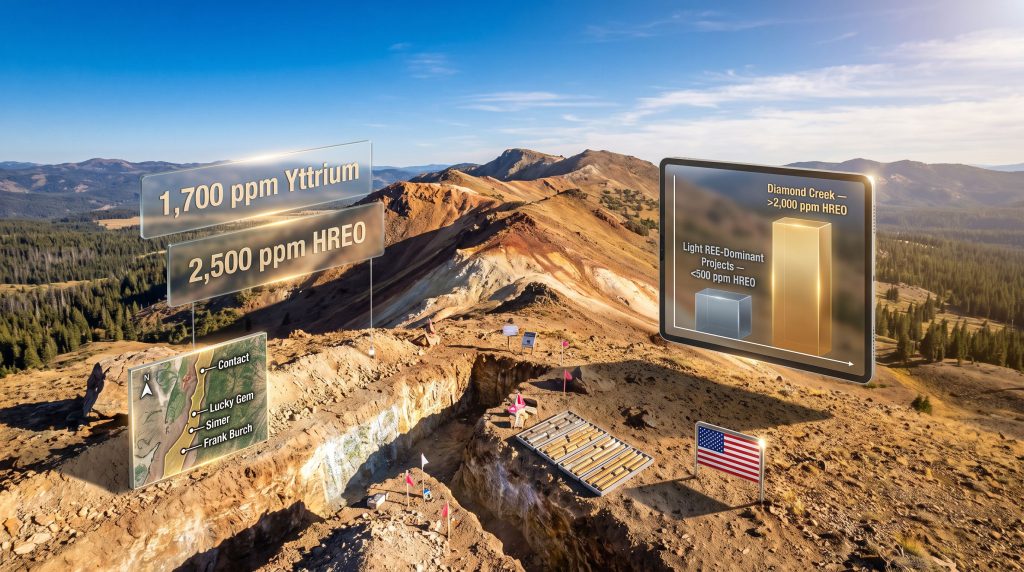
Diamond Creek itself sits along a structurally controlled mineralisation corridor approximately 3.2 kilometres in length, within which four surface prospects have been identified. Moving from north to south, these are designated as Contact, Lucky Gem, Simer, and Frank Burch. This linear arrangement along a structural trend suggests that the mineralisation is fault-controlled, a common characteristic of hydrothermal rare earth systems in metamorphic terrane settings.
Xenotime: The Mineral That Changes Everything About Processing
One of the most technically significant findings at Diamond Creek is the identification of xenotime as the primary yttrium-bearing mineral phase. This detail matters considerably more than it might initially appear.
Xenotime is a yttrium phosphate mineral with the chemical formula YPO₄. It belongs to the tetragonal crystal system and is structurally analogous to zircon, which means it can incorporate a range of heavy rare earth elements and actinides into its crystal lattice. Its key characteristics include:
- HREO concentration: Xenotime preferentially incorporates yttrium and heavy lanthanides, making it a far richer HREO carrier than bastnäsite or monazite
- Processing pathway differences: Xenotime dissolves effectively in strong mineral acids under hydrometallurgical conditions, but requires different leach parameters than carbonate-hosted REE minerals
- Distinct from monazite: Unlike monazite, xenotime has lower thorium content on average, which simplifies radioactive waste classification in processing
- Recoveries: Gravity and flotation circuits must be specifically designed for xenotime's density and surface chemistry, distinct from standard light-REE flowsheets
The identification of xenotime at Diamond Creek at this early stage is strategically valuable because it allows metallurgical test work to be designed with the correct mineral target from the outset, avoiding costly process redesign later in development.
Breaking Down Diamond Creek's Exploration Data
The most current surface sampling program across all four Diamond Creek prospects returned results that are notable by North American HREO standards.
Surface Sampling Summary Across All Four Prospects
| Prospect | Average TREO | Average HREO | Average Yttrium |
|---|---|---|---|
| Contact | ~1.8% TREO | >2,000 ppm | >1,300 ppm |
| Lucky Gem | ~1.8% TREO | >2,000 ppm | >1,300 ppm |
| Simer | ~1.8% TREO | >2,000 ppm | >1,300 ppm |
| Frank Burch | ~1.8% TREO | >2,000 ppm | >1,300 ppm |
These figures represent averages from surface sampling programs. Individual prospect results vary. These results do not constitute a formal mineral resource estimate under NI 43-101, JORC, or equivalent reporting standards.
Lucky Gem: The Project's Most Technically Mature Data Set
Lucky Gem is the only prospect at Diamond Creek to have been subjected to both trenching and drilling, making it the primary basis for any preliminary technical interpretation of the project's potential.
Key results from Lucky Gem include:
- A 32-metre surface trench averaging 1.5% TREO, with HREO enrichment of approximately 2,300 ppm including 1,600 ppm yttrium
- Drillhole DC 22-8 intersecting 11.3 metres averaging 1.5% TREO, with HREO exceeding 2,500 ppm and yttrium concentrations reaching 1,700 ppm
The consistency between the trench and drillhole results at Lucky Gem is geologically encouraging. It suggests that the mineralisation has meaningful vertical continuity from surface, rather than representing a weathering-enriched supergene blanket that would deteriorate with depth. That said, a single drillhole is insufficient to draw firm conclusions about deposit geometry, and additional drilling is required before any resource characterisation can occur.
Important caveat: Neither the historic USGS estimate of over 70,000 tonnes of total rare earth oxides at Diamond Creek, nor Idaho Strategic's conceptual internal model of approximately 20,000 tonnes at ~1,600 ppm yttrium, constitutes a compliant mineral resource estimate under modern reporting standards. Both figures should be treated as directional indicators only, not as investment-grade resource statements.
What 1,600–1,700 ppm Yttrium Actually Means in Commercial Terms
For context, yttrium concentrations in the 800 to 2,000 ppm range within a broader TREO host are generally considered commercially meaningful for projects targeting HREO-focused processing streams. The significance of Diamond Creek's yttrium grades is best understood relative to the overall TREO composition.
At Lucky Gem, yttrium at 1,600 to 1,700 ppm within a 1.5% TREO host means that yttrium constitutes roughly 10 to 11% of the total rare earth oxide mass. In a light-REE-dominant deposit, yttrium might represent less than 1% of the TREO basket. This HREO-enriched composition dramatically changes the value profile of the contained rare earths, particularly given current ex-China yttrium pricing dynamics where supply scarcity is already reflecting in market premiums.
How Diamond Creek Compares to North American Rare Earth Peers
The competitive landscape for Diamond Creek is not defined by grade alone. The more important differentiator is the HREO enrichment profile, which is genuinely uncommon among North American exploration-stage projects.
| Characteristic | Light REE-Dominant Projects | Diamond Creek (HREO Profile) |
|---|---|---|
| Primary REE type | Ce, La, Nd, Pr | Y, Dy, Tb, Ho |
| Typical HREO content | Less than 500 ppm | Greater than 2,000 ppm |
| Primary mineral carrier | Bastnäsite or Monazite | Xenotime |
| Processing complexity | Well-established flowsheets | Requires tailored hydrometallurgy |
| Supply chain gap addressed | NdPr magnet materials | Defence, electronics, ceramics, superconductors |
| Ex-China sourcing urgency | Moderate | High and structurally increasing |
The scarcity of HREO-enriched exploration projects in North America means Diamond Creek occupies a differentiated position in the development pipeline, one that is directly relevant to the supply chain problems that existing and planned North American rare earth producers are not structured to solve. In addition, America's rare earth supply chain pressures are intensifying as geopolitical tensions escalate.
The Commercial Logic: Why Price-Insensitive Customers Change the Equation
A commercially important observation underpins Idaho Strategic's approach to Diamond Creek. Heavy rare earths and yttrium typically represent a small fraction of the total input cost in the finished goods they enable, whether those goods are phosphor panels, superconducting wire, thermal barrier coatings, or specialty ceramics.
This cost structure creates a category of end-user that prioritises supply security over lowest-cost sourcing. Idaho Strategic's president and CEO John Swallow has noted publicly that an increasing number of conversations with global end-users are now being driven by the need for supply continuity rather than price sensitivity, as reported by Yahoo Finance. The implication is that end-users in HREO-dependent manufacturing can absorb a meaningful premium for domestically sourced, ex-China material without materially impacting their product economics.
This observation carries real strategic weight because it changes the commercial viability threshold for a project like Diamond Creek. Large light-REE projects must achieve substantial economies of scale to compete on cost. However, a small-scale, high-grade domestic HREO operation serving price-insensitive customers in critical technology sectors operates under a fundamentally different commercial model, one where security of supply commands its own premium. Moreover, China's rare earth strategy of leveraging supply dominance is accelerating this shift towards security-driven procurement globally.
The next major ASX story will hit our subscribers first
Near-Term Development Pathway and Key Catalysts
Idaho Strategic has outlined a series of near-term steps for Diamond Creek that reflect the project's current exploration maturity:
- Additional surface fieldwork across the four prospects during the current field season, aimed at expanding the geological database and identifying new targets along the 3.2 km structural corridor
- Refined mineralogical studies to better characterise xenotime distribution, grain size, and liberation characteristics, which will directly inform metallurgical test work design
- Evaluation of a bulk sample program at the Lucky Gem prospect, representing a potential step-change in technical maturity
The bulk sample decision is particularly significant. Moving beyond grade characterisation to process confirmation is the single most important technical threshold for an HREO project at Diamond Creek's stage of development. Successful bulk sampling at Lucky Gem would provide the metallurgical recovery data necessary to support a preliminary economic assessment, and would likely serve as a key milestone before any serious offtake conversations with end-users could advance.
The multi-project structure of Idaho Strategic's Idaho belt holdings, spanning Diamond Creek, Lemhi Pass, and Mineral Hill, also creates the possibility of aggregating geological knowledge across the district. Understanding structural controls that repeat across multiple prospects within the same terrane can significantly accelerate resource definition drilling efficiency.
Frequently Asked Questions
What makes Diamond Creek's mineralisation profile strategically significant?
Diamond Creek's HREO enrichment, with yttrium concentrations consistently in the 800 to 2,000 ppm range and HREO averaging above 2,000 ppm across surface sampling, is uncommon among North American rare earth projects. The vast majority of development-stage North American rare earth projects are structured around light rare earth production and cannot address the HREO supply gap that end-users are increasingly seeking to fill with ex-China sources.
Is Diamond Creek currently producing?
No. Diamond Creek is an exploration-stage project. No formal mineral resource estimate compliant with NI 43-101, JORC, or equivalent modern reporting standards has been published. The project is in the surface sampling, trenching, and early-stage drilling phase, with additional fieldwork and mineralogical studies underway.
What is xenotime and why does it matter for processing?
Xenotime (YPO₄) is a yttrium phosphate mineral that preferentially concentrates yttrium and associated heavy rare earths. Its identification as the primary yttrium-bearing mineral at Diamond Creek is significant because xenotime has distinct hydrometallurgical processing characteristics compared to the bastnäsite and monazite assemblages that host light rare earths at most other projects. Tailored leach chemistry and flotation circuit design are required, and early identification of xenotime allows this to be incorporated into test work planning from the outset rather than discovered late in development.
What is the difference between the historic USGS figure and Idaho Strategic's conceptual model?
The historic USGS reference of over 70,000 tonnes of total rare earth oxides at Diamond Creek predates modern resource estimation standards and should not be interpreted as a compliant mineral resource. Idaho Strategic's own conceptual internal model of approximately 20,000 tonnes at around 1,600 ppm yttrium is described by the company as preliminary and constrained by available drill data. Neither figure represents a formal resource under any current reporting framework, and both should be treated as directional references only.
Key Takeaways
- Idaho Strategic Resources Diamond Creek heavy rare earths yttrium represent one of a very limited number of US-based exploration projects with documented HREO enrichment at surface, including yttrium in the commercially relevant 800 to 2,000 ppm range across all four identified prospects
- Lucky Gem is the project's most technically advanced location, with trench and drillhole results both averaging 1.5% TREO with HREO exceeding 2,500 ppm and yttrium reaching 1,700 ppm across an 11.3 metre intersection
- The identification of xenotime as the dominant yttrium-bearing mineral phase provides a clear foundation for targeted metallurgical test work and sets Diamond Creek's processing pathway apart from conventional light-REE projects
- End-user demand for ex-China HREO supply is shifting structurally from price-driven to security-driven procurement, improving the commercial rationale for small-scale, high-grade domestic operations
- Near-term catalysts include additional fieldwork, refined mineralogical characterisation, and a potential bulk sample program at Lucky Gem that could materially advance the project's technical credibility
This article contains references to exploration-stage results and forward-looking development plans. Readers should note that exploration results do not guarantee the discovery of a commercially viable mineral deposit. All investment decisions should be made with reference to independent professional advice. The conceptual and historical resource figures cited are not compliant mineral resource estimates under NI 43-101, JORC, or equivalent standards.
Want to Stay Ahead of the Next Major Mineral Discovery on the ASX?
Discovery Alert's proprietary Discovery IQ model delivers real-time alerts the moment significant mineral discoveries are announced on the ASX, instantly translating complex geological data into actionable insights for both short-term traders and long-term investors. Explore Discovery Alert's dedicated discoveries page to understand how historic mineral discoveries have generated substantial returns, and begin your 14-day free trial today to position yourself ahead of the broader market.