June 26, 2026
The Invisible Bottleneck Holding Back America's Clean Energy Transition
The global race to electrify transport, decarbonise power grids, and modernise defence systems all share one critical dependency: rare earth elements. Yet for decades, the infrastructure required to transform raw rare earth concentrates into usable high-purity oxides has been almost entirely absent from American soil. Mining ore is one thing. Separating, refining, and purifying individual rare earth elements is an entirely different discipline, one that demands specialised chemical engineering, solvent extraction technology, and industrial-scale hydrometallurgical processing. It is precisely this capability gap that has left U.S. manufacturers exposed to supply chain disruption at the most fundamental level.
Understanding what the Aclara Louisiana rare earth processing plant tax exemptions actually represent requires stepping back from the headline numbers and examining what this facility would genuinely add to the domestic industrial base, and why that matters far more than any single incentive figure.
When big ASX news breaks, our subscribers know first
Why Heavy Rare Earths Are a Different Problem Entirely
Not all rare earth elements carry equal strategic weight. The industry broadly distinguishes between light rare earth elements (LREEs), such as cerium and lanthanum, and heavy rare earth elements (HREEs), including dysprosium, terbium, holmium, and yttrium. While LREEs are more abundant and have well-established processing pathways, HREEs are considerably scarcer, more technically difficult to separate, and disproportionately critical for high-performance applications.
The permanent magnets that power electric vehicle motors, wind turbine generators, and precision robotics systems rely on neodymium-iron-boron (NdFeB) magnet formulations. Adding dysprosium and terbium to these magnets dramatically increases their resistance to demagnetisation at high operating temperatures, a property essential for traction motors in electric vehicles and direct-drive offshore wind turbines. Without adequate HREE inputs, the performance envelope of next-generation clean energy hardware contracts significantly.
Furthermore, the rare earth supply chains that underpin these technologies have long been considered a critical vulnerability for Western nations. This is the material context for what Project Dynamo is attempting to solve. The Port of Vinton facility would be the first purpose-built heavy rare earth separation plant in the United States, addressing a structural absence in domestic processing infrastructure that no amount of upstream mining development can compensate for on its own.
Project Dynamo: The $277 Million Infrastructure Commitment
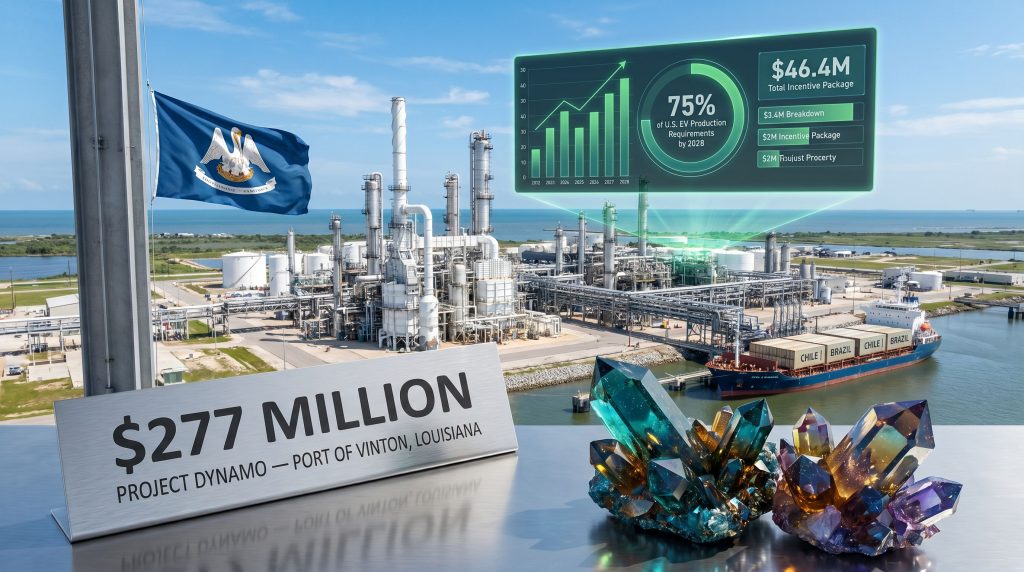
Aclara Resources, listed on the Toronto Stock Exchange, has committed approximately $277 million in capital investment toward the construction of a heavy rare earth separation facility at the Port of Vinton in Calcasieu Parish, Louisiana. The project, designated internally as Project Dynamo, represents the commercial-scale realisation of separation chemistry that Aclara has been developing and validating at a pilot plant facility located at Virginia Tech in Virginia.
This staged development model is worth examining more closely. Pilot-scale separation work at a university facility allows a company to refine its solvent extraction circuits, optimise reagent consumption, and characterise the behaviour of its specific ore chemistry before committing to full-scale capital expenditure. The Virginia Tech connection provides technical credibility to the commercial-scale design and reduces the technology execution risk that would otherwise shadow a first-of-kind facility.
The feedstock for the Louisiana plant will be sourced from Aclara's rare earth projects located in Chile and Brazil, two jurisdictions with established mining regulatory frameworks and existing bilateral trade relationships with the United States. By anchoring its upstream supply in South America rather than relying on Chinese-controlled rare earth concentrates, the supply chain architecture is deliberately structured to create a fully non-Chinese mine-to-magnet pathway, from ore extraction through to separated oxide production destined for advanced technology manufacturing. In addition, America's rare earth supply chain considerations have made this kind of domestically rooted infrastructure increasingly urgent for policymakers.
Dissecting the $46.4 Million Louisiana Incentive Package
The Aclara Louisiana rare earth processing plant tax exemptions form the centrepiece of a broader incentive structure assembled by Louisiana Economic Development (LED). Receiving final government approval in June 2026, the total package spans four distinct programmes and carries a combined estimated value of approximately $46.4 million.
| Incentive Programme | Benefit Type | Estimated Value | Duration |
|---|---|---|---|
| Industrial Tax Exemption Program (ITEP) | 80% ad valorem property tax exemption | $29.3 million | 5 years + 5-year renewal option |
| High Impact Jobs Program (HIP) | Performance-based wage grants (18-22% of wages) | $11.6 million | 3 years + 2-year renewal option |
| Performance-Based Infrastructure Grant | Utility and road improvement reimbursements | $3.0 million | One-time |
| LED FastStart | Customised workforce recruitment and training | $2.5 million | One-time |
| Total Package | $46.4 million |
The ITEP: Why Property Tax Relief Matters Most in Year One
The Industrial Tax Exemption Program provides qualifying manufacturing facilities with an 80% exemption on ad valorem property taxes for an initial five-year term, renewable for a further five years subject to performance criteria. For the Aclara facility, this translates to approximately $29.3 million in avoided property tax obligations across the initial exemption window, generating savings of roughly $4.2 million per year.
For a capital-intensive greenfield project of this scale, the timing of this relief is as important as its magnitude. Rare earth separation facilities carry exceptionally high fixed asset values relative to their early-stage revenue generation. During the engineering, permitting, construction, and commissioning phases, a facility is accumulating significant capital on its balance sheet while producing no commercial output. Property tax obligations during this window represent a purely cash-consumptive burden. The ITEP converts that burden into deferred savings, effectively extending the financial runway available for completing construction and reaching first production.
Wage Grants and Workforce Development: Solving the Skills Gap
The High Impact Jobs Program allocation of $11.6 million addresses one of the least-discussed risks in domestic rare earth processing development: the absence of a trained technical workforce. Solvent extraction operators, hydrometallurgical engineers, and rare earth chemistry specialists are not drawn from a large talent pool in the United States. The HREE industry's near-total absence from American soil for several decades means that domestic expertise has atrophied.
The HIP's performance-based wage grants, equivalent to 18-22% of qualifying employee wages over three years, function as a direct subsidy to workforce establishment costs. Combined with the $2.5 million LED FastStart allocation for customised recruitment pipelines and technical training, these programmes collectively address the human capital deficit that any first-of-kind industrial facility must overcome. The rare earth processing challenges associated with skills shortages have long been underestimated in industry planning.
- LED FastStart is specifically designed for industries requiring specialised skills not available in the existing local workforce
- The programme covers curriculum development, recruitment support, and pre-employment training at no cost to the employer
- For rare earth processing specifically, this could include hydrometallurgy fundamentals, chemical plant safety certification, and solvent extraction process operations
Infrastructure Grants: Removing the Greenfield Cost Penalty
The $3.0 million performance-based infrastructure grant targeting utility connections and road improvements addresses a cost category that consistently inflates greenfield industrial project budgets. Connecting a new processing facility to adequate power, water, and wastewater infrastructure at an undeveloped port site involves capital outlays that generate no productive asset for the project itself. By reimbursing these costs, Louisiana removes a structural disadvantage that greenfield sites carry relative to brownfield development options.
Why Louisiana Outcompeted Over 100 U.S. Sites
The selection of Calcasieu Parish followed a competitive evaluation process involving more than 100 candidate locations across the United States. Understanding why Louisiana prevailed reveals the specific combination of factors that rare earth separation facilities require, and that most U.S. states cannot simultaneously offer.
| Competitive Factor | Louisiana Advantage |
|---|---|
| Chemical industry infrastructure | Deep Gulf Coast industrial base with directly relevant processing expertise |
| Port logistics | Port of Vinton provides maritime access for South American feedstock import |
| Incentive comprehensiveness | Bundled ITEP, HIP, infrastructure grants, and workforce training in a coordinated package |
| Workforce availability | Established chemical processing labour pool throughout the Gulf Coast region |
| Regulatory coordination | State-level alignment through Louisiana Economic Development |
The Gulf Coast's existing petrochemical and chemical processing industry is a particularly underappreciated advantage. The operational culture, safety frameworks, equipment supply chains, and workforce skill sets associated with large-scale chemical processing in Louisiana translate directly into rare earth hydrometallurgical operations in ways that manufacturing-focused or logistics-focused competing sites cannot replicate.
The EV Supply Chain Equation and the 2028 Target
Louisiana officials have projected that output from the Port of Vinton facility could satisfy up to 75% of U.S. electric vehicle production requirements for heavy rare earth oxides by 2028, a figure that reflects the outsized impact a single domestic separation facility can have in a market where the current domestic supply is effectively zero.
This projection should be interpreted as a scenario estimate contingent on the facility reaching targeted production capacity on schedule. Readers should note that projections of this nature involve assumptions about EV production ramp rates, magnet demand intensity per vehicle, and facility output timelines, all of which carry execution and market risk.
The end-use breakdown for separated heavy rare earth oxides from the Louisiana facility spans several high-growth sectors. Consequently, the energy transition minerals debate is increasingly anchored around exactly these downstream separation capabilities:
- Electric vehicles: Dysprosium and terbium additions to NdFeB motor magnets for thermal stability
- Wind turbines: Rare earth permanent magnets in direct-drive generator configurations
- Defence systems: Guidance, propulsion, and communications hardware with rare earth magnet dependencies
- Robotics: Precision servo motors requiring high-energy-density permanent magnets
- Advanced electronics: Specialty applications including sensors, actuators, and displays
The next major ASX story will hit our subscribers first
Construction Timeline and Pre-Groundbreaking Milestones
The targeted Q4 2026 groundbreaking date establishes a clear near-term deliverable, but reaching that milestone requires the completion of several sequential workstreams currently underway.
- Completion of detailed engineering and process design specifications
- Finalisation of environmental permitting and operational licensing
- Closure of project financing arrangements at commercial scale
- Procurement of long-lead construction and processing equipment
- Workforce recruitment initiation through the LED FastStart programme
- Utility and road infrastructure improvement works funded by the state grant
Each of these workstreams carries its own execution timeline and risk profile. Environmental permitting for a hydrometallurgical processing facility involves regulatory review of chemical storage, wastewater discharge, and air quality impacts, processes that do not move on fixed schedules. Project financing at $277 million scale for a first-of-kind facility in a sector without a recent domestic track record represents a genuinely complex capital markets exercise.
China's Refining Dominance: The Structural Problem This Facility Addresses
China controls an estimated 85-90% of global rare earth separation and refining capacity, a position built over three decades of deliberate industrial policy, subsidised processing infrastructure, and tolerance for the environmental costs associated with rare earth hydrometallurgy. This concentration creates a structural vulnerability that extends well beyond simple trade policy risk.
Even countries that mine rare earth ores domestically have historically been unable to bypass Chinese refining infrastructure. Australian, Canadian, and American rare earth mining projects have frequently found themselves shipping concentrates to China for processing because no viable alternative refining pathway existed at commercial scale. The resulting dynamic effectively neutralises the supply chain diversification benefits of upstream mining investment.
The distinction between light and heavy rare earth dependency is critical here. Light rare earth refining capacity exists in small quantities outside China, including at facilities in Estonia and Malaysia. Heavy rare earth separation at commercial scale is almost exclusively a Chinese capability. However, the critical minerals coalition movement among Western nations has begun to generate the political will necessary to fund alternatives. Project Dynamo is specifically targeting this more acute gap, positioning the facility as a foundational piece of infrastructure rather than an incremental addition to existing capacity.
Key Takeaways for Industry Watchers
- The $46.4 million incentive package is structured to reduce financial risk across the three highest-cost phases of a greenfield rare earth facility: capital carrying costs, workforce establishment, and infrastructure connection
- Property tax relief of approximately $4.2 million per year provides meaningful cash flow support during the pre-revenue construction and commissioning period of a $277 million capital project
- The Virginia Tech pilot plant provides technical validation that de-risks the commercial-scale separation process design
- South American feedstock sourcing from Chile and Brazil creates a supply chain architecture that avoids Chinese upstream dependency at every stage
- The Q4 2026 groundbreaking target positions the facility to contribute to EV and defence supply chains within a strategically relevant timeframe, contingent on financing and permitting milestones being achieved on schedule
- Louisiana's success in this competitive evaluation demonstrates that coordinated state-level industrial incentive stacking can offset the cost advantages of international processing locations when the package is sufficiently comprehensive
Disclaimer: This article contains forward-looking projections, including production capacity estimates and supply chain coverage figures, that are subject to execution risk, market conditions, regulatory outcomes, and financing availability. Nothing in this article constitutes financial or investment advice. Readers should conduct independent due diligence before making any investment decisions related to companies or projects discussed herein.
Want to Track the Next Major Minerals Discovery Before the Market Moves?
Discovery Alert's proprietary Discovery IQ model delivers real-time alerts on significant ASX mineral discoveries across critical minerals and rare earth sectors, transforming complex data into actionable investment insights — explore the historic returns major discoveries have generated and begin a 14-day free trial at Discovery Alert to position yourself ahead of the broader market.