
July 25, 2026
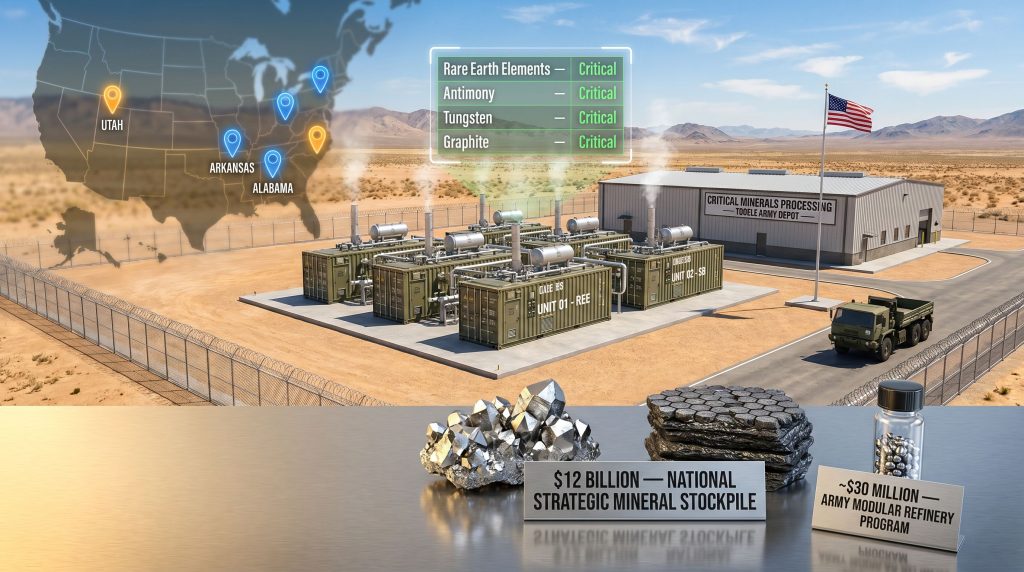
The Geopolitics of Ground: Why Mineral Security Now Starts at the Base Gate
For decades, the prevailing assumption in Western defence planning was that global commodity markets would reliably supply whatever raw materials modern militaries required. That assumption has been systematically dismantled over the past five years. Export controls, diplomatic friction, and deliberate supply chain weaponisation have exposed a structural vulnerability at the heart of US army bases critical minerals plants strategy — one that no amount of stockpiling can permanently solve. The real question facing US defence planners is no longer how much to stockpile, but where to build the capacity to produce materials on demand, regardless of what happens in Beijing.
The answer, increasingly, is to build that capacity on federal land already under military control.
When big ASX news breaks, our subscribers know first
How Dependent Is the US on Foreign Critical Minerals?
The China Supply Chain Problem in Numbers
The scale of US import dependency on processed critical minerals is not a theoretical concern. It is a measurable operational vulnerability, with specific materials carrying specific risk profiles tied directly to defence readiness. The critical minerals demand surge that has emerged in recent years has only intensified these pressures across Western allied nations.
| Critical Mineral | Primary Defence Use | US Import Reliance | Strategic Risk Level |
|---|---|---|---|
| Rare Earth Elements | Defence magnets, guidance systems | High | Critical |
| Graphite | Battery anodes, defence electronics | Very High | Critical |
| Antimony | Ammunition, armour, flame retardants | Extreme | Critical |
| Tungsten | Armour-piercing munitions, tooling | High | Critical |
| Lithium | Energy storage, military systems | Moderate-High | Elevated |
| Boron | Armour ceramics, nuclear applications | Moderate | Elevated |
What makes this dependency particularly acute is the concentration of processing capacity. Even where raw ore can be sourced from allied nations, the refining and separation infrastructure is overwhelmingly located in China. The US could theoretically mine domestic rare earth ore and still be functionally dependent on Chinese processors to turn that ore into usable materials for defence magnets.
China's Export Control Escalation and the 2021 Inflection Point
The proximate catalyst for the current Pentagon strategy was not a policy paper. It was a physical supply disruption. China's suspension of antimony exports in 2021 forced the US to draw down its strategic stockpile, creating an immediate operational gap in ammunition and armour supply chains. That single event reframed the internal Pentagon debate, shifting emphasis from passive reserve accumulation toward active domestic production capability.
The strategic environment has continued to deteriorate since then. In mid-2026, China's Commerce Department placed targeted export restrictions directly on US-based rare earth producers, including MP Materials Corp. and USA Rare Earth Inc. This represented an escalation from broad category controls to named-company restrictions — a move that signals a willingness to use mineral access as a precision geopolitical instrument rather than a blunt tariff tool.
The shift from stockpiling to active domestic production is widely understood within defence planning circles as the single most consequential doctrinal change in US mineral security strategy in a generation. Stockpiles deplete. Processing capacity, once built, compounds.
What Is the US Army's Critical Minerals Processing Strategy?
From Reserve Accumulation to On-Site Production
The Pentagon's evolving doctrine now operates across three reinforcing pillars, each addressing a different layer of supply chain vulnerability:
- Modular Refinery Deployment — Containerised, small-scale processing units that can be installed directly at military installations, producing critical minerals on-site without dependence on commercial refinery networks.
- Enhanced Use Leasing (EUL) — A formal legal mechanism allowing the Army to offer underutilised installation land to private operators under long-term leases, activating processing capacity without requiring direct government capital expenditure.
- Equity and Loan Participation — Direct government financial stakes and conditional loans to domestic producers, extending federal influence across the full supply chain from mine to processed output.
The EUL programme was formally activated for critical mineral processing in December 2025, when the Army issued a Request for Information seeking competitive proposals from qualified operators. The programme is explicitly structured to generate revenue for the Army rather than require congressional appropriations, making it fiscally attractive independent of the mineral security rationale.
Key objectives driving EUL deployment:
- Reinforce the national defence critical materials base without commercial market dependence
- Generate installation revenue to fund infrastructure maintenance and upgrades
- Create employment in communities surrounding military installations
- Establish processing capacity that functions regardless of global supply chain conditions
Which US Army Bases Are Hosting Critical Minerals Plants?
A Facility-by-Facility Breakdown
Four companies have reached agreements with the Pentagon to construct mineral processing facilities at military installations. Each targets a specific material with its own distinct defence criticality profile. The emergence of US army bases critical minerals plants marks a genuinely novel chapter in how the federal government approaches industrial security.
| Installation | State | Operator | Mineral Focus |
|---|---|---|---|
| Tooele Army Depot | Utah | REalloys Inc. | Rare Earth Separation |
| Pine Bluff Arsenal | Arkansas | Titan Mining Corp. | Graphite Purification |
| Anniston Army Depot | Alabama | Titan Mining Corp. | Graphite Purification |
| TBD Military Installation | TBD | EnergyX | Lithium Processing |
| TBD Military Installation | TBD | ioneer Ltd. | Boron Processing |
REalloys at Tooele Army Depot: Heavy Rare Earths for Defence Magnets
REalloys Inc. will construct a rare earth separation facility at Utah's Tooele Army Depot, with all output stockpiled on-site exclusively for military consumption. The facility's focus on heavy rare earth elements — specifically terbium and dysprosium — reflects a material priority that is often misunderstood in mainstream coverage.
Heavy rare earths are chemically and functionally distinct from the more commonly discussed light rare earths such as neodymium. Terbium and dysprosium serve as critical dopants in neodymium-iron-boron (NdFeB) permanent magnets, where they perform a specific function: raising the magnet's coercivity so that it maintains its magnetic field at elevated operating temperatures.
Without sufficient terbium and dysprosium content, NdFeB magnets in electric motors and defence platforms degrade in high-heat environments, creating performance failure modes that no amount of additional neodymium can compensate for. Furthermore, the global supply of heavy rare earths is even more geographically concentrated than the broader rare earth supply chains, with China controlling not only processing but a disproportionate share of primary deposit access.
Key details of the REalloys Utah facility:
- REalloys currently operates an alloy production plant in Ohio
- The company works with the Saskatchewan Research Council on heavy rare earth processing technology
- The Utah facility requires no taxpayer funding
- REalloys raised $100 million through a private placement of common stock to fund the initiative
Titan Mining's Dual-Base Graphite Network: Geographic Redundancy by Design
Titan Mining Corp., backed by Canadian mining billionaire Richard Warke, will operate graphite purification facilities at both Pine Bluff Arsenal in Arkansas and Anniston Army Depot in Alabama. The choice to split operations across two installations is not incidental. It creates explicit geographic redundancy in the graphite supply chain, ensuring that a single facility disruption cannot eliminate domestic processing capacity.
Graphite's role in defence applications is broader than its battery anode profile suggests. High-purity graphite is used in nuclear reactor moderators, as a lubricant in extreme-environment mechanical systems, and in carbon-carbon composites for hypersonic vehicle thermal protection. The purity standards required for these defence applications — typically exceeding 99.95% carbon content — are significantly more demanding than battery-grade specifications and require specialised purification processes beyond standard commercial graphite production.
Titan holds graphite and zinc project interests in New York State, giving the company an integrated domestic position that spans both raw material access and downstream processing.
ioneer's Boron Plant: Allied-Nation Expertise in the Onshoring Framework
Sydney-headquartered ioneer Ltd. is the sole non-US company among the four confirmed Pentagon partners. Its inclusion in the boron processing agreement carries a signal that many commentators have overlooked: the onshoring strategy is not purely protectionist in character. Where allied-nation companies possess demonstrated technical capability in a strategically critical mineral, they can be incorporated into the domestic processing architecture.
Boron's defence relevance extends well beyond its civilian industrial profile. It is a primary component in ceramic armour systems, where boron carbide is valued for its exceptional hardness-to-weight ratio. It also has critical applications in nuclear shielding and neutron absorption, making it irreplaceable in both reactor and warhead-adjacent technologies.
How Does the Modular Refinery Programme Work?
The Container-Sized Refinery: A Technical Overview
Running parallel to the installation leasing programme is the Army's development of modular, containerised processing refineries. Each unit occupies approximately the footprint of four standard intermodal shipping containers and is designed to be deployable at any military installation without requiring permanent infrastructure investment. According to reporting from Reuters, the Pentagon's modular refinery initiative represents one of the most operationally significant shifts in US defence supply chain policy in recent memory.
Programme technical specifications:
- Lead production target: Antimony (first priority mineral)
- Initial annual output capacity: 7–10 metric tonnes
- Programme budget: Approximately $30 million
- Development partners: Idaho National Laboratory (INL) and Perpetua Resources
- Planned expansion sequence: Tungsten, rare earth elements, and boron
The modular design philosophy reflects a broader lesson from the 2021 antimony disruption. Large centralised processing facilities create concentration risk. If a single commercial refinery is disrupted, the entire supply chain fails. Distributed modular capacity means no single point of failure exists.
Why Antimony Is the First Target
Antimony sits at the intersection of multiple defence supply chain vulnerabilities simultaneously. It is a primary ingredient in trioxide flame retardants used throughout military equipment. It is essential in ammunition primers and certain explosive compositions. It appears in night-vision optics through its role in infrared-transmitting materials. Concerns around strategic antimony supply have therefore moved firmly to the centre of Pentagon planning discussions.
China's 2021 suspension of antimony shipments created an immediate, measurable gap in US defence manufacturing capacity. The country that controls antimony processing controls a surprising breadth of military production throughput that rarely receives the same attention as rare earths or lithium — but is operationally just as consequential.
The Army has been explicit that its modular refinery programme is designed exclusively for defence supply, not commercial competition. This matters for market participants: the programme will not flood commercial antimony markets, but its existence provides a strategic floor beneath domestic pricing for defence-grade material.
The Federal Funding Architecture Behind the Strategy
Government Capital Flows Across the Supply Chain
The installation-based processing programme sits within a much larger federal investment architecture that spans extraction, processing, and downstream manufacturing.
| Programme or Initiative | Estimated Value | Purpose |
|---|---|---|
| DoD Equity Stake in MP Materials | $400+ million | Rare earth production and magnet manufacturing |
| Strategic Mineral Stockpile Build | $12 billion (planned) | National critical mineral reserve |
| Conditional Loan to Energy Fuels Inc. | $725 million | Rare earth processing expansion |
| Conditional Loan to Phoenix Tailings Inc. | $500 million | Critical mineral refining capacity |
| USA Rare Earth Funding Accord | $1.6 billion | Mining, processing, and magnet-making capacity |
| Army Modular Refinery Programme | ~$30 million | Containerised antimony and multi-mineral production |
Energy Fuels subsequently agreed to acquire rare-earth magnet supplier Vacuumschmelze GmbH & Co. and associated companies for $1.9 billion — a transaction that will provide processing facilities in Germany and Finland alongside a newly commissioned South Carolina operation. This move extends the US-aligned processing network into Europe, creating geographic diversification at the processing tier that mirrors the installation-level diversification being pursued domestically.
The Executive Order Foundation
The legal basis for the military installation processing programme traces to a critical minerals executive order signed by President Trump in March 2025, which invoked emergency powers to accelerate domestic critical mineral production capabilities. This order provided the statutory mechanism for the Pentagon to repurpose installation land and enter into processing agreements with private operators. No comparable precedent exists in the history of US mineral policy, making this programme genuinely novel as a legal and operational construct.
The next major ASX story will hit our subscribers first
Why Military Bases Solve the NIMBY Problem
Structural Advantages of Federal Land for Processing Infrastructure
Community opposition — commonly framed as the NIMBY problem — has historically been one of the most effective barriers to building mineral processing infrastructure in the United States. Processing facilities face multi-year environmental review timelines, organised local resistance campaigns, and state-level permitting complexity that can delay projects by a decade or terminate them entirely.
Military installations structurally circumvent most of these barriers. As analysts at the American Security Project have noted, securing the critical mineral supply chain is now inseparable from broader national security planning. Consequently, the case for federal land deployment is increasingly difficult to contest on strategic grounds.
- Federal land jurisdiction reduces state and local permitting authority as the primary approval pathway
- Pre-existing security perimeters satisfy defence classification requirements for stockpiled output at no additional cost
- Underutilised land inventory provides immediate deployment sites without acquisition costs or condemnation proceedings
- Established logistics infrastructure reduces transportation costs for defence-use output
- Community economic interest in base-adjacent employment reduces rather than amplifies local opposition
Comparing Processing Location Models
| Factor | Conventional Commercial Site | Military Installation Site |
|---|---|---|
| Community Opposition Risk | High to Very High | Negligible |
| Permitting Timeline | 5–15 years (typical) | Significantly compressed |
| Land Acquisition Cost | High | Eliminated via EUL lease |
| Security Infrastructure | Must be purpose-built | Pre-existing and operational |
| Supply Chain Destination | Commercial market | Direct-to-defence stockpile |
| Revenue Model | Market price dependent | Defence contract secured |
The G7 Dimension and Allied Coordination
Collective De-Risking Beyond US Borders
The Pentagon's installation-based processing initiative does not operate as a unilateral policy. In mid-2026, G7 nations formally committed to reducing collective reliance on Chinese critical mineral imports, creating a coordination framework that aligns with the US military processing expansion without duplicating it.
Several concurrent geopolitical developments reinforce the strategic environment driving this programme:
- China's targeted export restrictions on named US rare earth producers represent an escalation from systemic to precision supply chain pressure
- Congo's strategic pivot toward Western mineral partnerships, as Chinese operator influence is reduced, opens new upstream supply options for US-aligned processors
- Energy Fuels' European acquisition creates a transatlantic processing network that extends the reach of US-aligned mineral supply chains
- The G7 de-risking commitment provides diplomatic cover for allied-nation companies like ioneer to participate in US military processing programmes without triggering protectionist objections
What This Means for Investors and Industry Participants
Reading the Signal in the Structure
For investors tracking critical mineral equities, the US army bases critical minerals plants programme carries several non-obvious implications worth examining carefully.
First, the programme creates a dual-market structure for certain minerals. Commercial market prices will continue to reflect supply-demand dynamics in civilian applications. However, a parallel, defence-funded processing sector is now being constructed that operates on a different logic entirely — one where cost competitiveness matters less than supply certainty.
Second, the inclusion of allied-nation companies like ioneer signals that technical capability and geopolitical alignment are the primary selection criteria, not nationality. This opens the programme to a broader universe of potential participants than a strictly domestic-only framework would suggest.
Third, the modular refinery programme's budget of approximately $30 million is conspicuously small relative to the strategic value of the output it targets. This suggests the programme is designed as a proof-of-concept deployment that can be rapidly scaled if the technology performs as projected, with substantially larger capital commitments to follow.
Investors should treat this programme not as a one-time policy initiative but as the leading edge of a structural reorientation of how the US government approaches mineral supply security. The capital flows disclosed so far are most likely a floor, not a ceiling.
Frequently Asked Questions
Will Installation Processing Facilities Sell Minerals Commercially?
No. The Army has confirmed that output from installation-based facilities is designated exclusively for defence stockpiling and military consumption. These facilities are not designed to compete with, or supply, commercial mineral markets.
Which Minerals Are Currently Prioritised?
The active programme targets rare earth elements (with heavy rare earth emphasis), graphite, lithium, boron, antimony, and tungsten. Selection criteria reflect a combination of defence criticality and concentration of processing capacity in geopolitically adversarial or unstable source nations.
Are Non-US Companies Eligible?
Yes. ioneer Ltd., an Australian company headquartered in Sydney, is among the four confirmed Pentagon partners. Allied-nation alignment and demonstrated technical processing capability are treated as qualifying factors.
What Is the Timeline for Operational Production?
No official production timelines have been publicly confirmed for any of the four installation facilities. The modular antimony refinery, developed in partnership with Idaho National Laboratory, represents the most technically advanced initiative in terms of readiness, given its containerised design and pre-existing laboratory partnership structure.
Does the EUL Programme Require Congressional Appropriations?
The EUL-based leasing structure is designed to generate revenue for the Army rather than draw on appropriated funds. The REalloys facility at Tooele Army Depot has been specifically confirmed to require no taxpayer funding, with REalloys having raised $100 million through private capital markets to finance the project.
Disclaimer: This article contains forward-looking statements and projections relating to US government policy, mineral processing programmes, and investment implications. These represent analytical assessments based on publicly available information and should not be construed as financial advice. Programme timelines, budgets, and strategic priorities are subject to change. Readers should conduct independent research before making investment decisions based on any information contained herein.
Want to Track the Next Major Mineral Discovery Before the Broader Market Does?
Discovery Alert's proprietary Discovery IQ model delivers real-time alerts on significant ASX mineral discoveries — cutting through complex data across more than 30 commodities to surface actionable opportunities the moment they are announced. Explore Discovery Alert's dedicated discoveries page to understand how historic mineral discoveries have generated substantial returns, and begin your 14-day free trial today to position yourself ahead of the market.