July 24, 2026
The Industrial Waste Stream That Could Reshape Global Rare Earth Supply Chains
Across the world's aluminium refineries, hundreds of millions of tonnes of caustic red-brown sludge sit in containment ponds, slowly accumulating year after year. For most of industrial history, this material, known as bauxite residue or red mud, has represented little more than an expensive liability. Costly to store, difficult to neutralise, and environmentally hazardous, red mud has been the unwanted consequence of a process that extracts alumina from bauxite ore using caustic soda, leaving behind a highly alkaline slurry with a pH between 10 and 13.
What is changing, rapidly and materially, is how the world's critical mineral strategists are beginning to view this same material. Embedded within red mud are measurable concentrations of rare earth elements (REEs), iron oxide, titanium-bearing compounds, and other commercially valuable substances. The challenge was never geological scarcity. The challenge was always extracting those elements economically and at scale. That challenge is now being directly addressed by the Enervoxa India rare earths project, a commercial initiative that could simultaneously resolve an industrial waste problem and contribute to one of the most strategically important supply chain gaps of the 21st century.
When big ASX news breaks, our subscribers know first
Red Mud: From Environmental Liability to Critical Mineral Feedstock
To understand the opportunity, it helps to understand the Bayer process that creates red mud in the first place. Bauxite ore is dissolved in hot sodium hydroxide solution under pressure, which separates aluminium-bearing compounds from the remaining silica, iron, titanium, and other elements. What precipitates out as waste is red mud, named for its characteristic colour derived from high iron oxide content.
India's position in this story is structurally significant. The country ranks as the world's second-largest aluminium producer and its third-biggest consumer, meaning its refineries generate enormous red mud volumes annually. Eastern India, particularly the states of Odisha and Jharkhand, hosts concentrated bauxite refining capacity, making the region both a logical feedstock source and a natural focus for processing infrastructure development. Furthermore, bauxite production trends in this region continue to reinforce India's strategic position.
Critically, Indian bauxite residues from these regions are understood to carry REE concentrations that may support commercial extraction economics. This is not universally true of all red mud globally. REE grade varies considerably depending on the origin of the bauxite ore feed, making source-specific assay data an essential prerequisite for any definitive feasibility determination.
The concentration of rare earths in red mud is typically lower than in conventional hard rock deposits, but the absence of mining costs, the continuous feedstock supply, and the waste remediation co-benefit create an economic structure that is genuinely different from greenfield mine development.
What the Enervoxa India Rare Earths Project Actually Proposes
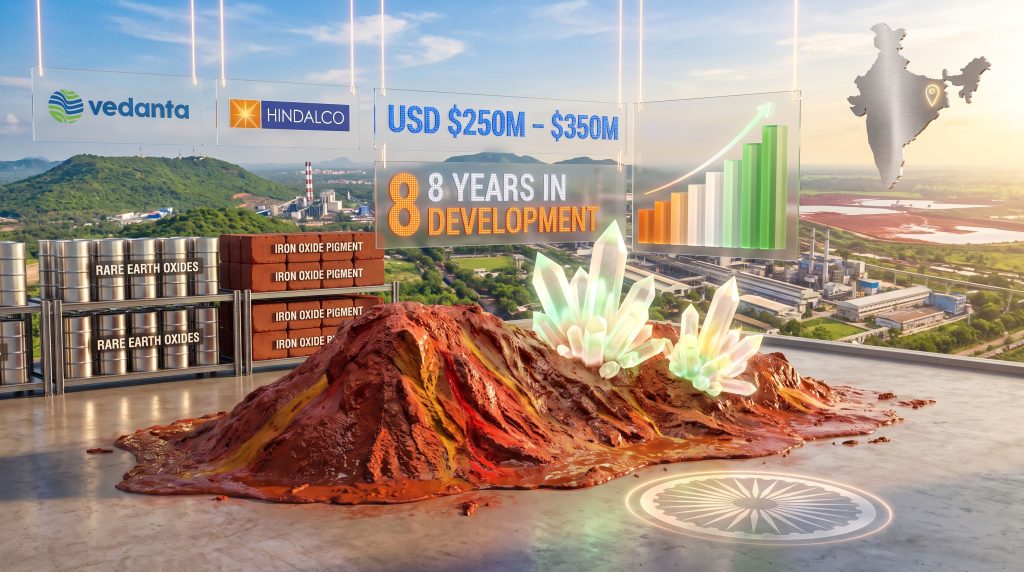
Enervoxa is a Canadian climate technology company that has spent approximately eight years developing a proprietary process to recover rare earth concentrates from bauxite residue. That development timeline is important context: it reflects the technical complexity of selectively leaching REEs from a matrix that is simultaneously rich in iron, titanium, silica, and sodium compounds, all of which can interfere with extraction chemistry.
The company is now moving toward commercial evaluation of an Indian processing facility, with a focus on eastern India. Two structural models are under active consideration:
- Full in-country processing — complete rare earth extraction, separation, and refining within India, maximising domestic value capture
- Concentrate production model — producing a mixed rare earth concentrate in India for downstream refining at a dedicated external facility in Canada, the US, or a partner nation
The project's commercial logic does not rest solely on rare earth revenues. Red mud processing yields multiple recoverable product streams:
- Iron oxide (with potential crossover demand from steel manufacturers)
- Coagulants (used in water treatment applications)
- Pigments (industrial and commercial uses)
- Titanium-bearing compounds (precursor materials for titanium dioxide and downstream applications)
This multi-product recovery architecture is central to the project's economic viability thesis. In isolation, rare earth revenues alone may not justify the capital outlay. Together, the combined product streams create a more robust return profile.
Capital Structure and Project Parameters
| Parameter | Detail |
|---|---|
| Estimated Plant Cost | USD $250 million to $350 million |
| Financing Approach | Strategic equity combined with project financing |
| Project Stage | Commercial evaluation and partnership discussions |
| Target Location | Eastern India |
| Technology Development Period | Approximately 8 years |
| Lead Entity | Enervoxa (Canada) |
The Partnership Architecture: Why Vedanta, Hindalco, and NALCO Each Matter
Enervoxa has indicated plans to initiate discussions with three of India's most significant aluminium sector players. Each brings a distinct strategic value that goes beyond simply supplying red mud feedstock. Among global aluminium producers, these three entities represent some of the most strategically positioned players for this kind of initiative.
Vedanta operates one of India's largest diversified natural resource portfolios, with substantial aluminium production capacity. Its scale and corporate financing capability make it a credible strategic equity partner capable of anchoring the capital structure of a $250 million to $350 million facility.
Hindalco Industries, part of the Aditya Birla Group, is a major integrated aluminium producer whose bauxite refining operations generate large red mud volumes. Hindalco's industrial integration means it could provide both feedstock supply and potentially offtake arrangements for iron oxide and other co-products.
NALCO (National Aluminium Company) is India's state-owned aluminium producer. Its involvement introduces a government-linked anchor partner dynamic that could facilitate land allocation and regulatory navigation in eastern India, though no specific government support has been confirmed for this project.
Beyond the aluminium sector, Enervoxa is also approaching engineering firms, steel manufacturers, and critical minerals processors, recognising that the iron oxide component of red mud creates natural demand linkages with the steel industry.
A consortium model involving multiple partners across different industry verticals would distribute capital risk while creating an integrated value chain that links aluminium waste remediation directly to downstream technology manufacturing inputs.
The Technical Process: How Rare Earths Are Recovered From Red Mud
The step-by-step recovery process involves several technically demanding stages, each of which must be optimised for the specific chemistry of the red mud source being processed:
- Feedstock acquisition — Red mud is sourced directly from aluminium refinery tailings storage, eliminating the need for any mining or ore extraction
- Pre-treatment and pH conditioning — The highly alkaline residue must be neutralised and prepared, which itself requires careful reagent management to avoid generating secondary waste streams
- Selective leaching — Chemical reagents are applied to dissolve rare earth elements from the solid matrix while minimising co-dissolution of abundant iron and titanium, which would burden downstream purification
- Solid-liquid separation — The REE-containing leachate is separated from residual solids, which are then processed for iron oxide and other co-product recovery
- Purification and concentration — Solvent extraction or ion exchange processes are applied to concentrate individual rare earth fractions and remove impurities
- Precipitation and product formation — Rare earth compounds are precipitated as mixed concentrates or, in a fully integrated model, as individual separated oxides
- Secondary product recovery — Remaining process streams yield iron oxide, titanium compounds, coagulants, and pigment precursors
One technically important and less commonly understood aspect of this process is that the REE selectivity during leaching is highly sensitive to pH control. At certain pH ranges, iron and aluminium dissolve preferentially, consuming reagents and creating impure leachate. Achieving high REE selectivity while keeping reagent consumption commercially viable is precisely the kind of process challenge that requires years of development to solve, which contextualises Enervoxa's eight-year development timeline. According to mining technology reporting, this process complexity is a key differentiator for the company.
India's Policy Framework: What Exists and What It Means
India has moved deliberately to develop its critical mineral processing capability. The Union Budget 2026-27 announced the establishment of Dedicated Rare Earth Corridors across four states:
| State | Strategic Role |
|---|---|
| Odisha | Mining and processing hub |
| Kerala | Coastal mineral sands and processing |
| Andhra Pradesh | Refining and manufacturing |
| Tamil Nadu | Research, processing, and manufacturing |
The government has also approved a ₹7,280 crore scheme targeting integrated rare earth permanent magnet manufacturing, creating downstream demand for domestically processed rare earths. Meanwhile, NITI Aayog is coordinating research into red mud metal extraction through the Jawaharlal Nehru Aluminium Research Development and Design Centre (JNARDDC), which has been formally tasked with rare earth enrichment research from bauxite residue.
Enervoxa has indicated it intends to seek Indian government assistance, which aligns the project with existing policy architecture. However, no specific government funding, designation, or formal support has been confirmed for the Enervoxa India rare earths project at this stage.
India's overall rare earth position can be understood through the following structural indicators:
| Indicator | India's Current Position |
|---|---|
| Global rare earth reserves | Substantial, among top global holders |
| Aluminium production rank | 2nd largest globally |
| Aluminium consumption rank | 3rd largest globally |
| High-purity REE processing capacity | Minimal at industrial scale |
| Rare earth corridor policy | Announced in 2026-27 Budget |
| Government magnet manufacturing scheme | ₹7,280 crore approved |
In addition, surging critical minerals demand globally is accelerating the urgency for India to develop sovereign processing capacity, further reinforcing the project's strategic timing.
The next major ASX story will hit our subscribers first
Comparing Red Mud Processing Against Conventional Rare Earth Development
One of the least appreciated dimensions of the red mud processing model is how its development timeline and risk profile differ from conventional rare earth mine development. The comparison is instructive:
| Development Pathway | Timeline | Capital Intensity | Feedstock Risk | Environmental Dimension |
|---|---|---|---|---|
| Greenfield rare earth mine | 10-15 years | Very high | Exploration risk | High disturbance footprint |
| Red mud processing (Enervoxa model) | 3-5 years (estimated) | Moderate ($250M-$350M) | Low, continuous industrial waste | Net positive via waste remediation |
| Import-dependent refining | Near-term | Low capex | Very high geopolitical exposure | Low domestic footprint |
| Seabed or unconventional REE | 15+ years | Extreme | High technical uncertainty | Uncertain and contested |
The absence of exploration risk is a genuinely distinctive feature. Conventional rare earth projects can spend years and hundreds of millions of dollars determining whether an orebody is economically mineable. Red mud processing begins with a known, continuously replenished feedstock sitting in an established industrial complex. The uncertainty shifts from geology to chemistry and process engineering, which are generally more tractable problems on shorter timelines.
Furthermore, the red mud model aligns naturally with the green transition raw materials agenda, offering a lower-disturbance pathway to critical mineral supply that conventional mining simply cannot replicate.
Scenario Analysis: Three Pathways to Commercial Operation
Scenario A: Full Domestic Processing
Enervoxa establishes a vertically integrated facility in eastern India with NALCO or Vedanta providing feedstock under long-term supply agreements. Output includes separated rare earth oxides for Indian permanent magnet manufacturers and allied nation export markets. This model maximises India's domestic value capture but requires the highest capital commitment and the most complex regulatory pathway.
Scenario B: Concentrate Export Model
An Indian facility produces mixed rare earth concentrate, which is then shipped to a downstream refinery in Canada, the US, the EU, or Japan for separation. A lower domestic capital requirement and faster path to first revenue result, but India captures less economic value-add internally. This model may be more achievable as a first stage, with domestic separation capacity added in subsequent phases.
Scenario C: Integrated Consortium Value Chain
A multi-partner structure spans aluminium producers for feedstock, engineering firms for construction and operations, steel manufacturers for iron oxide offtake, and government bodies for policy alignment. Most complex to execute but potentially the highest strategic value outcome for India's critical mineral industrial ambitions. This model aligns most closely with NITI Aayog's integrated value chain research mandate.
Key Risks That Investors and Policymakers Should Understand
The Enervoxa India rare earths project carries a distinct risk profile that differs meaningfully from conventional mining projects. Understanding these risks is essential for any investor or policy analyst evaluating the opportunity:
- REE grade variability — Red mud composition differs significantly by bauxite source region. Even within eastern India, variability between refinery sources could affect process performance and economics. Project-specific assay and metallurgical testing data are prerequisites for bankable feasibility
- Capital mobilisation — Raising $250 million to $350 million for a first-of-kind commercial plant requires anchor strategic investors with both appetite and alignment
- Multi-stakeholder regulatory complexity — Critical mineral licensing, environmental approvals for industrial waste processing, and multi-state coordination create a layered approval pathway that could extend timelines materially
- Partnership alignment risk — Vedanta, Hindalco, and NALCO have distinct corporate governance structures and strategic priorities, introducing negotiation complexity
- Downstream market readiness — India's domestic rare earth permanent magnet manufacturing sector remains nascent, making export market access critical to near-term project economics
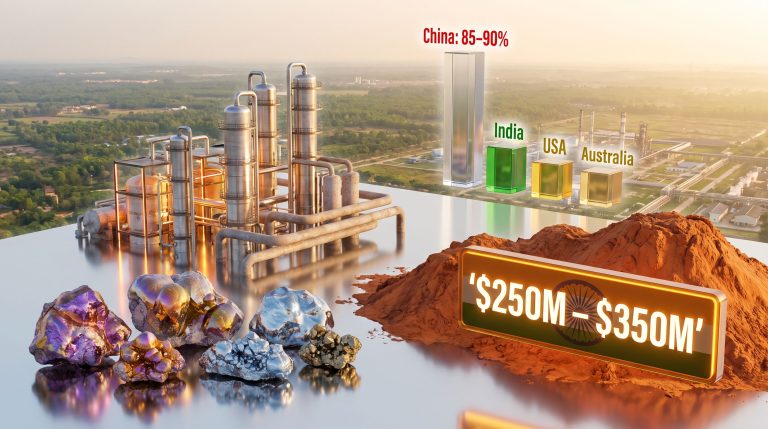
- China pricing dynamics — China controls an estimated 85% to 90% of global rare earth separation capacity and has historically demonstrated willingness to adjust export pricing strategically
The most significant near-term execution risk for the Enervoxa India rare earths project is not process technology. Eight years of development suggests meaningful process confidence. The critical path lies in securing anchor industrial partners and navigating India's multi-stakeholder regulatory and commercial environment within a commercially viable timeframe.
The Global Platform Thesis: India as Proof-of-Concept
Enervoxa's commercial evaluation activity extends well beyond India. The company is simultaneously assessing opportunities in North America, Southeast Asia, and other alumina-producing regions. This signals a platform technology strategy rather than a single-project initiative. India may be the first commercial deployment, but the industrial logic applies wherever large-scale aluminium refining generates red mud accumulations.
Globally, aluminium production generates hundreds of millions of tonnes of red mud annually. Major stockpiles exist at refineries in Australia, Jamaica, Brazil, Greece, and India. If the Enervoxa India rare earths project demonstrates that commercial-scale REE recovery from bauxite residue is technically and economically viable, it carries substantial proof-of-concept value for the entire global industry. The reclassification of red mud from a stored liability to a strategic mineral asset would, consequently, represent a fundamental shift in how aluminium producers account for and manage this material.
Allied governments actively seeking to diversify rare earth supply chains away from Chinese processing dominance — including those in the United States, European Union, Japan, and Australia — have each established critical mineral frameworks that could accommodate red mud processing projects within broader supply chain partnership structures.
India's combination of substantial in-ground rare earth reserves, large-scale aluminium production, growing domestic demand from electric vehicles, defence electronics, and consumer technology, and an increasingly deliberate government policy framework positions it as a potentially significant node in the non-Chinese rare earth supply chain architecture that allied nations are collectively working to build. For further context on India's rare earth opportunity, Yahoo Finance's coverage of the Enervoxa initiative provides useful additional perspective.
Frequently Asked Questions
What is the Enervoxa India rare earths project?
It is a planned commercial initiative by Canadian climate technology company Enervoxa to establish a processing facility in eastern India that recovers rare earth elements and other valuable materials from bauxite residue, the industrial byproduct of aluminium refining commonly called red mud.
How much will the facility cost to build?
A commercial-scale plant is estimated to require between USD $250 million and $350 million in capital, to be funded through a combination of strategic equity investment and project financing arrangements.
Which Indian companies may become partners?
Enervoxa plans to approach Vedanta, Hindalco Industries, and state-run NALCO, as well as engineering companies, steel manufacturers, and critical minerals processors, to develop an integrated value chain.
Why is eastern India the preferred location?
Eastern India hosts concentrated aluminium refining capacity generating substantial red mud volumes, and falls within the Dedicated Rare Earth Corridors announced under India's Union Budget 2026-27.
What products can be recovered from red mud beyond rare earths?
Iron oxide, coagulants, pigments, and titanium-bearing materials are all recoverable from red mud, and their combined revenues are important to the project's overall commercial viability.
How long has Enervoxa been developing this technology?
Approximately eight years have been invested in developing the proprietary process for rare earth recovery from bauxite residue.
Disclaimer: This article is intended for informational purposes only and does not constitute financial or investment advice. All financial figures, timelines, and project parameters referenced reflect information available at the time of writing. Forecasts, scenario analyses, and projections involve inherent uncertainty and should not be relied upon as guarantees of future outcomes. Readers should conduct their own due diligence before making any investment decisions.
Want to Track the Next Major Mineral Discovery Before the Broader Market Does?
Discovery Alert's proprietary Discovery IQ model delivers real-time alerts on significant ASX mineral discoveries across critical minerals, rare earths, and beyond — instantly transforming complex data into actionable investment insights for both short-term traders and long-term investors. Explore Discovery Alert's dedicated discoveries page to understand how historic mineral discoveries have generated substantial returns, and begin your 14-day free trial today to position yourself ahead of the market.