July 30, 2026
The Galilee Basin's Unlikely Frontier: Why Sub-Benchmark Coal Still Finds a Market
Thermal coal markets have always rewarded complexity over simplicity. The commodity does not trade as a single uniform product but as a spectrum of specifications, each finding its buyers based on calorific value, ash content, moisture levels, and ultimately, price. Within that spectrum, low-rank sub-bituminous coals occupy a distinct and often underappreciated position, one where volume, logistics, and price sensitivity matter more than outright quality. It is within this context that the Adani Carmichael mine coal output story becomes genuinely interesting, not simply as a tale of a controversial project, but as a case study in the commercial mechanics of sub-benchmark thermal coal in a rapidly shifting Asian import environment.
When big ASX news breaks, our subscribers know first
What Is the Carmichael Mine and Why Does Its Output Matter?
Located approximately 500 kilometres inland from the Queensland coast within the Galilee Basin, the Carmichael mine sits in one of the world's last significant undeveloped thermal coal frontiers. The Galilee Basin has long attracted attention from mining analysts precisely because its scale is exceptional, yet its remoteness and the economics of overland haulage have historically made commercial development challenging. The mine is operated by Bravus Mining and Resources, a subsidiary of the Adani Enterprises conglomerate, and its export chain flows through the Abbot Point coal terminal, also controlled by Adani, creating a vertically integrated supply corridor from pit to port.
This vertical integration is strategically significant. Owning both extraction and export infrastructure allows the operator to manage throughput economics across the supply chain, though the 500-kilometre overland haulage distance remains a structural cost burden that peers operating in the Bowen Basin or Hunter Valley do not face to the same degree.
Carmichael Mine at a Glance: Key Production Metrics
| Metric | Detail |
|---|---|
| Location | Galilee Basin, Queensland, Australia |
| Distance to Port | ~500km to Abbot Point |
| Coal Type | Thermal (sub-bituminous) |
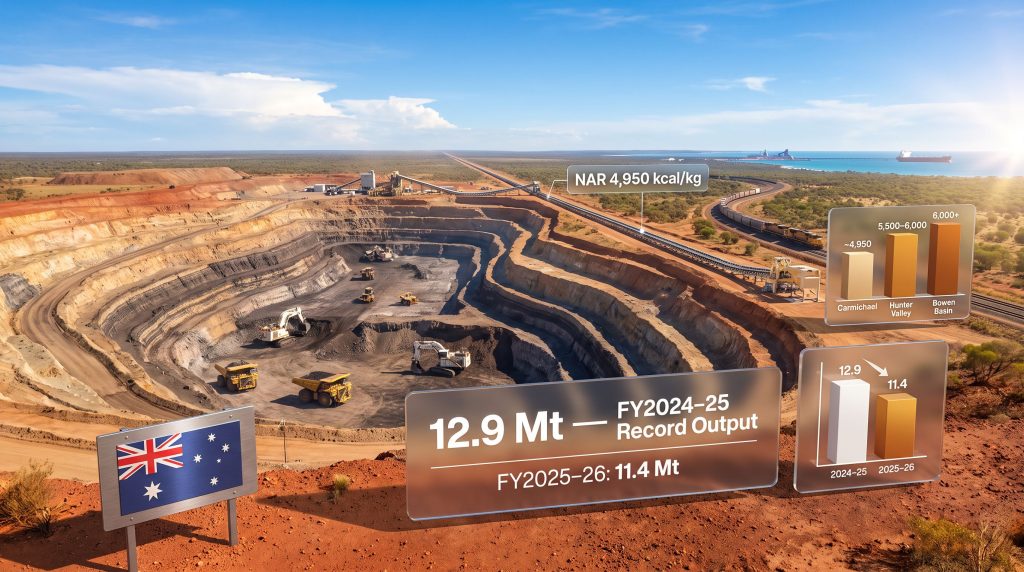
| Average Calorific Value | ~NAR 4,950 kcal/kg |
| Stage 1 Design Capacity | ~10 million tonnes per annum (Mtpa) |
| Original Project Design | 60 Mtpa (pre-scaled) |
| FY2023–24 Output | ~11.2 million tonnes |
| FY2024–25 Output | 12.9 million tonnes (record) |
| FY2025–26 Output | 11.4 million tonnes (~11% below record) |
Key Insight: Carmichael coal's calorific value of approximately NAR 4,950 kcal/kg sits meaningfully below the standard Australian export benchmark of NAR 5,500 to 6,000 kcal/kg produced in the Hunter Valley and Bowen Basin. This specification gap is not incidental — it defines the mine's entire market strategy, buyer profile, and pricing dynamics.
How the Carmichael Project Evolved from 60 Mtpa Vision to 10 Mtpa Reality
The project's origins trace back to the early 2010s, when the Galilee Basin was being marketed as the next great chapter in Australian thermal coal exports. Original project documentation envisaged a maximum extraction rate of 60 million tonnes per annum, a figure that, if realised, would have made Carmichael one of the largest coal mines on earth by output. That ambition was progressively scaled back to a first-stage commercial target of approximately 10 Mtpa, reflecting a combination of financing constraints, prolonged regulatory approvals, and a materially changed global energy financing environment in which ESG-linked lending restrictions severely curtailed institutional support for new coal infrastructure.
Intermediate expansion phases, targeting throughput of up to 27 Mtpa, have been discussed in project documentation but remain commercially aspirational rather than operationally imminent. The gap between the original 60 Mtpa ceiling and current 10 to 12 Mtpa operations is one of the starkest examples in recent mining history of how macro-level forces can fundamentally compress a project's commercial trajectory. Furthermore, coal supply challenges across global markets have added another layer of complexity to expansion planning for operations of this nature.
Quarter-by-Quarter Output: FY2025–26 in Focus
| Quarter | Production (Mt) | Sales (Mt) |
|---|---|---|
| January–March 2026 | 1.9 | 2.1 |
| April–June 2026 | 3.1 | 2.7 |
| Year-on-Year Change (Q4) | +7% production | +17% sales |
The April to June 2026 quarter delivered the strongest sequential improvement of the financial year, with production rising 7% year-on-year to 3.1 million tonnes and sales climbing 17% year-on-year to 2.7 million tonnes, according to data reported by Adani Enterprises on 29 July 2026. However, that quarterly momentum was insufficient to offset weaker output earlier in the fiscal year. Full-year production for FY2025–26 reached 11.4 million tonnes, an approximately 11% decline from the record 12.9 million tonnes produced in FY2024–25. Annual sales eased by around 8% year-on-year to 11.5 million tonnes.
Open-cut mining operations in inland Queensland are subject to seasonal variability, including wet season disruptions that can compress productive quarters, particularly in the first half of the fiscal year. This seasonal dynamic helps explain why the back-end of FY2025–26 showed stronger momentum even as the full-year result disappointed relative to the prior record.
Understanding the NAR 4,950 kcal/kg Specification and Its Market Implications
To understand Carmichael's commercial positioning, it is essential to understand what Net As Received (NAR) calorific value means in practice. NAR measures the usable energy content of coal accounting for the moisture it contains when delivered to the buyer. A higher NAR value means more energy per tonne, which translates to lower fuel consumption per unit of electricity generated. For power utilities operating with boilers designed around specific heat input requirements, fuel specification is not simply a preference but an engineering constraint.
Australian and Competing Coal Grades Compared
| Coal Grade | Calorific Value (NAR kcal/kg) | Primary Market |
|---|---|---|
| Carmichael (Galilee Basin) | ~4,950 | South/Southeast Asian utilities |
| Hunter Valley Standard | 5,500–6,000 | Northeast Asia, India |
| Bowen Basin Premium | 6,000+ | Japan, Korea, Taiwan |
| Indonesian GAR 4,200 | ~4,200 | India, Southeast Asia |
Carmichael's specification places it in direct competition with Indonesian low-rank product, particularly the widely traded GAR 4,200 kcal/kg grade. Indonesian suppliers benefit from significantly shorter shipping distances to Indian and Southeast Asian ports, which translates into freight cost advantages on a delivered basis. Carmichael's ability to compete rests on price discovery at the loading port and on the willingness of price-sensitive Asian utilities to accept the slightly higher calorific value relative to Indonesian alternatives.
A lesser-known aspect of sub-benchmark coal trading is the concept of calorific value adjustment pricing, where buyers calculate delivered cost per gigajoule rather than per tonne. On that basis, Carmichael coal at NAR 4,950 kcal/kg offers a meaningful efficiency premium over GAR 4,200 Indonesian product, which can partially offset Australia's freight disadvantage for certain buyers with flexible boiler configurations.
The Abbot Point Logistics Equation
Vertical integration between the Carmichael mine and the Abbot Point terminal provides operational control over the export chain, but it does not eliminate the cost reality of 500 kilometres of overland haulage. The Carmichael rail line, built specifically to connect the mine to Abbot Point, was itself a major infrastructure undertaking. Port capacity at Abbot Point effectively defines the ceiling on how much Carmichael coal can reach export markets, and any expansion of mine output toward intermediate targets of 27 Mtpa would require confidence that port throughput capacity can absorb the additional volumes without significant further capital expenditure.
The Production-Trading Divergence: Two Different Stories Within One Conglomerate
Perhaps the most analytically interesting dynamic emerging from Adani's latest quarterly data is the sharp divergence between its upstream mining performance and its downstream coal trading business. While the Carmichael mine posted a 7% year-on-year increase in quarterly production, the group's coal trading division recorded a 35% decline in sales volumes over the same April to June 2026 period, according to Argus Media reporting. This divergence is not coincidental. It reflects fundamentally different demand signals operating at different points in the supply chain.
Coal Trading Volume Collapse: Structural or Cyclical?
| Period | Trading Sales Volume | Change |
|---|---|---|
| April–June 2025 | 12.8 million tonnes | Baseline |
| January–March 2026 | 9.3 million tonnes | Sequential decline |
| April–June 2026 | 8.3 million tonnes | –35% YoY |
The trading division's 35% volume contraction outpaced even the broader decline in India's total thermal coal imports, which fell approximately 20% year-on-year to 38.97 million tonnes in the April to June 2026 quarter, according to data from shipping agency Interocean. Adani's trading business primarily serves India's private-sector and state-owned power utilities through competitive tender participation, meaning it operates in a segment acutely sensitive to domestic coal availability. Consequently, the latest coal price update signals from benchmark markets have added further uncertainty to short-term trading volume projections.
The underlying cause is well-documented. Coal India, which supplies approximately 80% of India's domestic coal demand, entered FY2026–27 with pithead stockpiles of around 130 million tonnes. In the April to June 2026 quarter alone, Coal India liquidated approximately 28.3 million tonnes from those stocks, leaving just over 100 million tonnes at pitheads by the end of the quarter. When domestic inventory buffers of this scale exist, utilities have little incentive to participate actively in seaborne tenders, particularly when freight costs add an additional delivered cost layer.
India's Paradoxical Power Situation
What makes India's import suppression particularly striking is that it coincides with record levels of coal-fired electricity generation. Coal-fired generation reached 92.6 TWh over 1 to 25 July 2026, up 12% from the same period in 2025, driven by a weak monsoon reducing hydropower availability and elevating cooling demand. Combined dispatches to the power sector from Coal India, Singareni Collieries, and captive and commercial producers rose 4.6% year-on-year to 70.92 million tonnes in June 2026 alone.
Yet despite this surge in coal consumption, seaborne import demand has remained subdued. Power plant inventories stood at 39.22 million tonnes as of late July 2026, down 28% year-on-year but still representing approximately 13 days of consumption cover, according to Central Electricity Authority data. Industry analysts have noted that a government directive to mandatorily raise imports becomes probable only if combined power plant stocks fall below 30 million tonnes, a threshold that had not yet been breached as of the reporting period.
Strategic Insight: The paradox of record coal burn failing to translate into higher seaborne demand illustrates a critical dynamic for Carmichael's primary market: domestic coal buffer management in India can decouple import volumes from generation volumes for extended periods, creating structural demand uncertainty for offshore suppliers regardless of physical power sector conditions.
How Seaborne Coal Prices Are Shaping Carmichael's Revenue Environment
While volume trends have been challenging, the price environment across the April to June 2026 quarter provided meaningful revenue support. Argus-assessed Australian NAR 5,500 kcal/kg coal averaged $96.39 per tonne FOB Newcastle during the quarter, representing a 41% increase from the same quarter in 2025. The most recent assessment available at the time of reporting placed the benchmark at $93.73 per tonne FOB Newcastle as of 24 July 2026.
Carmichael's sub-benchmark NAR 4,950 product trades at a discount to the Newcastle benchmark, with the discount typically reflecting both the calorific value differential and the competitive dynamics of the sub-5,000 kcal/kg market segment. Illustrative revenue scenarios based on typical discount structures are outlined below.
Price Sensitivity Analysis: Carmichael's Revenue Under Different Scenarios
| Price Scenario (NAR 5,500 Benchmark) | Estimated Carmichael Discount Grade | Quarterly Revenue Implication (3.1 Mt) |
|---|---|---|
| $70/t (bear case) | ~$55–60/t | ~$170–186 million |
| $96/t (April–June 2026 actual) | ~$75–82/t | ~$233–254 million |
| $115/t (bull case) | ~$90–100/t | ~$279–310 million |
Note: Discount estimates are illustrative, based on typical sub-benchmark grade differentials. Actual realised prices are not publicly disclosed by the operator.
The competing GAR 4,200 kcal/kg Indonesian market, which is Carmichael's closest substitute in price-sensitive Asian markets, came under pressure after reaching a three-year high in mid-June 2026. Sluggish pricing in that segment prompted opportunistic purchasing from Indian trading firms, creating a competitive environment that constrains Carmichael's ability to capture premium pricing within the sub-benchmark segment. In addition, freight rate escalations linked to geopolitical tensions in the Middle East have added delivered cost pressure for Indian buyers weighing seaborne purchases against domestic inventory drawdown. Australia's resource exports more broadly have faced similar headwinds as shifting freight dynamics weigh on delivered competitiveness across multiple commodity classes.
The next major ASX story will hit our subscribers first
Long-Term Expansion Scenarios and the Risks Shaping Each Pathway
Three distinct futures are credibly conceivable for the Adani Carmichael mine coal output trajectory, each dependent on a different configuration of market, regulatory, and operational variables.
Scenario 1: Steady-State Operation at 10 to 12 Mtpa. The most probable near-term outcome given current market conditions. At this scale, the operation generates commercial returns during periods of benchmark price strength while remaining exposed to demand suppression from Indian domestic coal availability. ESG-linked financing constraints continue to limit access to capital for expansion.
Scenario 2: Phased Expansion Toward 27 Mtpa. This intermediate target appears commercially feasible in theory but faces significant practical barriers, including Abbot Point port capacity constraints, the capital cost of production scale-up, and the need for sustained above-$90 per tonne benchmark pricing to justify the investment case. Market absorption capacity for additional low-rank Australian thermal coal would also need to be demonstrated in a supply-competitive environment where Indonesian producers defend market share aggressively.
Scenario 3: The Original 60 Mtpa Vision. This ambition has effectively transitioned from an operational target to a theoretical ceiling. The combination of ESG financing barriers, structural changes to global coal demand forecasts through 2035, the Indian domestic coal growth trajectory, and competitive dynamics from Indonesian producers makes full-scale Galilee Basin development commercially implausible under current and projected energy transition conditions. Global bulk commodity trade disruptions have further undermined the case for large-scale greenfield coal development in this environment.
Key Risk Factors Across All Scenarios
- Demand risk: India's domestic production growth progressively reducing structural seaborne import dependency over the medium term
- Price risk: Sub-benchmark coal price volatility, particularly as Indonesian GAR 4,200 supply remains abundant and competitive
- Regulatory risk: ESG-linked financing restrictions on new and expanded coal infrastructure continuing to constrain capital access
- Logistics risk: Overland haulage economics and Abbot Point throughput capacity creating a structural ceiling on scalable growth
- Competitive risk: Indonesian low-rank suppliers defending price and volume share in Carmichael's primary South and Southeast Asian markets
- Monsoon risk: Erratic Indian monsoon patterns creating unpredictable swings in domestic hydro generation, which alternately depresses or elevates coal demand in ways that are difficult to forecast
How Carmichael Sits Within Australia's Broader Coal Export Landscape
| Operation | Basin | Coal Type | Annual Output (approx.) | Key Markets |
|---|---|---|---|---|
| Carmichael | Galilee Basin | Sub-bituminous thermal | ~10–12 Mtpa | India, Southeast Asia |
| Bowen Basin operations | Bowen Basin | Thermal and metallurgical | 100+ Mtpa (combined) | Japan, Korea, India |
| Hunter Valley operations | Sydney Basin | Thermal (high-rank) | 80+ Mtpa (combined) | Japan, Korea, Taiwan |
Carmichael's sub-benchmark specification is not simply a product characteristic but a market positioning constraint. The established Queensland and New South Wales coal industries benefit from superior coal quality, mature logistics infrastructure, multi-decade buyer relationships, and proximity advantages that compound over time. However, China demand challenges in the steel and iron ore sectors have also reshaped broader regional energy trade flows in ways that indirectly affect the competitive hierarchy across Australian thermal coal grades. Carmichael competes in a different tier of the market, one where price sensitivity dominates quality preference, and where Indonesian competition is both structurally entrenched and geographically advantaged.
Frequently Asked Questions: Adani Carmichael Mine Coal Output
How much coal does the Carmichael mine produce per year?
The Carmichael mine produced approximately 11.4 million tonnes in the FY2025–26 financial year, down from a record 12.9 million tonnes in FY2024–25. The mine's first-stage design capacity is approximately 10 million tonnes per annum, though recent production has exceeded that initial target.
What type of coal does Carmichael produce?
Carmichael produces sub-bituminous thermal coal with an average calorific value of approximately NAR 4,950 kcal/kg, which sits below the standard Australian export benchmark range of NAR 5,500 to 6,000 kcal/kg produced in the Hunter Valley and Bowen Basin.
What was the original planned capacity of the Carmichael mine?
The project was originally designed for a maximum capacity of 60 million tonnes per annum, subsequently scaled back to a first-stage operational target of approximately 10 Mtpa. Intermediate expansion phases of up to 27 Mtpa have been discussed but are not currently in active development.
Who owns and operates the Carmichael mine?
The mine is owned and operated by Bravus Mining and Resources, a subsidiary of the Indian conglomerate Adani Enterprises. The operation is vertically integrated with the Abbot Point coal terminal, which is also owned by Adani and handles the mine's export shipments. Further detail on the mine's structure and operations is available via the Carmichael mine factsheet published by Bravus Mining and Resources.
Why did full-year output decline in FY2025–26 despite strong quarterly results?
The April to June 2026 quarter showed a 7% year-on-year improvement in production, but earlier quarters in the fiscal year were weaker, pulling the annual total to approximately 11.4 million tonnes, around 11% below the FY2024–25 record. Seasonal variability in open-cut Queensland mining operations and potential operational factors in earlier quarters contributed to the full-year shortfall.
Key Takeaways: Carmichael's Strategic Position in 2026
- Production reality versus original ambition: At 10 to 12 Mtpa, the operation functions at a fraction of its originally envisioned 60 Mtpa capacity, reflecting commercial pragmatism shaped by a changed global financing and energy policy environment
- The quality discount is structural, not temporary: The NAR 4,950 kcal/kg specification permanently positions Carmichael as a price-competitive rather than quality-premium supplier, with all the demand sensitivity that entails
- Mining gains and trading losses tell different stories: A 7% quarterly production improvement alongside a 35% quarterly trading volume contraction illustrates how upstream and downstream coal businesses can face fundamentally different demand environments simultaneously
- India's domestic coal buffer is the decisive variable: With Coal India managing over 100 million tonnes of pithead inventory and dispatches to the power sector rising, the structural case for sustained Indian seaborne import growth faces genuine medium-term headwinds
- Price recovery provides a revenue cushion in the near term: The 41% year-on-year rise in Australian benchmark coal prices through April to June 2026 has supported revenue outcomes even as volumes remain below record levels, but this support is contingent on continued benchmark price strength in a market already weighing weak Chinese and Indian import demand
This article contains forward-looking analysis and scenario projections based on publicly available market data. Such projections involve inherent uncertainty and should not be construed as financial advice. Readers should conduct their own independent research before making investment or commercial decisions related to thermal coal markets.
Further Reading: Readers seeking independent price benchmarks and market commentary on Australian thermal coal export dynamics can explore resources available through Argus Media at argusmedia.com, which provides seaborne coal price assessments and analysis relevant to the topics covered in this article.
Want to Identify the Next Major ASX Resource Discovery Before the Broader Market?
Discovery Alert's proprietary Discovery IQ model delivers real-time alerts on significant ASX mineral discoveries across more than 30 commodities — instantly translating complex geological and market data into actionable investment insights for both short-term traders and long-term investors. Explore Discovery Alert's discoveries page to understand how historic ASX mineral finds have generated substantial returns, and begin your 14-day free trial today to secure a market-leading edge.