July 30, 2026
The Economics of Material Substitution: Why EV Wiring Is Being Reimagined
Every major technological transition in manufacturing history has been shaped as much by economics as by engineering ambition. The electrification of the global vehicle fleet is no different. As battery costs fall and production volumes climb, automakers are under mounting pressure to find savings across every component in the vehicle stack. One of the least visible yet increasingly consequential battlegrounds is aluminium use in EV wiring — the nervous system of any electric vehicle — and the material it is made from.
The conversation has shifted from whether aluminium can function in EV electrical systems to where it performs best and how quickly the industry can scale its adoption. Understanding that distinction is critical for anyone tracking the evolution of EV architecture, materials markets, or the long-term demand dynamics for industrial metals.
When big ASX news breaks, our subscribers know first
The Price Signal That Started the Conversation
Material substitution decisions in manufacturing rarely happen suddenly. They occur when a persistent price differential makes it economically irrational to continue using the more expensive option without scrutinising alternatives. In the case of copper and aluminium, that threshold is commonly cited as a price ratio of approximately 3.5 times — meaning when copper costs at least 3.5 times more than an equivalent volume of aluminium, the commercial case for substitution in suitable applications becomes difficult to ignore.
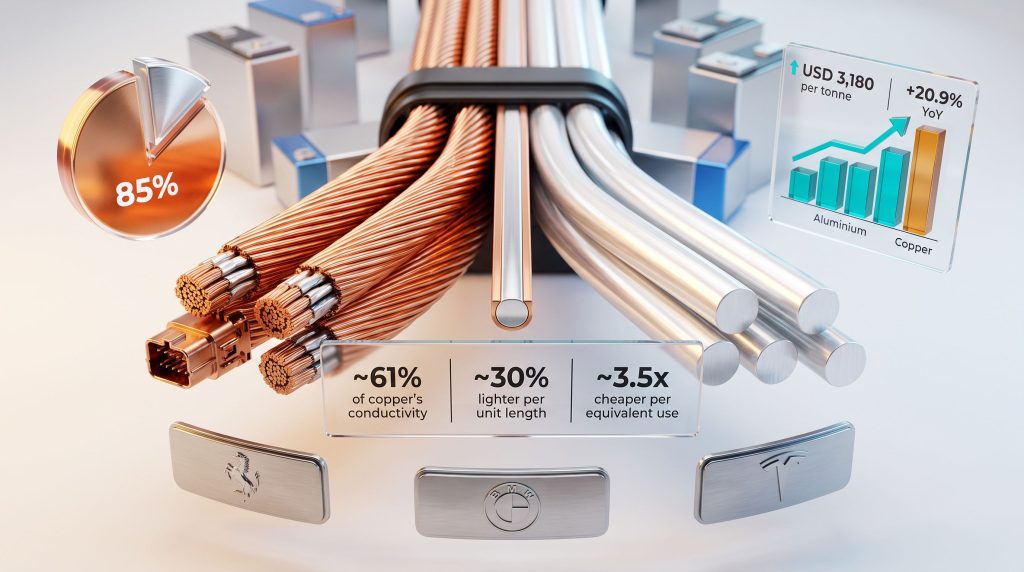
That threshold has not only been reached — it has become the new baseline. Aluminium futures have been trading near USD 3,180 per tonne, reflecting year-on-year gains of approximately 20.9%. Copper futures, while also elevated at roughly 11.81% above year-ago levels, have slipped below USD 6.3 per pound. The resulting ratio has remained consistently at or above the 3.5x level since around 2020, according to analysis from GEM Mining Consulting.
This is not a short-cycle pricing anomaly. The structural factors sustaining copper's premium include constrained mine supply growth, geopolitical concentration of copper deposits, and surging demand from electrification and data centre buildouts globally. Furthermore, the copper supply crunch shows no sign of easing in the near term. Aluminium, by contrast, benefits from more distributed production and greater bauxite resource availability, keeping its relative cost advantage durable rather than transient.
"When a price gap between two functionally overlapping materials becomes entrenched rather than temporary, engineering teams begin treating substitution not as a cost-cutting exercise but as a platform design decision. This reframing is precisely what is now occurring in EV wiring architecture."
Weight Engineering: The Second Driver Behind Aluminium Adoption
Cost is only half of the motivation. In electric vehicle design, every kilogram removed from a non-powertrain component translates into measurable efficiency gains — either through extended range on the same battery capacity or through the ability to reduce battery size while maintaining range targets.
Wiring harnesses in modern EVs are surprisingly heavy. A full harness in a complex electric vehicle can weigh between 40 and 70 kilograms depending on vehicle class and electrical architecture complexity. Achieving a 15 to 20% reduction in wiring weight — the figure Ferrari has reported through its aluminium power cable implementations in the 296 hybrid and Luce EV platforms — is not trivial. It creates a cascading benefit: lower harness weight reduces the battery capacity needed to deliver the same performance envelope, which in turn reduces the mass of the battery pack itself.
This compounding effect means that aluminium's contribution to EV lightweighting is larger than the raw weight saving in the wiring harness alone. In addition, copper demand drivers continue to intensify across multiple sectors, making the case for aluminium substitution even more commercially compelling.
How Aluminium and Copper Compare Across EV Electrical Applications
Conductivity, Cross-Section, and the Engineering Trade-Off
Aluminium is not a drop-in replacement for copper. Its electrical conductivity sits at roughly 61% of copper's benchmark value, which means that to carry an equivalent current load, an aluminium conductor must have a larger cross-sectional area. This has direct implications for routing, connector sizing, and packaging within tight vehicle spaces.
The following table summarises the key material properties relevant to EV wiring decisions:
| Property | Aluminium | Copper |
|---|---|---|
| Electrical Conductivity | ~61% of copper | Benchmark standard |
| Weight | ~30% lighter per unit length | Heavier |
| Relative Cost | ~3.5x cheaper per equivalent use | Higher |
| Flexibility in High-Flex Zones | More challenging | Superior |
| Termination Complexity | Requires specialist design | Simpler |
| Oxidation Risk at Connections | Higher | Lower |
| Typical Application Fit | High-current cables, busbars | Compact, safety-critical zones |
Where Aluminium Excels in EV Architecture
The applications best suited to aluminium in electric vehicle electrical systems share a common characteristic: they involve high-current, low-frequency power transfer where the physical routing path allows for a larger conductor diameter without compromising packaging. For instance, examples of aluminium use in electric vehicles illustrate how widely this material is already being deployed across multiple platforms.
- High-current power cables linking battery packs to drive motors
- Busbars within battery management systems
- High-voltage conductors in drivetrain connections
- Low-voltage system conductors where space constraints are less acute
- Battery-to-inverter connections in larger vehicle platforms
BMW's eDrive architecture has demonstrated this approach across both high-voltage and low-voltage systems since 2011, giving it over a decade of real-world validation data — a longer track record than almost any other major original equipment manufacturer (OEM).
Where Copper Remains Structurally Necessary
Despite aluminium's advances, copper retains engineering supremacy in several application categories:
- Wiring zones subject to repeated mechanical flexing, such as door harnesses and seat adjustment systems
- High-vibration environments where aluminium's fatigue characteristics create long-term reliability risks
- Compact routing paths where the larger cross-section required for aluminium is not physically accommodatable
- Safety-critical sensing and control circuits where electrical loss tolerances are minimal
The practical outcome emerging across the industry is a hybrid conductor strategy — aluminium for trunk cables and main power circuits, copper for branch circuits and precision applications. This is not a compromise born of limitation; it is an optimisation approach that extracts the cost and weight benefits of aluminium precisely where they are achievable, while preserving copper's reliability advantages where they remain irreplaceable.
Which Automakers Are Leading Aluminium Integration?
Ferrari: Precision Engineering Meets Material Science
Ferrari's adoption of aluminium power cables across its 296 hybrid and Luce EV platforms is particularly significant from an industry credibility standpoint. Ferrari's engineering philosophy prioritises performance outcomes above all else, meaning that aluminium's presence in its wiring systems is an endorsement of the technology's functional maturity rather than a purely commercial decision. A 15 to 20% reduction in wiring weight achieved within Ferrari's demanding performance specifications signals that aluminium can meet requirements well beyond those of mainstream mass-market vehicles.
BMW: A Decade-Long Systems Integration Approach
BMW's phased adoption of aluminium conductors beginning in 2011 provides the industry's most extensive longitudinal data set on aluminium wiring performance in real-world conditions. Its current deployment spans both high-voltage and low-voltage systems within the eDrive powertrain family, demonstrating that aluminium integration does not require choosing between voltage domains — both can be addressed with the right engineering framework. Consequently, light alloys in EV infrastructure are increasingly viewed as foundational rather than supplementary to modern vehicle design.
Tesla: Proving Scalability at Volume
Tesla's introduction of aluminium wiring in the Model Y, subsequently extended to the Cybertruck, carries a different kind of significance. Where Ferrari proves aluminium's performance credentials and BMW demonstrates longevity, Tesla demonstrates that aluminium wiring can be manufactured and integrated at very high production volumes without quality deterioration. Given that Tesla's supply chain decisions have historically propagated across the broader EV ecosystem, its adoption of aluminium conductors is likely to accelerate the development of specialist supplier capability globally.
Chinese EV Manufacturers: Volume Acceleration
Multiple Chinese EV producers are embedding aluminium conductors into their vehicle architectures, driven by the extreme cost sensitivity of high-volume manufacturing at Chinese price points. This accelerates the global development of aluminium wiring supply chains, specialist connector technologies, and manufacturing equipment — reducing barriers for adoption by OEMs worldwide. However, the broader context of battery raw materials availability continues to shape how aggressively these manufacturers pursue substitution strategies.
The Engineering Challenges That Constrain Faster Adoption
Oxidation at Connection Points
One of the least publicly discussed but most technically significant challenges in aluminium wiring adoption is the metal's tendency to form an oxide layer at connection points. Unlike copper oxide, aluminium oxide is electrically resistive, creating a risk of increased contact resistance over time. Addressing this requires specialist termination techniques including bimetallic connectors and ultrasonic welding processes that disrupt the oxide layer during joining. These techniques are available but add manufacturing complexity and cost that partially offset the raw material savings.
Component Redesign and Requalification
Transitioning from copper to aluminium wiring is not achievable through a simple material swap. It requires:
- Full component redesign to accommodate larger conductor cross-sections
- Connector and terminal system re-engineering for aluminium compatibility
- Product requalification through internal testing protocols and independent certification
- Manufacturing line modifications for new joining and termination processes
- Supply chain revalidation for new conductor specifications
For large OEMs with dedicated materials engineering teams, this process is manageable. For smaller EV manufacturers operating with leaner R&D resources, the requalification burden represents a genuine barrier to adoption — one that may extend timelines by two to four years beyond the initial design decision.
Fatigue and Vibration Limitations
Aluminium's fatigue resistance under cyclic mechanical loading is lower than copper's. In applications involving repeated flexing or vibration exposure, this creates a long-term durability risk that current aluminium conductor formulations have not fully resolved. Alloy development work — including the use of higher-purity aluminium grades and additions of trace elements such as zirconium and silicon — is an active area of materials research that could meaningfully shift this limitation over the next five to ten years.
"The engineering obstacles facing aluminium wiring are real, but they are not permanent. They reflect the current state of material and process technology, not a fundamental incompatibility between aluminium and EV electrical architecture."
The next major ASX story will hit our subscribers first
What Market Data Reveals About the Current State of Adoption
Despite growing momentum, aluminium's penetration in EV wiring remains modest in absolute terms. Industry data from Hydro indicates that approximately 85% of EV electrical wiring and busbars connected to battery systems are still manufactured using copper. Aluminium's share, while growing, is concentrated in the high-current trunk cable and busbar applications where its engineering case is strongest.
The demand implications of this transition are projected but not yet transformative. GEM Mining Consulting estimates that material substitution using aluminium, graphene-enhanced conductors, bimetallic composites, and other emerging materials could reduce global copper demand by 1.5 to 6% by 2035. Furthermore, the lithium demand boom continues to reshape raw material consumption patterns alongside these conductor-level shifts.
| Demand Driver | Impact on Copper | Impact on Aluminium |
|---|---|---|
| EV Adoption Growth | Strong positive demand | Growing wiring share |
| Renewable Energy Infrastructure | High copper intensity | Moderate aluminium use |
| Data Centre Expansion | Significant copper demand | Limited substitution |
| Aluminium Substitution in Wiring | Mild reduction (1.5–6% by 2035) | Incremental share gains |
Critically, GEM Mining expects long-term copper consumption to remain robust. The substitution effect is expected to ease pricing pressure rather than undermine copper's fundamental demand trajectory, which continues to be supported by EV adoption growth, grid infrastructure investment, and data centre expansion.
Advanced Materials: The Next Frontier Beyond Aluminium
The aluminium-versus-copper conversation is evolving into a broader materials competition that will define EV electrical architecture over the next decade. Several emerging technologies are worth understanding, and the role of Chinese battery recycling breakthroughs may further influence how manufacturers approach conductor material sourcing.
Bimetallic conductors combine an aluminium core with a copper outer cladding, addressing the termination oxidation problem while preserving most of the weight advantage. These represent a practical near-term bridge technology already entering limited production use.
Graphene-enhanced aluminium conductors aim to improve the base conductivity of aluminium through the addition of graphene at the nanoscale, potentially narrowing the conductivity gap with copper. If commercially viable formulations are proven at scale, they could meaningfully shift the economics and performance envelope of aluminium use in EV wiring in applications currently reserved for copper.
Carbon nanotube conductors remain a longer-horizon possibility, with laboratory demonstrations showing conductivity comparable to or exceeding copper at a fraction of the weight. Commercial scalability remains unproven, but the technology trajectory suggests it could become relevant within EV wiring applications before 2040.
Frequently Asked Questions: Aluminium Use in EV Wiring
Why are EV manufacturers switching to aluminium wiring?
The primary drivers are cost and weight. Aluminium costs substantially less than copper on a per-use basis when the copper-to-aluminium price ratio exceeds the 3.5x commercial viability threshold, and it delivers wiring weight reductions of up to 20% in suitable applications — a meaningful advantage in battery-powered vehicles where mass directly affects range.
Does aluminium conduct electricity as well as copper in EVs?
No. Aluminium operates at approximately 61% of copper's electrical conductivity, requiring larger conductor cross-sections to carry equivalent current. This trade-off is manageable in high-current trunk cables and busbars but makes copper preferable in compact or high-flex wiring zones where space or fatigue resistance is critical.
Which EVs currently use aluminium wiring?
Ferrari's 296 hybrid and Luce EV, BMW's eDrive-equipped models across both voltage systems (since 2011), and Tesla's Model Y and Cybertruck are among the most prominent examples. Multiple Chinese EV manufacturers are also integrating aluminium conductors into volume production platforms.
Will aluminium fully replace copper in EV wiring?
This outcome is unlikely in any near-term timeframe. With approximately 85% of EV battery-connected wiring still manufactured in copper, aluminium is growing its share incrementally in specific high-current applications. The industry consensus positions aluminium as a strategic complement to copper rather than a wholesale replacement.
What are the main engineering challenges of aluminium EV wiring?
The principal challenges include oxidation at connection points (requiring specialist termination techniques), reduced fatigue resistance in high-flex and vibration zones, larger cross-section requirements limiting routing flexibility, and the need for full component redesign and regulatory requalification when transitioning from copper-based designs.
Key Takeaways: Where the Aluminium Wiring Transition Is Headed
The structural shift toward greater aluminium use in EV wiring is underpinned by durable economic and engineering logic rather than short-term market movements. Several conclusions emerge from the available evidence:
- The copper-to-aluminium price ratio has remained at commercially meaningful levels since approximately 2020, creating sustained incentive for material substitution in eligible applications
- Weight reduction benefits compound across vehicle platforms, making aluminium wiring's contribution to efficiency larger than the harness-level saving alone
- Ferrari, BMW, and Tesla have each validated aluminium wiring across different performance segments, demonstrating the technology's credibility from precision engineering to high-volume manufacturing
- Approximately 85% of EV battery-connected wiring remains copper, indicating that substitution is gradual, application-specific, and far from complete
- Engineering challenges around oxidation, fatigue resistance, and requalification represent real but surmountable barriers, with active materials research addressing each
- Aluminium, bimetallic conductors, and graphene-enhanced composites collectively represent the frontier of EV electrical architecture optimisation over the next decade
Readers interested in broader aluminium industry developments and downstream applications in electric vehicles can explore further coverage available at AL Circle.
Want To Stay Ahead of the Next Major ASX Mineral Discovery?
Discovery Alert's proprietary Discovery IQ model delivers real-time alerts on significant ASX mineral discoveries — instantly translating complex data across 30+ commodities into clear, actionable insights for both short-term traders and long-term investors. Explore why historic mineral discoveries have generated exceptional returns and begin your 14-day free trial at Discovery Alert to position yourself ahead of the broader market.