
July 30, 2026
When One Refinery Becomes a Global Crude Market Force
The commodity markets operate on a simple but powerful principle: size confers influence. For most of the past century, that influence resided in a handful of refining hubs concentrated in the United States Gulf Coast, Western Europe, and Northeast Asia. The idea that a single facility on the west coast of Africa could absorb a measurable share of the entire world's internationally traded crude oil would have seemed improbable even a decade ago.
That calculation has now changed fundamentally. The Dangote Petroleum Refinery in Lagos, Nigeria, has reached a scale where its procurement decisions ripple through spot markets, freight rate calculations, and regional fuel supply chains across multiple continents. Understanding precisely what the Dangote refinery's 2.5% of global traded crude oil consumption figure actually represents requires stepping back to examine how crude oil market dynamics function at a structural level, and why volume thresholds matter so profoundly to price formation.
When big ASX news breaks, our subscribers know first
What 2.5% of Global Crude Trade Actually Represents
Global seaborne crude oil trade moves at approximately 40 to 42 million barrels per day, a figure encompassing all crude cargoes transported via tanker between producing nations and refining destinations. A 2.5% share of that total translates to roughly 1 million to 1.05 million barrels per day being absorbed by a single facility.
To contextualise that volume further:
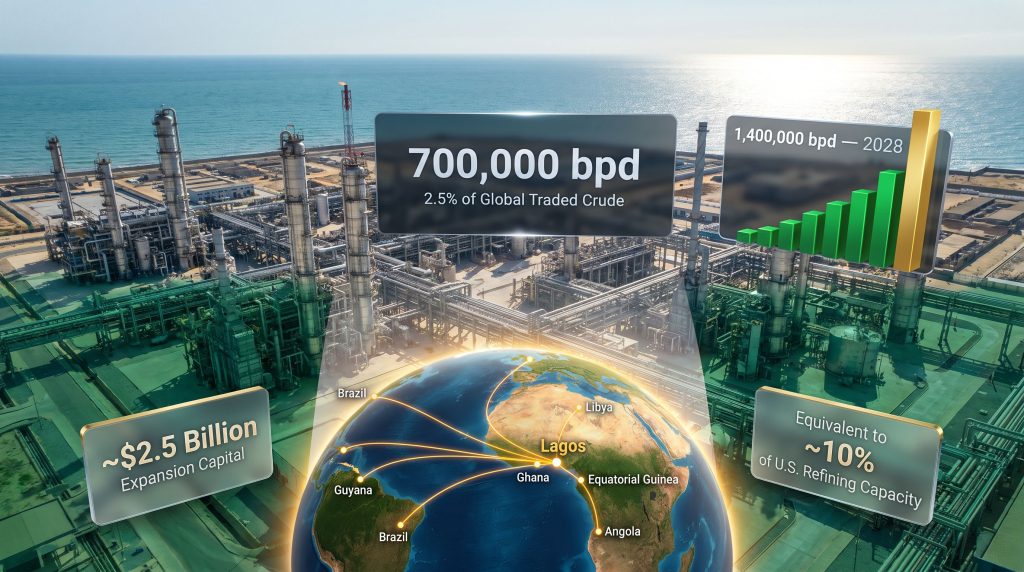
- The Dangote refinery's current nameplate capacity stands at 700,000 barrels per day (bpd)
- At 700,000 bpd, the facility already represents approximately 1.75% of global seaborne crude trade
- The 2.5% figure reflects the refinery's trajectory toward full operational utilisation
- That same 700,000 bpd volume is equivalent to roughly 10% of the entire United States' refining capacity, which processes around 17 to 18 million barrels per day across dozens of facilities spread across multiple states
- A planned expansion, backed by $2.5 billion in secured capital, targets 1.4 million barrels per day by 2028
Energy economists broadly recognise that when a single buyer consistently absorbs more than 1 to 2% of a globally traded commodity, that entity transitions from being a passive price-taker to a structural market participant capable of influencing spot pricing, regional supply availability, and freight economics. The Dangote refinery has demonstrably crossed that threshold.
How Dangote Compares to the World's Largest Refining Complexes
| Refinery / Complex | Country | Capacity (bpd) | Status |
|---|---|---|---|
| Dangote Petroleum Refinery (current) | Nigeria | ~700,000 | Operational |
| Dangote Petroleum Refinery (post-2028) | Nigeria | ~1,400,000 | Expansion planned |
| Jamnagar Refinery (Reliance) | India | ~1,240,000 | Largest single-site (current) |
| Paraguana Refinery Complex | Venezuela | ~940,000 | Significantly underutilised |
| Ruwais Refinery (ADNOC) | UAE | ~922,000 | Major Middle East exporter |
| SK Energy Ulsan | South Korea | ~840,000 | Major Northeast Asian buyer |
The table reveals a striking projection: at 1.4 million bpd post-expansion, Dangote would rival or potentially surpass Reliance's Jamnagar complex in India, currently recognised as the world's largest single-site refinery. The competitive implications for global crude trade trends, tanker chartering, and refined product trade are considerable.
From Price-Taker to Market Mover: The Structural Crude Demand Shift
Crude Sourcing Diversity as a Competitive Weapon
One of the less widely understood aspects of the Dangote refinery's competitive positioning is its deliberate expansion of feedstock flexibility. The facility has been engineered to process up to 130 different crude grades, a specification that distinguishes it from many older refining complexes optimised for narrow crude slates.
This flexibility carries significant market implications:
- Processing multiple crude grades enables margin optimisation by exploiting price differentials between light-sweet and medium-sour crude streams
- Multi-origin sourcing across the Atlantic Basin creates a form of natural supply hedging against geopolitical disruptions affecting any single producing nation
- Flexibility to shift between crude grades gives the refinery negotiating leverage in term contract discussions with crude producers
As of mid-2026, the refinery's feedstock composition showed approximately 78% Nigerian domestic crude and 22% internationally sourced crude. Earlier 2025 data indicated a different split, with international crude accounting for roughly 35% of the approximately 400,000 bpd the facility was receiving at that stage, reflecting the ramp-up in domestic supply access as production targets were met.
The confirmed international supply origins span a broad geographic footprint: Nigeria, Angola, Libya, Guyana, Ghana, Brazil, and Equatorial Guinea. This Atlantic Basin sourcing strategy mirrors the procurement geography of major Asian refiners, suggesting Dangote is deliberately building the kind of diversified crude book typically associated with state-owned refining giants. Furthermore, according to BusinessDay, the refinery's growing crude appetite is already reshaping Atlantic Basin trade flows in ways that were not anticipated even by major market participants.
The Systemic Importance Test: When Maintenance Moves Markets
A genuinely revealing indicator of the refinery's market influence emerged recently when a scheduled maintenance period caused a reduction in output. The downstream consequence was an observable tightening of petrol, diesel, and jet fuel supplies not only across Nigeria but into European export markets.
When a single facility's maintenance schedule is capable of tightening fuel supply across multiple countries and continents simultaneously, it has crossed the threshold from being a large industrial asset into functioning as critical energy infrastructure. The Dangote refinery has demonstrably reached this status.
This sensitivity event is analytically important for several reasons. It confirms that the refinery is no longer operating at the margins of Atlantic Basin fuel supply; it has become a load-bearing node within regional supply chains. Markets that previously ignored the facility's operational status now need to price its throughput into forward fuel supply calculations. Consequently, the oil price volatility trends observed across Atlantic Basin benchmarks are increasingly sensitive to the refinery's operational rhythm.
Nigeria's Energy Paradox: Reversed in Real Time
From Chronic Importer to Regional Fuel Exporter
For decades, Nigeria maintained one of the most paradoxical energy positions of any nation on earth. As Africa's largest crude oil producer, it nonetheless imported virtually all of its refined petroleum products, an outcome of chronically underinvested domestic refining infrastructure that generated enormous foreign exchange outflows and exposed Nigerian consumers to global price volatility.
The Dangote refinery has structurally reversed this position across several dimensions:
- Nigeria has eliminated its dependence on imported petrol, removing a persistent drain on foreign exchange reserves
- The country has emerged as an exporter of aviation fuel (jet fuel) to regional and international buyers
- Nigerian-origin refined products have entered European fuel supply chains, a commercial relationship that would have been inconceivable five years ago
- The refinery's integrated design, encompassing petrochemicals and fertiliser production alongside fuel refining, creates multiple export revenue streams from a single industrial complex
This reversal carries profound fiscal implications. Every barrel of refined product exported generates foreign exchange inflows. Every barrel of imported petrol eliminated reduces foreign exchange outflows. The compound effect on Nigeria's balance of payments has been material enough to contribute to the country's first sovereign credit rating upgrade in 14 years, a milestone that reflects genuine improvement in the nation's external accounts rather than mere policy signalling. In addition, these developments have begun to address longstanding resource export challenges that have historically constrained African energy economies.
The Sovereign-Corporate Yield Inversion: An Unusual Market Signal
Among the more technically interesting financial developments surrounding the refinery complex is the recent bond issuance by Dangote Industries. The company successfully placed an unsecured and unrated bond at yields below Nigeria's own sovereign benchmark, an outcome that inverts the typical risk hierarchy between corporate borrowers and their home governments.
In standard credit markets, sovereign debt sets the theoretical risk floor for borrowers operating within that jurisdiction. When a private company borrows at rates beneath that floor, markets are implicitly signalling that they view the corporate entity as carrying lower effective risk than the state itself. This yield inversion reflects the refinery's perceived strategic durability and the confidence investors attach to the enterprise's cash flow visibility.
Aliko Dangote has emphasised that this outcome reflects the importance of policy consistency over incentives in building long-term investor confidence, a perspective that carries broader implications for how African governments approach industrial investment attraction.
The Industrialisation Thesis and Its African Precedent
Why Manufacturing Scale Matters More Than Raw Resources
Throughout discussions surrounding the refinery's significance, Dangote has consistently returned to a structural economic argument: nations cannot generate durable employment or long-term prosperity by exporting raw commodities. The value addition occurs in transformation, and transformation requires manufacturing capacity at scale.
Nigeria's Industry Minister John Owan Enoh has framed the integrated refinery, petrochemicals, and fertiliser complex as central to the country's ambition of building a $1 trillion economy through domestic value addition. This framing positions the facility not merely as an energy asset but as an anchor investment for a broader industrialisation strategy.
The project's completion is particularly notable given the obstacles encountered during construction:
- COVID-19 pandemic disruptions delayed equipment delivery and workforce deployment
- Foreign exchange volatility inflated the naira cost of dollar-denominated procurement
- Rising global construction costs pushed total investment beyond initial projections to approximately $20 billion
- Institutional financiers repeatedly questioned whether the project could be completed at all
Dangote has acknowledged the refinery represented the greatest commercial risk of his career. The fact that it reached full operational capacity in 2026 despite this combination of headwinds is being cited across African business circles as a proof-of-concept for large-scale private infrastructure delivery in frontier markets, a category that has historically struggled to attract the patient capital such projects require.
The Road to 1.4 Million Barrels Per Day by 2028
Expansion Mechanics and Supply Chain Consequences
The $2.5 billion expansion programme targeting 1.4 million bpd by 2028 introduces supply chain dynamics that extend well beyond Nigerian borders. As reported by OilPrice.com, Dangote has already broken ground on a second crude processing unit as part of this ambitious expansion, signalling that the programme is advancing from planning into active execution.
| Milestone | Metric | Timeline |
|---|---|---|
| Current operational capacity | ~700,000 bpd | 2026 |
| Expansion capital secured | $2.5 billion | 2026 |
| Post-expansion capacity target | 1,400,000 bpd | 2028 |
| Crude demand at full expansion | Potentially top 1-3 globally | 2028+ |
A critical supply arithmetic challenge emerges at 1.4 million bpd. Nigerian domestic crude production has recently ranged between approximately 1.3 and 1.5 million bpd, meaning domestic output alone would be insufficient to fully supply the expanded refinery. This structural gap will accelerate the facility's international crude sourcing programme, with implications across several dimensions:
- Sustained demand for Very Large Crude Carriers (VLCCs) and Suezmax vessels on Atlantic Basin routes, supporting freight markets for operators in those trade lanes
- Intensified competition with Asian refiners for West African and South American crude grades
- Potential for Dangote to become a benchmark-setting buyer in regional crude pricing negotiations, particularly for grades where it represents a dominant portion of demand
- Greater integration between Nigerian crude production targets and the refinery's throughput requirements, potentially influencing OPEC's market influence and NNPC's production and allocation decisions
The speculative but analytically credible scenario is that at 1.4 million bpd, Dangote's crude procurement team effectively functions as a sovereign-scale buyer, with the market power to influence differentials on specific crude grades in ways that currently only national oil companies or major trading houses can achieve.
The next major ASX story will hit our subscribers first
Frequently Asked Questions: Dangote Refinery and Global Crude Markets
What does the Dangote refinery's 2.5% of global traded crude oil mean in practical terms?
Global crude oil trade involves approximately 40 to 42 million barrels per day crossing international borders. A 2.5% share equates to roughly 1 million to 1.05 million barrels per day, the volume the Dangote refinery 2.5% of global traded crude oil would need to source at full operational capacity. This makes it one of the largest single crude buyers anywhere in the world.
Why does crude sourcing flexibility across 130 grades matter?
Refineries optimised for narrow crude slates are exposed to significant margin compression when their preferred grades become expensive or scarce. A 130-grade feedstock capability allows Dangote to pursue the most economically attractive crude available at any given time, functioning more like a commodity trading operation than a traditional fixed-input processor.
How has the refinery affected European fuel markets?
Dangote-origin refined products, including aviation fuel, have entered European supply chains. A maintenance-related production slowdown at the Lagos facility was sufficient to visibly tighten fuel availability in European markets, confirming that the refinery's operational status now carries pricing relevance beyond Africa.
What does the bond yield inversion signal to investors?
When Dangote Industries placed debt at yields below Nigeria's sovereign rate, it indicated that credit markets assessed the company's cash flow durability and strategic importance as representing lower risk than the Nigerian government itself. This is an unusual and significant market signal for any private entity, let alone one based in a frontier market economy.
Disclaimer: This article contains forward-looking projections regarding refinery capacity, crude demand, and expansion timelines. These projections are subject to change based on market conditions, capital availability, regulatory developments, and operational factors. Nothing in this article constitutes financial or investment advice.
Want to Track the Next Major Commodity Discovery Before the Market Does?
Discovery Alert's proprietary Discovery IQ model delivers real-time alerts on significant ASX mineral discoveries, transforming complex data across more than 30 commodities into clear, actionable insights — just as scale and speed are reshaping global energy markets like the Dangote refinery's rise. Explore how historic discoveries have generated substantial returns on Discovery Alert's discoveries page, and begin your 14-day free trial today to position yourself ahead of the market.