July 30, 2026
The Global Race for Mineral Sovereignty Is Reshaping State-Level Policy
Across the industrialised world, governments are grappling with an uncomfortable realisation: decades of offshoring mineral processing to a handful of dominant nations created fragilities that are now painfully visible. Trade disruptions, export restrictions, and geopolitical tensions have exposed just how concentrated critical mineral supply chains had become. The response from resource-rich jurisdictions has not been passive.
States and provinces with genuine mineral endowments are moving decisively to convert geological advantage into economic architecture, and Queensland is among the most strategically positioned to do so. Furthermore, critical minerals and energy security concerns are increasingly driving this policy urgency at every level of government.
The Queensland critical minerals roadmap, formally titled Delivering Queensland's Critical Minerals Future 2026-30, represents the most substantive and capital-backed expression of this ambition the state has produced. However, to understand why this roadmap matters, it helps to first understand what makes Queensland's position genuinely different from other aspiring critical minerals jurisdictions.
When big ASX news breaks, our subscribers know first
Queensland's Structural Advantage: More Than Just Geology
Many resource-rich regions around the world hold promising mineral deposits. Far fewer hold the combination of existing refining infrastructure, a technically skilled workforce, functioning logistics corridors, and proximity to the world's largest manufacturing economies. Queensland sits at the intersection of all four.
The state's mineral endowment spans the full spectrum of what the clean energy transition demands, including vanadium, copper, graphite, high-purity alumina, and various battery chemical precursors. Unlike jurisdictions that must build processing capability from the ground up, Queensland can leverage existing industrial frameworks developed through decades of coal and base metal production.
Critically, Queensland's northern ports and established road and rail networks provide direct access to Asian manufacturing hubs. This geographic reality reduces the delivered cost of Queensland minerals compared to competing sources in landlocked or more distant jurisdictions — a factor that becomes highly material when buyers are evaluating long-term offtake economics.
Queensland is not constructing a critical minerals sector from scratch. It is redirecting and amplifying pre-existing industrial capability toward higher-value applications, which is a materially different and lower-risk undertaking than greenfield industrial development.
From Strategy to Implementation: What the 2026-30 Roadmap Actually Does
The Queensland critical minerals strategy established the conceptual foundation in 2023. The 2026-30 roadmap moves decisively beyond concept-setting into funded action. The distinction matters enormously for investors and project developers evaluating Queensland as a destination for capital.
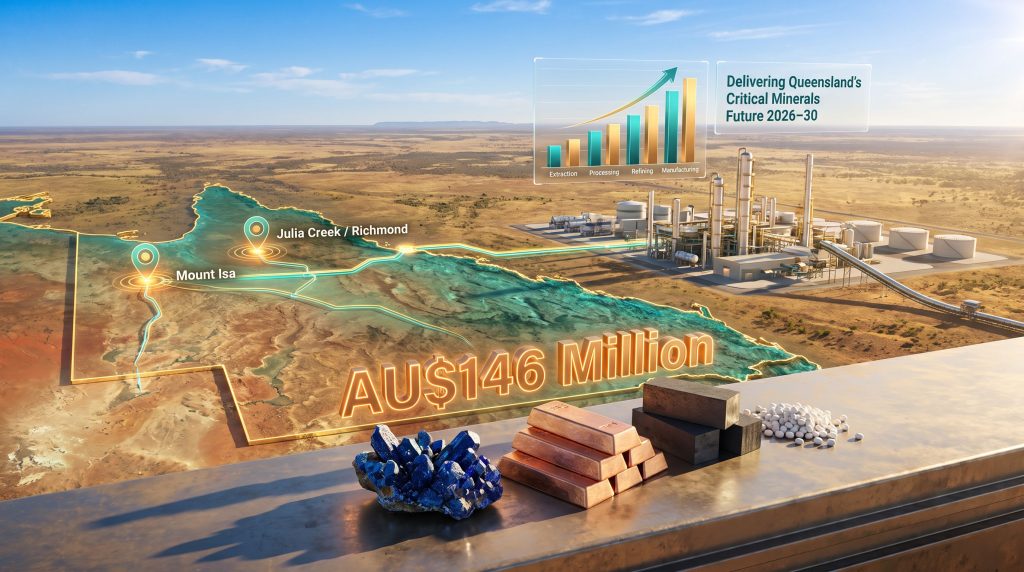
Backed by AU$146 million in committed State Budget funding, the roadmap translates aspirational objectives into concrete programmes, geographic zones, and capital allocation priorities. The budget commitment is not symbolic. It funds sovereign capability development, regional economic infrastructure, international investor attraction, battery technology investment, common-user processing facilities, and exploration co-investment.
The roadmap is structured around four strategic pillars that collectively address the full development lifecycle:
| Strategic Pillar | Core Focus |
|---|---|
| Move Faster and Smarter | Streamline approvals, reduce development timelines, support exploration |
| Maximise Investment | Attract domestic and international capital through prospectus and investor hubs |
| Build Value Chains | Expand processing, refining, and manufacturing beyond raw material export |
| Foster Research and ESG Excellence | Develop provenance traceability, environmental standards, and R&D capacity |
Each pillar addresses a distinct barrier that has historically prevented resource-rich jurisdictions from capturing the full economic value of their mineral endowments. The first pillar tackles approval timelines, which mining industry participants consistently identify as one of the most significant deterrents to project investment. The second addresses the capital attraction challenge through structured deal facilitation.
The third confronts the most persistent economic leakage in Australian resources: exporting raw material rather than processed product. The fourth positions Queensland to meet the increasingly demanding ESG compliance requirements of international buyers.
The Critical Minerals Prospectus: Turning Policy Into a Bankable Pipeline
One of the more practically significant tools embedded in the roadmap is the Queensland Critical Minerals Prospectus — a curated showcase of investment-ready projects presented to international capital markets. This mechanism serves a function that is frequently underappreciated: it dramatically reduces the due diligence burden for institutional investors who may lack internal resources to independently identify and assess project opportunities.
Projects within the prospectus span multiple stages of development and multiple mineral types, which is strategically important. Investors with different risk appetites — from early-stage venture capital through to sovereign wealth funds seeking near-production exposure — can identify appropriate entry points without navigating the entire Queensland project landscape independently.
Featured projects provide a useful cross-section of the state's development pipeline:
| Project | Mineral Focus | Development Stage |
|---|---|---|
| Townsville Energy Chemicals Hub | Battery chemicals | Processing/Manufacturing |
| Briggs Copper Project | Copper | Exploration/Development |
| BAM Graphite | Graphite | Development |
| HPA First | High-purity alumina | Processing |
| Richmond-Julia Creek | Vanadium | Development/Processing |
The Townsville Energy Chemicals Hub deserves particular attention. Townsville has long functioned as a major industrial and port city, and anchoring battery chemical processing there creates geographic concentration of downstream capability adjacent to existing port infrastructure. This is not accidental, as proximity to export logistics is a decisive factor in the economics of processed mineral products.
Critical Minerals Zones: The Geographic Logic of Concentrated Investment
The roadmap's designation of Critical Minerals Zones reflects an understanding of industrial economics that is sometimes absent from resource policy frameworks. Rather than spreading infrastructure investment thinly across the entire state, concentrated zoning creates the conditions for shared-use facilities, pooled logistics, and co-located processing that generate genuine economies of scale.
The two priority zones — Julia Creek/Richmond and Mount Isa — were not selected arbitrarily. Both locations combine meaningful mineral endowments with existing infrastructure that reduces the marginal cost of additional development.
Why Vanadium Matters at Julia Creek
Julia Creek and the broader Richmond corridor host some of Australia's most significant vanadium deposits. Vanadium is attracting intensifying interest from grid-scale energy storage developers because vanadium redox flow batteries offer advantages in long-duration storage applications that lithium-ion chemistry does not easily replicate.
The ability to discharge over extended periods without significant degradation makes vanadium flow batteries particularly relevant to renewable energy firming at utility scale. Consequently, the critical minerals demand surge for vanadium is expected to accelerate substantially as grid storage deployment expands globally.
Mount Isa's Legacy Infrastructure Advantage
Mount Isa, meanwhile, carries decades of multi-metal mining history and infrastructure that would cost billions of dollars to replicate. Its positioning as a Critical Minerals Zone effectively converts legacy industrial investment into a competitive asset for the next generation of mineral development.
Exploration De-Risking: The Collaborative Exploration Initiative
One of the least-discussed but potentially most consequential elements of the roadmap is the Collaborative Exploration Initiative. Funded through to June 2027, this programme provides co-investment support for greenfield and brownfield exploration, addressing one of the most persistent structural problems in the junior mining sector.
The challenge facing junior explorers funding is well understood within the industry but often invisible to outside observers. Exploration is expensive, high-risk, and produces no revenue. Capital markets have historically been willing to fund this activity during periods of elevated commodity prices and strong investor sentiment, but have proven extremely reluctant to do so during downturns.
The result is a cyclical pattern where exploration pipelines dry up precisely when processing and manufacturing sectors are hungry for new project development. Government co-investment through the Collaborative Exploration Initiative provides a counter-cyclical funding mechanism that helps sustain exploration activity regardless of prevailing market sentiment.
The most important projects entering production in 2035 are likely to be those entering exploration today. Government co-investment at the earliest stage of the development cycle is therefore a strategically rational use of public capital, even if the returns are long-dated.
The next major ASX story will hit our subscribers first
Downstream Processing: Capturing the Value That Raw Exports Leave Behind
Perhaps the most economically significant ambition within the Queensland critical minerals roadmap is the explicit drive toward downstream processing and manufacturing. To understand why this matters, it helps to quantify the value differential at stake.
A tonne of raw vanadium ore carries a fraction of the value of vanadium pentoxide, which itself carries a fraction of the value of vanadium electrolyte ready for installation in a flow battery system. Each processing step captures value that, under a raw export model, is captured by the importing nation's industrial sector rather than the exporting jurisdiction.
Australia has historically exported raw or minimally processed minerals and watched the value-add occur offshore. The roadmap explicitly targets this economic leakage. Common-user infrastructure funding is central to this ambition, as many individual projects cannot economically justify the capital expenditure required to build dedicated processing facilities.
Sovereign Capability and the Trade Partner Dimension
The concept of sovereign capability has moved from policy jargon to genuine commercial requirement in critical mineral supply chains. Trading partners in the United States, European Union, and Japan are increasingly conditioning long-term offtake agreements on the ability of supplier jurisdictions to demonstrate independent processing capability, rather than simply providing raw feedstock.
This shift reflects a specific concern: supply chains that route through concentrated processing hubs remain vulnerable to the same geopolitical disruptions that motivated supply chain diversification in the first place. Genuine sovereign capability means processing within a trusted jurisdiction, not simply mining within one.
Queensland's investment in domestic refining infrastructure and battery chemical processing directly addresses this requirement. In addition, the Australia critical minerals strategy at the federal level reinforces Queensland's state-level ambitions, creating a complementary policy environment for project developers.
ESG, Traceability, and the Emerging Regulatory Architecture
International buyers of critical minerals are operating under rapidly evolving regulatory frameworks that impose increasingly detailed provenance and environmental disclosure requirements. The European Union's Critical Raw Materials Act and the United States Inflation Reduction Act both contain provisions that effectively require documented supply chain transparency as a condition of preferential market access.
Queensland's roadmap incorporates traceability planning specifically to align with these frameworks. The Queensland Critical Minerals Provenance and Traceability Roadmap explores blockchain-based and digital tracking systems to provide end-to-end supply chain documentation, positioning Queensland projects to qualify for the most demanding buyer requirements.
This is commercially significant beyond the compliance dimension. Minerals with documented ESG credentials and verifiable provenance are increasingly commanding pricing premiums in markets where buyers face their own downstream regulatory exposure. A Queensland copper or graphite product with full chain-of-custody documentation is a fundamentally different commercial proposition from an otherwise equivalent product of unknown provenance.
Comparing the 2023 Strategy and the 2026-30 Roadmap
Understanding the evolution from Queensland's 2023 Critical Minerals Strategy to the current roadmap clarifies exactly how much further the state's policy ambition has advanced.
| Dimension | 2023 Queensland Critical Minerals Strategy | 2026-30 Roadmap |
|---|---|---|
| Primary Focus | Strategic framework and objective-setting | Implementation, value chain construction |
| Investment Tools | Early-stage prospectus development | Mature prospectus with pipeline projects |
| Processing Ambition | Identified as a priority | Actively funded and zoned |
| ESG Integration | Acknowledged | Embedded with traceability planning |
| Budget Commitment | Strategy-level | AU$146 million State Budget allocation |
| Geographic Focus | State-wide | Critical Minerals Zones (Julia Creek, Mount Isa) |
The transition from the 2023 document to the current roadmap is qualitatively significant. The 2023 strategy named the right objectives. The 2026-30 roadmap backs them with capital, geographic specificity, and implementation mechanisms. For project developers and investors, this distinction determines whether policy represents a genuine development tailwind or merely an aspirational statement.
Regional Economic Development: Beyond the Resource Sector Itself
The roadmap's regional development mandate carries implications that extend well beyond the economics of individual mining projects. Communities in Queensland's resource regions have historically experienced boom-bust cycles tied to single-commodity price dynamics. The diversification into critical minerals, combined with the downstream processing emphasis, creates conditions for more structurally stable regional economies.
Processing and manufacturing operations generate higher-skill, higher-wage employment than extraction alone. They also create sustained demand for local services, professional expertise, and infrastructure that extraction-focused operations do not. The concentration of development activity in designated zones near existing communities like Mount Isa and Julia Creek amplifies these local economic multiplier effects.
The AU$146 million budget commitment signals to both communities and investors that the policy framework has genuine duration, not merely electoral cycle relevance. Long-term planning certainty is one of the most valuable things a government can provide to major project developers, whose capital commitment horizons typically span decades. Furthermore, copper investment strategies aligned with Queensland's development pipeline represent one of the more compelling near-term opportunities within the broader roadmap framework.
Frequently Asked Questions: Queensland Critical Minerals Roadmap
What is the Queensland Critical Minerals Roadmap?
The Queensland Critical Minerals Roadmap, formally titled Delivering Queensland's Critical Minerals Future 2026-30, is a five-year strategy supported by AU$146 million in State Budget funding. It outlines how Queensland intends to grow its critical minerals sector through accelerated exploration, downstream processing, manufacturing expansion, and international investment attraction.
Which minerals does the Queensland roadmap prioritise?
The roadmap covers a broad range of strategic minerals including vanadium, copper, graphite, high-purity alumina, and battery chemical precursors. Projects within the Critical Minerals Prospectus span multiple mineral types at different development stages.
What are Critical Minerals Zones?
Critical Minerals Zones are geographically designated clusters where infrastructure investment and development support are concentrated. The current priority zones are Julia Creek/Richmond, focused on vanadium, and Mount Isa, a multi-mineral hub with established industrial infrastructure.
How does the roadmap support junior and early-stage explorers?
The Collaborative Exploration Initiative provides co-investment support for both greenfield and brownfield exploration programmes, funded through to June 2027. Common-user infrastructure funding further reduces capital requirements for smaller operators seeking to progress projects toward development.
How does the roadmap align with international trade requirements?
The ESG and traceability pillar is designed to meet the provenance documentation requirements of major trading partners operating under frameworks including the EU Critical Raw Materials Act and the US Inflation Reduction Act. This alignment positions Queensland minerals to qualify for preferential supply chain status with allied-nation buyers.
Key Takeaways: Queensland Critical Minerals Roadmap at a Glance
- AU$146 million in committed State Budget funding over the 2026-30 period
- Four strategic pillars: move faster and smarter, maximise investment, build value chains, foster ESG and research excellence
- Critical Minerals Zones designated at Julia Creek/Richmond (vanadium) and Mount Isa (multi-mineral)
- Collaborative Exploration Initiative funded through June 2027 to reduce early-stage discovery risk
- Critical Minerals Prospectus presents investment-ready projects including the Townsville Energy Chemicals Hub and Richmond-Julia Creek vanadium project
- Sovereign processing capability is a central ambition, addressing international trading partner requirements for supply chain assurance
- ESG traceability planning positions Queensland to comply with and benefit from EU and US critical minerals regulatory frameworks
- Common-user infrastructure funding enables smaller operators to access processing facilities that would be uneconomic to build independently
Disclaimer: This article is intended for informational purposes only and does not constitute financial or investment advice. References to government funding, project pipelines, and market dynamics reflect publicly available information at the time of writing. Forward-looking statements involve inherent uncertainty and actual outcomes may differ materially from those discussed. Readers should conduct independent due diligence before making any investment decisions.
Ready to Capitalise on the Next Major Critical Minerals Discovery on the ASX?
Discovery Alert's proprietary Discovery IQ model delivers real-time alerts the moment significant mineral discoveries — including vanadium, copper, and battery chemical plays — are announced on the ASX, turning complex geological data into clear, actionable insights for investors at every experience level. Explore how historic discoveries have generated extraordinary returns on Discovery Alert's dedicated discoveries page, and begin your 14-day free trial today to position yourself ahead of the market.