July 30, 2026
Global Energy Chokepoints and the Fragile Architecture of LNG Supply Security
The global LNG trade operates on a foundational assumption that is rarely examined until it fails: that narrow maritime corridors will remain open, predictable, and commercially navigable. When that assumption is tested, the reverberations extend far beyond the vessels involved, touching national energy grids, sovereign procurement strategies, and spot market pricing across three continents simultaneously. The events of late July 2026 surrounding a QatarEnergy LNG tanker exit through the Strait of Hormuz represent precisely such a test.
When big ASX news breaks, our subscribers know first
The Strait of Hormuz as the World's Most Consequential LNG Corridor
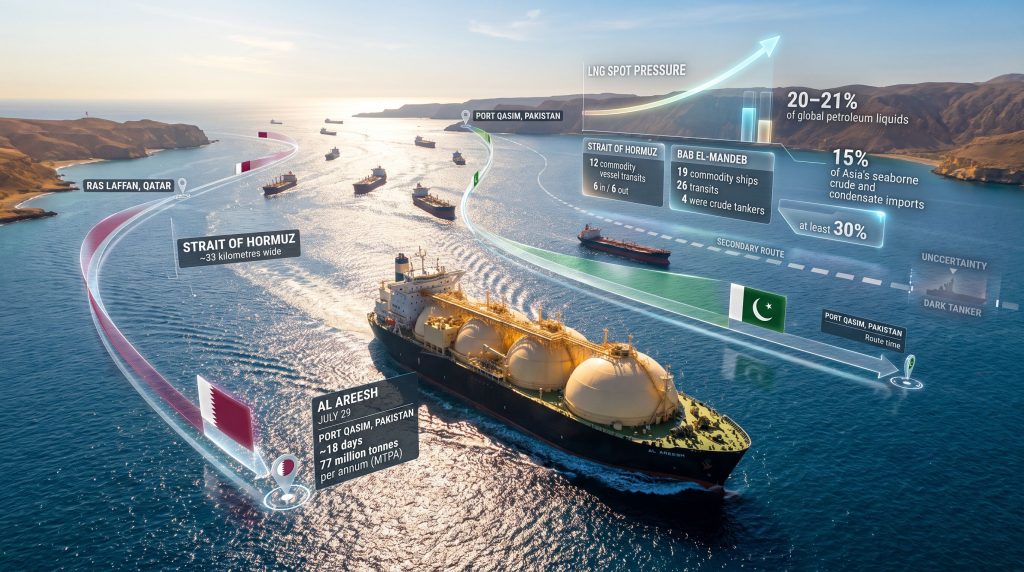
Few geographic features exert as much influence over the global economy as a waterway barely 33 kilometres wide at its narrowest navigable point. The Strait of Hormuz connects the Persian Gulf to the Gulf of Oman and serves as the sole maritime exit for Qatar's entire LNG export infrastructure at Ras Laffan. Approximately 20 to 21% of global petroleum liquids transit this passage annually, alongside a substantial share of the world's seaborne LNG supply.
Qatar's position within global LNG markets amplifies this geographic concentration considerably. The country operates liquefaction capacity exceeding 77 million tonnes per annum (MTPA), placing it consistently among the world's three largest LNG exporters alongside Australia and the United States. Unlike those competitors, virtually every cargo Qatar ships must navigate Hormuz before reaching open ocean. This structural dependency means any disruption to the strait functions as a systemic shock rather than an isolated operational inconvenience.
Furthermore, the LNG supply market implications of sustained chokepoint volatility extend well beyond spot pricing. What makes Hormuz uniquely dangerous from a supply chain perspective is not just its narrowness but its irreplaceability. There is no pipeline bypass, no alternative loading terminal, and no practical rerouting option that preserves delivery economics for time-sensitive cargoes.
When the strait's operational status deteriorates, buyers face a binary choice: wait, or pay dramatically higher costs to source alternative supply from different geographic origins.
Reconstructing the Al Areesh Transit: What Vessel Tracking Data Revealed
On the night of July 29, 2026, the LNG tanker Al Areesh navigated through the Strait of Hormuz, becoming the first QatarEnergy LNG tanker exit visible on ship-tracking data since July 11. According to data compiled by analytics firms Kpler and LSEG, the vessel had loaded its cargo at Ras Laffan terminal in Qatar during approximately July 4 to 6 before remaining within the Gulf for an extended period.
LSEG tracking data confirmed the vessel was heading toward Port Qasim, Pakistan, with an estimated arrival of July 31. The table below summarises the key data points associated with this transit:
| Data Point | Detail |
|---|---|
| Vessel Name | Al Areesh |
| Cargo Loading Location | Ras Laffan, Qatar |
| Loading Period | Approximately July 4 to 6 |
| Strait Exit Date | July 29 (overnight) |
| Destination | Port Qasim, Pakistan |
| Estimated Arrival | July 31 |
| Gap Since Last QatarEnergy Exit | Approximately 18 days (since July 11) |
The previous QatarEnergy-linked exit had been the Al Hamra, which departed on July 11 carrying a cargo loaded at Das Island in the United Arab Emirates. The gap between these two transits, spanning nearly three weeks, represents a materially significant operational pause by historical standards and carries clear implications for supply-dependent import markets.
Separately, the ADNOC Gas-controlled tanker Mraweh, which had last been detected outside the strait in ballast on July 24, reappeared inside the strait on July 31 according to Kpler and LSEG data. The vessel remained in ballast, illustrating how fluid and non-linear routing decisions become during elevated threat environments.
What Triggered the 18-Day Transit Pause
The resumption of visible QatarEnergy LNG tanker activity through Hormuz takes on its full significance only when considered alongside the event that preceded the operational pause. The striking of the Al Rekayyat, a QatarEnergy-affiliated LNG tanker, in early July effectively triggered the suspension of visible tanker exits from the strait for the subsequent period.
This type of operational response is well-established in maritime security practice. Following hostile incidents in contested waterways, LNG operators typically implement a layered set of protective measures:
- Vessel holding patterns within the Gulf pending security clearance from relevant authorities
- Route deviation assessments, including evaluation of longer alternatives such as the Cape of Good Hope for non-time-sensitive cargoes
- Transponder management protocols, which can obscure vessel positions from public AIS-based tracking platforms
- Coordination with naval escort and maritime protection programmes where operationally available
- Insurance and underwriting consultations to assess war risk coverage terms before committing vessels to transit
A critical and frequently underappreciated dimension of this period involves what tracking data cannot show. Vessels operating with their Automatic Identification System (AIS) transponders disabled, commonly referred to in the industry as running dark, are entirely absent from publicly available transit counts.
Important Caveat: Ship-tracking platforms capture only vessels with active AIS transponders. Actual transit volumes through Hormuz during any given period may exceed reported figures due to dark shipping activity, making public data an imperfect proxy for true throughput.
This means the 18-day gap in visible QatarEnergy exits does not necessarily confirm that zero LNG cargoes transited the strait during that window. It confirms that no such transits were visible on public tracking infrastructure, which is a meaningfully different claim.
Port Qasim and South Asia's Disproportionate Exposure
The routing of the Al Areesh toward Port Qasim in Pakistan is not incidental. It underscores a dimension of Hormuz disruption risk that receives less analytical attention than the impact on European or East Asian buyers: the acute vulnerability of South Asian energy systems to Gulf supply chain interruptions.
Port Qasim serves as Pakistan's primary LNG import facility and handles the majority of the country's seaborne gas imports. Pakistan has contended with chronic electricity and gas shortfalls driven by inadequate domestic production and infrastructure constraints. For a grid under this kind of structural stress, a delayed or cancelled LNG cargo from Qatar is not merely a commercial inconvenience. It can translate directly into load shedding, industrial curtailments, and broader economic disruption.
The limited storage buffer capacity at Port Qasim compounds this vulnerability. Unlike Japan or South Korea, which maintain substantial strategic LNG reserves capable of absorbing weeks of supply interruption, Pakistan's import infrastructure operates with considerably tighter margins. This makes the country one of the most immediate and measurable victims of any sustained disruption to a QatarEnergy LNG tanker exit through the Strait of Hormuz.
Hormuz Traffic Volumes: What Wednesday's Numbers Indicated
On Wednesday, July 29, Kpler recorded 12 commodity vessel transits through the Strait of Hormuz, comprising six entering and six exiting. This represented an increase from the transit volumes recorded across the preceding two days, providing a tentative signal that operational confidence among shipping operators was beginning to recover.
The comparison with Bab el-Mandeb data from the same date reveals the scale of the dual chokepoint problem currently confronting global energy supply chains:
| Chokepoint | Kpler Transit Count (July 29) | LSEG Transit Count | Key Cargo Types |
|---|---|---|---|
| Strait of Hormuz | 12 (6 in / 6 out) | Not specified | LNG, crude oil, refined products |
| Bab el-Mandeb | 19 (8 in / 11 out) | 26 | Crude oil, tankers, dry bulk |
The divergence between Kpler's count of 19 Bab el-Mandeb transits and LSEG's estimate of 26 is itself instructive. It reflects the methodological variability inherent in AIS-based tracking systems and reinforces the need to treat these figures as directional indicators rather than precise measurements.
The next major ASX story will hit our subscribers first
The Houthi Blockade and Its Measurable Impact on Yanbu Crude Exports
Yemen's Houthi forces declared a blockade on Saudi Arabia during this period, producing an immediately measurable contraction in visible crude loadings from the Red Sea port of Yanbu. Kpler and AXSMarine data indicated that visible crude loadings fell by at least 30% in the week following the blockade declaration.
However, Vortexa offered a contrasting assessment, concluding that total exports remained broadly stable. The firm attributed the discrepancy to a measurable rise in dark tanker loadings that bypass public tracking systems entirely. According to Vortexa's analysis, the security conditions around Bab el-Mandeb had driven a clear increase in crude and condensate tankers choosing northward routes after loading in the Red Sea.
The strategic weight of this disruption becomes clear when expressed in a single figure: cargoes loaded at Yanbu accounted for approximately 15% of Asia's seaborne crude and condensate imports in June 2026, according to Vortexa data. Any sustained interference with these flows creates a genuine structural supply risk for the world's largest refining complex. Consequently, this is not merely a logistical inconvenience for Asian refiners.
Asian refiners exposed to this disruption face a difficult trilemma:
- Absorb materially higher freight costs associated with rerouted cargoes taking longer alternative passages
- Compete aggressively in spot markets for Atlantic Basin, West African, or North American crude as a substitute
- Reduce refinery run rates to match constrained supply availability, accepting lower throughput and margins
None of these options is cost-free, and the compounding effect of simultaneous Hormuz and Bab el-Mandeb stress removes the optionality that would normally allow buyers to offset one disruption against another.
The Dark Tanker Variable and Its Effect on Data Reliability
The methodological gap between Kpler and Vortexa estimates for Yanbu exports highlights a structural challenge in contemporary energy market analysis that is not widely appreciated outside specialist circles. Dark tanker activity, involving vessels that disable AIS transponders to avoid detection, has expanded substantially in recent years as sanctions regimes, conflict zones, and war risk insurance exclusion clauses have multiplied.
This creates a systematic blind spot in publicly available data. During periods of elevated geopolitical stress, the proportion of total shipping activity that goes dark tends to increase precisely when accurate data is most needed. The result is that published figures for both disruption severity and actual supply throughput carry wider uncertainty bands during crisis periods than during normal conditions.
For energy market participants, this means over-reliance on AIS-based transit counts during security incidents can produce both false positives and false negatives. A dramatic visible drop in exports may partly reflect tankers going dark rather than genuine supply reduction. Conversely, a recovery in visible transits may understate continuing risk if operators are selectively routing sensitive cargoes through dark channels.
Intermittent Transit Versus Structural Normalisation: A Critical Distinction
Historical tracking data from 2026 reveals that QatarEnergy-linked LNG tanker movements through the Strait of Hormuz have followed an intermittent pattern rather than a continuous one. Earlier in the year, individual vessels including the Al Kharaitiyat, Al Samriya, Al Dafna, Al Gattara, and Al Rayyan were documented transiting the strait during separate windows. Each represented an isolated event rather than evidence of a sustained return to normal operational tempo. In each case, periods of reduced or halted visible activity followed.
Analytical Framework: A single LNG tanker exit through Hormuz should be interpreted as an operational test of prevailing security conditions rather than confirmation of a stable corridor. Markets that price in a full resumption of LNG flows based on isolated transits risk systematically mispricing both supply availability and freight risk premiums.
The appropriate analytical lens is probabilistic rather than binary. The relevant question is not whether the Strait of Hormuz is categorically open or closed. It is what probability-weighted volume of LNG can realistically be expected to transit over a rolling 30-day window under current security conditions.
Energy procurement teams at major utilities and national oil companies are increasingly applying scenario-weighted supply models that account for this transit volatility. These models must also factor in broader natural gas price trends that compound the cost impact of any supply interruption, rather than treating the corridor as either fully operational or fully blocked.
Freight Markets and War Risk Insurance: The Hidden Cost Architecture
The escalation of security incidents around Hormuz has driven a significant expansion in war risk insurance premiums for vessels operating in the region. These elevated costs add directly to the delivered price of LNG cargoes, functioning as a hidden and largely invisible surcharge on energy security for importing nations.
The economic mechanics work through several reinforcing channels:
- Higher war risk premiums increase the operating cost baseline for vessels accepting Hormuz transit assignments
- Reduced availability of vessels willing to transit at standard charter rates tightens the overall LNG shipping market
- Tighter shipping markets push spot freight rates higher, disproportionately disadvantaging spot cargo buyers relative to long-term contract holders
- Long-term contract holders with fixed or formula-based shipping arrangements effectively receive a supply security premium relative to spot market participants
This dynamic creates a structural two-tier market during periods of chokepoint stress. Buyers with strong long-term contractual relationships, particularly in Japan, South Korea, and China, are partially insulated from the worst of the freight cost escalation. Spot-dependent buyers, which include a disproportionate share of South and Southeast Asian utilities, face the full brunt of market tightening.
Strategic Implications for Energy Procurement and Policy Planning
The events of July 2026 carry actionable implications across multiple categories of market participant. For LNG buyers and procurement teams, the key takeaways can be summarised as follows:
- Diversify supply source geography to reduce dependency concentration in Gulf-origin LNG, particularly for markets currently heavily weighted toward Qatari supply
- Maintain elevated strategic storage buffers during periods of chokepoint volatility rather than managing to minimum inventory targets
- Monitor AIS-based data alongside dark shipping estimates to avoid placing excessive weight on visible transit counts during security incidents
- Stress-test procurement models against scenarios involving two to four week Hormuz transit interruptions, which this event confirms are operationally plausible
- Evaluate long-term contract structures with alternative suppliers in Australia, the United States, and East Africa as structural hedges against Gulf supply disruption
For policy planners in South and East Asian import-dependent nations, the structural message is equally clear. Nations carrying high LNG import dependency should be accelerating strategic reserve build programmes and investing in demand-side flexibility mechanisms that allow temporary reduction in gas consumption without cascading grid failures.
The broader geopolitical architecture underpinning Hormuz risk has not stabilised. Furthermore, the influence of OPEC and oil markets on regional pricing dynamics adds another layer of complexity for energy planners. Iran's geographic position along the northern shore of the strait provides persistent leverage over commercial maritime traffic as a geopolitical instrument.
The simultaneous activation of security risks across Hormuz, Bab el-Mandeb, and the broader Gulf represents a qualitatively different threat environment from single-theatre disruptions. Indeed, the global trade realignment currently underway means energy planners must model scenarios in which multiple chokepoints face concurrent stress — a challenge that the trade war oil markets dynamic has only served to intensify.
This article contains forward-looking assessments and scenario analyses based on publicly available shipping data and market commentary. Vessel tracking data derived from AIS systems may not capture all maritime movements. Readers should not rely solely on this analysis for commercial or procurement decisions. Independent verification of all data points is recommended.
Want to Stay Ahead of the Next Major ASX Resource Discovery?
While global energy chokepoints reshape commodity supply chains and freight markets, Discovery Alert's proprietary Discovery IQ model delivers real-time alerts on significant ASX mineral discoveries — turning complex market signals into actionable investment insights the moment they hit the exchange. Explore historic discoveries and their extraordinary returns to understand why being first to a major find matters, then start your 14-day free trial to secure your market-leading edge.