July 30, 2026
The Hidden Architecture of a Supply Chain Crisis
Every major industrial transformation in history has eventually collided with a materials constraint. The steam age ran into iron and coal bottlenecks. The semiconductor revolution created dependency on silicon and rare earth processing. Today, the global clean energy transition is surfacing a structurally similar problem, but with far greater geographic concentration and far less time to solve it.
For India, this collision is not hypothetical. It is already underway. The country has committed to some of the most ambitious clean energy targets on the planet, yet the minerals required to fulfil those commitments flow almost entirely through supply chains India does not control. Understanding the scale, structure, and urgency of this problem requires moving beyond headline figures and into the underlying mechanics of how India critical minerals demand is set to transform the country's economic and geopolitical trajectory through 2047.
When big ASX news breaks, our subscribers know first
How Big Is India's Critical Minerals Demand Problem, Really?
A report published by Grant Thornton Bharat, titled Building a Critical Minerals Ecosystem in India, places quantitative boundaries around a challenge that has often been discussed in qualitative terms. The findings are striking in their scale. Furthermore, the critical minerals and energy security nexus makes this a genuinely urgent strategic issue.
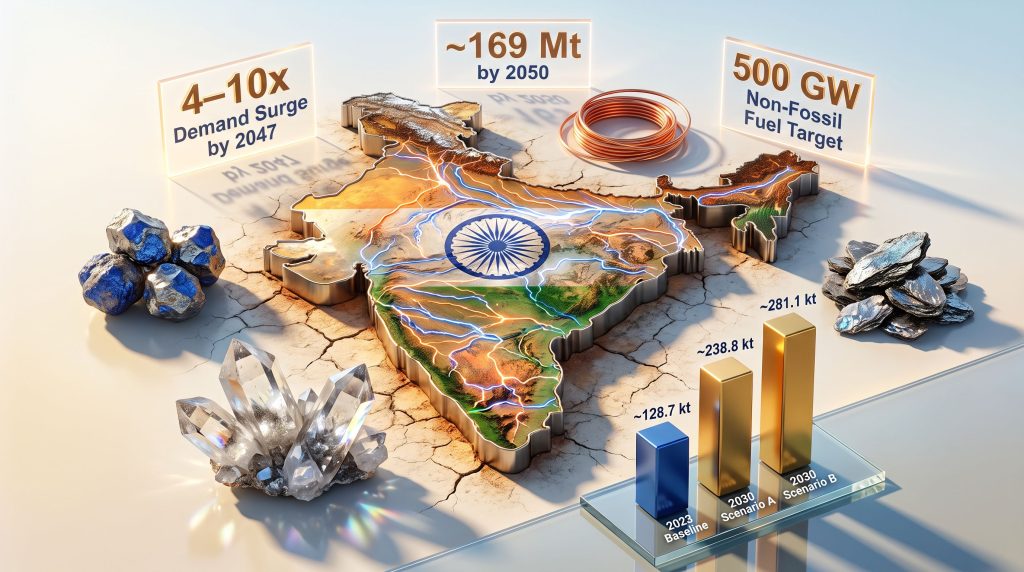
Under the report's projections, India's overall demand for critical minerals could rise between 4 and 10 times its current levels by 2047. That range reflects the uncertainty inherent in modelling a transition that depends on policy execution, technology costs, and global market conditions. However, even the lower bound represents a transformation of extraordinary magnitude.
The near-term numbers are equally significant. By 2030, India's EV battery capacity requirement is projected to reach 110 to 130 GWh, a figure directly tied to the national target of deploying 500 GW of non-fossil fuel energy capacity. Meeting that battery demand will require mineral volumes that are multiples of current consumption levels.
| Mineral | Estimated 2023 Demand | 2030 Scenario A | 2030 Scenario B |
|---|---|---|---|
| Cobalt | ~1.4 kt | ~5.65 kt | ~7.39 kt |
| Total Minerals Basket | ~128.7 kt | ~238.8 kt | ~281.1 kt |
| EV Battery Capacity Need | — | 110 GWh | 130 GWh |
Looking further out to 2050, cumulative critical energy transition mineral demand under a net-zero scenario could reach approximately 169 million tonnes. Within that basket, copper demand alone is projected to exceed 20 million tonnes, while graphite demand is expected to surpass 14 million tonnes. India's share of total global critical mineral demand under the net-zero pathway is projected at roughly 9%, a significant portion for a single emerging economy.
Three Demand Engines Running Simultaneously
What makes India's situation particularly complex is that demand is not being driven by a single sector. Three distinct forces are accelerating simultaneously, and each compounds the others.
Electric mobility is the most visible driver. India's EV transition is accelerating across two-wheelers, three-wheelers, and increasingly passenger vehicles. Each battery pack requires lithium, cobalt, nickel, manganese, and graphite in specific formulations, and the aggregated national demand across millions of vehicles represents an enormous and sustained mineral draw.
Renewable energy infrastructure adds a second, less frequently discussed layer. Solar photovoltaic panels require silicon, silver, and indium. Wind turbines depend on rare earth elements including neodymium and dysprosium for their permanent magnets. Grid-scale battery storage systems require many of the same battery minerals as EVs. India's 500 GW non-fossil fuel target cannot be achieved without securing these inputs at scale.
Industrial expansion and downstream manufacturing form the third engine. As India builds out its manufacturing base, including ambitions to become a global EV component and battery cell producer, the derivative demand for minerals at each stage of the value chain multiplies. A country that assembles battery packs domestically requires far more mineral input than one that simply imports finished cells.
India's critical minerals challenge sits at the intersection of three converging forces: a national EV adoption push, a 500 GW non-fossil fuel energy capacity target, and accelerating industrial manufacturing growth. Each of these trends individually would create significant mineral demand. Together, they create a supply challenge of a different order of magnitude entirely.
The Import Dependency Problem India Cannot Ignore
Against this demand backdrop, India's current supply position is acutely vulnerable. The country is 100% import-dependent for lithium, cobalt, and nickel, the three minerals most central to battery chemistry. Graphite dependency, while less discussed in policy circles, presents an equally significant vulnerability given that graphite constitutes the largest single material input by weight in lithium-ion battery anodes.
India's government has officially identified 30 critical minerals whose supply security is considered essential to national economic and strategic interests. The selection criteria weigh supply concentration risk, economic importance, and the degree to which substitution is either technically difficult or commercially impractical. According to the World Economic Forum, securing these minerals is fundamental to India's low-carbon economic ambitions.
A critical and often underappreciated constraint is timing. Even if India were to dramatically accelerate domestic exploration and mine development today, geological, regulatory, and infrastructure timelines mean that new domestic production at meaningful scale is more than a decade away. This means import reliance is structurally locked in through at least the mid-2030s, regardless of what policy decisions are made in the near term.
This creates a narrow but consequential window: the decisions made between now and 2030 will determine how exposed India remains when demand peaks, not whether exposure exists.
Building the Five Pillars of a Critical Minerals Ecosystem
The Grant Thornton Bharat analysis makes clear that the solution to India's minerals challenge is not simply mining more. The country must build capabilities across five distinct dimensions of the value chain, most of which are currently underdeveloped.
- Exploration – Accelerating geological surveys and establishing a more complete picture of domestic resource endowment, particularly for lithium deposits in Rajasthan and Jammu & Kashmir.
- Refining and processing – Converting raw ore into battery-grade material requires highly specialised industrial chemistry. India currently lacks scale in this area, which means even if domestic ore were mined, it would likely need to be sent offshore for processing.
- Recycling infrastructure – End-of-life batteries from EVs and consumer electronics represent a growing secondary resource stream. Building collection, sorting, and hydrometallurgical processing capacity creates a domestic supply loop that reduces long-term import exposure. In addition, a recent battery recycling breakthrough demonstrates how advanced recovery technologies are reshaping the global supply equation.
- Financing mechanisms – Critical minerals projects carry long lead times, high upfront capital requirements, and significant technical risk. Standard commercial financing structures are poorly suited to these projects, creating a gap that requires instruments such as concessional loans, sovereign guarantees, and blended finance structures.
- Downstream manufacturing – Anchoring battery cell production, cathode active material manufacturing, and EV component assembly within India converts minerals from imported commodities into domestically created economic value.
Of these five pillars, refining and processing represent the most acute gap. China's dominance in critical minerals is not primarily a function of mining output. It is a function of processing capacity. China controls roughly 60 to 80% of global refining capacity across key battery minerals, meaning countries that mine ore must still route it through Chinese facilities before it can be used in manufacturing. India building domestic refining capacity is therefore not just an industrial ambition, it is a prerequisite for genuine supply chain independence.
The $10-15 Billion Recycling Economy: A Three-Phase Roadmap
One of the more forward-looking elements of the Grant Thornton Bharat report is its articulation of battery recycling as a strategic supply chain asset rather than simply a waste management obligation. The roadmap it proposes unfolds across three phases.
| Phase | Timeframe | Key Priorities |
|---|---|---|
| Phase 1 | 2026-2030 | Battery traceability systems, recycling incentives, refining scale-up |
| Phase 2 | 2030-2040 | Domestic processing hubs, sovereign resource partnerships, value-add mandates |
| Phase 3 | 2040-2047 | Full end-to-end value chain maturity, recycling economy at $10-15B annual scale |
The economic logic of Phase 3 is compelling. A mature recycling economy recovering lithium, cobalt, nickel, and manganese from spent batteries reduces the volume of primary mineral imports required to sustain battery production. It also creates a closed-loop industrial system that is geopolitically insulated from external supply disruptions. The traceability infrastructure built in Phase 1 is foundational because you cannot recover what you cannot track.
Battery recycling in India is often framed as an environmental compliance issue. Its actual strategic value is as a domestic mineral supply mechanism that reduces dependency on geopolitically concentrated extraction and processing networks.
The next major ASX story will hit our subscribers first
Is the National Critical Mineral Mission Sufficient?
India's National Critical Mineral Mission provides the institutional and financial scaffolding for this transition, with an announced outlay of ₹34,300 crore. This is a meaningful commitment, but the Grant Thornton Bharat analysis notes that the capital requirements for commercially unproven and technically complex activities, particularly advanced refining, mineral separation, and closed-loop recycling, will exceed what this single mechanism can provide.
The report argues for supplementary financing tools including concessional financing, sovereign guarantees for overseas resource acquisition, and structured public-private capital arrangements that share risk across state and private sector actors. A dedicated sovereign critical minerals fund is specifically proposed as a vehicle for securing overseas resource rights in partnership with resource-rich nations.
This is a model that draws implicitly on approaches used by Japan through its JOGMEC mechanism and by South Korea through its Korea Resources Corporation, both of which built upstream resource positions overseas decades before domestic demand peaked. The strategic logic is that resource access secured when markets are relatively relaxed is far cheaper than access sought during a supply crunch. Consequently, India's lithium supply strategy with Australia exemplifies the kind of bilateral resource partnership this model encourages.
India vs. China: A Strategic Gap That Took Decades to Build
Understanding how far India needs to travel requires understanding how far China has already come. China's dominance in critical minerals was not accidental or rapid. It was the product of deliberate, multi-decade investment in every layer of the value chain, from overseas mine acquisition to domestic refining to battery cell manufacturing to EV production.
| Strategic Lever | China (Established Model) | India (Emerging Model) |
|---|---|---|
| Overseas resource acquisition | State-backed, decades of investment | Early-stage sovereign fund development |
| Domestic refining capacity | Global dominance in processing | Nascent, requires significant scale-up |
| Recycling infrastructure | Advanced and expanding | Policy framework being established |
| Bilateral mineral agreements | Extensive global network | Growing through multilateral partnerships |
India's emerging model is building toward similar strategic depth, but is doing so under time pressure that China never faced. The global clean energy transition is accelerating faster than any comparable industrial shift in history, and the window to establish secure supply positions is compressing. Innovations such as direct lithium extraction technology could, however, meaningfully accelerate India's domestic production timelines if adopted at scale.
Frequently Asked Questions: India Critical Minerals Demand
What minerals are most critical for India's energy transition?
Lithium, cobalt, nickel, manganese, graphite, and copper are the most important. Rare earth elements including neodymium and dysprosium are also significant for wind turbine manufacturing. India is currently 100% import-dependent for lithium, cobalt, and nickel.
Why is India so dependent on mineral imports?
India's domestic geological endowment for battery minerals is limited and underexplored. Where deposits exist, the regulatory, infrastructure, and technical pathways to commercial production take more than a decade to navigate. Processing capacity for converting raw minerals into battery-grade materials is also largely absent domestically.
What is the National Critical Mineral Mission?
It is India's primary policy and financing vehicle for building critical mineral supply security, with an announced outlay of ₹34,300 crore. It covers exploration, processing, recycling, and international partnerships, but supplementary financing will be needed for the highest-risk activities.
How much will India's EV battery demand grow by 2030?
India's EV battery capacity requirement is projected to reach 110 to 130 GWh by 2030, driven by the 500 GW non-fossil fuel energy target and accelerating EV adoption across vehicle categories.
What does the 2047 demand projection mean in practice?
A 4 to 10 times increase in critical mineral demand by 2047 means India needs to either mine, process, import, or recover through recycling volumes of minerals that dwarf anything in its current supply architecture. Building toward this requires beginning construction of the value chain now, not after demand materialises.
How does recycling reduce import dependency?
By recovering lithium, cobalt, and nickel from end-of-life batteries, India creates a secondary domestic supply stream. As the EV fleet grows and first-generation batteries begin reaching end of life in the early 2030s, this stream becomes economically significant and strategically valuable. The battery raw materials market is already pricing in the long-term importance of these secondary supply streams.
What is a sovereign critical minerals fund?
It is a state-managed investment vehicle designed to acquire upstream resource rights in foreign jurisdictions on behalf of the national interest. It provides capital and risk coverage for overseas mine stakes, offtake agreements, and processing partnerships that purely commercial investors would not pursue at scale. The IEEFA's analysis of India's hunt for critical minerals outlines how such instruments can be structured effectively across different resource-rich geographies.
The Narrowing Window Before 2030
The most consequential insight from this body of analysis is not the scale of India's long-term demand, but the asymmetric importance of the next five years. Infrastructure built between now and 2030, including battery traceability systems, refining pilot facilities, recycling collection networks, and overseas resource agreements, will compound in value as demand accelerates through the 2030s.
Conversely, inaction in this window carries compounding costs. Import bills for critical minerals will grow as India critical minerals demand intensifies. Supply disruptions will become more economically damaging as clean energy infrastructure becomes more central to the grid. Geopolitical exposure will intensify as other nations compete for the same concentrated resource pools.
The policy pivot that Grant Thornton Bharat advocates, from revenue maximisation in domestic mineral governance toward resource security as the overriding objective, reflects a fundamental reorientation. A country that taxes and restricts mineral activity to maximise near-term fiscal returns will consistently underinvest in the supply security infrastructure that protects long-term economic resilience. Getting that balance right before 2030 is the most consequential minerals policy decision India faces.
This article contains forward-looking projections and demand forecasts sourced from the Grant Thornton Bharat report titled Building a Critical Minerals Ecosystem in India. All forecasts involve inherent uncertainty and should not be interpreted as guaranteed outcomes. Readers are encouraged to consult primary sources and conduct independent analysis before making investment or policy decisions.
Want to Stay Ahead of the Next Major Mineral Discovery?
As India's critical minerals demand accelerates toward a projected 4 to 10 times increase by 2047, the investment opportunities emerging across the ASX are becoming increasingly significant — Discovery Alert's proprietary Discovery IQ model delivers real-time alerts on significant ASX mineral discoveries, instantly transforming complex geological data into actionable insights for both traders and long-term investors. Explore historic discoveries and the returns they generated, then begin your 14-day free trial to position yourself ahead of the market.