
August 4, 2026
How Crude Oil Benchmarks Actually Work — And Why Changing Them Is a Major Event
Most commodity markets operate invisibly to the public, yet the pricing mechanisms underpinning them shape everything from petrol prices at the pump to the margins earned by refineries across Asia. At the heart of global crude oil trade sits a deceptively complex architecture: the official selling price, or OSP. For national oil companies, the OSP is not merely an administrative number. It is the primary instrument through which billions of dollars in revenue are allocated each month, and the benchmark it references determines who bears risk, who benefits from volatility, and how reliably buyers can plan their procurement.
When a major producer changes the benchmark at the core of its OSP system, the ripple effects extend far beyond a single contract. Hedging strategies must be rebuilt, trading desks must reassess their instruments, and exchange platforms built around the old system face an uncertain future. That is precisely the situation unfolding across Middle Eastern crude markets following the ADNOC benchmark change announced in late July 2026.
When big ASX news breaks, our subscribers know first
Understanding OSPs and Why Benchmark Selection Is a Foundational Decision
An official selling price is a formula-based price that a national oil company publishes each month. Rather than quoting a flat dollar figure, most NOCs express their OSP as a differential to an agreed reference price. The buyer pays that reference price plus or minus the stated spread, depending on the crude grade's quality relative to the benchmark.
This structure means the choice of benchmark is not a technicality. It determines:
- Which market's liquidity backs the pricing signal
- How far in advance prices are fixed relative to cargo loading
- What hedging instruments buyers and traders can use to manage risk
- How exposed the pricing formula is to geopolitical or logistical disruptions
For decades, Middle Eastern producers pricing crude into Asia have gravitated toward Platts Dubai as their reference. Platts Dubai is a daily price assessment published by S&P Global Commodity Insights, reflecting the value of Dubai crude for prompt delivery. It is deeply embedded in Asian crude trading, with the vast majority of Middle Eastern barrels sold into Japan, South Korea, and China priced against it. Understanding the broader crude oil market dynamics helps contextualise why benchmark selection carries such significant commercial weight.
ADNOC had taken a different path. When it launched Murban futures trading on ICE Futures Abu Dhabi (IFAD) in 2021, the ambition was explicit: to establish Murban crude as a genuine global benchmark, competing with Brent and WTI on the world stage. The exchange attracted institutional participation, and traders began using Murban futures as their primary hedging tool against ADNOC's OSP exposure. For a period, the project appeared to be gaining traction.
The Structural Flaw That Geopolitics Exposed
The futures-based OSP system carried an inherent vulnerability that remained manageable under normal market conditions but became acutely destabilising when geopolitical disruption struck. Because Murban futures priced crude approximately two months ahead of actual cargo loading, traders hedging OSP exposure were, by definition, operating with a significant time mismatch between their hedge and their physical position.
Under stable conditions, this lag was tolerable. However, when the Iran conflict of 2026 triggered disruptions to oil export flows through the Strait of Hormuz, one of the world's most critical maritime chokepoints, the basis risk embedded in the futures-based system became catastrophic for some market participants. Traders holding hedged positions in Murban futures found that the futures price and the physical price of Abu Dhabi crude were moving in ways that did not offset each other cleanly. The result was substantial and in some cases severe hedging losses.
Jorge Montepeque, Managing Director of Onyx Capital Group, observed that the repeated closure of the Strait of Hormuz, combined with mounting caution among both sellers and buyers and abrupt shifts in pricing methodology, had created genuine structural pressure to reform OSP formulas and spot selling practices across the region. This perspective captures a dynamic that deserves particular attention: the Strait of Hormuz has always been recognised as a geopolitical risk factor, but the 2026 crisis demonstrated that a futures-based OSP can actively amplify rather than dampen that risk for hedgers.
This is a non-obvious insight. Conventional thinking treats exchange-based benchmarks as more sophisticated than assessment-based ones, on the grounds that they reflect continuous market price discovery. Furthermore, the ADNOC experience illustrates that when a futures contract is used primarily as an OSP hedge rather than as a speculative or directional instrument, its two-month forward pricing horizon creates a structural exposure to events that the spot market immediately prices in but the futures hedge does not absorb until contract expiry. These oil market trade shocks are increasingly relevant to how producers and buyers structure their risk frameworks.
The ADNOC Benchmark Change: Scope, Timing, and Design
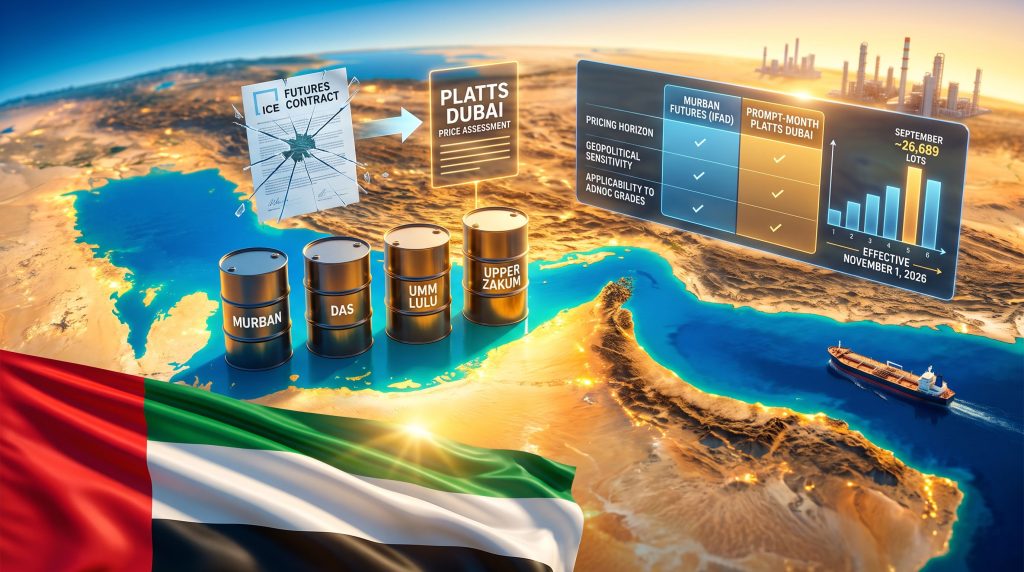
Effective November 1, 2026, ADNOC will price all four of its Abu Dhabi crude grades using prompt-month Platts Dubai as the reference benchmark. The grades affected are:
- Murban (onshore, light sour)
- Das (offshore, medium sour)
- Umm Lulu (offshore, medium sour)
- Upper Zakum (offshore, medium sour)
Under the new framework, ADNOC will publish differentials to Platts Dubai assessments one calendar month before cargo loadings begin. This compresses the pricing horizon significantly compared to the previous two-month forward structure, bringing OSPs much closer to the actual market conditions prevailing at the time of shipment.
Notably, the scope of the July 31, 2026 announcement was considerably wider than the market had anticipated. Earlier signals from June 2026 had suggested ADNOC was reviewing OSP methodology for three offshore grades only, with Murban expected to remain anchored to its futures contract. The decision to include Murban in the transition was a materially larger policy shift, one that effectively ended IFAD's primary commercial purpose in a single announcement.
Benchmark Comparison: Murban Futures vs. Prompt-Month Platts Dubai
| Feature | Murban Futures (IFAD) | Prompt-Month Platts Dubai |
|---|---|---|
| Pricing horizon | ~2 months forward | Aligned to loading month |
| Price discovery mechanism | Exchange-traded futures | S&P Global Platts assessment |
| Geopolitical sensitivity | High basis risk during disruptions | More reflective of spot conditions |
| Hedging instrument utility | High (pre-change) | Lower direct relevance |
| Transparency model | Exchange-based | Publicly available market reference |
| Asian buyer familiarity | Moderate | Very high |
What Happens to IFAD and the Murban Futures Market?
The institutional consequences of the ADNOC benchmark change for ICE Futures Abu Dhabi are profound. IFAD was established with considerable fanfare as a vehicle for giving Murban crude international benchmark status. That ambition has now been formally set aside. The exchange announced it will continue to facilitate trading in Murban futures contracts for months that carry open interest, while contracts without open interest were suspended from late July 2026.
As of July 31, 2026, open interest data presented the following picture:
- September 2026 contract: approximately 26,689 lots (highest active month at that date)
- Record open interest: 28,548 lots, set by the May 2026 contract in March 2026
- Each lot represents: 1,000 barrels of Murban crude
- Contracts with open interest remaining: monthly contracts spanning November 2026 through March 2027
Traders holding positions across these contracts are expected to systematically wind down their exposure as each contract approaches expiry. The hedging rationale that previously sustained IFAD's liquidity — using Murban futures to offset ADNOC OSP price risk — is structurally redundant under the new Platts Dubai methodology. Without that fundamental use case, the organic basis for liquidity on the exchange evaporates.
ICE did not respond to questions regarding the long-term future of the Abu Dhabi exchange, leaving its institutional trajectory formally unresolved. That silence itself carries meaning. Exchanges require liquidity to survive, and liquidity requires a commercial reason for participants to hold positions. With the core hedging rationale gone, the path forward for IFAD is genuinely uncertain.
Where Will Hedging Activity Migrate?
Trading sources indicate that market participants are likely to redirect hedging activity toward the following instruments:
- Dubai crude futures on ICE — directly aligned with the new Platts Dubai reference framework
- Brent futures on ICE — the dominant global crude benchmark with deep liquidity
- Dated Brent instruments — relevant for spread-based hedging strategies
Each of these alternatives offers significantly deeper liquidity than Murban futures ever achieved, and none carries the same geopolitical basis risk that the IFAD contract demonstrated during the Strait of Hormuz disruptions. For sophisticated trading desks, the migration is operationally straightforward. The more complex adjustment falls on institutional risk managers who built OSP hedging frameworks specifically around Murban futures and must now rebuild those models from scratch.
Asian Refiner Perspectives: Less Disruption Than Expected
One of the more revealing aspects of the ADNOC benchmark change is how little alarm it has generated among the buyers most directly affected. Three separate Chinese refining sources indicated that the OSP methodology shift is not expected to materially alter their crude procurement strategies. The explanation is logical: Chinese refiners have operated within a Platts Dubai pricing framework for decades and possess well-established systems for evaluating, contracting, and hedging crude priced against that benchmark.
For North Asian buyers more broadly, including major refiners in South Korea and Japan, the transition actually reduces friction. The previous two-month forward pricing structure created planning complexity when physical market conditions shifted significantly between the OSP fixing date and the actual loading month. Prompt-month pricing eliminates most of that lag, making forward procurement planning more straightforward.
A trader at a major North Asian refinery, speaking without attribution, characterised the decision as ADNOC prioritising a stable commercial outlet to accommodate its production growth aspirations over the prestige of maintaining a global benchmark. This framing is insightful. It suggests that the benchmark ambition was always in tension with ADNOC's core commercial objective: securing reliable, high-volume long-term offtake for a rapidly expanding production base.
The next major ASX story will hit our subscribers first
Production Strategy and the UAE's OPEC Exit
The benchmark change cannot be understood in isolation from ADNOC's broader strategic trajectory. The UAE's departure from OPEC in May 2026, ending nearly six decades of membership, removed the production quota constraints that had previously capped Abu Dhabi's output growth. Consequently, with those constraints lifted, ADNOC is pursuing an expansion to 5 million barrels per day, a target that requires a fundamentally different commercial framework than the one suited to a quota-constrained producer.
Securing long-term offtake agreements with North Asian refiners is central to that strategy. Those refiners operate on planning horizons of years, not months, and they require pricing certainty and methodological stability to commit to large-volume contracts. A Platts Dubai-linked OSP, backed by the most liquid and well-understood pricing reference in Asian crude markets, is better suited to that commercial requirement than an exchange-based benchmark that proved vulnerable to geopolitical disruption and basis risk. Monitoring current crude prices remains essential for both producers and buyers navigating this transitional period.
The decision effectively represents a strategic trade-off: ADNOC sacrificed benchmark prestige in exchange for commercial resilience, choosing depth and stability over the aspirational goal of competing with Brent and WTI as a global crude reference.
Broader Implications for Middle East Crude Pricing Governance
The ADNOC benchmark change carries implications that extend well beyond Abu Dhabi's own OSP framework. For other national oil companies in the Gulf region, the episode provides a cautionary lesson about the conditions under which exchange-based benchmarks can function effectively as OSP anchors. In addition, understanding oil trade geopolitics is increasingly vital for producers seeking to design resilient pricing frameworks.
The core issue is a structural one. Exchange-based benchmarks work well as OSP references when:
- The futures contract has deep, diversified liquidity from speculative as well as hedging participants
- The pricing horizon closely matches the physical cargo delivery timeline
- The underlying crude faces limited geopolitical chokepoint risk
Murban futures satisfied none of these conditions robustly. Liquidity was predominantly driven by hedgers rather than speculators, limiting the market depth needed to absorb large position movements. The two-month pricing horizon created systematic basis risk. Furthermore, the Strait of Hormuz is arguably the single most geopolitically sensitive maritime route in the global crude trade.
IFAD's trajectory also raises a broader question about the competitive landscape for regional benchmark development. Launched in 2021 with strong institutional backing and significant operational investment, the exchange achieved respectable open interest at its peak, with the May 2026 contract reaching a record 28,548 lots. Yet within five years, the core rationale for its existence has been removed. That timeline suggests the barriers to establishing a genuine global crude benchmark are considerably higher than the institutional enthusiasm surrounding new exchange launches typically acknowledges.
For the sour crude complex specifically, the migration of hedging activity toward Dubai and Brent futures consolidates pricing power further within the existing duopoly of established benchmarks. This reinforces rather than challenges the architecture that regional players have long sought to diversify away from. OPEC's market influence, meanwhile, continues to shape how producers and traders interpret pricing signals across the broader Gulf region, even as individual member strategies diverge.
You can also track how ICE Futures exchange is adapting its product offerings in response to evolving regional benchmark structures.
Frequently Asked Questions: ADNOC Benchmark Change
What is the ADNOC benchmark change?
ADNOC has replaced Murban crude futures on ICE Futures Abu Dhabi with prompt-month Platts Dubai as the pricing reference for all Abu Dhabi crude grade official selling prices, effective November 1, 2026.
Which grades are affected?
All four Abu Dhabi crude grades are included: Murban, Das, Umm Lulu, and Upper Zakum, covering both onshore and offshore production.
Why did ADNOC make this change?
The primary drivers were hedging losses sustained by traders during the 2026 Iran conflict and associated Strait of Hormuz disruptions, combined with ADNOC's strategic need for a pricing framework that supports high-volume long-term contracts as it pursues 5 million barrels per day production capacity.
What happens to Murban futures on IFAD?
The exchange will continue trading Murban futures for contract months carrying open interest. Contracts without open interest were suspended from late July 2026. Traders are expected to wind down positions progressively through to March 2027.
How will grade-level differentials be set under the new system?
ADNOC will publish differentials to Platts Dubai one month before cargo loadings. The company has confirmed the methodology will be transparent and rules-based, but has not disclosed the specific formulas for individual grade spreads — a detail the market will scrutinise closely as November 2026 approaches.
How are Asian refiners responding?
Chinese and North Asian refiners have indicated minimal disruption. Platts Dubai is deeply familiar to Asian crude buyers, and prompt-month pricing is expected to simplify rather than complicate procurement planning.
Key Takeaways
- Pricing horizon compression reduces basis risk and aligns OSPs more closely with loading-month market conditions
- Geopolitical stress-testing revealed a structural flaw in futures-based OSP frameworks for Middle Eastern crude, particularly given Strait of Hormuz exposure
- IFAD's commercial purpose has been effectively removed, leaving the exchange's long-term institutional future unresolved
- Asian buyer familiarity with Platts Dubai means the transition is less disruptive for physical buyers than for trading desks and risk managers
- Production strategy alignment explains why ADNOC prioritised commercial stability over benchmark prestige at this particular moment in its growth trajectory
- Grade-level differential formulas remain undisclosed, representing the most significant outstanding uncertainty for market participants as the November 2026 effective date approaches
Disclaimer: This article contains forward-looking observations and market analysis that involve inherent uncertainty. Nothing in this article constitutes financial or investment advice. Readers should conduct independent research and consult qualified advisers before making any decisions based on the information presented here.
Want to Stay Ahead of Major Commodity Market Shifts?
Discovery Alert's proprietary Discovery IQ model delivers real-time alerts on significant ASX mineral discoveries, transforming complex commodity data into actionable investment insights — explore historic discoveries and their returns to understand the scale of opportunity, then begin your 14-day free trial at Discovery Alert to position yourself ahead of the market.