
August 4, 2026
When Warehouse Receipts Become Weapons: The Hidden Mechanics of LME Zinc Concentration
Commodity markets are rarely as transparent as their exchange-traded prices suggest. Beneath the headline numbers that flash across trading terminals lies a far more complex architecture of physical flows, warehouse receipts, and strategic positioning that can shape prices just as powerfully as any shift in fundamental supply or demand. The London Metal Exchange zinc market is currently exhibiting precisely this dynamic, with Trafigura LME zinc holdings drawing significant attention from traders monitoring a combination of historically low available inventories, steep near-term price premiums, and concentrated warrant positions converging to create conditions that seasoned metals traders describe as a structurally fragile state.
Understanding what is actually happening in the LME zinc market right now requires looking well beyond the headline price to examine the mechanics that sit underneath it.
When big ASX news breaks, our subscribers know first
The Inventory Floor That Changed Everything
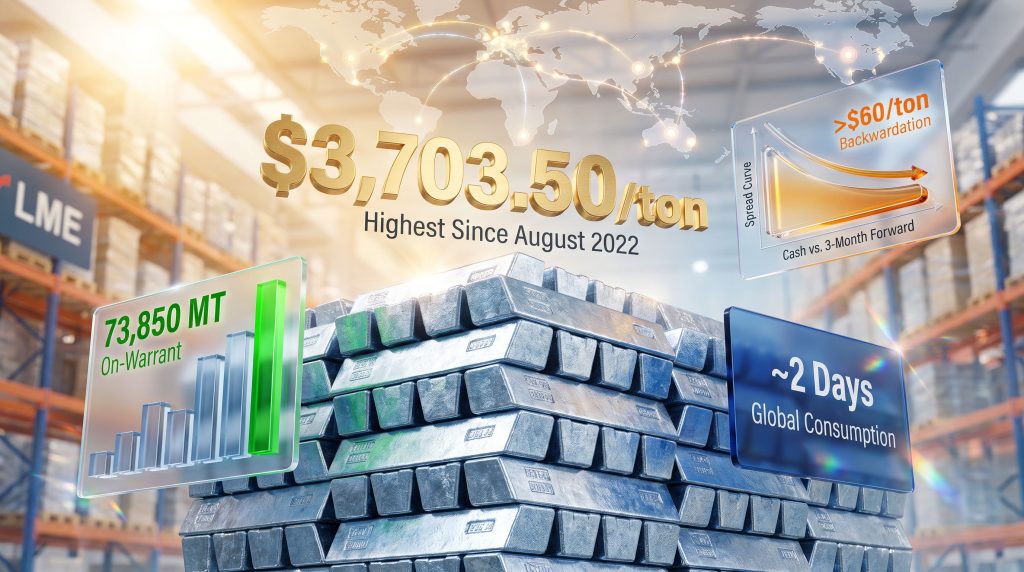
Available zinc stocks on the LME, known in market terminology as on-warrant stocks, currently stand at approximately 73,850 metric tons. This figure represents metal stored in LME-approved warehouses for which title documents, called warrants, remain unallocated and available for delivery against exchange contracts.
To contextualise why this number carries such weight, consider that global refined zinc consumption reached 13.8 million metric tons in the most recent annual period tracked by the International Lead and Zinc Study Group (ILZSG). Dividing that annual demand figure across 365 days reveals that 73,850 tons of on-warrant stock represents roughly two days of global consumption. In practical terms, the entire buffer of immediately deliverable exchange stock could be absorbed in approximately 48 hours of normal global usage.
This is not a situation the market has drifted into gradually. LME on-warrant zinc inventories have been in structural decline, reflecting a broader pattern of physical metal being withdrawn from LME-approved storage for direct industrial use rather than remaining available as an exchange-deliverable buffer. Furthermore, when stocks fall to levels this compressed, the market's ability to absorb sudden demand spikes or supply shortfalls without price disruption becomes severely diminished. This dynamic is well documented across metals and mining analysis covering recent years.
Market Insight: Two days of global consumption cover is not merely a low inventory figure — it is a threshold at which the physical and financial markets lose their typical separation, and where concentrated holdings of warrants can exert disproportionate influence over price discovery.
How LME Warrants Work and Why Concentration Matters
An LME warrant is, at its most fundamental level, a title document. It confers legal ownership of a specific parcel of metal sitting in a specific LME-registered warehouse location. When a buyer takes delivery on an LME contract, they receive warrants, not physical bars directly. When those warrants are cancelled, the metal is being prepared for removal from LME storage entirely.
The LME publishes daily data on warrant holdings in banded categories, revealing when one or more entities hold significant concentrations of available warrants. Current data shows three large holders of LME zinc warrants alongside cash contracts, giving those three entities significant collective influence over the immediately deliverable supply pool. One of these entities has been identified by industry sources as Trafigura, one of the world's largest commodity trading giants, though Trafigura declined to comment publicly on the matter.
The significance of concentrated warrant holdings in a low-stock environment cannot be overstated. With only 73,850 tons of on-warrant metal available, any single entity controlling a meaningful portion of those warrants holds considerable sway over whether physical supply can actually reach the market in the short term.
The Backwardation Signal: Reading the Spread
The structural tightness visible in the warehouse data is being confirmed in a second, equally important way: through the shape of the forward curve. The LME zinc market is currently in steep backwardation, meaning near-term contracts are trading at a significant premium over longer-dated forward contracts.
| Market Structure | Definition | Signal |
|---|---|---|
| Backwardation | Spot/near-term price > forward price | Physical tightness, immediate demand pressure |
| Contango | Forward price > spot/near-term price | Oversupply, storage incentive |
| Current Zinc Market | Cash ~$60/ton above 3-month forward | Acute near-term supply concern |
The cash LME zinc contract is currently trading approximately $60 per ton above the three-month forward contract. This premium eased from a peak of more than $73 per ton recorded roughly a week prior, but remains at levels that commodity professionals interpret as indicating acute near-term supply stress. The August delivery contract is trading more than $63 per ton above the three-month forward, representing the highest August-to-three-month spread since that contract began trading on May 20.
For physical consumers, a $60-per-ton backwardation represents a real and immediate cost. Any buyer needing zinc for near-term delivery must pay a significant premium over the price they would obtain for forward supply. This creates enormous commercial pressure to source metal well in advance, which in a tight market simply accelerates the existing squeeze dynamic. Consequently, commodity market volatility of this nature increasingly affects hedging strategies for industrial participants seeking to manage short-term exposure.
Trafigura, Nyrstar, and the Vertical Integration Factor
Trafigura's presence in the LME zinc market is not incidental. The trading house controls Nyrstar, a major zinc smelting and mining operation with facilities spread across Europe, Australia, and North America. Nyrstar processes zinc concentrate into refined metal and counts among the significant contributors to global refined zinc supply. However, Trafigura slashed Australian smelter valuations by $363 million, highlighting the financial pressures these downstream assets have faced in recent periods.
This vertical integration creates a fundamentally different risk profile from a purely financial market participant. A trading house with downstream smelting operations has legitimate, commercially justified reasons to hold physical zinc warrants as a hedge against supply disruptions to its industrial facilities. Securing warrants ensures that Nyrstar's smelters have a physically deliverable source of refined metal if concentrate supply or intermediate processing is disrupted.
However, the same concentration of warrants that serves a legitimate industrial hedging purpose also creates a situation where a small number of entities exert significant influence over immediately deliverable supply in an already thin market. These two realities coexist, and separating them from the outside is extremely difficult.
Three Interpretive Scenarios for the Current Positioning
Market participants have advanced three broad explanations for the current Trafigura LME zinc holdings concentration:
-
Physical supply security for Nyrstar's European smelting operations, where energy cost volatility and operational uncertainty have historically created a strong incentive to maintain secure physical metal buffers.
-
Trading book optimisation, where holding long warrant positions in a steeply backwardated market generates roll yield as shorter-dated contracts roll up to deliver against the premium spot price.
-
Geographic arbitrage, where metal is being repositioned between LME delivery points in Asia, Europe, and North America to exploit regional price differentials, creating temporary concentration at specific warehouse locations before redistribution.
Each of these explanations is individually plausible, and the reality likely involves elements of all three operating simultaneously within a single integrated trading strategy.
The Short Position Problem and the August 19 Deadline
Adding further complexity to the already tight market structure is a significant short position in the LME August zinc contract. Exchange data reveals that one entity holds a short position equivalent to between 20% and 29% of open interest on the August contract. This position must be resolved before the contract expires on August 19.
The holder of this position faces two broad paths forward, both carrying meaningful financial risk:
| Position Type | Squeeze Risk | Roll Cost Exposure | Resolution Path |
|---|---|---|---|
| Producer hedge | Low (can deliver physical) | Moderate | Deliver against contract |
| Speculative short | High | High ($60-$73/ton premium) | Buy to close or roll at loss |
| Financial arbitrage | Medium | High | Depends on access to physical |
If the short holder is a zinc producer with physical metal available, delivering against the contract is a straightforward resolution, though it does confirm the underlying tightness by directing physical supply into LME delivery rather than the open market. If the short position is speculative or represents a financial bet on lower zinc prices, the situation becomes considerably more dangerous.
Rolling the position into the next contract requires paying the steep backwardation premium on each roll, a cost that compounds rapidly in a market where the cash-to-forward spread exceeds $60 per ton. In addition, base metal price delays can further complicate the financial modelling underpinning such short positions.
Risk Alert: A speculative short holder without physical metal access faces a choice between absorbing roll costs exceeding $60 per ton per contract cycle or buying back the position at elevated spot prices, with neither option offering an attractive financial outcome in the current market configuration.
The Benchmark Price and What Breaking $3,700 Means
Against this backdrop, the benchmark three-month LME zinc price reached $3,703.50 per ton, its highest level since August 16, 2022. While the price subsequently pulled back to trade near $3,633 per ton during the same session, the breach of the $3,700 level carries technical significance for market participants tracking multi-year resistance zones.
A sustained close above $3,700 per ton would signal to technically-oriented traders that the multi-year resistance level has converted to support, potentially attracting further momentum buying. However, given the extent to which the current rally is driven by physical tightness rather than purely by demand growth or macroeconomic optimism, any easing of the inventory situation could trigger a rapid retracement.
Supply Fundamentals: Structural or Cyclical Tightness?
The critical question for longer-term market participants is whether the current tightness reflects a structural imbalance or a cyclical dislocation that will self-correct as new supply enters the market.
Several supply-side factors have converged to reduce LME deliverable zinc availability:
- Mine production disruptions at key operations across South America and Asia have constrained concentrate availability.
- European zinc smelters, including Nyrstar's facilities, have historically operated at reduced rates during periods of elevated power prices, reducing refined metal output.
- Lead times between mine production, concentrate shipping, smelting, and final refined metal delivery to LME warehouses span multiple months, meaning supply responses to elevated prices are delayed.
- Zinc withdrawn from LME warehouses for direct industrial use, rather than financial trading, removes inventory from the exchangeable buffer permanently until producers choose to redeliver.
On the demand side, the ILZSG's figure of 13.8 million tons of annual refined zinc consumption reflects sustained demand driven primarily by galvanised steel production for infrastructure and construction applications. This demand base also intersects meaningfully with the broader stainless steel market, where zinc-adjacent metals face similar structural pressures. Furthermore, emerging demand from zinc-based battery chemistries, including zinc-air and zinc-ion technologies, represents a nascent but directionally significant addition to the demand base that was not present in previous commodity cycles.
The next major ASX story will hit our subscribers first
What Investors and Physical Consumers Should Watch
For those with exposure to zinc, whether as investors, producers, or industrial consumers, the following metrics function as the most reliable real-time indicators of market stress:
- LME on-warrant zinc stocks: Any move below 70,000 tons would intensify squeeze concerns; a recovery above 100,000 tons would signal easing pressure.
- The cash-to-three-month spread: Sustained backwardation above $50 per ton indicates persistent physical tightness; a move toward contango would signal inventory recovery.
- Warrant cancellations: Daily LME data on cancelled warrants, indicating metal booked for physical removal, provides early warning of further inventory drawdowns.
- The August contract spread over three-month forward: Already at its highest level since May 20, any further widening above $70 per ton would indicate escalating squeeze pressure heading into the August 19 expiry.
Investor Note: The LME cash-to-forward spread is arguably the single most actionable real-time signal of physical zinc market stress, providing market participants with near-instantaneous feedback on whether tightness is intensifying or resolving.
Key Data Snapshot: LME Zinc Market at a Glance
| Metric | Value | Significance |
|---|---|---|
| LME on-warrant zinc stocks | ~73,850 metric tons | Approx. 2 days of global consumption |
| Global refined zinc consumption (annual) | 13.8 million metric tons | ILZSG benchmark |
| Benchmark 3-month LME zinc price (peak) | $3,703.50/ton | Highest since August 16, 2022 |
| Cash-to-3-month forward premium | ~$60/ton | Steep backwardation |
| Peak cash-to-forward premium (recent) | >$73/ton | Extreme near-term tightness |
| August contract premium over 3-month | >$63/ton | Highest since May 20 spread launch |
| Short position in August contract | 20-29% of open interest | Significant squeeze exposure |
The zinc market is demonstrating that physical commodity dynamics — specifically the interplay between deliverable inventory, warrant concentration, and forward curve structure — can drive price behaviour that is both technically significant and fundamentally justified. Whether the current tightness resolves through new supply entering LME warehouses or through a financially painful unwinding of short positions, the Trafigura LME zinc holdings situation has placed the market in a phase where the cost of being wrong, for either shorts or physical buyers, is unusually high.
Disclaimer: This article is intended for informational purposes only and does not constitute financial or investment advice. Commodity markets involve significant risk, and forecasts or scenario analyses presented here reflect analytical frameworks rather than guaranteed outcomes. Readers should conduct independent due diligence before making investment decisions.
Want to Stay Ahead of Major Commodity Market Movements?
Discovery Alert's proprietary Discovery IQ model delivers real-time alerts on significant ASX mineral discoveries the moment they hit the exchange, transforming complex commodity data into actionable insights for both short-term traders and long-term investors — explore historic examples of major discovery returns to see what's possible, then begin your 14-day free trial at Discovery Alert to position yourself ahead of the broader market.