
August 4, 2026
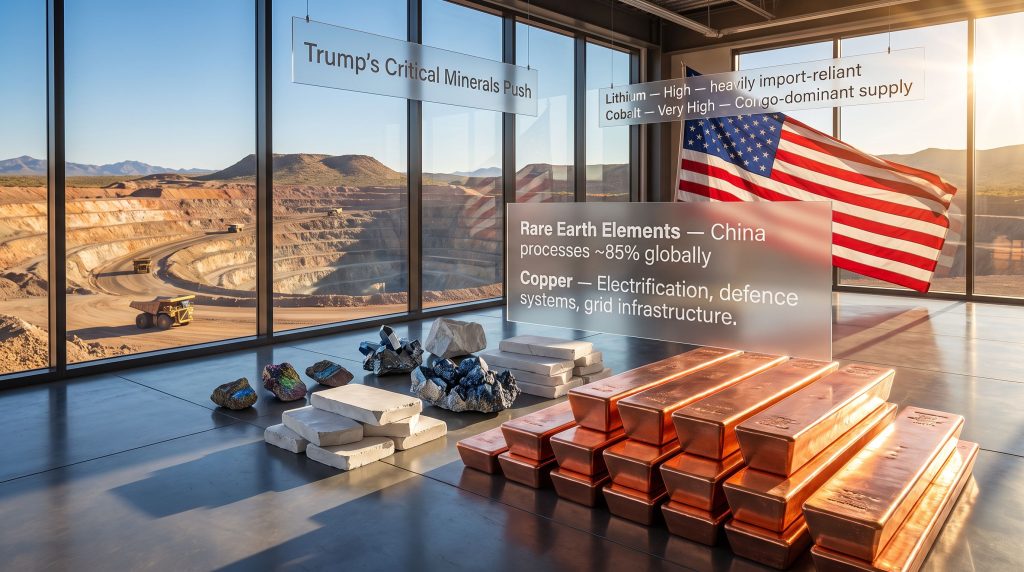
The Hidden Bottleneck Undermining America's Critical Minerals Ambitions
The global race to secure critical minerals is not simply a story about geology or geopolitics. It is fundamentally a story about institutional capacity: the ability of a nation to find, extract, process, and deliver the raw materials that underpin modern industrial civilisation. The United States, despite holding significant untapped mineral endowments, faces a structural mismatch between its consumption of critical materials and its domestic capacity to produce them. Understanding why that gap exists, and whether current policy can close it, requires looking well beyond executive orders and trade negotiations.
The Trump critical minerals push with mining executives has placed this challenge at the centre of U.S. industrial policy, most visibly through a high-level State Department roundtable expected to draw presidential attendance alongside senior industry leaders. However, the strategic challenge runs far deeper than any single meeting can resolve. The Trump critical minerals order provides a policy foundation, but execution remains the defining test.
When big ASX news breaks, our subscribers know first
China's Structural Advantage: More Than Just Resources
A persistent misconception in Western policy circles is that China's dominance in critical minerals stems primarily from having more of them. The reality is considerably more nuanced. While China does hold significant reserves of several key minerals, its true competitive advantage lies in decades of coordinated investment across the entire value chain: from exploration and extraction through to processing, refining, and manufacturing of finished components.
China processes approximately 85% of the world's rare earth elements, despite other countries holding meaningful reserves. For cobalt, the Democratic Republic of Congo dominates raw ore production, yet Chinese entities control a substantial share of the processing infrastructure that converts that ore into battery-grade material. This distinction between mining and processing is critical and frequently underappreciated in Western policy debates.
Furthermore, rare earth supply chains reveal just how entrenched this structural advantage has become. Three structural pillars underpin China's minerals position:
- A state-coordinated network of mining schools producing technically skilled graduates at scale across geology, metallurgy, and mine engineering disciplines
- Long-horizon state capital that tolerates multi-decade return profiles incompatible with Western private equity investment models
- Vertically integrated supply chains that capture value at every stage, from raw ore to refined product to manufactured component
The United States currently lacks all three at competitive scale. Addressing only one — say, permitting reform for new mines — while leaving the others unresolved will not meaningfully shift the strategic balance.
What the State Department Roundtable Actually Signals
Presidential engagement with industry is not unprecedented, but the venue matters. Hosting a mining roundtable at the State Department rather than the Commerce Department or the White House situates the minerals challenge explicitly within the architecture of foreign policy. This framing carries specific implications.
It signals that the administration views minerals security not merely as an industrial competitiveness issue but as a diplomatic and geopolitical priority requiring allied-nation coordination. The State Department's mandate extends to managing the international relationships and trade negotiations through which allied-nation supply partnerships must be constructed. Locating the executive engagement there suggests that the administration recognises domestic production alone cannot close the supply gap within any strategically relevant timeframe.
The earlier Trump administration engagement with leadership from Rio Tinto and BHP, centred on the Resolution Copper project in Arizona, illustrates this dual-track approach. Resolution Copper represents one of the largest undeveloped copper deposits in North America, with estimates suggesting it could supply approximately 25% of U.S. copper demand upon full development. Copper's centrality to electrification infrastructure — from grid upgrades to defence electronics and EV drivetrains — makes it perhaps the single most strategically consequential mineral in the near-term transition economy.
Yet the project has faced prolonged permitting delays and land rights disputes, demonstrating precisely the execution gap between political intent and operational reality. In addition, the broader energy security challenge compounds the pressure on policymakers to accelerate tangible progress.
Priority Minerals and U.S. Dependency: A Strategic Scorecard
| Mineral | Primary Strategic Application | U.S. Import Dependency Risk | Key Supply Concentration |
|---|---|---|---|
| Copper | Grid infrastructure, defence electronics, EVs | Moderate | Chile, Peru dominant |
| Lithium | Battery storage, EVs, grid-scale energy | High | Australia, Chile, China processing |
| Rare Earth Elements | Defence magnets, advanced electronics | Very High | China processes ~85% globally |
| Cobalt | Battery cathodes, aerospace alloys | Very High | DRC ore, China processing |
| Nickel | EV batteries, stainless steel | High | Indonesia, Philippines dominant |
What this table obscures is an important distinction: ore dependency versus processing dependency. For several of these minerals, the United States could theoretically expand domestic mining output substantially, yet still remain dependent on foreign — predominantly Chinese — processing and refining infrastructure to convert that ore into usable industrial material. This upstream-downstream split is the defining structural vulnerability that a mines-only policy approach fails to resolve.
The Workforce Crisis: A Four-to-Six Year Lag That Cannot Be Shortcut
Concurrent with the State Department roundtable, the U.S. Department of Energy convened a separate workforce development forum, bringing together representatives from all 14 accredited U.S. mining schools. The dual-track nature of these events — one focused on executive supply chain diplomacy and the other on educational pipeline development — reflects an acknowledgment that the minerals challenge has both an immediate geopolitical dimension and a generational structural dimension.
The workforce problem is particularly acute because it operates on a fundamentally different timeframe than executive action. A presidential order can modify a permitting framework within months. Training a qualified mine geologist, metallurgical engineer, or processing technician takes four to six years at minimum, and building a cohort large enough to staff multiple new major mines takes considerably longer.
Several structural barriers compound the challenge:
- Mining careers remain significantly underrepresented in STEM education pipelines relative to technology, finance, and biomedical fields, partly due to perception issues around remote work locations and physical demands
- University mining programmes are geographically concentrated in regions that do not overlap well with major population centres or elite research institution networks
- The career pathway visibility problem: many high school students with aptitude for geology, chemistry, or engineering are unaware that mining offers technically sophisticated, well-compensated professional careers
- A generational knowledge gap as experienced mining professionals retire faster than new graduates enter the workforce
China's position here is instructive and sobering. Its state-coordinated system of mining education institutions has produced a technically skilled workforce that directly supports its dominant position across the minerals value chain. The U.S. is not simply behind on mine approvals; it is behind on the human capital required to operate the mines it hopes to build.
The National Mining Association has positioned workforce development as inseparable from supply chain security, publicly committing to collaborative engagement with the administration on building the next generation of mining professionals alongside responsible domestic resource development.
The Processing Bottleneck: The Problem That Permitting Reform Cannot Fix
A mines-focused strategy without a corresponding domestic processing investment plan addresses only the upstream dimension of the critical minerals challenge. The refining and processing deficit remains the most structurally difficult problem to solve.
This is the insight most frequently absent from public policy discussions about U.S. minerals security. Permitting reform, executive orders, and even successful mine development address the extraction phase of the minerals value chain. However, for most critical minerals, raw ore has minimal strategic value. What matters is the refined, battery-grade, high-purity material that can be directly incorporated into defence systems, battery cells, and advanced electronic components.
Building domestic processing capacity requires:
- Separate and substantial capital investment, typically running into hundreds of millions to billions of dollars per facility
- Distinct environmental permitting processes from mine permits, often involving different regulatory frameworks and community opposition dynamics
- Specialised technical expertise in hydrometallurgy, pyrometallurgy, and chemical separation that the U.S. has allowed to atrophy over decades
- Long construction and commissioning timelines that extend the gap between policy intent and operational capability
Efforts to scale up critical minerals production domestically must consequently address processing infrastructure as a parallel priority, not an afterthought. Without parallel progress on processing, expanded domestic mining output risks simply redirecting ore flows toward foreign refiners — potentially including the same Chinese processors the strategy is designed to bypass.
The next major ASX story will hit our subscribers first
Trade Architecture: What the Price Floor Retreat Reveals
The administration's January 2026 decision to defer tariff imposition on select critical minerals in favour of structured trade negotiations, followed by the subsequent scaling back of proposed price floor mechanisms, reveals something important about the real-world constraints facing even a politically determined minerals strategy.
Price floors — which would have established minimum guaranteed prices for domestically produced critical minerals — were theoretically designed to reduce the investment risk facing mining companies weighing multi-billion-dollar capital commitments. In practice, they encountered resistance from multiple directions: downstream manufacturers concerned about cost pass-through, allied nations wary of market distortion effects, and mining companies themselves uncertain about long-term political durability of the mechanism.
Policy Watch: The Trump critical minerals push with mining executives and its associated framework remain in active development. Mechanisms including pricing supports, permitting acceleration timelines, and allied-nation partnership structures are subject to ongoing revision as geopolitical and market conditions evolve. Investors and project developers should not treat current policy settings as durable without independent verification.
The fluidity of the policy environment creates a genuine investment dilemma. Mining projects require decade-scale capital commitments. Regulatory environments that shift materially within a single presidential term create uncertainty that rational capital markets will price accordingly, potentially deterring the private investment the strategy depends upon to succeed.
Allied Nation Partnerships: The Near-Term Bridge Strategy
Given the multi-year to multi-decade timelines associated with domestic production expansion, the most actionable near-term pathway to minerals security runs through allied-nation supply partnerships. Australia, Canada, and select African nations hold the resource endowments and political alignment necessary to serve as reliable supply alternatives to Chinese-controlled sources. The historic critical minerals framework signed between President Trump and Prime Minister Albanese exemplifies how these bilateral arrangements are taking shape.
The Minerals Security Partnership (MSP), a multilateral framework involving the U.S. and key allied nations, provides the diplomatic architecture through which these arrangements are being developed. The framework's practical impact depends on the depth and durability of bilateral agreements negotiated within it, which remain works in progress. Consequently, the scale of critical minerals demand projected through the 2030s means that allied partnerships alone are unlikely to be sufficient without concurrent domestic investment.
| Strategic Approach | Key Advantages | Primary Limitations |
|---|---|---|
| Domestic Production Expansion | Supply security, job creation, political capital | Long timelines, high capital costs, permitting risk |
| Allied Nation Partnerships | Faster supply access, lower capital requirement | Geopolitical dependency, logistics complexity |
| Trade Negotiation Tools | Market incentive alignment | Policy uncertainty, industry resistance |
| Workforce Development | Long-term structural solution | Four to six year minimum lag before impact |
| Processing Infrastructure Build-Out | Closes downstream vulnerability | Highest capital intensity, longest construction timeline |
Three Scenarios for U.S. Minerals Strategy Through the 2030s
Scenario One: Accelerated Domestic Build-Out
Permitting reform achieves meaningful acceleration, landmark projects including Resolution Copper advance through regulatory approval, and workforce investment begins generating qualified graduates at scale. Processing infrastructure investment follows mine development with a two to three year lag. By the mid-2030s, U.S. import dependency for copper and select battery metals begins a measurable decline.
Scenario Two: Allied Partnership-Led Supply Security
Domestic permitting challenges persist, driven by environmental litigation and community opposition. However, deep supply agreements with Australia, Canada, and African partner nations — structured through the MSP and bilateral trade frameworks — provide reliable access to processed minerals. Supply chain security is achieved diplomatically rather than through domestic production growth. Inside Trump's ambitious minerals push provides further context on the risks and opportunities within this approach.
Scenario Three: Policy Fragmentation and Continued Vulnerability
Regulatory opposition, persistent policy volatility, and insufficient private sector investment stall both domestic and allied-nation strategies. Processing infrastructure gaps remain unaddressed. U.S. critical minerals dependency persists through the decade, with strategic vulnerability most acute in rare earth processing and battery-grade lithium refining — precisely the materials most central to next-generation defence systems and energy storage.
The probability weighting across these scenarios remains genuinely uncertain. What is clear is that the Trump critical minerals push with mining executives represents a necessary but not sufficient condition for closing the strategic gap. Political intent, executive action, and industry engagement must translate into funded projects, qualified workforces, and operational processing facilities before the minerals security objective can be considered achievable.
Disclaimer: This article contains forward-looking analysis, scenario projections, and references to policy frameworks that remain subject to change. Nothing in this article constitutes financial or investment advice. Readers should conduct independent research before making investment decisions related to the mining sector or critical minerals markets.
For ongoing coverage of global mining sector developments and U.S. critical minerals policy, Mining Weekly provides continuous reporting across the full spectrum of mining industry news at miningweekly.com.
Want to Stay Ahead of the Next Major Mineral Discovery on the ASX?
Discovery Alert's proprietary Discovery IQ model instantly identifies significant ASX mineral discoveries across critical commodities — including copper, lithium, and rare earths — translating complex data into actionable investment insights for both traders and long-term investors. Explore historic examples of exceptional mineral discovery returns and begin your 14-day free trial today to position yourself ahead of the broader market.