August 4, 2026
The Revenue War: Understanding How Russia Sanctions on Oil Exports Are Built to Squeeze, Not Stop
Most economic sanctions in history have been designed to cut off trade entirely. The architecture governing Russia sanctions on oil exports operates on an entirely different philosophy. Rather than attempting to eliminate Russian crude from global markets, the framework that has evolved since 2022 targets something more precise: the price Russia receives per barrel. This distinction is not a loophole. It is a deliberate design choice, built to suppress Kremlin revenue without triggering the kind of global supply shock that would inflict economic pain on the very nations imposing the restrictions.
Understanding why this framework was constructed this way, how it functions across multiple jurisdictions, and why it is now escalating toward its most aggressive configuration yet, requires examining the full architecture from the ground up.
When big ASX news breaks, our subscribers know first
Why Russia Oil Sanctions Were Designed Around Revenue, Not Volume
When Western governments confronted the challenge of sanctioning Russian oil after the February 2022 invasion of Ukraine, they faced a structural dilemma. Russia supplies roughly 10 to 12 percent of global crude oil, and an abrupt removal of that volume from world markets would have sent energy prices to levels capable of triggering recessions across Europe and North America.
The solution was a revenue-suppression model rather than a volume-elimination model. The core mechanism, developed jointly by the G7 nations and the European Union, works through a price cap enforced not at the point of production but at the point of service. Western shipping companies, insurers, and financial intermediaries are prohibited from facilitating the transport or financing of Russian oil unless that oil is sold at or below designated cap levels.
Furthermore, the sanctions impact on Russian oil trading does not prevent Russia from exporting oil entirely. It prevents Russia from receiving full market prices for that oil by making Western maritime services conditional on price-cap compliance.
This design means Russian crude can continue flowing to non-Western buyers, but the logistics cost of moving that oil outside the Western services ecosystem rises substantially, compressing margins from both ends.
The EU Sanctions Architecture: Bans, Price Caps, and Shadow Fleet Enforcement
What the EU Has Actually Prohibited
The European Union's direct trade restrictions on Russian oil took effect in two phases:
- December 5, 2022: Ban on seaborne Russian crude oil imports into EU member states
- February 5, 2023: Ban on Russian refined petroleum product imports into EU member states
- Pipeline gas exemptions remain in place for select member states, including Hungary and Slovakia, which currently receive approximately 32% of Russia's remaining pipeline gas exports under these carve-outs
- The EU as a collective bloc remains the world's largest buyer of Russian liquefied natural gas, accounting for 49% of Russia's total LNG export volume
The EU has committed to phasing out these residual dependencies on a fixed timeline: Russian LNG by January 2027, natural gas by September 2027, and crude oil by December 2027. The paradox of the EU simultaneously leading the sanctions charge while remaining Russia's single largest LNG customer is not lost on policy analysts. Consequently, it represents one of the more uncomfortable contradictions within the current framework.
How the Price Cap Mechanism Functions
The G7/EU price cap structure as of mid-2026 is as follows:
| Product Category | Price Cap Level |
|---|---|
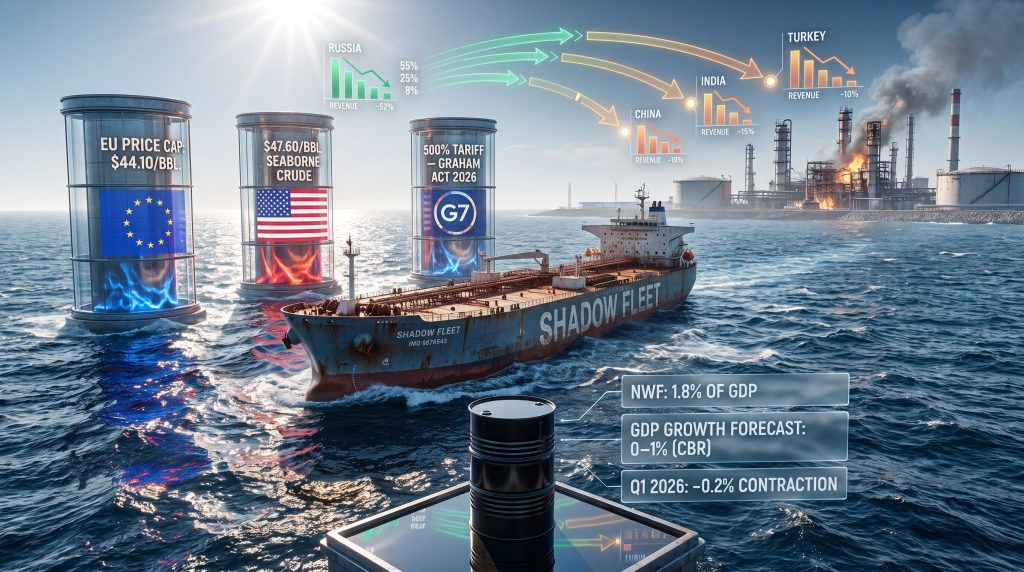
| Russian Seaborne Crude | $47.60 per barrel |
| Premium Refined Products | $100.00 per barrel |
| Discount Refined Products | $45.00 per barrel |
| EU Internal Freeze (21st Package) | $44.10 per barrel (frozen for 12+ months) |
In July 2026, the EU froze the seaborne crude cap at $44.10 per barrel for at least twelve months through its 21st Sanctions Package. This decision paused a floating calculation mechanism that would otherwise have raised the cap by more than $10 per barrel during the scheduled review period. The freeze was a deliberate tightening signal, designed to prevent any accidental loosening of revenue pressure on Moscow.
The 21st Sanctions Package: Shadow Fleet Escalation
The EU's 21st Sanctions Package introduced structural changes to shadow fleet enforcement that go beyond anything attempted previously:
- 41 additional vessels added to the EU asset freeze list
- For the first time, sanctioning authority was extended to vessels that do not directly carry Russian crude but instead provide logistical support to blacklisted shadow tankers
- Any vessel caught refuelling, towing, or conducting ship-to-ship cargo transfers with a designated shadow tanker now faces automatic designation and a total maritime services ban
- EU member states were granted new authority to seize and liquidate oil cargoes discovered aboard detained shadow fleet vessels
The extension of sanctions to support-service vessels represents a fundamental change in how the EU approaches interdiction. Previous enforcement targeted the cargo carrier. The new architecture, however, targets the entire operational ecosystem that keeps shadow fleet tankers moving.
The U.S. Framework: From Import Bans to the 2026 Legislative Push
Current U.S. Sanctions on Russian Oil
The United States banned imports of Russian energy products in March 2022, acting more rapidly than its European counterparts due to its lower dependence on Russian supply. Since then, the Office of Foreign Assets Control (OFAC) has conducted successive rounds of designations targeting Russian producers, traders, tankers, and petroleum service providers. The U.S. was also a co-architect of the original $60 per barrel crude oil price cap established by the Price Cap Coalition.
The Graham Act: What an 86-12 Senate Vote Could Mean for Russian Oil
On July 28, 2026, the U.S. Senate voted 86 to 12 to advance the Lindsey O. Graham Sanctioning Russia and Iran Act of 2026. The breadth of the vote signals unusually strong bipartisan appetite for escalation. In addition, the bill's provisions represent the most expansive sanctions architecture yet proposed against Russia's energy revenue base.
The key provisions of the legislation are:
- Secondary tariffs of up to 100% on imported goods from the top five countries identified as enabling Russian oil sanctions evasion, based on purchasing volumes in the preceding 12-month period
- Current top five individual country buyers identified as primary targets: China, India, Turkey, Brazil, and Azerbaijan
- Direct Russia tariffs of up to 500% on all goods imported from Russia, explicitly covering crude oil, natural gas, LNG, petroleum products, and coal
- Prohibition on new U.S. investment in Russia's energy sector
- Ban on U.S. energy product exports to Russia within 30 days of enactment
- Foreign vessel designation as blocked property for tankers transporting Russian-origin energy commodities without compliant maritime insurance or in violation of price cap rules
The secondary tariff mechanism targeting third-country buyers is arguably the most consequential element. It transforms compliance with Russia sanctions on oil exports from a bilateral Western obligation into a global trade risk calculation, forcing major purchasing nations to weigh continued Russian crude access against their access to U.S. markets. This dynamic is closely connected to broader geopolitical tensions reshaping global trade patterns in 2025 and beyond.
Who Is Still Buying Russian Oil and What Sanctions Risk Do They Face?
| Buyer | Primary Exposure | Sanctions Risk Under 2026 Bill |
|---|---|---|
| China | Seaborne crude, pipeline gas | High: identified top individual buyer |
| India | Seaborne crude (record volumes in 2026) | High: identified top individual buyer |
| Turkey | Crude and refined products | High: identified top individual buyer |
| Brazil | Crude and petroleum products | Moderate: top five buyer |
| Azerbaijan | Transit and product purchases | Moderate: top five buyer |
| EU (collective) | Russian LNG (49% of total LNG exports) | Transitional: phaseout committed by 2027 |
India's purchases of Russian seaborne crude reached record highs in mid-2026 despite sustained Western diplomatic pressure. This development has reinforced the case for secondary tariff mechanisms among U.S. policymakers. The arithmetic is straightforward: as long as major non-Western buyers face no binding compliance obligations, Russia retains a partial export lifeline regardless of how tightly the EU tightens its own restrictions.
It is worth noting that the EU, assessed as a collective purchasing bloc, would rank in approximately fourth place among global buyers of Russian energy given its continued LNG dependence. This complicates the application of secondary tariff logic and creates a diplomatic sensitivity that the bill's architects have not yet fully resolved. For instance, the trade war impact on oil markets in 2025 has already demonstrated how quickly these diplomatic tensions can translate into price volatility.
Russia's Shadow Fleet: How Sanctions Evasion Is Structured
The Operational Architecture of the Shadow Fleet
Russia's shadow fleet is not a single organised entity. It is a decentralised network of tankers operating outside Western insurance, classification society oversight, and flag-state regulatory frameworks. Vessels are typically registered in permissive jurisdictions, owned through opaque multi-layered corporate structures, and insured through non-Western providers whose compliance with price cap rules cannot be verified through standard channels.
Key evasion methods employed by the shadow fleet include:
- Ship-to-ship cargo transfers conducted in international waters, obscuring the origin of the crude before it enters a buyer's port
- Re-flagging and re-registration in jurisdictions with minimal regulatory oversight
- Use of non-Price Cap Coalition traders as intermediaries, breaking the compliance chain
- Falsification of cargo origin and destination documentation
- Transiting through third-country ports to create the appearance of a different supply origin
What Sanctions Have Actually Achieved on Revenue
The measurable impact of Russia sanctions on oil exports should not be read through the lens of export volume alone. Russia has not stopped selling oil. However, what has changed is the economics of each barrel sold.
The Urals-to-Brent spread, a closely watched indicator of sanctions-induced revenue compression, captures the discount Russia must offer to move crude outside Western logistics networks. This discount represents a direct transfer of revenue away from the Kremlin and toward discount-seeking buyers. Combined with the higher logistical costs of operating through the shadow fleet and the longer voyage distances involved in redirecting roughly 80% of former European crude volumes toward Asian buyers, the per-barrel revenue Russia actually receives is materially lower than headline Brent prices suggest.
Sanctions effectiveness against Russian oil is therefore most accurately measured not by export volume data but by the cumulative revenue gap between what Russia would have earned at pre-war Brent prices and what it actually receives after applying cap-enforced discounts, extended voyage premiums, and shadow fleet operational costs.
The next major ASX story will hit our subscribers first
Ukraine's Drone Campaign: The Compounding Variable
Refinery Damage as an Economic Weapon
Overlaying the sanctions pressure is a separate but complementary degradation campaign. Ukraine has conducted a sustained drone offensive against Russian refinery infrastructure, with a concentrated escalation beginning in August 2025. Since the start of 2026, Ukrainian drones have struck Russian refineries at least 194 documented times, with cumulative damage approaching 43% of Russia's total operating refinery capacity.
The consequences of this infrastructure campaign compound the sanctions effect in several ways:
- Russia has been forced to seek external refining arrangements, including approaches to Kazakhstan for processing capacity
- Domestic fuel export bans covering both diesel and gasoline have been extended through to December 31, 2027
- Fuel scarcity is increasingly constraining both civilian supply chains and military logistics
- The Kremlin has issued retaliatory export rules prohibiting the sale of Russian oil and petroleum products that would be subject to Western price caps
Ukraine's drone campaign against refinery assets has effectively added a domestic supply constraint on top of the external revenue constraint created by sanctions — a combination that the Kremlin's wartime economic managers did not fully anticipate when redirecting the economy toward military production.
Russia's Economic Indicators: Reading the Stress Signals
The macroeconomic picture inside Russia in 2026 reflects the accumulated weight of sanctions, infrastructure damage, and wartime fiscal strain.
| Indicator | Pre-Sanctions Baseline | 2026 Status |
|---|---|---|
| GDP Growth Forecast | ~3-4% (wartime surge period) | 0-1% (Central Bank of Russia) / 0.4% (Ministry of Economic Development) |
| National Wealth Fund (% of GDP) | 6.5% | 1.8% |
| Q1 2026 GDP Growth | Positive (multi-quarter streak) | -0.2% contraction |
| Refinery Capacity (operational) | ~100% | ~57% (post-drone campaign) |
| Monthly Military Recruitment vs. Casualties | Replacement-positive | Deficit: ~27,000 recruited vs. ~30,000+ casualties/month |
Central Bank of Russia Governor Elvira Nabiullina's assessment at the St. Petersburg International Economic Forum in 2025 signalled a critical inflection point, indicating that Russia's available resources across labour, manufacturing capacity, and sovereign wealth fund reserves had reached exhaustion. The subsequent data has borne out that assessment.
Russia's National Wealth Fund liquid assets have contracted from 6.5% of GDP to just 1.8%, stripping the Kremlin of the fiscal buffer that absorbed earlier sanctions pressure. Official Rosstat data showed the economy contracting by 0.2% in early 2026, ending a multi-quarter streak of wartime growth that had given Moscow a degree of economic resilience in the first two years of the conflict.
Scenario Pathways: What Happens Next to Russia Oil Sanctions
Three Scenarios for the Graham Act
The trajectory of Russia sanctions on oil exports in the second half of 2026 hinges substantially on the legislative fate of the Graham Act. Three broad scenarios are plausible:
Scenario A: Full Enactment
Secondary tariffs trigger a diplomatic confrontation with China and India. Both nations face a binary choice between continued access to discounted Russian crude and preserved access to U.S. markets. Russian export revenues face structural compression from both the EU price cap freeze and the removal of key Asian demand at current discount-accessible volumes.
Scenario B: Partial or Conditional Implementation
The tariff threat functions as leverage rather than a fully enforced mechanism. Major Russian oil buyers reduce purchase volumes or diversify supply sources in response to the threat, achieving partial sanctions compliance without requiring direct confrontation between Washington and Beijing.
Scenario C: Legislative Delay or Stall
Russia maintains current export levels. Sanctions pressure remains primarily EU-led and cap-dependent. The shadow fleet continues operating with manageable interdiction risk, and the revenue gap narrows if oil prices rise. The oil price shock facing energy executives in this scenario would be considerably less severe than under full enactment.
The September 2026 Elections and Post-Election Signalling
Russia's first major parliamentary and regional elections since the 2022 invasion are scheduled for September 18 to 20, 2026. Analysts widely expect the post-election period to serve as political cover for announcements that would be domestically unpopular before the vote, including potential expansion of conscription requirements.
Speakers at a recent Atlantic Council Eurasia Center forum noted that former Russian Federation officials have assessed a coordinated escalation of oil sanctions combined with Ukraine's battlefield momentum as capable of pushing Russia's economy into acute crisis before the end of 2026. The convergence of EU price cap tightening, potential U.S. legislative action, continued infrastructure degradation, and sovereign fund depletion represents an alignment of pressure variables that has no precedent in the conflict's history to date.
Furthermore, the broader geopolitical dimensions of these sanctions extend well beyond Russian oil alone. For instance, oil prices tied to Venezuela tariffs demonstrate how interconnected modern energy market pressures have become, with policy decisions in one region rippling across global supply chains.
Frequently Asked Questions: Russia Sanctions on Oil Exports
What is the current price cap on Russian seaborne crude oil?
As of mid-2026, the EU froze the seaborne crude oil price cap at $44.10 per barrel through its 21st Sanctions Package, pausing a floating mechanism that would otherwise have raised the threshold by more than $10 per barrel.
Has the EU completely banned Russian oil imports?
The EU has banned direct seaborne crude and refined product imports. However, pipeline gas exemptions remain for specific member states, and the EU collectively remains the world's largest buyer of Russian LNG, accounting for 49% of total Russian LNG exports, with a full phaseout committed by January 2027.
Which countries are the largest buyers of Russian oil in 2026?
China and India are the two largest individual purchasers of Russian seaborne crude. Turkey, Brazil, and Azerbaijan round out the top five individual country buyers identified under the proposed U.S. Graham Act secondary tariff mechanism.
What is Russia's shadow fleet?
The shadow fleet is a decentralised network of tankers operating outside Western insurance, classification, and flag-state oversight systems, enabling Russian crude to reach buyers without adherence to G7/EU price cap conditions. The EU's 21st Sanctions Package introduced new designations targeting vessels that provide support services to these tankers.
How effective have Russia oil sanctions been?
Sanctions have not eliminated Russian oil exports but have materially compressed per-barrel revenues, increased operational costs, and forced a structural reorientation of trade routes toward Asian buyers at discounted prices. Combined with Ukrainian drone strikes on refinery infrastructure, cumulative pressure on Russia's energy revenue base is measurably intensifying through 2026. The Office of Foreign Assets Control provides ongoing guidance on how these designations are applied and enforced.
What would the Graham Act do to Russian oil export economics?
The proposed legislation would impose tariffs of up to 500% on goods imported directly from Russia and up to 100% on goods from the top five nations enabling Russian oil sanctions evasion. It would also prohibit new U.S. investment in Russia's energy sector and designate non-compliant foreign tankers as blocked property.
This article is intended for informational and educational purposes only and does not constitute financial, investment, or legal advice. Forecasts, scenario projections, and legislative outcomes referenced herein are subject to uncertainty and should not be relied upon as predictive of future events. Readers should conduct their own independent research before making any decisions based on the content of this article.
Want to Stay Ahead of Major Commodity and Resource Discoveries Shaping Global Markets?
While geopolitical forces compress Russian oil revenues and reshape energy trade flows worldwide, savvy investors are positioning themselves in the resource sectors that stand to benefit — and Discovery Alert's proprietary Discovery IQ model delivers real-time ASX mineral discovery alerts, turning complex commodity data into actionable insights for both short-term traders and long-term investors. Explore historic discoveries and the returns they generated to understand the opportunity, then begin your 14-day free trial to secure your market-leading edge.