August 4, 2026
The World's Most Dangerous Bottleneck: How US and Iran Hormuz Discussions Are Repricing Global Energy Risk
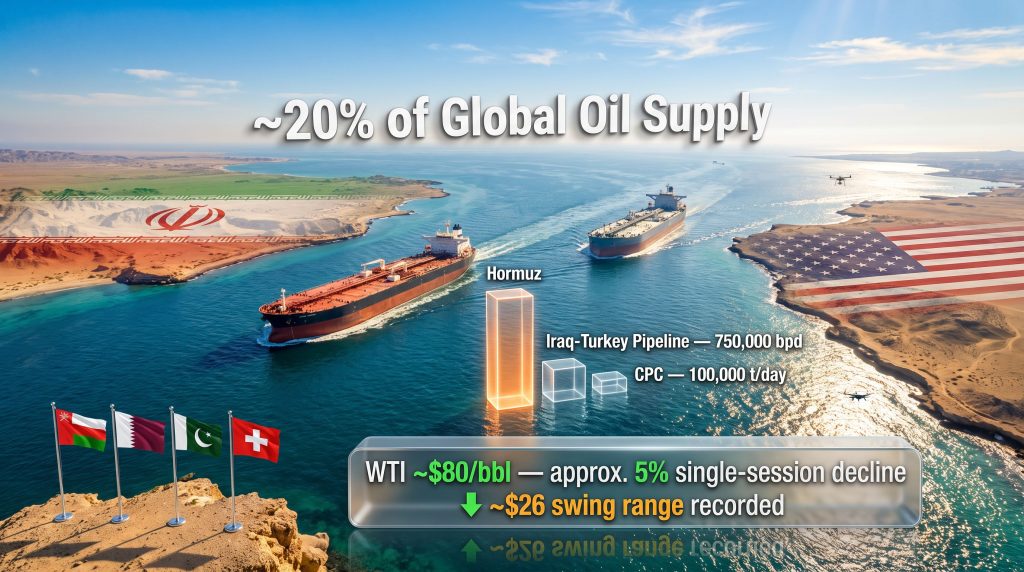
Few geographic features carry as much economic weight as a narrow strip of water barely 33 kilometres across at its tightest point. The Strait of Hormuz has long functioned as the circulatory system of global oil markets, quietly processing roughly one-fifth of the world's total oil supply every single day. When that system comes under threat, the consequences ripple outward with remarkable speed, touching everything from Asian factory inputs to European household energy bills. Understanding what the current US and Iran Hormuz discussions actually represent, and what they do not, is now one of the most consequential analytical tasks facing energy market participants.
When big ASX news breaks, our subscribers know first
The Hormuz Chokepoint: Why Nothing Else Comes Close
The Strait of Hormuz occupies a category of its own in global energy infrastructure. Unlike pipeline networks, which can be rerouted or expanded over years, or refining capacity, which can be diversified across regions, Hormuz is a fixed geographic reality. Persian Gulf producers, including Saudi Arabia, the UAE, Kuwait, Iraq, and Iran itself, all depend on the strait as their primary or sole pathway to seaborne export markets.
What makes Hormuz uniquely dangerous as a chokepoint is not just its throughput volume but the absence of any credible short-term substitute. Furthermore, the crude oil geopolitical risks surrounding this region continue to intensify, making the situation increasingly difficult to navigate:
- The East-West Pipeline in Saudi Arabia can carry approximately 5 million barrels per day (bpd) to Red Sea terminals but is already operating near capacity and cannot absorb full Gulf export volumes
- The Habshan-Fujairah pipeline in the UAE provides a partial bypass for Abu Dhabi crude but again represents a fraction of total Hormuz-dependent flows
- Overland and pipeline alternatives across the broader region collectively fall far short of replacing the strait's pre-conflict throughput
The result is a system with extreme concentration risk. When conflict constrains Hormuz, there is no equivalent pressure-release valve at comparable scale.
| Metric | Pre-Conflict Baseline | Current Status |
|---|---|---|
| Oil transiting Hormuz daily | ~20% of global supply | Severely constrained |
| Active vessel crossings | Normal commercial traffic | Ongoing threat environment |
| WTI price range (prior month) | Moderate volatility | ~$26 swing range recorded |
| European natural gas movement | Stable | Fell up to 6.3% intraday |
Decoding the Diplomatic Architecture Behind the US and Iran Hormuz Discussions
The phrase US and Iran Hormuz discussions suggests a straightforward bilateral negotiation. The reality is considerably more complex, and that complexity carries direct implications for how durable any agreement is likely to be.
Who Is Actually in the Room?
Rather than direct face-to-face engagement, the current framework relies on a web of intermediary states, each carrying different degrees of trust and influence with Tehran and Washington:
- Oman has historically served as the most reliable back-channel between the two governments and is currently at the centre of discussions around provisional navigation arrangements
- Qatar is involved in broader Gulf de-escalation efforts, given its relationships with multiple regional actors
- Pakistan has been cited as a secondary communication conduit
- Switzerland, in its longstanding role as the protecting power for US interests in Iran, continues to provide a formal diplomatic relay
The reliance on this layered mediation structure rather than direct talks is not incidental. It reflects decades of accumulated mistrust and means that every signal transmitted between Washington and Tehran passes through at least one interpretive filter. This introduces meaningful risk of miscommunication and raises the fragility of any provisional arrangement that emerges. For additional context, DW's live coverage of Iran ruling out direct US talks provides further detail on Tehran's official position.
What the Talks Actually Cover
The US and Iran Hormuz discussions are not purely about maritime access. Reporting indicates the negotiations span at least four interconnected domains:
- Safe passage for commercial vessels through the strait under defined operational conditions
- Ceasefire and de-escalation terms connected to the broader conflict that resumed after a June truce collapsed
- Iran's nuclear program, which US officials have consistently tied to any durable resolution of the Hormuz situation
- Sanctions relief and access to frozen assets, which remain Tehran's primary economic leverage in any comprehensive framework
The interdependence of these issues is a critical analytical point. Maritime access cannot be resolved cleanly in isolation from the nuclear and sanctions questions, which means any Hormuz arrangement that excludes those broader issues is inherently provisional and structurally fragile. However, the oil market trade war impact adds yet another layer of complexity to an already fraught negotiating environment.
How Oil Markets Responded: Reading the 5% WTI Drop
West Texas Intermediate crude fell approximately 5% to settle near $80 per barrel after both governments signalled that discussions were progressing. That reaction reveals something important about how the market had been positioned heading into the diplomatic signals: it had already priced in sustained disruption, which meant even ambiguous progress was enough to trigger a sharp repricing downward. Monitoring current crude oil prices remains essential for anyone tracking how these diplomatic developments are feeding through to market valuations.
Ryan McKay, senior commodity strategist at TD Securities, noted that the market's crude oil read was overly bearish, consistent with the asymmetric downside sensitivity to headlines. He cautioned that the market may find itself quickly disappointed if supply flows fail to surge the way they did following a prior memorandum of understanding.
This observation captures a well-documented structural dynamic in commodity markets. Geopolitical risk headlines generate faster and more violent price moves on the downside than equivalent positive developments generate on the upside. When diplomatic progress is announced, sentiment shifts quickly, but physical supply restoration follows on a far longer timeline.
The Asymmetry Problem Every Energy Trader Needs to Understand
| Signal Type | Market Response | Physical Supply Reality |
|---|---|---|
| Diplomatic progress announced | Immediate price decline (~5%) | Flows unchanged in short term |
| Post-MoU historical precedent | Surge in supply expectations | Actual flow restoration was gradual |
| Ongoing vessel threats | Persistent risk premium | Tanker incidents continue |
| Alternative route announcements | Partial price offset | Limited capacity vs. Hormuz volume |
Traders who treat diplomatic announcements as leading indicators of physical supply recovery consistently overestimate how quickly barrels follow words. The operational mechanics of resuming tanker traffic through a contested strait involve insurance market decisions, flag state risk assessments, vessel owner willingness, and cargo buyer comfort levels, none of which move at the speed of a presidential statement.
Separating Official Statements From Operational Reality
One of the most analytically demanding aspects of the current situation is the direct contradiction between official narratives coming out of Washington and Tehran, and even between different Iranian government channels.
US President Donald Trump stated publicly that the two countries are engaged in active discussions about opening the strait and suggested resolution could come within a matter of days, while simultaneously framing the moment as a final opportunity for Iran following the cancellation of what he described as a major planned military operation.
Iranian officials, by contrast, acknowledged separate negotiations through Oman focused on establishing a temporary passage arrangement, while explicitly denying direct engagement with the United States on the matter. Time Magazine's reporting on the peace talks provides useful additional context on where the two sides currently stand.
Against this backdrop of competing narratives, UK Maritime Trade Operations reported that a tanker off the Omani coast experienced an explosion in close proximity, a stark reminder that the operational threat environment has not changed regardless of what is being said at the diplomatic level.
Critical Point: The gap between political rhetoric and the actual security situation for vessels in the strait remains substantial. Any framework for temporary passage has yet to translate into enforceable safety guarantees that commercial shipping operators can rely on when making routing and insurance decisions.
Alternative Export Routes: Partial Solutions to a Structural Problem
With Hormuz constrained, regional producers and transit states have moved to activate or expand export alternatives. These developments are worth tracking carefully, both for their immediate relief potential and their longer-term infrastructure implications.
Iraq-Turkey Pipeline Extension
Turkey and Iraq reached an agreement to extend an expired bilateral pipeline arrangement by one year, with capacity of up to 750,000 bpd. This provides Iraq with a meaningful non-Hormuz export pathway, reinforces Turkey's role as a strategic energy transit hub, and reduces Iraq's vulnerability to further strait disruptions in the medium term.
Kazakhstan's Caspian Pipeline Consortium Route
Kazakhstan's Energy Ministry confirmed the Caspian Pipeline Consortium (CPC) resumed full operations from August 1, with oil intake running at 100,000 tonnes per day. However, the route carries its own threat profile:
- A series of drone attacks on tankers loading at or near the CPC's Black Sea terminal has created persistent disruption to export flows
- European refineries that are heavily dependent on Kazakh crude blends via this route face ongoing supply uncertainty
- Tanker willingness to accept loading assignments at the terminal remains a constraining variable that caps actual export volumes below theoretical capacity
The Structural Gap That Cannot Be Papered Over
| Route | Countries Involved | Capacity | Current Status |
|---|---|---|---|
| Iraq-Turkey Pipeline | Iraq, Turkey | Up to 750,000 bpd | Extended by 1 year |
| Caspian Pipeline Consortium | Kazakhstan, Russia (Black Sea) | ~100,000 t/day intake | Operating, drone threat active |
| Strait of Hormuz (pre-conflict) | Multiple Gulf producers | ~20% of global supply | Severely constrained |
Even combining the capacities of these alternative routes, the volume shortfall relative to pre-conflict Hormuz throughput is enormous. This is not a gap that infrastructure announcements can close on a timeframe relevant to near-term market pricing.
The next major ASX story will hit our subscribers first
The Red Sea Dimension: A Two-Chokepoint Crisis
The Hormuz situation is further complicated by simultaneous pressure on Red Sea shipping lanes. The concurrent disruption of both waterways creates a dual-chokepoint scenario that amplifies systemic risk across global energy logistics in ways that a single-corridor disruption would not.
WTI experienced a roughly $26 price swing range during the month prior as fighting resumed following the June truce collapse and extended into the Red Sea. European natural gas markets, which depend heavily on LNG flows transiting broader Middle Eastern supply chains, fell as much as 6.3% intraday before partially recovering on diplomatic signals.
The compounding effect of two simultaneous chokepoint threats limits the rerouting options available to shipping operators and creates particular pressure on Asian import-dependent economies, which rely on both corridors for energy security. Consequently, the broader oil market dynamics at play here extend well beyond the Hormuz corridor alone.
Three Scenarios for Resolution and Their Market Implications
Scenario 1: Temporary Navigation Agreement
A limited, Oman-mediated arrangement establishes provisional safe passage under defined conditions. This resolves neither the nuclear dispute nor the sanctions framework.
- Oil price impact: Moderate decline as risk premium partially unwinds; physical flow recovery is gradual
- Duration risk: High, as temporary arrangements are vulnerable to collapse at any new escalation point
- Investor implication: Markets that price in rapid supply restoration based on this scenario are likely to be disappointed
Scenario 2: Comprehensive Diplomatic Settlement
A broader agreement links Hormuz navigation, nuclear constraints, and sanctions relief into a durable framework.
- Oil price impact: Significant downward pressure as Iranian export capacity re-enters global supply and disrupts OPEC market influence and strategic calculus
- Timeline: Realistically months to years given the complexity of interconnected issues
- Prerequisite: Requires alignment across US domestic political dynamics, Iranian factional interests, and regional stakeholder positions
Scenario 3: Escalation and Fragmentation
Talks collapse, vessel attacks intensify, and conflict spreads further into Gulf energy infrastructure.
- Oil price impact: Rapid upward price spike; potential deployment of strategic petroleum reserves across IEA member states
- Supply chain impact: Severe disruption particularly for Asian importers; LNG spot market dislocation
Key Takeaways for Energy Market Participants
- The Strait of Hormuz carried approximately one-fifth of global oil supply before the conflict, with no short-term substitute capable of replacing that volume
- WTI's ~5% decline to roughly $80 per barrel on diplomatic signals illustrates how heavily disruption risk had already been priced in
- The US and Iran Hormuz discussions operate through a multilateral, indirect mediation framework centred on Oman, making any resulting agreement structurally fragile
- Maritime access cannot be resolved in isolation from the nuclear program and sanctions issues that form the broader negotiating context
- Alternative routes, including the Iraq-Turkey pipeline at up to 750,000 bpd and CPC operations at 100,000 tonnes per day, provide partial relief but cannot bridge the throughput gap
- Historical post-agreement patterns consistently show that physical supply flows lag significantly behind diplomatic optimism, and the current situation gives no reason to expect a different outcome
Disclaimer: This article contains forward-looking analysis and scenario modelling based on publicly available information as of the date of publication. It does not constitute financial or investment advice. Energy markets are subject to rapid change driven by geopolitical developments, and readers should conduct their own due diligence before making any investment decisions.
Want to Turn Global Energy Disruptions Into Actionable Investment Opportunities?
When geopolitical shocks like the Hormuz crisis rattle commodity markets, the investors who move fastest gain the most — Discovery Alert's proprietary Discovery IQ model scans ASX announcements in real time, instantly identifying significant mineral discoveries across 30+ commodities and delivering actionable alerts directly to subscribers. Explore how historic discoveries have generated substantial returns and begin your 14-day free trial at Discovery Alert to position yourself ahead of the market.