August 24, 2026
How Oil Futures Actually Price a War: Understanding the Geopolitical Risk Premium Mechanism
Crude oil futures markets don't simply reflect current supply and demand. They continuously price the probability of future supply disruptions, embedding a risk premium that inflates rapidly when conflict escalates and collapses just as sharply when tensions ease. This asymmetric pricing dynamic sits at the heart of one of the most significant single-session crude selloffs of 2026, and WTI falls as US cancels Iran strikes serves as the defining headline event that crystallises this mechanism in real time.
The concept of a geopolitical risk premium in oil futures represents the additional cost that traders embed into forward contracts when credible supply disruption threats emerge. It is not a fixed number. It is a continuously recalibrated probability-weighted estimate of how much supply could be lost, for how long, and across which grades and export routes. When those probability distributions shift, prices move with them, often violently. Understanding trade and geopolitics is therefore essential for any serious market participant.
When big ASX news breaks, our subscribers know first
The Strait of Hormuz: A Chokepoint That Controls Global Sentiment
No single piece of maritime infrastructure carries more weight in global crude pricing than the Strait of Hormuz. Approximately 20 to 21 percent of all globally traded petroleum liquids transit this narrow passage between the Persian Gulf and the Gulf of Oman. This concentration of energy trade through a single corridor means that even language about the strait, not just physical disruption to it, is sufficient to move benchmark futures materially.
When the US-Iran conflict began on 28 February 2026, oil and gas exports through the strait plummeted almost immediately. A brief recovery occurred in mid-June 2026 following an interim peace agreement that temporarily restored transits. That deal unravelled in early July due to unresolved disagreements over control of the waterway, triggering a renewed cycle of drone and missile attacks by Iran and regional proxies against oil infrastructure in neighbouring countries.
The Conflict Timeline and Its Market Consequences
| Event | Date | Market Impact |
|---|---|---|
| US-Iran war begins | 28 February 2026 | Sharp crude spike; Hormuz transits collapse |
| Interim peace deal reached | Mid-June 2026 | Transits briefly recover; prices ease |
| Peace deal collapses | Early July 2026 | Renewed escalation; drone and missile attacks resume |
| US cancels new military assault | 3 August 2026 | WTI falls over 5%; Brent drops approximately 4.4% |
The progression above illustrates a critical market dynamic: each de-escalation event triggers a partial unwinding of the war risk premium, but the underlying uncertainty never fully resolves. This creates a price floor built on residual conflict risk, and when that floor is tested by a significant diplomatic signal, the move can be abrupt and outsized. These oil market effects are well documented in periods of elevated geopolitical tension.
Breaking Down the August 3 Selloff: Numbers Behind the Move
When US President Donald Trump announced on 3 August 2026 that he had cancelled plans for a new military assault on Iran, citing progress toward a negotiated agreement, crude markets registered one of their sharpest single-session declines of the year. According to Reuters, the announcement triggered an immediate and decisive market response across all major crude benchmarks.
WTI and Brent Futures: Exact Price Movements
| Contract | Settlement | Change | Prior Settlement |
|---|---|---|---|
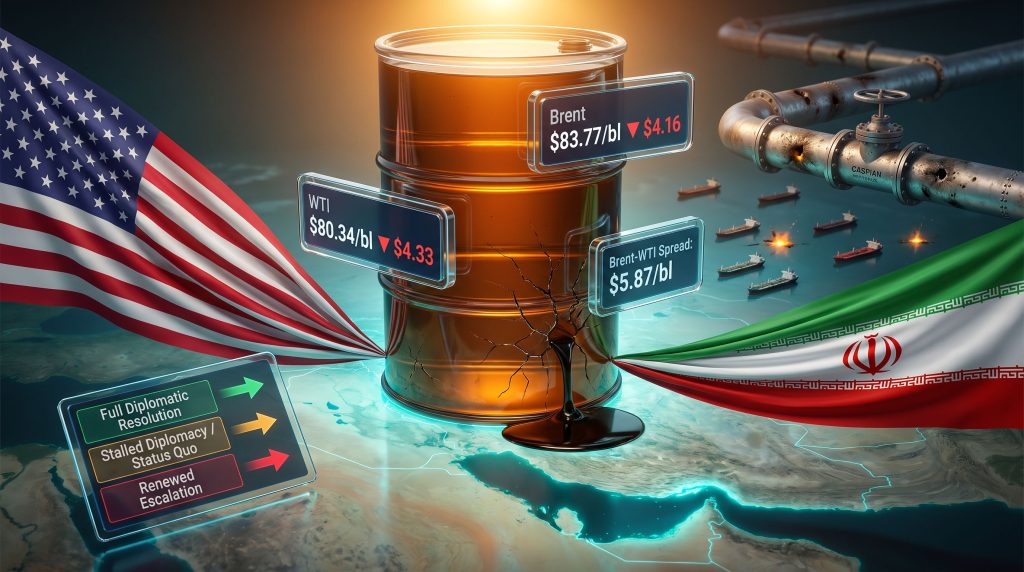
| September Nymex WTI | $80.34/bl | -$4.33/bl (-5.1%) | $84.67/bl |
| October Ice Brent | $83.77/bl | -$4.16/bl (-4.7%) | $87.93/bl |
| October Brent-WTI Spread | $5.87/bl | +$2.61/bl widening | $3.26/bl |
| Nymex RBOB Gasoline | $2.9667/USG | -25.49¢/USG | $3.2217/USG |
| Nymex ULSD Diesel | $3.8772/USG | -24.43¢/USG | $4.1215/USG |
Intraday, the selloff was even more pronounced. WTI and Brent futures saw WTI touch approximately $79.30/bl at around 10:30am ET, representing a decline of roughly 6% from the prior settlement. WTI at the Magellan East Houston terminal was discussed at a 90¢ to $1/bl premium bid-ask spread to the Cushing benchmark at 3pm ET, down modestly from the prior session's $1.03/bl volume-weighted average premium, according to data from the Argus Crude Market Ticker.
What Does the Widening Brent-WTI Spread Reveal?
The $2.61/bl widening in the Brent-WTI spread to $5.87/bl is a structural signal that deserves specific attention. Brent crude carries a higher intrinsic sensitivity to Middle Eastern supply disruptions than WTI, which is primarily priced on US domestic supply-demand dynamics. When a de-escalation event occurs, Brent retains somewhat more residual risk premium than WTI because its supply base remains more exposed to the geopolitical situation.
A widening Brent-WTI spread in a de-escalation environment suggests that markets are not pricing a full resolution. They are pricing a partial probability shift, one in which some geopolitical premium remains embedded in globally traded crude, even as the most acute escalation scenarios are assigned lower probabilities. For US domestic crude producers and exporters, a wider spread reduces competitiveness of WTI-priced barrels against Brent-priced alternatives in international markets.
The asymmetry embedded in geopolitical risk premium mechanics is a frequently underappreciated feature of crude futures markets. Premiums build slowly as conflicts escalate through a sequence of threatening but non-disruptive events, then collapse rapidly when a single credible de-escalation signal arrives, even when that signal contains significant ambiguity.
The Diplomatic Contradiction: Why Tehran's Denial Amplified the Selloff
One of the more analytically complex dimensions of the 3 August price move is how the market processed a direct contradiction between Washington and Tehran. Trump asserted that talks with Iran were actively underway, while Iran's foreign ministry stated clearly that no negotiations with the United States were taking place. Iran indicated that its bilateral discussions with Oman concerned only the logistics of safe shipping routes through the Strait of Hormuz, and that even those discussions would not, by themselves, lead to a reopening of the strait.
Iran further conditioned any change in the strait's status on the cessation of what it characterised as US violations of the prior interim agreement. The position was unambiguous: no significant change in the Hormuz situation would occur while those conditions remained unmet.
Despite this diplomatic ambiguity, markets chose to treat Trump's cancellation of the planned strikes as the dominant signal. The reasoning is structurally consistent with how geopolitical risk premiums work: the removal of an active escalation catalyst (the military strike) is a discrete, observable event that reduces the probability of the most severe supply disruption scenarios, regardless of whether the underlying diplomatic situation is resolved. Markets don't require certainty about the future. They reprice the probability distribution of outcomes, and a cancelled strike meaningfully shifts that distribution toward lower disruption scenarios even in the absence of a formal agreement.
OPEC+ Production Increases: Paper Commitments vs. Physical Reality
On the same Sunday that Trump announced the cancellation of the strikes, the OPEC+ core group of seven nations reached an agreement to raise collective production targets by a further 188,000 barrels per day, effective from September 2026. OPEC's market influence remains a central variable in crude pricing, and the participating countries — Saudi Arabia, Russia, Iraq, Kuwait, Kazakhstan, Algeria, and Oman — also reaffirmed their commitment to compensate for prior overproduction episodes.
This increase completes, at least in theoretical terms, the phased unwinding of the 1.65 million b/d in voluntary production cuts that the same group announced back in 2023. On paper, the trajectory from those cuts to the current quota levels represents a substantial shift in supply policy.
In practice, the impact has been zero.
Quota increases over recent months have not converted into additional physical barrels reaching global markets, because export disruptions from the US-Iran conflict have prevented participating nations from realising their stated targets. The Strait of Hormuz disruption has effectively neutralised the supply expansion that OPEC+ has been signalling.
Critical Market Implication: If Hormuz transit normalisation occurs simultaneously with OPEC+ quota increases converting into real physical supply, crude markets face a compounding bearish scenario. The war premium unwinds at the same time that suppressed supply volumes begin reaching refiners. Traders monitoring both variables should treat this as a non-linear downside risk rather than a simple additive effect.
OPEC+ Compliance: A Structural Uncertainty Worth Tracking
OPEC+ enforcement history is inconsistent. Overproduction compensation pledges have regularly been made and only partially fulfilled. Kazakhstan, in particular, has a documented track record of exceeding its production quota. There is a structural irony in the current situation: the CPC drone attack disruptions may paradoxically be suppressing Kazakhstan's capacity to compensate for its own prior overproduction, creating a situation where the compliance math is further distorted by external factors.
The CPC Pipeline: An Underappreciated Secondary Supply Risk
While Hormuz receives most of the analytical attention, the Caspian Pipeline Consortium system represents a separate and underappreciated source of supply disruption that deserves more focus. Kazakhstan's energy ministry issued a formal statement on 1 August 2026 denying reports that a complete shutdown of the CPC system was under consideration. The ministry described such a scenario as one that is simply not being contemplated.
However, the operational reality is more complicated. CPC Blend crude loadings have been disrupted by drone attacks targeting tankers at the CPC terminal on Russia's Black Sea coast. At least eight tankers have been struck by drones at or en route to the terminal since mid-July 2026. These logistical supply risks extend the market's uncertainty well beyond any single diplomatic announcement.
CPC Blend is a light sour crude grade with significant demand from European refineries. Disruptions to its export flow reduce the availability of light sour barrels in the regional market, creating differential pricing effects that ripple through refinery procurement strategies. The drone attack pattern targeting CPC infrastructure is strategically significant: it indicates that the campaign against oil export infrastructure extends well beyond the Hormuz corridor, encompassing the Black Sea route as well.
Furthermore, these disruptions are compounded by a separate infrastructure constraint affecting the same regional market. Low water levels on the Rhine River have restricted barge traffic between the Amsterdam-Rotterdam-Antwerp hub and inland German tank farms, tightening motor fuel supply in western Germany precisely at a time when CPC Blend supply disruptions are already affecting light sour crude availability. Water levels at the key Kaub bottleneck fell below 0.3 metres in late July, restricting most barge transit and limiting product deliveries to refineries and storage facilities along the Upper Rhine and Main.
The next major ASX story will hit our subscribers first
Oilfield Services: Positioning for a Post-Conflict Recovery
Beyond the immediate price dynamics, the oilfield services sector offers a longer-term lens through which to assess the investment implications of the current conflict environment. Major global services firms including SLB, Halliburton, and Baker Hughes have reported growing confidence in international market opportunities, with offshore projects emerging as a primary growth driver.
Third-party forecasts cited by industry executives project that final investment decisions for long-cycle projects will increase by approximately 30% in 2026, with Africa identified as the leading region for upstream capital expenditure growth in the second half of the year. As reported by CNBC, analysts who track the oilfield services sector note that the Middle East is positioning for what could be a rapid and strong production recovery once security conditions allow operations to resume.
The rationale is operationally grounded: workforce capabilities in the region remain largely intact, equipment has not been significantly damaged, and national oil companies have strong financial and strategic incentives to restore output quickly. The recovery, when it comes, is expected to vary in pace by country and operating environment, with Iraq facing the most complex security-related challenges.
A notable structural shift is also underway in how oilfield services capacity is being allocated globally. Shale technology and equipment that previously focused on North American basins is being redeployed internationally, with Argentina's Vaca Muerta, the UAE, and Australia emerging as growth destinations. This internationalisation of shale services capacity reflects a broader maturation of the North American market and the growing attractiveness of international margins.
Baker Hughes has also flagged a new revenue stream that is gaining genuine scale: power markets and data centre infrastructure. Gas turbine and generator orders have doubled year-on-year in the most recent quarter for the company's power systems and LNG business unit. The oilfield services sector is evolving beyond its traditional upstream focus, adding a layer of earnings diversification that alters the investment risk profile of companies in this space.
Scenario Framework: Three Pathways for WTI From Here
| Scenario | Key Conditions | WTI Price Implication |
|---|---|---|
| Full diplomatic resolution | Hormuz reopens; formal US-Iran agreement signed; OPEC+ supply normalises | Significant further downside; war premium fully unwound; dual supply pressure |
| Stalled diplomacy, status quo | Talks continue without breakthrough; Hormuz remains partially restricted | Prices stabilise near current range; limited directional momentum |
| Renewed escalation | Negotiations collapse; new US or Iranian military action | Sharp rebound; war premium re-enters at elevated levels; CPC risk amplifies |
The current pricing environment most closely resembles the middle scenario, with markets pricing a probability-weighted blend of all three outcomes rather than committing to any single pathway. The diplomatic contradiction between Washington and Tehran, combined with Iran's explicit conditions for Hormuz normalisation, means the market cannot yet price a resolution scenario with high confidence. Consequently, WTI falls as US cancels Iran strikes may represent only the first phase of a broader repricing process.
Key Takeaways for Market Participants
The 3 August crude selloff encodes several structural lessons that extend beyond the immediate news cycle:
- Geopolitical risk premiums are non-linear pricing mechanisms. They build gradually through escalation sequences and collapse suddenly on discrete de-escalation signals, even ambiguous ones.
- The Brent-WTI spread widening to $5.87/bl reflects the differential sensitivity of the two benchmarks to Middle Eastern supply risk, not a change in domestic US supply fundamentals.
- OPEC+ production quota increases remain paper commitments until Hormuz transit normalisation enables the physical conversion of those quotas into actual export volumes.
- The CPC drone attack campaign represents an underappreciated secondary supply disruption that partially offsets the price impact of any geopolitical premium unwinding in Brent and WTI.
- The oilfield services sector is already positioning for a post-conflict Middle East recovery, with national oil company urgency and intact operational capacity pointing toward a potentially swift rebound in upstream activity once conditions allow.
- The Rhine River logistics constraint adds a regional complexity to refined product markets that compounds the broader crude market dynamics, particularly for light sour crude and motor fuel supply in European inland markets.
This article is intended for informational purposes only and does not constitute financial or investment advice. Crude oil markets are subject to rapid and unpredictable change. All price figures, dates, and market data referenced reflect information available as of 3 August 2026 and should be independently verified before being relied upon for trading or investment decisions. Forward-looking statements and scenario projections involve inherent uncertainty and actual outcomes may differ materially from those described.
Want To Identify The Next Major Mineral Discovery Before The Market Does?
While geopolitical events continue to reshape commodity markets, Discovery Alert's proprietary Discovery IQ model delivers real-time alerts on significant ASX mineral discoveries, transforming complex geological and market data into clear, actionable investment insights — explore Discovery Alert's discoveries page to understand how historic finds like those by De Grey Mining and WA1 Resources have generated extraordinary returns, and begin your 14-day free trial today to position yourself ahead of the broader market.