August 23, 2026
The Minerals Intelligence Gap That Atlanta Is About to Close
The global race to secure critical mineral supply chains has exposed a structural problem that transcends geopolitics: the people who extract materials from the earth, those who recycle them from discarded electronics and batteries, and those who write the regulations governing both, almost never occupy the same room at the same time. That fragmentation carries a real cost. Investment decisions get made on incomplete information. Policy frameworks emerge without adequate technical input.
Recyclers and primary miners develop parallel processing solutions to problems they could be solving together. The critical minerals demand driving this urgency is only intensifying as the energy transition accelerates, making cross-sector dialogue more essential than ever.
This is the information architecture problem that large-scale, multi-track industry convergence events are uniquely positioned to fix. And in October 2026, Atlanta becomes the focal point for exactly that kind of convergence.
When big ASX news breaks, our subscribers know first
What Is the Critical Minerals Expo North America and Why Does It Matter?
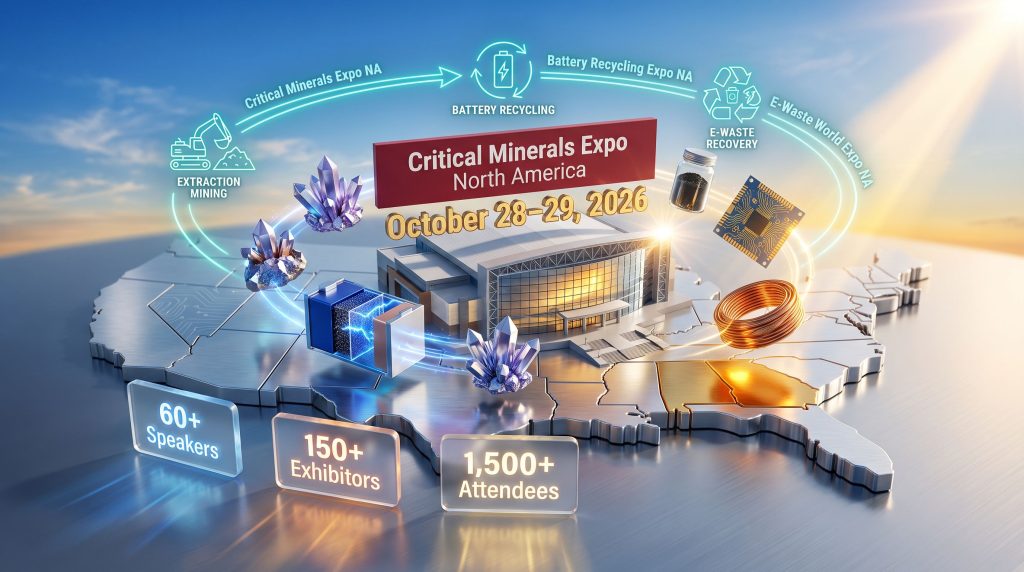
The Critical Minerals Expo North America in Atlanta is a co-located industrial B2B event scheduled for October 28–29, 2026, at the Cobb Convention Center and Cobb Galleria Centre in Atlanta, Georgia. The event runs simultaneously with the Battery Recycling Expo North America and the E-Waste World Expo North America, giving attendees access to three distinct but deeply interconnected conference programs under a single registration.
Organised by Trans-World Events Ltd, a company whose management team carries more than 60 years of combined experience in B2B industrial exhibitions, the expo is structured to connect professionals across the full materials value chain — from primary extraction and refining through to end-of-life recovery and remanufacturing.
The scale of the event is notable:
| Detail | Information |
|---|---|
| Event Name | Critical Minerals Expo North America |
| Co-located Events | Battery Recycling Expo NA + E-Waste World Expo NA |
| Dates | October 28–29, 2026 |
| Venue | Cobb Convention Center / Cobb Galleria Centre, Atlanta, GA |
| Admission | Free (Conference Pass required) |
| Speakers | 60+ |
| Exhibitors | 150+ |
| Expected Attendees | 1,500+ |
| Organiser | Trans-World Events Ltd |
One of the event's most structurally significant features is its entirely free-to-attend model. Rather than charging the $1,500 to $5,000-plus registration fees common at comparable industry conferences, Trans-World Events has opted for a complimentary Conference Pass system. The rationale centres on ensuring that engineers, metallurgists, recyclers, and policymakers can access the technical strategies and market data they need without financial barriers determining who gets a seat at the table.
The practical catch: seating at conference stages is strictly limited and allocated on a first-come, first-served basis, which means that early registration carries genuine strategic value for anyone who intends to attend. You can explore the full conference programme and secure your place directly through the official event website.
Inside the 2026 Conference Agenda: Three Tracks, One Supply Chain
The preliminary conference agenda has been released and reflects a deliberate attempt to address the minerals ecosystem as an integrated system rather than a series of isolated industry verticals. Each of the three tracks approaches a different segment of the value chain while consistently connecting back to the overarching theme of North American supply chain resilience.
Track One: Critical Minerals, Geopolitics, and Operational Strategy
The Critical Minerals Track is positioned as the event's flagship programme, covering the intersection of resource nationalism, domestic processing capacity, and allied-nation sourcing frameworks. Sessions confirmed in the preliminary agenda include:
- A discussion on rare earth supply chain vulnerabilities presented by Mark Wall, CEO of American Rare Earths, examining North American production pathways and the gap between domestic output and strategic demand
- A focused deep-dive on the North American tungsten market led by Lewis Black, CEO and President of Almonty — a topic that receives far less attention than lithium or cobalt despite tungsten's critical role in defence manufacturing and cutting tool production
- A base metals panel hosted by Kamila Slupek, Secretary General of the International Copper Study Group, addressing copper's expanding role in electrification infrastructure
Tungsten is an instructive case study in strategic mineral blind spots. North American primary tungsten production is negligible relative to demand, with China controlling the vast majority of global refined output. Unlike lithium, tungsten has not attracted the same level of public or investor attention, yet it sits at the centre of defence procurement, semiconductor manufacturing, and heavy industrial tooling.
The 2026 agenda's decision to dedicate a session specifically to the North American tungsten market signals a maturing awareness of which supply chain vulnerabilities actually carry the highest risk-adjusted exposure.
The rare earth processing challenges facing North America deserve equal scrutiny. Despite years of policy discussion about reducing dependence on Chinese rare earth processing, North American separation capacity remains structurally insufficient relative to demand from EV motor manufacturers and defence electronics suppliers. The gap between the volume of rare earth ore that can be mined domestically and the volume that can be processed into magnet-grade oxides domestically is one of the least-discussed but most consequential bottlenecks in the entire clean energy supply chain.
Track Two: Battery Recycling, Regulatory Compliance, and Technical Innovation
The Battery Recycling Track addresses one of the fastest-evolving regulatory and technical environments in the North American industrial sector. Confirmed sessions include:
- An examination of EPA regulations governing end-of-life lithium-ion battery management, presented by Phoebe O'Connor, Program Analyst at the U.S. Environmental Protection Agency, covering both federal disposal requirements and critical mineral recovery frameworks
- A session on black mass recovery processes and direct recycling methodologies featuring Ryan Melsert, CEO at American Battery Technology Company
- A supply chain security discussion with Jeff Reeves, VP of Marketing and Communications at Battery Council International, addressing how recycled material flows can reduce dependence on primary extraction for lithium, cobalt, and nickel
What Is Black Mass and Why Does It Matter?
When lithium-ion battery cells are mechanically shredded at end-of-life, the resulting powdered mixture is referred to as black mass. This material contains recoverable concentrations of lithium, cobalt, nickel, and manganese. The battery recycling process uses both hydrometallurgical techniques — aqueous chemical solutions to selectively dissolve and separate metals — and pyrometallurgical methods involving high-temperature smelting to extract these elements for reuse in new battery production.
Black mass recovery is increasingly viewed not as a waste management solution but as a secondary mining operation, with the economic viability of the process heavily dependent on the grade and chemistry of the input material.
A less commonly understood dimension of battery recycling economics is the relationship between cell chemistry and recyclate value. Lithium iron phosphate (LFP) chemistries, which are gaining market share in stationary storage and entry-level EVs, produce black mass with a fundamentally different elemental profile than nickel manganese cobalt (NMC) cells. LFP black mass contains no cobalt or nickel, which substantially reduces its value using conventional hydrometallurgical recovery pathways. This chemistry shift is quietly reshaping the economics of battery recycling at scale.
Track Three: E-Waste Recycling and the Urban Mining Opportunity
The E-Waste Recycling Track brings together some of the more overlooked corners of the critical minerals recovery ecosystem. Confirmed sessions address:
- Printed circuit boards as a commercial gold source, presented by Alexandra Levesque, Co-founder and CEO at iUMiX SA. PCBs from consumer electronics typically contain gold concentrations that, on a per-tonne basis, exceed those found in many commercial gold mining operations
- African e-waste supply chain opportunities for North American processors, featuring Nana Yaw Konadu, CEO of Electro Recycling Ghana
- The incoming e-waste surge from AI hardware proliferation, addressed by Jim Puckett, Founder of the Basel Action Network, examining global e-waste governance frameworks
Furthermore, the urban mining opportunity embedded within e-waste streams is becoming increasingly commercially viable, particularly as first-generation electronics from the AI hardware boom approach end-of-life. Graphics processing units (GPUs) and specialised AI accelerator chips contain recoverable quantities of gold, silver, tantalum, and rare earth elements — presenting a materially different recovery challenge than the consumer electronics streams that currently dominate e-waste processing operations.
Why Atlanta and Why Now?
The selection of Atlanta as the host city for the Critical Minerals Expo North America in Atlanta is not incidental. Georgia has emerged as one of the most significant nodes in North American EV manufacturing and battery supply chain development, attracting substantial investment in EV assembly and battery cell production.
The Cobb Convention Center and adjoining Cobb Galleria Centre provide the logistical infrastructure to accommodate three concurrent exhibition floors and multi-stage conference programmes simultaneously. Atlanta's position as a major domestic and international air hub ensures that attendees travelling from mining regions in the western United States, processing operations in the Midwest, and policy centres on the East Coast can reach the venue without prohibitive transit complexity.
How This Event Compares to Traditional Industry Conferences
The structural differentiation between this event and conventional paid industry conferences is substantial enough to warrant direct comparison.
| Feature | Critical Minerals Expo NA | Typical Paid Industry Conference |
|---|---|---|
| Admission Cost | Free | $1,500 to $5,000+ |
| Co-located Events | 3 (Minerals, Battery, E-Waste) | Usually 1 |
| Speaker Count | 60+ | 20 to 40 |
| Exhibitor Count | 150+ | 50 to 100 |
| Audience Size | 1,500+ | 300 to 800 |
| Value Chain Coverage | Full (extraction to recycling) | Typically single-sector |
The full value chain lens is arguably the most strategically valuable feature. When a metallurgist working on rare earth separation sits in the same room as a battery recycler discussing black mass recovery, the resulting cross-pollination of technical knowledge accelerates commercial and policy outcomes that siloed events simply cannot generate.
Who Should Be in the Room in Atlanta
The critical mineral benefits that flow from cross-sector knowledge sharing are most directly accessible to professionals spanning the entire minerals and materials sector. The professional profiles that stand to gain most include:
- Mining engineers and exploration geologists tracking critical mineral resource definition and project development timelines
- Metallurgists and processing specialists focused on refining, separation, and hydrometallurgical or pyrometallurgical recovery techniques
- Battery manufacturers and EV supply chain professionals monitoring secondary material flows and chemistry transition impacts
- Electronics recyclers, ITAD operators, and urban mining specialists evaluating new feedstock streams and processing economics
- Regulatory compliance officers and policy analysts navigating evolving EPA frameworks and international e-waste governance requirements
- Investors and capital allocators assessing project pipelines across primary extraction and commercial recycling ventures
The next major ASX story will hit our subscribers first
Frequently Asked Questions About the Critical Minerals Expo North America in Atlanta
Is attendance at the Critical Minerals Expo North America genuinely free?
Yes. A complimentary Conference Pass provides access to all three co-located events. However, seating at conference stages is allocated strictly on a first-come, first-served basis. Given that expected attendance exceeds 1,500 industry professionals across the two-day programme, early registration is strongly advisable for anyone seeking guaranteed access to specific sessions.
What topics will the 2026 conference cover?
The programme spans three dedicated tracks: Critical Minerals (covering geopolitics, rare earths, tungsten, and base metals), Battery Recycling (covering EPA compliance, black mass recovery, direct recycling, and supply chain security), and E-Waste Recycling (covering PCB gold recovery, African supply chain opportunities, AI hardware waste, and international governance frameworks).
When and where does the event take place?
The event runs October 28–29, 2026, at the Cobb Convention Center and Cobb Galleria Centre in Atlanta, Georgia. A single registration provides access to all three concurrent expo programmes.
Who are the confirmed speakers?
The preliminary agenda confirms speakers including Mark Wall (American Rare Earths), Lewis Black (Almonty), Kamila Slupek (International Copper Study Group), Phoebe O'Connor (U.S. EPA), Ryan Melsert (American Battery Technology Company), Jeff Reeves (Battery Council International), Alexandra Levesque (iUMiX SA), Nana Yaw Konadu (Electro Recycling Ghana), and Jim Puckett (Basel Action Network), among more than 60 confirmed contributors.
The Circular Economy Imperative Behind the 2026 Agenda
The deeper strategic logic underpinning events like the Critical Minerals Expo North America is rooted in a fundamental shift in how supply chain planners and policymakers are modelling material flows. Recycled mineral streams are no longer being treated as supplementary inputs to primary extraction.
In planning scenarios for lithium, cobalt, nickel, and rare earth elements, secondary recovery from batteries and electronics is increasingly modelled as a primary supply source in its own right — particularly as first-generation EV battery packs approach end-of-life volumes that make recycling economically self-sustaining.
The convergence of regulatory pressure — driven by frameworks like EPA battery disposal rules and tightening Basel Convention standards for e-waste — with improving hydrometallurgical recovery economics is accelerating the commercial viability of recycling at industrial scale. Understanding how those two forces interact requires exactly the cross-sector dialogue that the 2026 Atlanta event is structured to enable.
For further details on the full agenda, exhibitor opportunities, and registration, visit the Critical Minerals Expo North America official website. Ongoing updates and industry reporting can also be followed through the Mining Frontier events hub, which tracks developments across North America's leading critical resources gatherings.
Want to Stay Ahead of the Next Major Critical Minerals Discovery?
While the Atlanta expo brings the critical minerals conversation together in one room, Discovery Alert's proprietary Discovery IQ model ensures you never miss a significant ASX mineral discovery the moment it's announced — explore historic examples of major discovery returns that demonstrate just how transformative early positioning can be, and begin your 14-day free trial to gain an immediate market-leading edge.