August 23, 2026
Commodity Cycles and the Case for Non-Ferrous Leadership in India's Metals Sector
Understanding how commodity super-cycles behave across different metal categories is essential context before evaluating any single quarter's earnings data. Industrial metals have historically moved in waves shaped by infrastructure investment cycles, energy cost regimes, and the interplay between domestic demand growth and global price benchmarks. What makes the current FY27 environment particularly instructive is that the metals sector outlook non-ferrous earnings Systematix analysis reveals India's metals sector is not rising uniformly — it is bifurcating sharply, with non-ferrous producers capturing the most durable earnings momentum while ferrous and mining segments deliver a more fragmented picture.
This divergence is not accidental. It reflects structural differences in cost exposure, copper price drivers and demand-side dynamics that have been building for several years. Furthermore, for investors and analysts tracking the metals sector outlook, the non-ferrous earnings story emerging from Systematix's Q1 FY27 coverage data represents one of the clearest sector-level signals in recent memory.
When big ASX news breaks, our subscribers know first
The Numbers That Define the Moment: Q1 FY27 Earnings in Focus
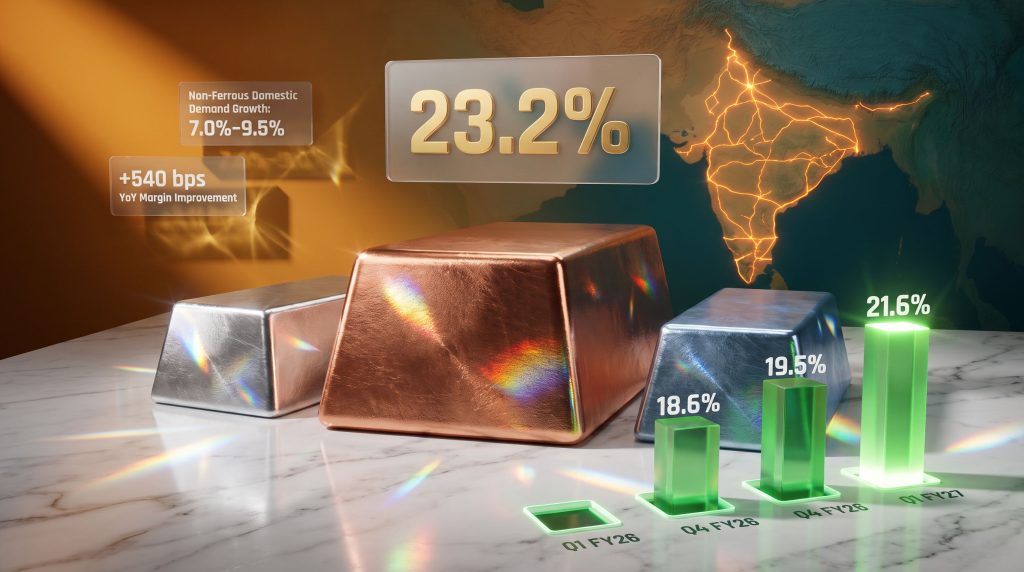
The headline figure from Systematix's coverage universe is a blended EBITDA margin of 21.6% for Q1 FY27, a meaningful step up from 19.5% in the preceding quarter and 18.6% recorded in the same period a year earlier. That year-on-year improvement of roughly 300 basis points across the full coverage universe is notable, but it understates the performance of the segment driving the recovery.
Non-ferrous companies within the Systematix coverage reported an EBITDA margin of 23.2% in Q1 FY27, compared to 21.1% sequentially and 17.8% in Q1 FY26. The year-on-year margin expansion of approximately 540 basis points for the non-ferrous cohort is the standout data point of the quarter.
| Metric | Q1 FY26 | Q4 FY26 | Q1 FY27 |
|---|---|---|---|
| Blended EBITDA Margin (Coverage Universe) | 18.6% | 19.5% | 21.6% |
| Non-Ferrous EBITDA Margin | 17.8% | 21.1% | 23.2% |
| YoY Margin Improvement (Non-Ferrous) | — | — | +540 bps |
| Sequential Margin Improvement (Non-Ferrous) | — | — | +210 bps |
Key Insight: A 540 basis point year-on-year margin improvement is not a marginal refinement — it represents a structural shift in earnings quality. When combined with volume growth and operating leverage, this kind of margin trajectory can generate significant earnings upgrades relative to consensus estimates.
Primary steel producers, by contrast, demonstrated resilient but comparatively static margins during the same period. They faced a dual headwind of seasonally softer demand linked to monsoon-adjacent consumption patterns and elevated coking coal procurement costs. Steel pipe and mining companies delivered mixed outcomes, reinforcing the view that non-ferrous earnings are the primary engine of sector recovery in the current cycle.
Why Non-Ferrous Metals Are Pulling Away from the Rest of the Sector
Three Interlocking Drivers Behind the Earnings Acceleration
The non-ferrous outperformance story rests on three mutually reinforcing dynamics that are operating simultaneously, which is why the margin improvement has been so pronounced.
1. Commodity Price Realisation at Elevated Levels
Copper market trends and aluminium prices remained constructive through the early portion of FY27, allowing producers to capture stronger revenue per unit. Alumina realisation improvement has been particularly impactful for integrated aluminium operators, who benefit not just from finished metal pricing but from upstream processing margins. Copper-linked earnings have emerged as a standout contributor, benefiting from both price appreciation and volume growth at key domestic processing facilities.
2. Structural Cost Containment
Energy and raw material inputs represent the dominant cost component for smelting and refining operations. Relative to the elevated cost environment of FY24 and early FY25, the current input cost regime has been meaningfully more contained. This compression in cost pressure, occurring simultaneously with price improvement, creates a powerful margin expansion mechanism that is difficult to replicate in cost-intensive ferrous production.
3. Operating Leverage from Capacity Growth
Production volumes across the non-ferrous segment have grown without proportional cost escalation. When fixed cost bases are spread across higher output volumes, incremental EBITDA generation accelerates rapidly. Integrated producers — those spanning mining, refining, and smelting within a single organisational structure — capture the most complete version of this margin benefit, as they are partially insulated from spot raw material price volatility that affects pure-play smelters.
A Note on Integration as a Competitive Moat
One aspect of non-ferrous leadership that receives insufficient attention in mainstream sector analysis is the structural advantage of vertical integration. A producer controlling bauxite or copper ore through to finished metal output operates with a fundamentally different cost and margin profile than one dependent on spot alumina or copper concentrate procurement. In commodity downturns, integration provides a floor; in commodity upturns like the current one, it amplifies upside. Consequently, the non-ferrous earnings recovery is not distributed evenly across all operators — integrated companies are capturing disproportionate margin gains. According to non-ferrous metals market insights from S&P Global, this integration advantage is becoming an increasingly decisive differentiator across global metals markets.
Steel Producers: Resilient but Waiting for the Next Catalyst
The Coking Coal Constraint and Its Structural Implications
India's primary steel producers occupy a more complex earnings position. Coking coal — the critical input for blast furnace steelmaking — is predominantly sourced through imports, as domestic coking coal reserves are both geologically limited and often of insufficient quality for direct use in steel production without blending. This import dependency creates a persistent margin risk that non-ferrous producers do not face to the same degree.
Coking coal pricing is influenced by supply dynamics from Australia, Russia, and Canada — three geopolitically distinct source regions — meaning procurement costs can shift rapidly on factors entirely outside the control of Indian steelmakers. When global coking coal prices rise, Indian steel margins compress almost mechanically. In addition, the commodity price impact on broader mining company performance underscores how interconnected these cost pressures can be across the sector.
What Could Re-Rate Steel Earnings in H2 FY27?
| Catalyst | Probability | Expected Timeline |
|---|---|---|
| Domestic demand pickup lifting realisations | Moderate to High | H2 FY27 |
| Coking coal price normalisation | Moderate | Ongoing |
| New capacity commissioning and operating leverage | High (company-specific) | FY27–FY28 |
| Infrastructure-led volume demand acceleration | High | FY27 |
The second half of the fiscal year historically sees stronger steel consumption as infrastructure spending resumes at scale following the monsoon season. For companies executing capacity expansion programmes on schedule, the operating leverage story becomes compelling — fixed costs remain relatively stable while revenue and volume scale upward. Systematix identifies this combination of volume recovery, capacity expansion, and operating leverage as the primary earnings support mechanism for select steel producers through the balance of FY27.
Mining Sub-Sectors: A Differentiated Landscape Across Commodities
Iron Ore: Visible Volume Growth Pathway
NMDC's earnings trajectory benefits from a relatively visible growth catalyst: incremental volume contributions from Deposit 4 and Deposit 13, combined with ongoing mine debottlenecking initiatives and logistics infrastructure improvements that are reducing evacuation bottlenecks. In iron ore mining, logistics efficiency is often as critical as ore availability — a mine producing at nameplate capacity but constrained by rail or road evacuation infrastructure cannot translate geological resource into financial performance. Monitoring iron ore demand prospects remains essential context for understanding NMDC's earnings uplift pathway through FY27 and into FY28.
Coal Mining: Demand Is Strong, But Execution Is Struggling
India's dominant coal producer faces a paradox: power sector demand for thermal coal is structurally elevated as electricity generation requirements grow, yet volume delivery and price realisation have come under pressure. This disconnect between demand strength and earnings delivery reflects operational and logistical constraints that are not easily resolved in the near term. Systematix's assessment reflects this complexity — Coal India faces earnings headwinds despite the apparent demand tailwind from rising power consumption.
Manganese: A China-Linked Recovery Play
MOIL's earnings trajectory is characterised as a recovery-dependent story within the Systematix framework. Both production volume normalisation and manganese ore realisation improvement are required for earnings to improve meaningfully. Manganese pricing is closely correlated with global steel production trends, particularly in China steel and iron ore markets, which account for a substantial share of global manganese consumption in steelmaking alloys. This external price sensitivity makes MOIL a higher-beta play on Chinese industrial activity recovery compared to the more domestically insulated non-ferrous leaders.
India's Non-Ferrous Sector Versus Global Peers: Structural Advantages in Context
Domestic non-ferrous consumption in India is projected to grow at approximately 7.0% to 9.5%, a rate that substantially exceeds the demand growth benchmarks of most developed market peers. This structural demand growth advantage is underpinned by India's ongoing infrastructure build-out across electrification, renewable energy deployment, and urban development — all of which are copper and aluminium intensive.
| Metal | Primary Domestic Demand Driver | FY27 Demand Outlook | Global Price Sensitivity |
|---|---|---|---|
| Copper | Power infrastructure, EV charging networks | Strong | High |
| Aluminium | Construction, packaging, automotive lightweighting | Moderate to Strong | High |
| Zinc | Galvanising for infrastructure steel | Moderate | Moderate to High |
| Manganese | Steel alloy production | Moderate (recovery-dependent) | High (China-linked) |
Copper deserves particular attention. India's national electrification agenda, combined with the expansion of EV charging infrastructure and grid modernisation programmes, creates sustained structural demand that is largely decoupled from global cyclical fluctuations. A kilogram of copper required for a transformer or a charging station is not discretionary — it is embedded in capital investment programmes with multi-year timelines. This provides non-ferrous producers with a degree of demand visibility that commodity producers in more cyclical end-markets do not enjoy.
The next major ASX story will hit our subscribers first
Risk Framework: What Could Interrupt the Recovery Trajectory
Critical Monitoring Variables: The metals sector outlook non-ferrous earnings Systematix recovery is real but multi-dimensional risks can interact in non-linear ways. No single risk factor should be evaluated in isolation.
Raw Material Cost Risks
- Coking coal import prices remain exposed to supply disruptions from Australia, Russia, and Canada
- Alumina and bauxite procurement costs can shift rapidly with freight rate movements and regional supply constraints
- Energy price volatility affects smelting cost structures for both aluminium and copper producers
Commodity Price Volatility
- Base metal prices are sensitive to Chinese demand signals, US Federal Reserve monetary policy trajectory, and global manufacturing PMI trends
- A sustained deterioration in Chinese industrial activity could compress London Metal Exchange prices and reduce realisation for Indian non-ferrous producers
- Currency movements, particularly INR depreciation, create a mixed impact: export revenue benefits but import costs for coal and raw materials increase
Operational and Seasonal Risks
- Monsoon-related demand weakness typically affects construction-linked steel consumption in Q1 and Q2 of each fiscal year, creating predictable but manageable headwinds
- Capacity expansion execution risk represents a less predictable variable — delays in commissioning new plants or mines can defer the operating leverage benefits that underpin earnings upgrade cycles by a full financial year or more
| Risk Factor | Impact on Non-Ferrous | Impact on Steel | Impact on Mining |
|---|---|---|---|
| LME Price Decline (greater than 10%) | High Negative | Low to Moderate | Moderate |
| Coking Coal Price Spike | Low | High Negative | Low |
| Chinese Demand Slowdown | High Negative | Moderate | Moderate to High |
| INR Depreciation | Mixed | Negative | Low |
| Domestic Demand Acceleration | Moderate Positive | High Positive | High Positive |
Identifying Outperformers: What Operational Attributes Actually Matter
Systematix's sector framework points to a consistent set of company-level characteristics that distinguish likely outperformers in the current cycle. Furthermore, the emphasis is on operational fundamentals rather than commodity speculation. The broader metals sector recovery trends detailed in recent industry analysis reinforce this focus on execution quality as the decisive differentiating factor.
- Expansion Pipeline Execution: Companies with clearly defined, near-term capacity additions on schedule to commission within FY27 to FY28 carry the most credible operating leverage story. The earnings upgrade potential from incremental volume on a largely fixed cost base is substantial when execution is reliable.
- Cost Structure Optimisation: Producers that have structurally reduced their cost-per-tonne through process efficiency improvements, energy optimisation programmes, or backward integration into raw materials are better insulated from input cost volatility. This insulation is not temporary — it compounds over time.
- Sub-Optimal Utilisation Positioning: Businesses currently operating below their potential utilisation rates are positioned to generate disproportionate EBITDA growth as demand recovers, because incremental volume flows to the bottom line at high marginal contribution rates.
- Commodity Diversification: Multi-metal producers with exposure across copper, aluminium, and zinc are structurally better hedged against single-commodity price cycles than mono-product operators, providing more consistent earnings performance through price volatility periods.
Strategic Insight for Investors: The current earnings cycle in India's metals sector rewards operational discipline over commodity price speculation. Companies that invested in cost structure improvement and capacity development during the prior downturn are now capturing disproportionate margin upside as the commodity price environment recovers. This is a fundamental rather than a momentum story.
Key Monitoring Indicators for the Balance of FY27
For investors tracking the metals sector outlook non-ferrous earnings Systematix evolution through the remainder of FY27, the following data points and milestones carry the highest signal value.
Monthly and Quarterly Data Points
- LME copper, aluminium, and zinc price movements relative to Q1 FY27 average benchmarks
- Coking coal import price indices, particularly Australian hard coking coal spot assessments
- NMDC monthly iron ore dispatch volumes as a leading indicator for mining earnings
- Domestic steel consumption data from India's Ministry of Steel
- Alumina spot prices and their margin impact on integrated aluminium producers
Structural Milestones
- Commissioning timelines for announced capacity expansions across non-ferrous and steel sectors
- Progress on mine debottlenecking and logistics infrastructure improvements at key iron ore operations
- Manganese production volume recovery trajectory at MOIL as a signal for realisation improvement
The FY27 metals sector recovery, as framed by Systematix's coverage analysis, is genuine but deliberately selective. Non-ferrous companies represent the highest-conviction earnings improvement story within the sector, supported by converging commodity price tailwinds, input cost discipline, and domestic demand growth running at structurally above-global-average rates. Steel producers and mining companies, however, offer more selective opportunities where company-specific execution quality and commodity price normalisation are the primary variables determining whether earnings upgrades materialise.
This article is based on publicly available sector analysis and is intended for informational purposes only. It does not constitute financial advice. Investors should conduct their own due diligence and consider their individual risk tolerance before making investment decisions. Commodity price forecasts and earnings projections involve inherent uncertainty and may differ materially from actual outcomes.
Readers seeking broader context on India's energy and industrial commodities landscape can explore ongoing reporting and analysis at ETEnergyworld, which covers developments across India's metals, mining, and energy sectors.
Want To Identify The Next Major Mineral Discovery Before The Broader Market?
Discovery Alert's proprietary Discovery IQ model delivers real-time alerts on significant ASX mineral discoveries, instantly transforming complex mineral data into actionable insights for both short-term traders and long-term investors. Explore Discovery Alert's dedicated discoveries page to understand how historic discoveries have generated substantial returns, and begin your 14-day free trial today to position yourself ahead of the market.