
August 23, 2026
The Hidden Mechanics Behind Base Metal Price Explosions
Commodity markets rarely move in straight lines, and zinc's behaviour through 2026 has been a masterclass in how physical supply constraints, financial positioning, and regional inventory distortions can combine to produce price dislocations that confound even the most experienced market participants. Understanding why zinc hits four-year peak on supply fears and speculators requires looking beyond the headline number and into the structural plumbing of how this metal actually moves through the global economy.
Zinc is not a glamorous metal. It rarely attracts the breathless coverage reserved for gold or copper. Yet its role in protecting steel from corrosion makes it foundational to construction, transportation, and manufacturing across every industrialised economy. When zinc supply becomes genuinely constrained, the consequences ripple outward with surprising force.
When big ASX news breaks, our subscribers know first
Benchmarking the Rally: What $3,823.85 Per Metric Ton Actually Means
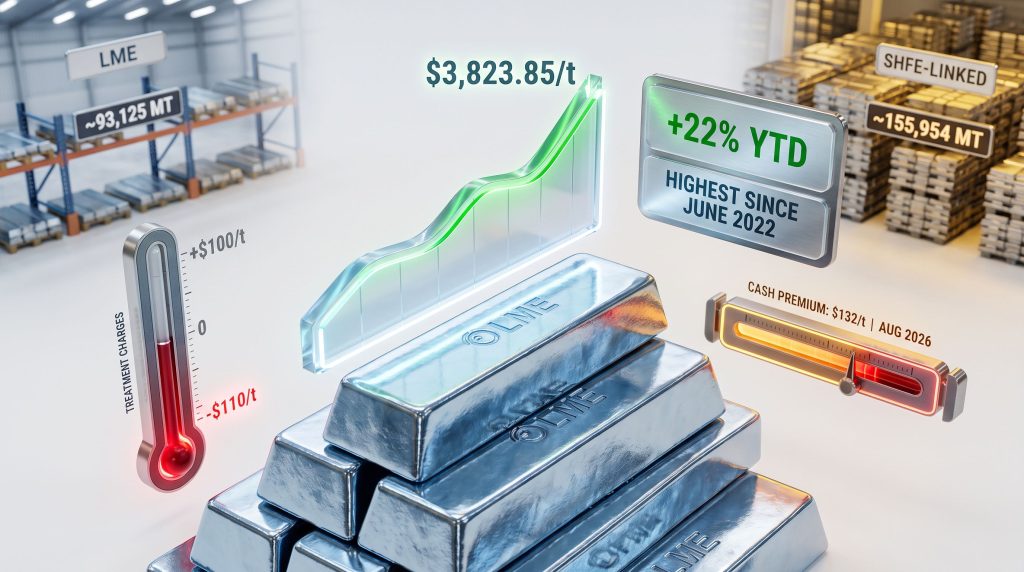
On August 21, 2026, LME benchmark zinc reached $3,823.85 per metric ton, its highest level since June 2022. That single data point, while striking, only tells part of the story.
Year-to-date, zinc has gained approximately 22% on the London Metal Exchange, a performance that places it ahead of nearly every other major base metal tracked on the exchange, with only tin delivering stronger returns over the same period.
| Metal | 2026 YTD Performance | Primary Driver |
|---|---|---|
| Zinc | +22% | Supply tightness + short squeeze |
| Tin | Outperforming zinc | Semiconductor demand surge |
| Copper | Moderate gains | Energy transition infrastructure |
| Aluminium | Lagging | Demand softness in construction |
What makes zinc's trajectory particularly significant is that it has occurred against a backdrop of consensus forecasts entering 2026 that anticipated a production surplus. The gap between what analysts projected and what markets delivered has become one of the defining commodity stories of the year. Furthermore, global zinc production shifts in the lead-up to 2026 laid much of the groundwork for this disconnect between expectation and reality.
Disclaimer: Past price performance is not indicative of future results. Commodity markets involve substantial risk and readers should not interpret this analysis as financial advice.
The East-West Inventory Divide Driving Physical Scarcity
How a Global Surplus Can Coexist With a Regional Deficit
One of the most counterintuitive dynamics in zinc's 2026 rally is that total global inventory levels are not dramatically depleted. The problem is where the metal sits, and the answer to that question explains almost everything.
LME-registered warehouse stocks fell approximately 25% over just two months, declining to around 93,125 metric tons by late August 2026. Simultaneously, inventories held within Shanghai Futures Exchange-linked storage facilities more than doubled year-to-date, reaching approximately 155,954 metric tons.
| Inventory Location | Approximate Level (August 2026) | Recent Trend |
|---|---|---|
| LME Registered Warehouses | ~93,125 metric tons | -25% in two months |
| SHFE-Linked Storage | ~155,954 metric tons | More than doubled YTD |
| Net Global Perception | Tight ex-China | Diverging sharply |
Metal accumulating in Chinese warehouses provides essentially no relief to industrial consumers in Europe, North America, or non-Chinese Asia. The LME operates as the pricing benchmark for Western physical markets, and when its registered stocks decline sharply, the signal it sends to traders and industrial buyers is one of acute scarcity, regardless of what is sitting in a warehouse in Shanghai.
The Hong Kong Delivery Signal Worth Watching
A notable development during the same week was the delivery of approximately 9,175 metric tons into LME warehouses located in Hong Kong. This figure, highlighted by Macquarie analyst Alice Fox, is analytically interesting because it sits geographically between the two inventory pools. Hong Kong LME deliveries can reflect attempts to bridge regional arbitrage gaps, but they also raise questions about whether Chinese-held metal is finding its way toward LME certification in ways that may partially moderate the Western supply squeeze over time.
What Zinc Treatment Charges Reveal That Price Charts Cannot
The Concentrate Processing Economy Explained
To understand zinc's true supply crisis, one must look past refined metal prices and into the concentrate market, which operates largely out of public view. Zinc concentrate is partially processed ore, produced at mines and then shipped to smelters where it undergoes further refining into the metal that end-users actually purchase.
Under normal market conditions, miners pay smelters a fee, known as a treatment charge (TC), for processing their concentrate. This arrangement reflects the relative negotiating leverage of each party. When concentrate is abundant, smelters have the upper hand and command higher fees. When concentrate is scarce, the dynamic reverses.
Treatment charges function as one of the most sensitive real-time indicators of upstream supply health in the zinc market. Unlike price, which reflects both physical and financial forces, treatment charges capture the pure physical balance between mine output and smelter demand for feedstock.
The $210 Per Ton Reversal That Tells the Full Story
According to data from Fastmarkets, zinc spot concentrate treatment charges on a cost-insurance-freight basis into China were last quoted at approximately minus $110 per metric ton in August 2026. In November 2025, the same figure stood at approximately plus $100 per metric ton.
| Period | Zinc TC Level (CIF China) | Market Interpretation |
|---|---|---|
| November 2025 | ~+$100/metric ton | Miners held pricing power |
| August 2026 | ~-$110/metric ton | Smelters paying for feedstock access |
| Swing Magnitude | ~$210/metric ton | Severe upstream concentrate shortage |
This $210 per ton reversal within roughly nine months is extraordinary by historical standards. Negative treatment charges are not simply a contractual curiosity. They represent a fundamental inversion of market power, where smelters are effectively paying a premium just to secure enough raw material to keep their processing operations running. When smelters cannot source adequate concentrate, refined metal output eventually falls, compressing the supply of the finished product that industrial users need.
Why This Creates a Lagged But Powerful Threat to Refined Supply
The concentrate-to-refined-metal pipeline involves meaningful lead times. A smelter that cannot secure sufficient concentrate in August 2026 may see its refined output decline in the months that follow. This lagged relationship means the concentrate crisis visible in treatment charges today could translate into further tightening of LME stocks over coming quarters, even if mine output begins recovering. Broader base metal price delays have similarly reflected this lag dynamic across other metals in recent cycles. This supply chain lag is frequently underappreciated by market participants focused primarily on headline price movements.
Speculators, Short Squeezes, and the Amplification of Price Moves
Why Bears Keep Losing Money in Zinc
Financial positioning has significantly amplified zinc's 2026 price trajectory. Throughout the year, a recurring pattern has played out in the market: traders anticipating a surge in mine production took short, or bearish, positions expecting prices to fall. When anticipated supply increases failed to materialise on schedule, spot prices rose rather than fell, forcing those traders to buy back their positions at a loss.
Alastair Munro, Senior Base Metals Strategist at Marex, has characterised zinc as continuing to confound bearish traders, noting that repeated attempts to position for a price decline, driven by expectations of increased mine supply coming to market, have been consistently undermined by the slower-than-expected pace at which new production actually arrives. Each cycle of forced buybacks adds incremental buying pressure to a market already tight on physical supply.
The Short-Squeeze Cycle in Zinc Markets:
- Traders anticipate increased mine output and establish short (bearish) positions
- Expected supply increases are delayed or fail to materialise as projected
- Physical tightness persists, pushing spot prices higher rather than lower
- Short-sellers face mounting mark-to-market losses and are forced to buy back positions
- Forced buying adds further upward momentum, pushing prices even higher
- New bearish traders enter expecting a correction, and the cycle resets
This dynamic is particularly powerful in markets where physical supply is genuinely constrained, because the fundamental backdrop keeps validating the price move and invalidating the bearish thesis. The result is a self-reinforcing loop that can push prices well beyond what supply-demand fundamentals alone would justify. Indeed, commodity market volatility of this kind creates compounding challenges for traders attempting to hedge exposure in real time.
Backwardation: The Market Structure Indicator Most Investors Overlook
Understanding the Cash-to-Three-Month Spread as a Scarcity Barometer
Backwardation occurs when the price for immediate delivery of a commodity trades above the price for future delivery. In zinc, the premium of the LME cash price over the three-month forward contract surged to approximately $132 per metric ton in August 2026, up from near zero in early July 2026 and the highest reading since December 2025.
| Date Reference | LME Cash-to-3M Premium | Market Signal |
|---|---|---|
| Early July 2026 | ~$0/metric ton | Balanced near-term supply |
| December 2025 | Prior stress high | Earlier squeeze episode |
| August 2026 | ~$132/metric ton | Acute near-term physical scarcity |
The velocity of this move is what warrants particular attention. Moving from approximately zero backwardation to $132 per ton within approximately six weeks signals that near-term physical scarcity intensified rapidly, not gradually. This is consistent with the sharp drawdown in LME warehouse stocks and the deteriorating treatment charge environment occurring simultaneously.
The Compounding Danger for Short Positions in Backwardation
For traders holding short positions in a backwardated market, the financial mechanics are punishing. Each time a short position is rolled forward from one contract period to the next, the holder must effectively pay the backwardation premium as a cost. In a deeply backwardated market with $132 per ton spreads, these roll costs compound aggressively, accelerating the point at which short-sellers capitulate and cover their positions. This creates a mechanistic buyer in the market entirely independent of any fundamental view on zinc's long-term price trajectory.
Macquarie analyst Alice Fox has flagged the risk of a prolonged squeeze scenario in which persistent backwardation and escalating roll costs could produce disorderly market conditions, distorting price discovery in ways that complicate hedging strategies for industrial consumers.
The next major ASX story will hit our subscribers first
Why the Consensus Got 2026 Wrong
The Surplus That Never Materialised
Heading into 2026, the dominant view among commodity analysts was that zinc would face a production surplus as new mine capacity additions came online. This consensus shaped financial positioning across the market and contributed to the heavy short interest that later became the fuel for the short-squeeze dynamic described above.
The failure of this surplus to emerge reflects a persistent challenge in commodity market forecasting: mine-level disruptions, permitting delays, and ramp-up timelines are systematically underestimated in forward supply projections. Projected capacity and deliverable capacity are frequently very different things, particularly in mining jurisdictions with complex regulatory environments or difficult geological conditions.
When smelter output cannot compensate for upstream shortfalls because concentrate itself is unavailable, the entire supply chain suffers. This upstream-to-downstream transmission mechanism is one of the least appreciated structural features of the zinc market, and it helps explain why consensus surplus forecasts can coexist with real-world physical tightness. Detailed metals and mining analysis has consistently shown that these upstream frictions are among the most common sources of forecasting error across base metal markets.
Which Industries Face the Greatest Cost Exposure
The Downstream Sectors Under Pressure From Elevated Zinc Prices
Zinc's primary industrial application is the galvanisation of steel, a process that coats steel with a protective zinc layer to prevent corrosion. This single application accounts for the largest share of global zinc consumption, which means sustained price elevation directly compresses margins across steel-intensive sectors including construction, infrastructure, and heavy manufacturing.
Industries Most Exposed to Elevated Zinc Prices:
- Steel galvanising accounts for the dominant share of zinc consumption globally; cost increases flow through to construction and manufacturing supply chains
- Die-casting alloys used in automotive components and consumer electronics carry significant zinc content, exposing these sectors to input cost inflation
- Brass production relies on zinc as a primary alloying metal, impacting plumbing, electrical components, and precision engineering applications
- Chemical and agricultural inputs including rubber vulcanisation and certain fertiliser applications face elevated raw material costs
For steel galvanisers in particular, zinc typically represents a substantial share of variable production costs. Unlike some commodity inputs where substitution is feasible, galvanisation chemistry has limited near-term alternatives at industrial scale, meaning cost absorption or passthrough to customers are the primary available responses. These commodity price impacts are equally significant for mining companies whose margins depend on the downstream sectors purchasing their output.
Is the Rally Sustainable, or Is a Correction Approaching?
The Bull and Bear Cases in Parallel
Zinc's 2026 price trajectory presents a genuinely contested outlook, with credible arguments on both sides of the debate.
The bull case rests on the structural nature of the concentrate deficit. Treatment charges do not turn negative by $110 per ton without a genuine and severe shortfall in upstream supply. If mine disruptions and permitting delays persist, the concentrate famine will continue feeding through into tighter refined metal availability outside China, sustaining LME backwardation and supporting elevated prices.
The bear case centres on two key risk factors. First, Chinese SHFE inventories at approximately 155,954 metric tons represent a substantial overhang that could find its way into global markets if arbitrage conditions shift sufficiently. Second, demand weakness in key consuming sectors, particularly construction and automotive manufacturing, could reduce zinc offtake and ease physical tightness faster than the supply side recovers.
Important caveat: Commodity price forecasting involves significant uncertainty. The scenarios presented here are analytical frameworks, not predictions. Investors and industrial buyers should conduct independent analysis and consult qualified advisors before making decisions based on commodity price expectations.
Distinguishing a Short Squeeze From a Structural Bull Market
Perhaps the most important analytical distinction for market participants at this juncture is whether zinc's rally represents a genuine structural bull market driven by multi-year supply deficits, or a technically-amplified squeeze that will normalise once short positions are fully covered and inventory flows adjust. These two scenarios have very different implications for how long elevated prices persist and how sharply a correction might unfold when it arrives.
The treatment charge data and LME inventory trends suggest the physical supply stress is real. However, the speed and magnitude of the backwardation surge, combined with the short-squeeze dynamic, indicates that financial amplification has pushed prices beyond pure fundamental justification. Markets that combine genuine physical tightness with heavy speculative involvement are capable of both overshooting significantly to the upside and correcting sharply when the speculative overlay unwinds. For further context on the zinc price four-year high and the signs of extreme supply tightness underpinning this rally, industry reporting provides useful corroboration of the dynamics outlined here.
Frequently Asked Questions: Zinc Prices, Supply Fears, and Market Dynamics
What caused zinc to hit a four-year high in 2026?
A convergence of declining LME warehouse stocks, record-negative zinc concentrate treatment charges, sustained speculative short-covering, and a widening regional inventory gap between China and the rest of the world collectively drove LME zinc to its highest level since June 2022. In short, zinc hits four-year peak on supply fears and speculators because multiple structural and financial forces aligned simultaneously.
What are zinc treatment charges and why do they matter?
Treatment charges are fees miners normally pay smelters for processing zinc concentrate into refined metal. When they turn negative, reaching approximately minus $110 per metric ton in August 2026 compared to plus $100 per metric ton in November 2025, it signals that concentrate supply is so scarce that smelters must pay a premium to access feedstock. This is one of the most reliable indicators of genuine upstream supply stress.
Why does zinc backwardation matter to industrial buyers?
When near-term prices exceed forward prices by $132 per metric ton, as occurred in August 2026, it signals acute immediate scarcity. For industrial buyers needing to secure metal now rather than in three months, backwardation translates directly into higher procurement costs and procurement risk.
How do short squeezes amplify zinc price rallies?
Traders betting on falling prices must buy back their positions if prices rise instead. In physically tight markets, this forced buying adds momentum to price increases that already have fundamental support, creating a feedback loop that can push prices significantly beyond what supply-demand analysis alone would suggest. Reuters coverage of how speculators drove the surge offers additional perspective on the financial mechanics at play.
Could zinc prices fall significantly from current levels?
Yes. A large-scale release of Chinese inventory into Western markets, faster-than-expected recovery in global mine concentrate output, or a meaningful demand contraction in galvanising-intensive sectors could all contribute to price normalisation. However, the structural depth of the current concentrate deficit suggests any correction would need to be driven by supply-side recovery rather than demand destruction alone.
Key Takeaways: Zinc's 2026 Market Structure at a Glance
- LME zinc reached approximately $3,823.85 per metric ton in August 2026, its highest level since June 2022
- Zinc delivered approximately 22% year-to-date gains on the LME, outperforming all major base metals tracked on the exchange except tin
- LME registered warehouse stocks fell approximately 25% over two months to around 93,125 metric tons
- SHFE-linked inventories more than doubled year-to-date to approximately 155,954 metric tons, creating a stark East-West divide
- Zinc concentrate treatment charges swung from approximately +$100/t in November 2025 to -$110/t in August 2026, a $210 per ton reversal indicating a severe upstream concentrate famine
- LME cash-to-three-month backwardation surged to approximately $132 per metric ton from near zero in early July 2026, signalling acute near-term physical scarcity
- The anticipated 2026 production surplus failed to materialise, exposing a systematic tendency to underestimate mine-level supply friction in commodity forecasting
- Speculative short-covering has materially amplified price gains beyond what physical fundamentals alone would support, raising the risk of disorderly market adjustments if the squeeze unwinds rapidly
For ongoing coverage of global zinc market dynamics and base metals pricing trends, Mining Weekly at miningweekly.com provides regular analysis across global producing regions and commodity sectors.
Want to Spot the Next Major Base Metal Discovery Before the Market Does?
Discovery Alert's proprietary Discovery IQ model scans ASX announcements in real time, instantly identifying significant mineral discoveries across zinc, copper, tin, and more than 30 other commodities — turning complex upstream supply data into actionable investment insights before the broader market reacts. Explore historic discoveries and their returns to understand the scale of opportunity, then begin your 14-day free trial to position yourself ahead of the next major move.