August 22, 2026
The Carbon Border Divide: What BRICS Opposition to CBAM Means for Global Aluminium Trade
Carbon pricing has spent decades maturing inside national borders, functioning as a domestic instrument designed to reshape industrial behaviour within a single regulatory jurisdiction. That era is now giving way to something more complex and contentious: the use of carbon costs as a variable embedded directly into international trade. BRICS challenges EU carbon tax on aluminium trade represents one of the most significant multilateral pushbacks in recent climate trade history, with measurable cost implications for producers across the developing world.
Understanding why a bloc as economically diverse as BRICS has aligned so forcefully against the European Union's Carbon Border Adjustment Mechanism requires looking beyond the diplomatic language. It demands examining the structural mechanics of the mechanism itself, the specific vulnerabilities of aluminium supply chains, and the deeper equity arguments that developing economies have spent years attempting to embed into international climate governance.
When big ASX news breaks, our subscribers know first
What CBAM Actually Does and Why Aluminium Is Caught in the Crosshairs
The EU's Carbon Border Adjustment Mechanism was designed to resolve a fundamental competitive problem. As European producers operating under the EU Emissions Trading System face rising carbon costs, foreign exporters selling into the European market from jurisdictions with no equivalent carbon price could undercut them without bearing any comparable climate obligation. CBAM closes that gap by requiring importers to purchase certificates corresponding to the carbon emissions embedded in covered goods.
The mechanism covers six product categories selected for both their carbon intensity and the degree to which production can migrate to avoid regulation — a phenomenon known as carbon leakage. Those categories are aluminium, steel, iron, cement, fertilisers, and electricity.
CBAM's Implementation Timeline
The rollout followed a two-stage structure:
| Phase | Period | Core Obligation |
|---|---|---|
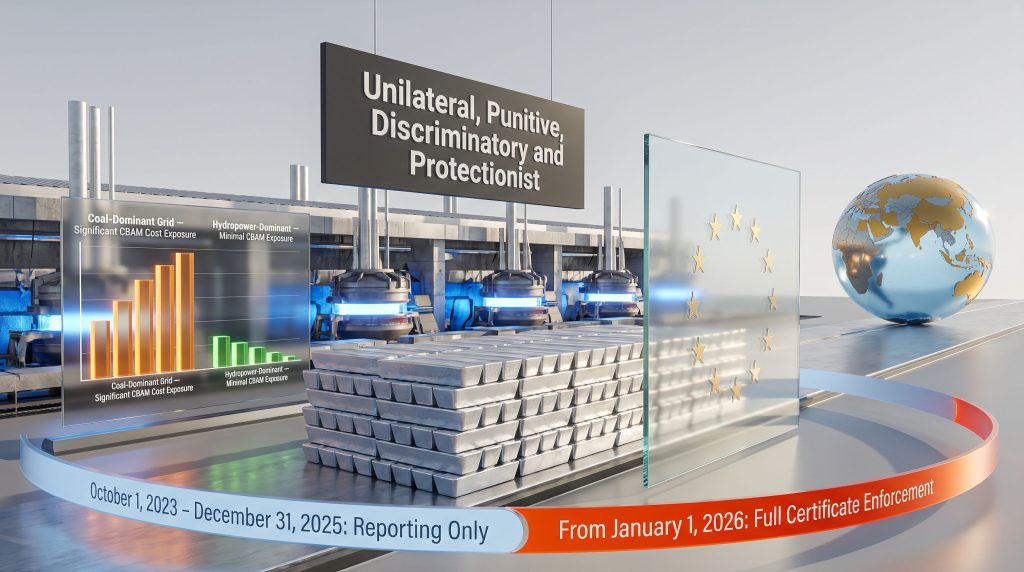
| Transitional (Reporting Only) | 1 October 2023 – 31 December 2025 | Importers report embedded emissions; no financial liability |
| Full Enforcement | From 1 January 2026 | Importers must purchase and surrender CBAM certificates |
The transition from a data-gathering exercise to a genuine financial obligation in January 2026 marks the point at which CBAM moved from a compliance framework to a live cost variable in international trade. For exporters who had not yet built measurement infrastructure or engaged with EU importers on certificate allocation, the shift was abrupt.
How Certificate Costs Are Calculated
The number of certificates an importer must surrender is determined by the carbon emissions intensity of the specific production process used. This means:
- Producers using coal-fired electricity for smelting carry a high embedded emissions figure and therefore face a proportionally larger certificate obligation
- Producers powered by hydroelectric or other renewable sources carry substantially lower embedded emissions and face minimal CBAM cost exposure
- Countries with their own functioning carbon pricing mechanisms may receive partial credit, reducing the effective certificate liability
This calculation methodology is where aluminium's structural vulnerability becomes apparent. Furthermore, the implications extend well beyond individual producers to reshape entire supply chains.
Why Aluminium Is Particularly Exposed to Carbon Border Costs
Aluminium smelting is among the most electricity-intensive industrial processes in global manufacturing. The Hall-Héroult process, which converts aluminium oxide into primary aluminium through electrolytic reduction, consumes roughly 13 to 15 megawatt-hours of electricity per tonne of metal produced. Where that electricity originates from carbon-intensive fossil fuel grids, the embedded emissions figure in every tonne of aluminium is substantial.
This creates a cost asymmetry that does not affect all aluminium exporters equally. The actual CBAM exposure depends almost entirely on the carbon intensity of the electricity grid powering the smelter. The aluminum and alumina markets have already begun to reflect these structural pressures in pricing and investment decisions.
Estimated Cost Exposure by Production Profile
| Exporter Profile | Grid Carbon Intensity | Relative CBAM Cost Exposure |
|---|---|---|
| Coal-dominant grid producers | High | Significant uplift in export costs to the EU |
| Mixed grid with partial renewables | Medium | Moderate compliance cost burden |
| Hydropower-dominant producers (e.g. parts of Canada, Norway, Brazil) | Low | Minimal CBAM exposure |
This asymmetry has a geographic dimension that maps closely onto BRICS membership. Several major BRICS aluminium-producing nations operate grids with significant coal dependence, meaning their producers face the heaviest CBAM certificate costs. The financial gap between a coal-powered smelter and a hydropower-powered smelter can be substantial when multiplied across large export volumes, effectively functioning as a structural trade penalty for producers in energy-disadvantaged markets.
The Secondary Aluminium Advantage
One less widely discussed dimension of CBAM's competitive reshaping is the position it creates for recycled and secondary aluminium producers. Recycling aluminium requires approximately 95% less energy than primary smelting, resulting in embedded emissions that are a fraction of those associated with primary production.
Under CBAM's certificate calculation methodology, secondary aluminium imports face minimal compliance costs, giving recycled metal a structural pricing advantage in the EU market. This has accelerated interest in aluminium scrap verification frameworks and traceability systems, since EU importers increasingly need documented proof of recycled content to avoid misclassification and unnecessary certificate obligations.
The BRICS Response: Formal Opposition and the Three Core Arguments
Environment and climate ministers representing BRICS member nations formally registered their opposition to CBAM during a ministerial meeting chaired by India in New Delhi. The participating delegations included representatives from Brazil, Russia, India, China, South Africa, the United Arab Emirates, Indonesia, Iran, Saudi Arabia, Egypt, and Ethiopia, reflecting the expanded composition of the bloc.
The collective position characterised CBAM as unilateral and punitive, discriminatory, and protectionist — an instrument the bloc believes is misaligned with international law and the principles underlying multilateral climate governance.
Three arguments underpin this position:
-
Historical emissions equity: Developing economies have contributed proportionally less to cumulative atmospheric carbon concentrations than industrialised nations. BRICS members argue that bearing the costs of a carbon border mechanism without receiving commensurate climate finance support is structurally inequitable under the principle of common but differentiated responsibilities enshrined in the UN Framework Convention on Climate Change.
-
WTO compatibility questions: The bloc has raised concerns that CBAM may conflict with non-discrimination principles embedded in the General Agreement on Tariffs and Trade, particularly the most-favoured-nation and national treatment obligations. No formal WTO ruling has been issued on this question as of the time of writing, and the legal debate remains genuinely contested among trade law specialists.
-
Revenue destination concerns: CBAM certificate revenues flow into the EU's general budget rather than being redirected toward climate adaptation finance for developing nations. BRICS ministers have argued that if carbon border costs are to be imposed on developing country exporters, a portion of those revenues should cycle back into the climate finance commitments that developed nations have historically struggled to meet.
The BRICS position reframes CBAM not simply as a trade complaint but as evidence of a deeper structural failure in global climate governance, one where financial and technological burdens are being redistributed toward the nations least responsible for the emissions that necessitated climate action in the first place.
The Climate Finance Linkage: More Than a Trade Dispute
Alongside their formal opposition to CBAM, BRICS ministers called on developed nations to significantly accelerate the delivery of climate adaptation finance. This connection is deliberate and strategically important. By linking carbon border taxation to the wider climate finance debate, the bloc is constructing an argument that treating these two issues in isolation misrepresents the actual burden-sharing calculus.
The logic runs as follows: if developed economies impose trade costs on carbon-intensive exports from developing nations, while simultaneously failing to deliver the financial flows needed for those nations to decarbonise their energy infrastructure, the net effect is a transfer of wealth from poorer to wealthier economies under the banner of climate policy. That framing has resonance far beyond BRICS membership and speaks to longstanding tensions in multilateral climate negotiations.
The China metals market provides a particularly stark illustration of these tensions, given China's position as both a major BRICS member and the world's largest aluminium producer. In addition, the broader tariff impacts on metals trade have compounded the pressure on developing-world producers navigating multiple simultaneous regulatory headwinds.
How CBAM Reshapes Global Aluminium Trade Flows
The competitive implications of CBAM extend well beyond the EU's borders. As the cost of EU market access rises for high-carbon aluminium producers, several structural adjustments become likely:
- Producers facing elevated certificate costs may redirect export volumes toward markets in Asia, the Middle East, and Africa where no equivalent carbon border mechanism currently applies
- Increased supply competing for non-EU markets could suppress aluminium prices in those regions, affecting producers who have always served those markets
- EU buyers with sustainability mandates may actively preference certified low-carbon aluminium suppliers, accelerating the emergence of a two-tier global market
- Domestic EU aluminium producers and recyclers stand to benefit from improved competitive positioning against imports that had previously undercut them on cost
The Decarbonisation Investment Imperative
CBAM creates a financial incentive for aluminium exporters to invest in renewable energy-powered smelting. The mechanism effectively translates carbon intensity into a price differential that grows with the EU ETS carbon price, which has shown a long-term upward trajectory despite periodic volatility.
However, the capital requirements for transitioning smelting operations from coal-based to renewable electricity are substantial. The broader zero-carbon metals push being pioneered by major mining companies demonstrates what is technically achievable, but well-capitalised producers in advanced economies are far better positioned to make this transition faster. For producers in emerging markets with limited access to green finance, this creates a compounding problem that may widen rather than narrow competitive gaps.
Compliance Infrastructure: What Exporters Now Need
For aluminium producers seeking to maintain EU market access under full CBAM enforcement, the operational requirements include:
- Comprehensive measurement and documentation of embedded emissions across the entire production chain, from bauxite refining through smelting to finished product
- Third-party verification of emissions data to satisfy EU reporting standards, which adds cost and requires engagement with accredited verification bodies
- Clear contractual arrangements with EU importers to determine how certificate obligations are allocated between exporter and importer
- Ongoing monitoring of EU ETS carbon price movements, since certificate costs fluctuate with the ETS market price
The next major ASX story will hit our subscribers first
Three Scenarios for How This Dispute Resolves
The trajectory of BRICS challenges EU carbon tax on aluminium trade is not predetermined, and multiple outcomes remain plausible depending on diplomatic developments, WTO dispute mechanisms, and the pace of decarbonisation investment in major producing nations.
Scenario 1: CBAM Accelerates Green Aluminium Investment
Sustained certificate cost pressure functions as the EU intended, incentivising aluminium producers in BRICS nations to invest in renewable-powered smelting over a 10 to 15 year horizon. EU market access is preserved for producers who successfully transition, and the mechanism contributes to a genuine structural reduction in global aluminium's carbon intensity.
Scenario 2: Trade Fragmentation and Market Bifurcation
High-carbon producers redirect export volumes away from the EU, concentrating in markets without carbon border requirements. A two-tier global aluminium market solidifies, with low-carbon certified product commanding a premium in regulated jurisdictions and high-carbon metal competing aggressively on price in unregulated ones. Notably, this outcome risks concentrating rather than reducing global emissions.
Scenario 3: Multilateral Renegotiation
Sustained BRICS diplomatic pressure, combined with formal WTO dispute proceedings, produces a renegotiated CBAM architecture. This could incorporate differentiated rates for developing economies, mandate a portion of certificate revenues flow toward climate adaptation finance, or integrate with a broader multilateral carbon pricing framework. BRICS nations have consistently opposed unilateral carbon measures of this kind, making this the most equitable but also the most diplomatically complex potential outcome.
Which scenario materialises will depend significantly on whether the EU treats CBAM as a fixed instrument or as a negotiating position within a broader climate trade framework. The BRICS response has made clear that affected nations view it as the latter.
Frequently Asked Questions: BRICS, CBAM, and Aluminium Trade
What products does CBAM cover?
CBAM applies to imports of aluminium, steel, iron, cement, fertilisers, and electricity entering the European Union, selected for their carbon intensity and carbon leakage risk.
When did CBAM's financial obligations begin?
Full enforcement requiring importers to purchase and surrender CBAM certificates commenced on 1 January 2026, following a reporting-only transitional phase that began on 1 October 2023.
Why is aluminium particularly vulnerable to CBAM costs?
Aluminium smelting is exceptionally electricity-intensive. Where that electricity is generated from carbon-intensive fossil fuel sources, the embedded emissions per tonne of metal are high, directly increasing the certificate obligation and therefore the compliance cost.
Is CBAM legal under WTO rules?
This remains actively contested. The EU maintains the mechanism is WTO-compatible; BRICS nations and several trade law specialists have raised concerns about potential conflicts with non-discrimination principles. No formal WTO ruling has been issued as of the time of writing.
Could CBAM revenues be redirected to developing country climate finance?
This is a central demand within the BRICS position. Currently, certificate revenues flow to the EU budget. The bloc has called for a portion to be directed toward climate adaptation finance for developing economies.
Key Strategic Takeaways for Aluminium Market Participants
- CBAM has transformed from a reporting exercise into a live commercial cost variable as of January 2026, and its financial impact on trade flows will grow as the EU ETS carbon price evolves
- BRICS challenges EU carbon tax on aluminium trade reflect substantive concerns about equity, WTO compatibility, and climate finance access rather than simple protectionist impulse
- Secondary and recycled aluminium producers hold a structural advantage under CBAM's certificate methodology that is likely to strengthen over time
- The major aluminium mining companies best positioned for EU market access will be those investing early in renewable-powered smelting and robust emissions documentation
- Monitoring EU ETS price trajectories, WTO dispute developments, and multilateral climate finance negotiations will be essential for strategic planning through 2026 and beyond
This article is intended for informational purposes only and does not constitute financial, investment, or legal advice. Forward-looking statements and scenario projections involve inherent uncertainty and should not be relied upon as predictions of actual outcomes. Readers are encouraged to consult relevant industry bodies, trade publications, and legal specialists for guidance specific to their circumstances.
Want to Know Which ASX Mineral Discoveries Could Define the Next Decade?
Discovery Alert's proprietary Discovery IQ model scans ASX announcements in real time, instantly identifying significant mineral discoveries across 30+ commodities — including the aluminium and metals sectors being reshaped by carbon trade shifts — and delivering actionable insights directly to subscribers. Explore historic discoveries and the returns they generated, then begin your 14-day free trial to position yourself ahead of the market.