August 22, 2026
The Architecture of Managed Decline: How Energy Sovereignty Is Reshaping Global Oil Markets
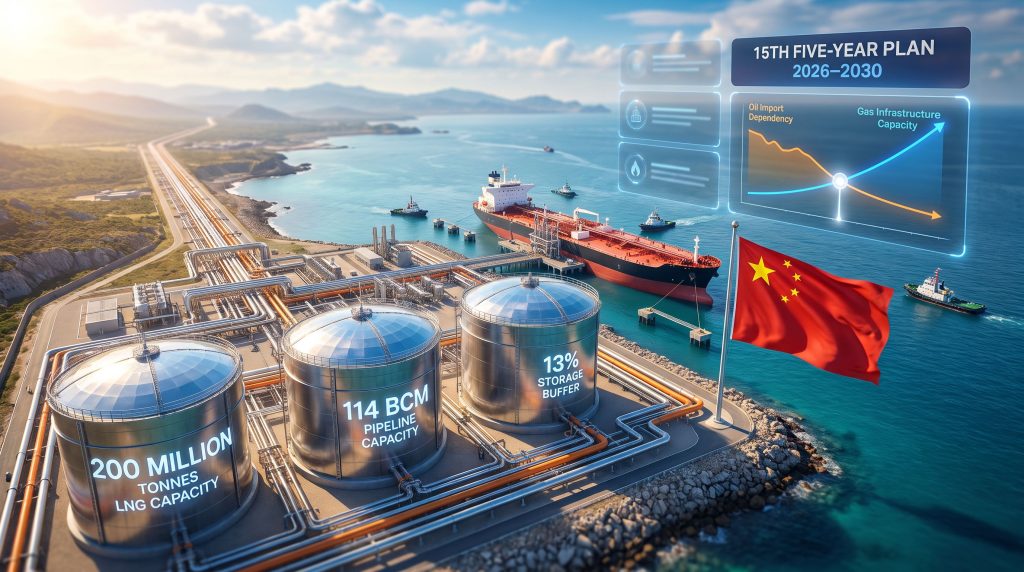
Before any policy document is written, before any five-year target is announced, the underlying logic of an energy superpower's strategy is already visible in the architecture it chooses to build. Storage terminals, overland pipelines, and strategic reserve buffers are not merely infrastructure decisions. They are geopolitical statements encoded in steel and concrete, signalling to the world which chokepoints a nation intends to no longer fear.
That architectural logic sits at the heart of China's approach to oil and gas security heading into the 2026-2030 period. The country's China five-year plan for peak oil represents something more ambitious than a simple consumption reduction target. It is a comprehensive sovereignty framework designed to systematically reduce the vulnerabilities that seaborne crude dependency creates, while simultaneously preparing for a world in which global oil production itself may begin its own structural decline.
When big ASX news breaks, our subscribers know first
What China's 15th Five-Year Plan Actually Targets
Released jointly by the National Development and Reform Commission (NDRC) and the National Energy Administration (NEA), China's 15th Five-Year Plan sets out binding infrastructure targets across three interconnected energy security pillars. Each pillar, furthermore, addresses a distinct vulnerability in China's current energy architecture.
| Infrastructure Target | 2030 Goal |
|---|---|
| LNG Terminal Capacity | 200 million tonnes |
| Natural Gas Pipeline Capacity | 114 billion cubic metres |
| Gas Storage Buffer vs. Annual Consumption | +13% above annual consumption |
| Domestic Crude Oil Production Target | ~200 million metric tonnes per year |
The scale of these commitments reflects a planning philosophy that treats energy supply chains as strategic assets rather than commercial conveniences. By targeting 200 million tonnes of LNG terminal capacity alongside 114 billion cubic metres of pipeline throughput, Beijing is constructing a diversified import architecture that deliberately reduces dependence on any single maritime corridor.
Critical Distinction: The 15th Five-Year Plan promotes the peaking of oil consumption as a directional policy objective, not a mandated cutoff date. Analyst estimates for the actual inflection point range from as early as 2026 to as late as 2030, depending on electric vehicle penetration curves and the pace of industrial fuel switching. The plan frames this as a managed transition, not a structural break imposed by regulatory mandate.
How Does the Plan Address Geopolitical Vulnerability?
The geopolitical trade realignment currently reshaping global energy flows makes this framework all the more significant. The plan's diversification logic is designed precisely to insulate China from the kind of supply disruptions that arise when major trading relationships fracture or reroute unexpectedly.
Peak Demand vs. Peak Supply: Two Very Different Problems
One of the most consequential and least widely understood distinctions in global energy analysis is the difference between peak oil demand and peak oil supply. These are not the same phenomenon, and conflating them produces fundamentally flawed conclusions about China's strategic intent.
Peak oil supply refers to the geological and production-side ceiling on global crude output. It is an externally imposed constraint driven by reservoir depletion rates, capital allocation cycles, and the long lead times inherent in upstream oil development. Nations that fail to prepare for peak supply face an involuntary adjustment, potentially an acute and disorderly one.
Peak oil demand, by contrast, is a choice. It represents a deliberate policy-driven suppression of consumption growth through electrification, efficiency mandates, fuel switching, and structural changes to the industrial economy. China is pursuing the latter with the explicit aim of getting ahead of the former.
Analytical Frame: For Beijing, voluntarily engineering a domestic oil demand ceiling before global supply constraints force one is not environmental policy. It is risk management at a civilisational scale. A nation that chooses its own peak is in a fundamentally different strategic position than one that has a peak chosen for it by geology or geopolitics.
This distinction also carries implications for Europe, where a recent analysis highlighted that the continent's next major energy crisis may not originate from conflict or weather disruption. Instead, it could be structurally triggered by the global contraction in oil production output, arriving in nations that never built managed transition frameworks and consequently have no buffer against an involuntary adjustment.
The Strait of Hormuz Closure as a Live Validation Event
Strategic frameworks are only as credible as their performance under real-world stress conditions. China's pre-existing approach to energy stockpiling and supply diversification received precisely that kind of real-world validation when the Strait of Hormuz closed in February of this year following the outbreak of conflict involving Iran.
At the time of closure, approximately one-fifth of the world's daily oil and gas trade transited the Strait. The majority of those flows were destined for Asian markets, and the disruption left many of China's regional neighbours in acute supply difficulty. Japan, South Korea, and several Southeast Asian economies faced immediate import stress as tanker routes fractured and spot market premiums surged.
China's experience was materially different. The country's strategic reserves and contingency supply infrastructure absorbed the disruption with minimal domestic market impact. Rather than scrambling to source alternative supply at crisis premiums, Beijing was able to draw on stockpiles accumulated precisely for this scenario while its overland pipeline routes continued operating independently of maritime chokepoint risk.
Josh Freed, Head of Climate and Energy at centre-left think tank Third Way, observed in a Washington Post analysis that the Hormuz disruption represented a shock Beijing was structurally positioned to absorb, predicting that China would emerge from the conflict in a stronger energy position than it held before the closure. (Washington Post, March 2026)
This assessment reflects a deeper truth about the compounding returns of strategic energy preparation. Each disruption that China weathers with relative stability, while competitors absorb larger shocks, widens the structural gap in energy sector resilience. In this context, the geopolitical oil price drivers shaping global crude benchmarks are increasingly being filtered through the lens of which nations have built adequate buffer infrastructure and which have not.
The 13% Storage Buffer Rule and Its Strategic Logic
One of the less-discussed but most analytically significant targets within the 15th Five-Year Plan is the requirement that natural gas storage capacity exceed national annual consumption by a margin of 13 percent. This is not an arbitrary figure.
A storage buffer of that magnitude creates a rolling reserve capable of sustaining domestic supply through a multi-month disruption of primary import routes. Based on the Hormuz closure experience, this is precisely the timeframe within which geopolitical supply interruptions tend to resolve or evolve into new stable configurations.
The strategic logic can be broken down as follows:
- Phase one involves a disruption event, whether geopolitical, weather-related, or infrastructure-based, interrupting primary supply routes.
- Phase two sees spot market prices spike as buyers without adequate reserves compete for available supply.
- Phase three finds well-prepared nations drawing on strategic reserves to stabilise domestic markets while others pay crisis premiums.
- Phase four involves the gradual resumption or rerouting of supply, with nations holding reserves emerging from the disruption in stronger structural positions.
China's 13% buffer rule is designed to make phase three sustainable for long enough that phase four can arrive without domestic market destabilisation.
Sovereignty, Not Sustainability: The Real Driver Behind the Transition
A common interpretive error in Western analysis of China's energy policy is framing the country's pivot away from oil demand growth as primarily a climate commitment. The 15th Five-Year Plan's internal logic makes clear that the primary driver is something different: energy sovereignty.
| Dimension | China's Approach | EU's Approach |
|---|---|---|
| Primary Driver | Energy sovereignty and import security | Climate commitments and carbon neutrality |
| Oil Demand Strategy | Managed peak, maintain domestic output | Demand reduction via regulation and carbon pricing |
| Gas Infrastructure | Aggressive expansion through 2030 | Phased reduction aligned with net-zero targets |
| Strategic Reserves | Expanding as geopolitical buffer | Moderate, crisis-response oriented |
| EV Adoption Role | Demand suppression tool | Emissions reduction mechanism |
The distinction is not semantic. It has direct consequences for the types of infrastructure China continues to build, the pace at which it is willing to reduce fossil fuel optionality, and the degree to which decarbonisation commitments will yield to energy security pressures when the two objectives conflict.
China is simultaneously expanding natural gas infrastructure aggressively while targeting peak oil consumption. These goals appear contradictory only if decarbonisation is assumed to be the primary objective. However, when energy independence is understood as the primary objective, both policies serve the same strategic purpose: reducing exposure to seaborne crude import dependency while maintaining thermal energy availability through diversified overland and coastal LNG routes.
The next major ASX story will hit our subscribers first
When Does Peak Oil Demand Actually Arrive? Three Scenarios
The timing of China's peak oil demand carries materially different implications for global crude benchmarks depending on which trajectory materialises. Three plausible scenarios exist, each governed by a distinct set of underlying variables.
Scenario 1: Early Peak (2026-2027)
This outcome requires EV penetration to accelerate beyond current projections, industrial fuel switching to proceed faster than the baseline, and petrochemical sector growth to moderate. If China's passenger vehicle fleet continues electrifying at its current trajectory, with EVs already representing a substantial share of new vehicle sales, the transport sector's oil demand could plateau or decline within the current planning period.
Scenario 2: Mid-Decade Peak (2028-2029)
This represents the base case, assuming EV adoption continues at recent rates without significant acceleration, industrial transition proceeds on schedule, and petrochemical demand growth offsets some transport sector reductions. Under this scenario, China's crude imports continue growing modestly before inflecting, providing a softer landing for global oil producers dependent on Chinese demand growth.
Scenario 3: Extended Plateau (2030 and Beyond)
If petrochemical sector expansion proves more durable than anticipated, if industrial electrification faces technical or economic obstacles, or if economic growth surprises to the upside and drives broader energy intensity increases, peak demand could be deferred beyond the 15th Five-Year Plan period entirely.
Key Variable: EV penetration rates, industrial fuel switching timelines, and petrochemical sector expansion are the three primary determinants of when Chinese oil demand actually inflects. Each scenario carries meaningfully different consequences for OPEC+ pricing strategy, long-run investment in upstream oil development, and Asian LNG market structure.
How China's Gas Infrastructure Buildout Functions as a Chokepoint Hedge
The plan's emphasis on overland pipeline capacity expansion alongside coastal LNG terminal development reflects a deliberate diversification away from Hormuz-dependent shipping lanes. Furthermore, the 114 billion cubic metre pipeline capacity target represents connectivity to Central Asian and Russian gas supplies that bypass maritime chokepoints entirely.
This overland diversification strategy has a precedent in China's earlier pipeline investments. The Central Asia-China Gas Pipeline network, connecting Turkmenistan, Uzbekistan, and Kazakhstan to Chinese domestic distribution infrastructure, demonstrated that large-scale overland supply diversification was both technically feasible and geopolitically valuable. The 15th Five-Year Plan accelerates this logic.
Simultaneously, the 200 million tonne LNG terminal capacity target ensures that even seaborne LNG supply can be sourced from a geographically diversified set of origins, including Australian, Qatari, American, and East African suppliers. This reduces the risk that any single exporting region's disruption creates systemic domestic supply stress. Indeed, China's plans to peak oil demand are closely tied to this parallel expansion of intelligent rig development and pipeline capacity.
Step-by-Step: The Construction Sequence of China's Energy Security Architecture
- Maximise domestic crude output at approximately 200 million metric tonnes annually, reducing the volume of seaborne imports required to meet domestic refining demand.
- Expand overland and coastal LNG import capacity to diversify supply origins away from Hormuz-dependent maritime routes.
- Build strategic gas storage buffers to the 13% surplus threshold, creating a multi-month shock absorber against supply disruptions.
- Accelerate EV adoption and industrial fuel switching to suppress oil demand growth through technology deployment rather than regulatory constraints alone.
- Set a managed peak oil demand objective within the China five-year plan for peak oil framework, signalling to global markets that Chinese crude import growth has a defined ceiling.
- Maintain fossil fuel optionality through continued parallel investment in oil and gas infrastructure, ensuring that no single transition failure creates a systemic domestic energy crisis.
Global Market Implications: What Happens When the World's Largest Importer Peaks?
China's position as the world's largest crude oil importer means that even a managed deceleration in its import growth has consequences that extend well beyond its own borders. OPEC's global oil influence, long-run upstream capital allocation decisions, and Asian LNG pricing structures are all calibrated to some degree around Chinese demand trajectory assumptions.
If peak demand arrives at the earlier end of the scenario range, producers that have invested heavily in capacity expansion on the assumption of continued Chinese demand growth could face structurally weaker pricing environments sooner than their planning cycles anticipated. The 2026-2030 period may consequently prove to be the last window in which Chinese demand growth provides a reliable demand-side tailwind for global crude markets.
For investors monitoring global commodity markets, WTI and Brent futures will serve as a key barometer of how quickly the market prices in a Chinese demand inflection. A sustained deceleration in import growth, even before an outright peak, would represent a leading indicator that the structural transition is tracking ahead of consensus expectations.
Moreover, US-China oil trade tensions add a further layer of complexity to how these shifts ripple through global benchmarks, particularly as Beijing accelerates its diversification away from dollar-denominated supply chains.
Investor Note: This article does not constitute financial advice. All references to market implications, price trajectories, and investment considerations are analytical observations based on publicly available information and should not be construed as recommendations to buy or sell any securities or commodity positions.
Frequently Asked Questions: China Five-Year Plan for Peak Oil
What is China's official peak oil demand target under the 15th Five-Year Plan?
The 15th Five-Year Plan sets the promotion of peak oil consumption as an explicit directional objective covering the 2026-2030 period. It does not specify a single mandatory year for achieving this milestone. Analyst estimates range from 2026 to 2030 depending on EV adoption curves and industrial transition rates.
How does China's peak oil demand strategy differ from peak oil supply?
China's plan addresses peak demand, a deliberate policy-driven reduction in consumption growth, rather than peak supply, which refers to the geological and production-side ceiling on global crude output. The China five-year plan for peak oil is actively managing its demand ceiling before global supply constraints impose an involuntary adjustment.
What role did the Strait of Hormuz closure play in shaping this policy?
The Strait's closure in February 2026 validated China's pre-existing stockpile and diversification strategy. The disruption left many Asian neighbours facing acute supply stress while China's reserves and contingency infrastructure absorbed the shock with minimal domestic market impact.
Will China continue importing oil even after peak demand?
Yes. The plan simultaneously targets peak oil consumption and stable domestic crude production of approximately 200 million metric tonnes per year. China will remain a significant oil importer for the foreseeable future. The strategic objective is to reduce the growth rate of import volumes and eliminate dependency on single supply corridors, not to eliminate imports entirely.
What are the key natural gas infrastructure targets in China's 2030 plan?
The plan targets 200 million tonnes of LNG terminal capacity, 114 billion cubic metres of natural gas pipeline capacity, and a gas storage buffer equivalent to 13% above annual national consumption, all by 2030.
Want to Track the Commodity Opportunities Emerging From China's Energy Transition?
China's strategic pivot away from seaborne crude dependency is already reshaping global commodity markets — and the mineral discoveries feeding that transition are happening right now on the ASX. Discovery Alert's proprietary Discovery IQ model delivers real-time alerts on significant ASX mineral discoveries, transforming complex geological data into actionable investment insights, so subscribers can position themselves ahead of the broader market — start your 14-day free trial today and explore why historic discoveries generate such substantial returns.