August 22, 2026
The $16 Trillion Frontier: Understanding the US and China Deep-Sea Mining Critical Minerals Race
Imagine a resource base larger than the GDP of the entire European Union, locked beneath thousands of metres of water, governed by a patchwork of international law that two of the world's most powerful nations interpret in fundamentally different ways. That is the reality of the modern US and China deep-sea mining critical minerals contest, and it is reshaping supply chain strategy, diplomatic posture, and investment capital flows in ways that most market participants have yet to fully absorb.
The seabed is not a new discovery. Scientists have understood the basic geology of polymetallic nodule fields since the 1960s. What has changed is the economic and geopolitical context surrounding them. The convergence of clean energy buildout, defence electronics demand, and aggressive supply chain nationalism has transformed the ocean floor from a scientific curiosity into a contested strategic asset. The question is no longer whether the seabed will be mined, but who will control the process, under what legal framework, and at what cost to marine ecosystems and terrestrial mineral producers.
When big ASX news breaks, our subscribers know first
Three Deposit Categories, Three Strategic Profiles
The mineralogy of the deep ocean is not uniform. Three distinct deposit types define the current exploration landscape, each carrying a different commercial risk-reward profile and strategic significance.
| Deposit Type | Primary Location | Key Minerals | Strategic Application |
|---|---|---|---|
| Polymetallic Nodules | Deep ocean abyssal plains | Manganese, Nickel, Copper, Cobalt | EV batteries, electronics, grid storage |
| Polymetallic Sulphides | Hydrothermal vent systems | Copper, Zinc, Gold, Silver | Defence systems, semiconductors |
| Ferromanganese Crusts | Underwater seamounts | Cobalt, Platinum, Rare Earths, Manganese | Clean energy infrastructure, aerospace |
Polymetallic nodules, roughly the size of potatoes, accumulate on abyssal plains over millions of years at growth rates measured in millimetres per million years, making them among the slowest-forming mineral deposits on Earth. This extraordinarily slow formation rate is a critical but underappreciated detail: unlike terrestrial ore bodies, these deposits cannot be meaningfully replenished on any human timescale, which raises profound questions about long-term resource governance.
Ferromanganese crusts are particularly prized within defence and clean energy sectors because of their elevated concentrations of cobalt and platinum group elements, which are essential to fuel cell technology, catalytic converters, and advanced aerospace alloys. Polymetallic sulphides, forming at active hydrothermal vents, are geologically younger and more variable in grade, making them simultaneously higher-risk and potentially higher-reward than nodule deposits.
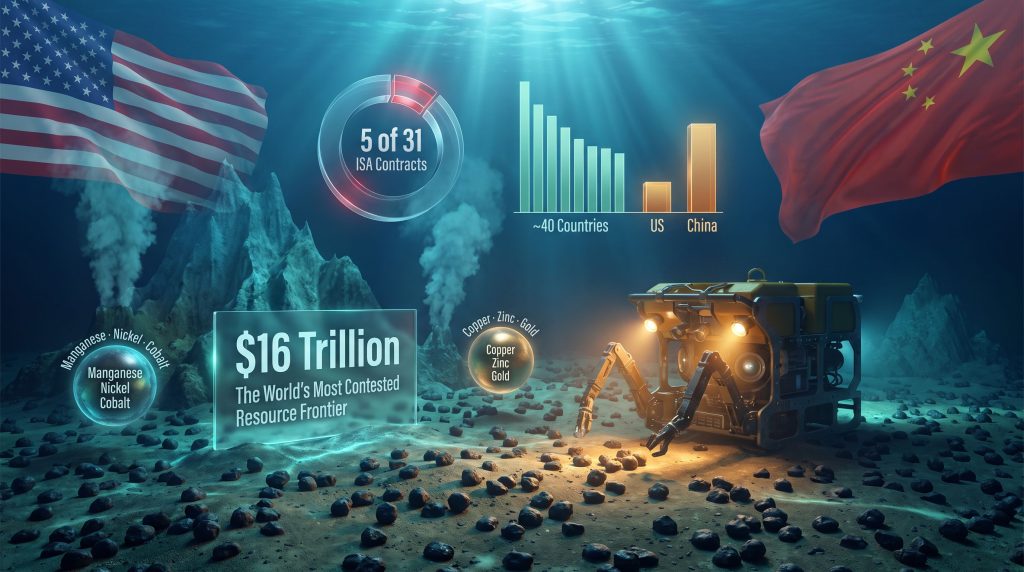
Total estimated seabed mineral value has been assessed at up to $16 trillion, a figure produced through geological survey extrapolation rather than bankable reserve estimation. Investors and policymakers should treat this number as an indicator of scale rather than a commercial forecast.
Important Distinction: The $16 trillion figure reflects geological resource estimates, not commercially recoverable reserves. The gap between what exists on the seabed and what can be economically extracted at depth remains enormous, and bridging that gap is the central technical and financial challenge facing the entire industry.
How Deep-Sea Extraction Actually Works: The Engineering Reality
Commercial-scale deep-sea extraction has not commenced anywhere in the world as of 2026. The operational environment presents challenges that have no direct terrestrial equivalent.
Working at depths of 4,000 to 6,000 metres means dealing with pressures exceeding 600 times atmospheric surface pressure, near-zero visibility, water temperatures approaching freezing, and substrate environments of extraordinary fragility. Current extraction concepts centre on three primary systems:
- Collector vehicles deployed to the seabed floor that mechanically harvest nodules or crust material using hydraulic suction or bucket systems.
- Riser and lift systems that transport extracted material upward through kilometres of pipe using either pump systems or air-lift technology.
- Surface support vessels that process, store, and transport recovered material.
The challenge is not simply engineering these systems to function, but doing so in a cost-competitive manner relative to terrestrial mining operations that benefit from decades of infrastructure investment, established logistics networks, and well-understood geology. Deep-sea mining companies face a fundamentally different cost structure, with no existing infrastructure, extreme equipment maintenance requirements, and the need to manage environmental monitoring obligations simultaneously.
A critical but rarely discussed distinction within the regulatory framework is the difference between an exploration contract and an exploitation licence. Under the International Seabed Authority framework, exploration contracts grant the right to survey and assess mineral deposits in designated areas. They do not confer any right to commercially extract minerals. Exploitation regulations, which would govern actual commercial mining, remain under negotiation and are not yet finalised. This means that all current deep-sea mining activity, including China's five contracted zones, is legally confined to the exploration phase.
The American Position: Strategic Intent, Legal Constraints, and the UNCLOS Problem
In April 2025, the US President signed an executive order classifying seabed mineral access as a national security priority, directing the acceleration of deep-sea mining permits and site assessments across Pacific locations, including waters near American Samoa and the Mariana Islands. This was not an impulsive policy shift but the culmination of years of accumulating anxiety over critical mineral import dependency.
The strategic logic behind the executive order traces directly to China's dominance over critical mineral processing. The surging critical minerals demand across the technology, defence, and clean energy sectors has made cobalt, nickel, manganese, and rare earth elements acutely strategic. The RAND Corporation has explicitly identified Pacific polymetallic nodule deposits as capable of supporting alternative supply chains that bypass Chinese processing infrastructure, framing these deposits in terms of economic security rather than purely commercial opportunity.
However, the United States faces a structural disadvantage that executive orders cannot resolve: Washington has not ratified the United Nations Convention on the Law of the Sea (UNCLOS).
Governance Gap: UNCLOS governs all mineral-related activities in international waters through the International Seabed Authority. The US Senate's failure to ratify this treaty, driven by concerns over sovereignty provisions, intellectual property clauses, and revenue-sharing obligations, means American operators pursuing extraction in international waters under domestic licences may face legitimacy challenges from ISA member states. This legal exposure is a material risk that has no clear resolution pathway without Senate action.
The practical consequence is that the US can accelerate permitting and site assessment domestically, but any American operator attempting to extract minerals from international seabed areas risks operating in a legal grey zone where other nations could challenge the validity of their licence. Furthermore, deep-sea mining regulations remain an evolving and contested space, adding another layer of uncertainty for US-backed operators.
China's Structural Advantage: Institutional Positioning and Long-Game Infrastructure
Where the United States has pursued executive authority, China has pursued institutional positioning. The contrast in strategy is stark and deliberate.
China currently holds 5 of the 31 exploration contracts issued by the International Seabed Authority, the largest allocation of any single country. These contracts were secured over years of sustained engagement with ISA processes by state-backed entities including COMRA (China Ocean Mineral Resources Research and Development Association) and China Minmetals. By operating within the multilateral framework rather than outside it, China has accumulated both contractual access and institutional legitimacy simultaneously.
Beijing is also constructing a permanent deep-sea research station in the South China Sea, targeted for completion by 2030. This facility represents an infrastructure investment that will compound China's positional advantage regardless of when commercial exploitation regulations are finalised. A permanent deep-sea research presence enables continuous data collection, equipment testing, and ecological baseline work that no competitor currently possesses at equivalent scale.
Investigative tracking conducted by CNN and Mongabay identified eight Chinese research vessels operating over a five-year period in deep-sea mining contexts, with several observed spending limited time in their designated ISA exploration zones while covering strategically significant broader ocean areas. Security analysts and China studies experts have noted that these vessels may simultaneously serve scientific and strategic intelligence-gathering functions, reflecting Beijing's broader approach to integrating civilian and military capabilities in the maritime domain.
Isaac Kardon, Senior Fellow for China Studies at the Carnegie Endowment for International Peace, has described China as the foremost actor in emerging high-seas navigation activities connected to undersea resources, with Beijing actively positioning itself to achieve commercial first-mover status in deep-sea extraction when regulatory conditions permit.
Comparing the Two Superpowers: A Strategic Scorecard
| Dimension | United States | China |
|---|---|---|
| Governance Approach | Domestic executive action, bilateral agreements | ISA multilateral framework participation |
| ISA Exploration Contracts | Limited | 5 of 31 contracts |
| Legal Standing in International Waters | Structurally constrained (non-UNCLOS signatory) | Institutionally grounded |
| Research Infrastructure | Developing | Permanent station targeted by 2030 |
| Commercial Readiness | Accelerating permitting | Exploration-phase dominant |
| Strategic Framing | National security / supply chain independence | Civilian-military integration |
The asymmetry is significant. China leads on institutional legitimacy and infrastructure, whilst the US leads on regulatory acceleration pace and strategic intent signalling. Neither country is close to commercial extraction in international waters, but China's ISA positioning means it would be the most legally defensible first mover if exploitation regulations are finalised.
The next major ASX story will hit our subscribers first
The ISA Framework: Governance Architecture and Its Limits
The International Seabed Authority, headquartered in Kingston, Jamaica, holds a mandate to regulate all mineral-related activities in international seabed areas beyond national jurisdiction, known formally as "the Area." Its Council holds 36 seats, of which 10 are currently held by African nations, giving the continent meaningful structural influence over how exploitation regulations are eventually shaped.
The critical governance challenge is that commercial exploitation regulations remain incomplete. This regulatory vacuum is being navigated in fundamentally different ways by the two dominant powers: the US by operating outside ISA jurisdiction entirely, and China by pushing the conceptual boundaries of what "research" activities are permitted to involve under its existing exploration contracts.
The absence of finalised exploitation regulations is not simply a bureaucratic delay. It represents a genuine unresolved tension between:
- The ISA's mandate to ensure that seabed resources benefit humanity as a whole
- Commercial operators' need for legal certainty before committing capital to extraction infrastructure
- Environmental protection advocates' calls for comprehensive ecological baseline data before any exploitation proceeds
- Developing nations' demands for benefit-sharing arrangements that reflect their interests
Africa's Strategic Dilemma: Investment Risk and the Moratorium Coalition
The continent sitting most directly in the crossfire of this deep-sea contest is Africa. The Democratic Republic of Congo alone holds mineral reserves estimated at approximately $24 trillion, a figure that dwarfs even the most optimistic seabed valuations on a per-accessible-tonne basis. In addition, the broader US-Congo minerals partnership underscores how terrestrial African resources are increasingly central to Washington's supply chain diversification strategy. African policymakers have consequently begun articulating a sophisticated dual argument: that deep-sea mining poses both environmental risks to marine ecosystems and economic risks to the continent's terrestrial mineral investment pipeline.
The capital allocation concern is structural rather than speculative. Mining project investment decisions respond to competing risk-adjusted return profiles. If deep-sea mineral supply enters global markets at scale, it could suppress commodity prices for cobalt, nickel, and manganese in ways that reduce the economic attractiveness of terrestrial African projects that are already in development or feasibility assessment phases.
Six African nations have formally aligned with calls for a precautionary pause or moratorium on deep-sea mining:
- Mauritius
- Mozambique
- Republic of the Congo
- Malawi
- Kenya
- Madagascar
These nations engaged directly at the ISA Council meeting in Kingston, Jamaica, in July 2026, using Africa's 10-seat Council bloc to amplify pressure on the moratorium question. If Africa's ISA representation were coordinated consistently, it would constitute a meaningful voting force capable of influencing the conditions under which exploitation regulations are finalised, particularly around benefit-sharing requirements and environmental standards.
Strategic Note: Africa's dual argument, combining environmental precaution with economic self-interest, is more strategically coherent than it might initially appear. The two positions reinforce each other in ISA negotiations because both support the same procedural outcome: delaying or conditioning exploitation regulations in ways that protect terrestrial mineral investment flows.
Approximately 40 countries globally have called for a moratorium or precautionary pause on deep-sea mining as of 2026, representing a substantial political coalition that cuts across developed and developing world lines.
Environmental Risks: What the Science Actually Shows
The deep ocean represents one of Earth's largest biomes and one of its least scientifically understood. Species and ecological structures in these environments developed across millions of years under conditions of extraordinary physical stability. Pressure constancy, temperature uniformity, and near-total absence of light have produced organisms and habitat dynamics that have no terrestrial equivalent and that science has barely begun to characterise.
The primary environmental damage vectors identified by researchers include:
- Sediment plume dispersion from seabed disturbance, which can travel hundreds of kilometres from extraction sites and smother filter-feeding organisms
- Substrate removal, which destroys the physical habitat structure that organisms depend upon and that took millions of years to form
- Noise and light pollution from operational equipment, disrupting species that depend on acoustic communication and bioluminescent signalling in lightless environments
- Potential introduction of surface-water organisms through riser and lift systems operating across multiple ocean depth zones
A particularly important scientific point that rarely receives sufficient attention is the absence of comprehensive baseline ecological data. Before any meaningful environmental impact assessment can be conducted, researchers need to understand what currently exists in target extraction zones. For most proposed mining areas, that baseline data is incomplete or non-existent. Research published in Nature reinforces this concern, highlighting that the precautionary argument rests on substantive scientific foundations rather than simple opposition to resource development.
Geopolitical Scenario Modelling: Three Futures Through 2032
Scenario 1: Multilateral Framework Holds
The ISA finalises exploitation regulations with robust environmental standards and benefit-sharing provisions. Both the US and China operate within a unified governance regime. African nations leverage their Council seats to secure meaningful royalty frameworks. Commercial extraction begins on a regulated basis in the late 2030s.
Scenario 2: Fragmented Unilateralism
The US proceeds with domestic licensing outside ISA jurisdiction whilst China accelerates activity under its existing ISA contracts. A parallel governance crisis emerges, with no effective enforcement mechanism for either framework. Legal disputes over extraction legitimacy create investment uncertainty that paradoxically delays commercial operations despite increased regulatory activity.
Scenario 3: Moratorium Coalition Prevails
The 40-nation moratorium coalition achieves a binding pause through ISA processes or UN General Assembly mechanisms. Deep-sea mining investment redirects toward terrestrial sources. African mineral-producing nations benefit from sustained capital flows, and commodity prices for cobalt, nickel, and manganese remain structurally supportive of new terrestrial project development.
No single scenario is inevitable. The most likely near-term trajectory involves elements of all three, with different governance outcomes applying to different deposit types and geographic zones simultaneously. Consequently, investors and policymakers monitoring the US and China deep-sea mining critical minerals race would be wise to model exposure across multiple regulatory scenarios rather than committing to a single outcome.
Key Metrics at a Glance
| Metric | Figure |
|---|---|
| Estimated seabed mineral value | Up to $16 trillion |
| ISA exploration contracts (total issued) | 31 |
| China's ISA exploration contracts | 5 |
| Countries supporting moratorium/pause | ~40 |
| African nations on ISA Council | 10 of 36 seats |
| African nations formally backing moratorium | 6 |
| DRC terrestrial mineral reserve estimate | ~$24 trillion |
| China's deep-sea station completion target | 2030 |
| Chinese research vessels tracked | 8 (over 5 years) |
| US executive order on seabed mining | April 2025 |
Frequently Asked Questions
What minerals are found on the deep-sea floor?
The three primary deposit categories contain manganese, nickel, copper, cobalt, zinc, gold, silver, platinum, and rare earth elements, distributed differently across polymetallic nodules, polymetallic sulphides, and ferromanganese crusts depending on the geological formation environment.
Has commercial deep-sea mining started?
No. As of 2026, commercial extraction in international waters has not commenced anywhere globally. All current activity remains at the exploration, research, and regulatory positioning phase. The broader contest over US and China deep-sea mining critical minerals, however, continues to intensify at the diplomatic and institutional level.
Why hasn't the US ratified UNCLOS?
The US Senate has declined to ratify UNCLOS primarily due to concerns over sovereignty implications, revenue-sharing obligations that some legislators view as incompatible with American interests, and intellectual property provisions. This creates a persistent structural disadvantage for US operators seeking legally defensible access to international seabed resources.
Could deep-sea mining harm African mineral investment?
African policymakers argue that if seabed-sourced cobalt, nickel, and manganese enter global markets in meaningful volumes, the resulting price pressure could reduce the economic viability of terrestrial African projects currently in development, diverting capital that would otherwise flow toward continental mineral development.
Disclaimer: This article is intended for informational and educational purposes only. It does not constitute financial or investment advice. All figures cited, including mineral value estimates and reserve assessments, reflect geological or analytical estimates rather than commercially verified reserves. Readers should conduct independent research before making any investment decisions related to mining, critical minerals, or related sectors.
Want to Track the Next Major ASX Mineral Discovery Before the Market Does?
Discovery Alert's proprietary Discovery IQ model delivers real-time alerts on significant ASX mineral discoveries across critical minerals including cobalt, nickel, copper, and manganese — instantly translating complex geological data into clear, actionable insights for investors at every experience level. Explore Discovery Alert's dedicated discoveries page to understand how major mineral discoveries have historically generated substantial returns, and begin your 14-day free trial today to position yourself ahead of the broader market.