August 21, 2026
When Energy Becomes a Weapon: Understanding the New Architecture of Oil Market Risk
The use of economic tools as instruments of geopolitical leverage is not a new phenomenon. From the Arab oil embargo of 1973 to the multilateral sanctions regimes of the 2010s, the history of global energy markets is punctuated by moments when political decisions override supply-demand fundamentals. Trump economic warfare against Iran oil prices represents a qualitative escalation beyond the maximum pressure framework of 2018 to 2019, and the consequences are reverberating across crude benchmarks, freight markets, refined product inventories, and liquefied natural gas pricing simultaneously.
Understanding what is actually happening in energy markets right now requires looking beyond the headline price moves and examining the mechanisms through which political decisions translate into barrel-by-barrel supply disruptions.
When big ASX news breaks, our subscribers know first
The Mechanics of Economic Warfare Against an Oil-Producing State
The term "economic warfare" as applied to Iran describes a coordinated system of pressure instruments operating across multiple domains at once. It is not simply a list of prohibited transactions. It involves the U.S. Treasury Department designating financial institutions, the State Department threatening secondary penalties against any third-country entity purchasing Iranian crude, and naval assets creating physical friction around Iran's ability to move oil through the Strait of Hormuz.
The critical innovation of the current campaign is secondary sanctions enforcement. Rather than targeting Iran directly, the policy weaponises access to the U.S. financial system as leverage against foreign buyers. Any refinery, trading house, or shipping company that handles Iranian barrels risks being cut off from dollar-denominated transactions, correspondent banking relationships, and U.S. market access. This transforms every barrel of Iranian crude into a legal liability for the entity that touches it.
Furthermore, several layers distinguish the current pressure campaign from earlier efforts:
- Traditional sanctions restrict Iranian entities from transacting directly with U.S. counterparties
- Secondary sanctions extend that prohibition to non-U.S. entities that conduct business with Iran
- Maritime enforcement creates physical chokepoints that restrict vessel movements regardless of sanctions
- Cargo insurance exclusions make it commercially untenable to ship Iranian oil even where buyers are willing
- Diplomatic signalling raises the perceived cost of compliance failure for allied and non-allied nations alike
The cumulative effect is to raise the transaction cost of Iranian oil to the point where even deeply discounted barrels become uneconomical for all but the most risk-tolerant buyers. This is the structural logic behind the "drive exports to zero" policy objective. As context, Trump's declaration of unprecedented economic warfare against Iran has drawn sharp responses from Tehran, with Iranian officials openly deriding the campaign's stated ambitions.
What Brent, WTI, and the Broader Market Are Actually Pricing Right Now
The price signals across multiple energy benchmarks during the week of August 21, 2026 are extraordinarily revealing. Rather than reflecting a single supply shock, they represent the aggregated probability judgement of global traders assigning risk weights to multiple disruption scenarios simultaneously.
| Benchmark | Recent Level | Key Driver |
|---|---|---|
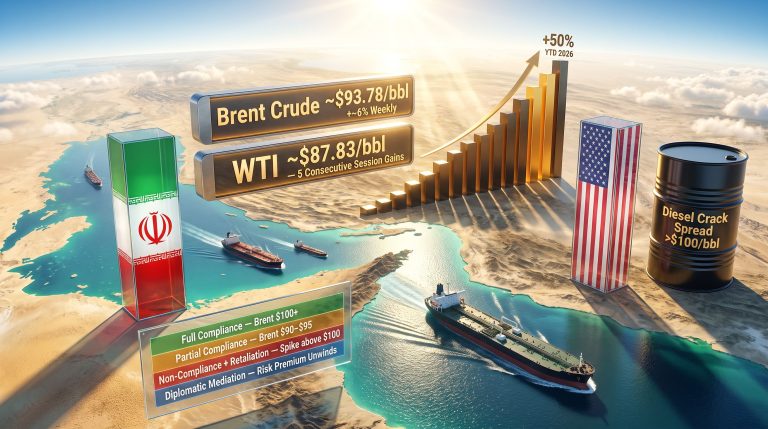
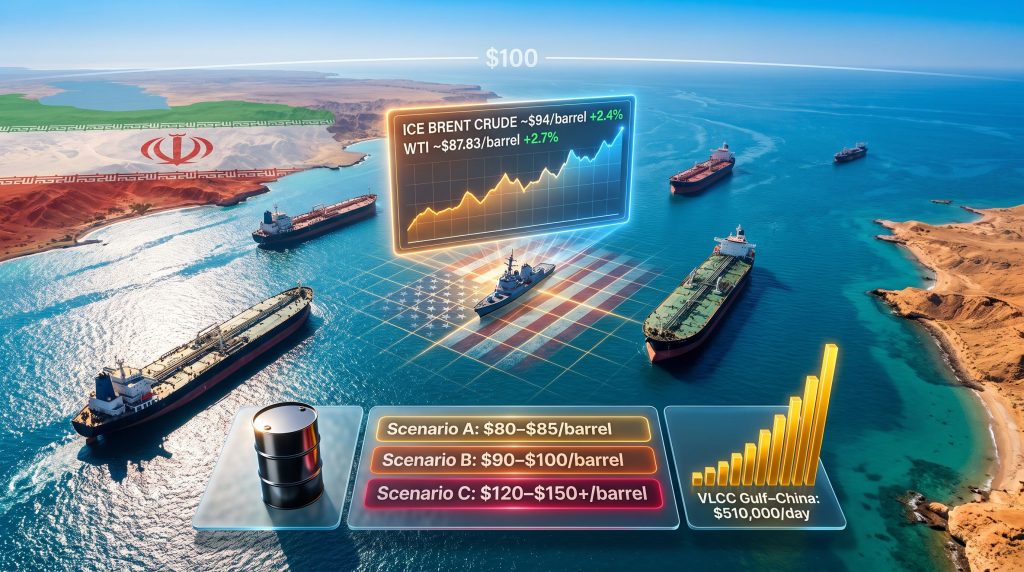
| ICE Brent Crude | ~$93.78/barrel | Sanctions risk premium + Hormuz disruption |
| WTI Crude | ~$87.83/barrel | Domestic supply tightness + geopolitical risk |
| Murban Crude (UAE) | $103.20/barrel | ADNOC supply restrictions to Asia |
| Iranian Heavy Crude | ~$64.96/barrel | Illiquidity premium + buyer risk aversion |
| Asian LNG Spot | $24/MMBtu | Middle East supply anxiety + demand competition |
| VLCC Freight (Gulf-China) | $510,000/day | Record; route risk + tanker availability |
Several dynamics within this data set deserve particular attention from a market intelligence perspective.
What Does the Murban-Iranian Spread Tell Us?
First, the spread between Murban at $103.20 and Iranian Heavy at $64.96 illustrates the premium the market now attaches to cleanly tradeable, sanctions-free supply versus barrels that carry legal and logistical risk. This nearly $40 per barrel gap is not a quality differential alone. It is a risk premium embedded in the price discovery mechanism itself.
Second, the VLCC freight rate of $510,000 per day on the Gulf-to-China route represents a genuine market stress signal. Under normal conditions, tanker day rates on this route sit in the $30,000 to $60,000 range. A rate exceeding $500,000 indicates that ship owners are effectively pricing in the possibility of vessel seizure, insurance invalidation, or route abandonment.
Third, and most underappreciated by mainstream analysis, commodity strategist Jeff Currie has argued that the crude benchmark discussion misses the more acute pressure point. His contention is that the real crisis is not $91 Brent but rather distillate markets, where diesel prices could reach the equivalent of $170 per barrel in market stress terms. U.S. distillate inventories have been sinking to critical levels precisely as Middle Eastern refinery throughput is constrained by tanker disruptions, tightening the refined product supply chain independently of crude benchmark movements.
Notably, an oil price shock of this nature has already been flagging concern among Canadian energy executives, who see downstream knock-on effects rippling well beyond the Middle East.
The Hormuz Chokepoint: Why Single-Digit Transits Are a Structural Crisis
The Strait of Hormuz is not simply a geographic feature. It is the single most consequential maritime chokepoint in the global energy system, responsible for approximately 20 to 21 percent of all global oil trade. Under normal operating conditions, between 20 and 25 commercial vessels make the transit each day in each direction. When transits fall to single digits, as occurred throughout the week of August 21, 2026, the volumetric consequences are severe.
What makes the current disruption particularly complex is that it operates through multiple channels simultaneously:
- Direct transit risk deters vessel operators even when no active interdiction occurs
- Cargo insurance premiums spike dramatically, making the economics of Iranian-origin cargoes unworkable
- VLCC availability in the region tightens as operators avoid positioning their assets into contested waters
- Saudi Aramco's decision to route Very Large Crude Carriers back through Hormuz after a three-week pause signals institutional willingness to absorb elevated risk, but does not normalise market conditions
- Alternative routing via Mediterranean shuttle services increases delivery times and freight costs substantially
Saudi Arabia's pivot toward Mediterranean export routes to bypass Houthi-controlled southern corridors adds another layer of cost and complexity to the regional supply architecture. These are not temporary operational adjustments. They represent the emergence of a structurally more expensive and logistically fragmented Gulf export system.
The Iraq-Syria pipeline proposal, which would provide a non-Hormuz export corridor for Iraqi crude, carries an estimated development cost of $15 billion and a timeline of approximately four years from a decision to proceed to operational status. This means there is no near-term fix for Hormuz dependence, regardless of political will.
The market is currently pricing a partial disruption scenario. The distance between partial disruption and full closure is measured not in policy cycles but potentially in a single maritime incident, making tail-risk positioning unusually important in the current environment.
China Caught in the Crossfire: The Secondary Sanctions Trap
China occupies an extraordinarily exposed position in the current geopolitical configuration. Over the past several years, Chinese independent refiners, commonly known as "teapot" refineries, have built their operational economics around deeply discounted Iranian crude. These facilities lack the scale economies and feedstock flexibility of major integrated refiners, making them particularly sensitive to both price shifts and legal risk escalation.
The Trump administration has made it explicit that Chinese entities purchasing Iranian oil are within scope for secondary sanctions enforcement. This creates a genuine dilemma for Beijing's energy supply managers. The broader context of US-China oil tensions has been building for some time, and the secondary sanctions mechanism represents its most acute expression yet.
The market evidence suggests the pivot is already underway. Iranian crude's pricing has shifted from a $3 discount to a $2 premium over Brent, a swing of approximately $5 per barrel that reflects collapsing buyer competition as teapot refiners step back. This price reversal is economically paradoxical: supply is being restricted, and yet the restricted barrels are trading at a premium because the remaining buyers willing to absorb sanctions risk are fewer and therefore can extract less discount.
Chinese refiners are, however, responding by actively pursuing alternative sources:
- Iraqi crude has emerged as the primary near-term substitute, with Chinese buyers securing supply as Gulf route disruptions create pricing opportunities
- Brazilian barrels are attracting increased attention as long-haul alternatives that carry no sanctions exposure
- The overall Chinese import volume is projected to rebound as refiners scramble to replace Iranian feedstock, which itself will place upward pressure on non-Iranian crude benchmarks globally
Japan's experience illustrates the supply substitution dynamic in practice. Japanese crude imports from the United States surged more than eight-fold to a record 891,000 barrels per day in July 2026, accounting for 36 percent of Japan's total oil inflows. Simultaneously, Japan's LNG imports from the U.S. jumped 59 percent as Tokyo diversified away from disrupted Middle Eastern supply. This pattern of U.S. supply filling the vacuum created by its own sanctions policy represents a strategically coherent, if geopolitically complex, energy trade realignment.
The Shadow Oil Highway and Why Iranian Barrels Still Matter
A critical insight that is frequently absent from mainstream coverage concerns the actual volume of oil that continues to move through Hormuz via non-transparent shipping arrangements. Available analysis suggests that approximately 4 million barrels per day of oil currently moves through the strait through what might be described as a shadow oil highway, utilising vessels operating outside normal AIS tracking protocols, flag-of-convenience registrations, and ship-to-ship transfer arrangements.
This shadow network has historically absorbed Iranian, Venezuelan, and Russian barrels that cannot access conventional trading channels. Its existence means that Iranian crude's irrelevance to official oil markets does not equate to irrelevance to actual global supply balances. If enforcement pressure successfully collapses this network, the market could face a sudden loss of supply that participants have quietly been relying upon without explicitly acknowledging.
This is the hidden fragility in the current pricing environment. The partial disruption scenario being priced by markets assumes that shadow flows continue to provide a buffer. If that assumption breaks down, the transition to higher price scenarios could occur faster than consensus forward curves suggest. The intersection of trade and geopolitics has rarely been more consequential for energy supply chains than it is at this juncture.
The next major ASX story will hit our subscribers first
Supply Wildcards That Could Shift the Outlook Through 2026
Beyond the Iran-specific dynamics, several supply-side variables compound the structural tightness in global oil markets.
Kazakhstan's Tengiz Field
ExxonMobil has projected that Kazakhstan's Tengiz field, currently producing approximately 1 million barrels per day, will plateau around 2027 before declining to 500,000 barrels per day by 2035. This trajectory removes one of the few large non-OPEC, non-U.S. production growth stories from the medium-term supply outlook. A potential $80 billion Kashagan expansion that could partially offset this decline remains blocked by unresolved legal disputes.
Iraq's Production Ambitions
Iraq's government has stated a target of reaching 8 to 10 million barrels per day within six years, a figure that would require unprecedented infrastructure investment and OPEC quota renegotiation. Current production sits at approximately 2.9 million barrels per day under existing OPEC restrictions, creating a substantial gap between aspiration and operational reality. In addition, the role of OPEC market influence in shaping how these ambitions are accommodated remains a defining variable for the medium-term price outlook.
Panama Canal Rationing
The Panama Canal Authority has announced a reduction in daily transits from approximately 35 to 32 by mid-September 2026, following a 44 percent below-normal drop in watershed inflows driven by El Niño conditions. When both the Strait of Hormuz and the Panama Canal face capacity constraints simultaneously, the compounding effect on global tanker routing costs and delivery timelines creates a second-order supply shock that crude benchmarks alone fail to capture.
Scenario Pathways for Brent Through Late 2026
| Scenario | Probability Assessment | Brent Range | Key Signal |
|---|---|---|---|
| Diplomatic De-escalation | Low | $80-$85/barrel | Iranian discount re-emerges; teapot buying resumes |
| Sustained Pressure, No Escalation | Base Case | $90-$100/barrel | Elevated freight; continued rerouting; tight distillates |
| Military Escalation or Full Hormuz Closure | Tail Risk | $120-$150+/barrel | IEA SPR release triggered; demand destruction begins |
The base case assumes that the current partial disruption at Hormuz continues without escalating to active military exchange, that Chinese teapot refiners continue their pivot toward alternative supply without triggering a formal diplomatic rupture, and that OPEC members with bypass-capable infrastructure continue to manage export flows actively.
The tail risk scenario requires only a single triggering event. Iran has historically used asymmetric responses to escalation pressure, and its warnings to Gulf states as Trump economic warfare against Iran oil prices intensifies represent a visible signalling channel that markets are monitoring closely. The UAE's decision to freeze trade with Iran following missile incidents near its coastline illustrates how rapidly regional alignments can shift in response to Iranian actions.
Furthermore, the broader pattern of trade war oil markets disruption adds another dimension of uncertainty, as interconnected trade tensions compound the direct geopolitical risks emanating from the Gulf.
What the scenario analysis cannot capture is the timing of transition between states. Markets that are comfortably priced for Scenario B can reprice for Scenario C within hours of a credible triggering event. This asymmetry in repricing speed is what makes tail-risk hedging through options structures particularly relevant for energy-exposed portfolios in the current environment. Consequently, the full implications of Trump economic warfare against Iran oil prices may only become apparent when a triggering event forces a rapid reassessment of the base case. Oil prices jumped sharply in response to early signals from this campaign, illustrating just how sensitive benchmark pricing remains to political developments in the region.
This article is intended for informational and educational purposes only. Nothing contained herein constitutes financial, investment, or legal advice. Commodity price forecasts and scenario analyses represent analytical frameworks based on publicly available information and carry inherent uncertainty. Readers should conduct their own due diligence before making any investment or commercial decisions.
Want to Stay Ahead of the Next Major Commodity Discovery?
While geopolitical shocks reshape global energy markets, Discovery Alert's proprietary Discovery IQ model scans the ASX daily to deliver real-time alerts on significant mineral discoveries — turning complex market data into actionable opportunities for investors at every level. Explore historic discoveries and their exceptional returns, then begin your 14-day free trial to position yourself ahead of the market.