August 21, 2026
The Hidden Architecture of Oil Price Shocks: When Financial Warfare Meets Energy Markets
Most commodity price movements trace back to a relatively straightforward supply-demand imbalance. However, there is a more complex category of price shock that operates through anticipation, legal architecture, and geopolitical signalling rather than any immediate physical shortage. The current surge in crude oil benchmarks belongs firmly in this second category. Understanding why oil prices rise on new Iran economic measures requires looking beyond the headlines and into the structural mechanics of how financial pressure campaigns interact with global energy flows.
The current environment is not simply about one nation's oil exports being threatened. It represents the intersection of decades-long sanctions policy, a critical maritime chokepoint, the world's largest crude importer caught in the crossfire, and a diesel market already operating at historically extreme margins. These forces are converging simultaneously, and the result is a price environment that defies easy resolution in either direction.
When big ASX news breaks, our subscribers know first
From Diplomatic Posturing to Economic Architecture: What the New Iran Measures Actually Represent
Washington's latest pressure campaign against Tehran has been publicly framed in dramatic terms, with senior U.S. officials describing the initiative as a financially oriented offensive designed to structurally isolate Iran's energy and banking infrastructure. The approach moves beyond bilateral restrictions and introduces a mechanism of secondary pressure: nations and entities that continue conducting commerce with Iran risk facing consequences from U.S. regulatory and financial authorities.
This secondary sanctions architecture is the market-moving element, not the Iran-specific measures themselves. Tehran has operated under successive layers of international financial restrictions for roughly five decades. Its economy has adapted through shadow shipping networks, alternative payment rails, grey-market crude transactions routed through intermediary jurisdictions, and opaque vessel-to-vessel transfer operations on the open ocean.
What changes when secondary sanctions enter the picture is the risk calculus for Iran's trading partners. The question shifts from whether Iran can sell oil to whether its buyers can afford to keep purchasing it without consequences. That is an entirely different threat model, and one that directly implicates China. Furthermore, this dynamic is closely tied to broader U.S.-China trade war tensions that have made the bilateral relationship increasingly volatile.
The Strait of Hormuz: Geography as Market Variable
No discussion of oil price dynamics in this context is complete without understanding the Strait of Hormuz's role as a structural amplifier of supply risk. The strait is a narrow waterway separating Iran from Oman, through which approximately 20% of the world's daily oil supply transits. For a market that prices on the margin, even the credible threat of disruption to this chokepoint carries significant pricing implications.
Iran's conditions for reopening the Strait of Hormuz have added a jurisdictional dimension that markets find particularly difficult to price. Washington has asserted that it controls navigational access through the strait, including a southern lane available for vessel transit. Tehran has consistently maintained that it retains sovereign authority over the waterway. This irresolvable jurisdictional conflict, combined with confirmed vessel attacks within the strait during the current period, has embedded a durable risk premium into crude prices.
The pressure campaign supplements an existing military posture that includes:
- Naval blockade operations limiting Iranian port access to international shipping
- Sustained strike campaigns targeting Iranian infrastructure assets
- Secondary sanctions architecture designed to penalise third-party trading partners
- Diplomatic isolation efforts intended to reduce Tehran's international leverage
A Data Snapshot: How Far and How Fast Oil Prices Have Moved
The scale of the 2026 crude rally is difficult to overstate from a historical perspective. Price appreciation of this magnitude within a single calendar year places the current episode among the most aggressive commodity bull runs in recent memory. In addition, the oil price rally has drawn comparisons to previous periods of acute geopolitical supply disruption.
| Benchmark | Current Price | Weekly Performance | Notable Threshold |
|---|---|---|---|
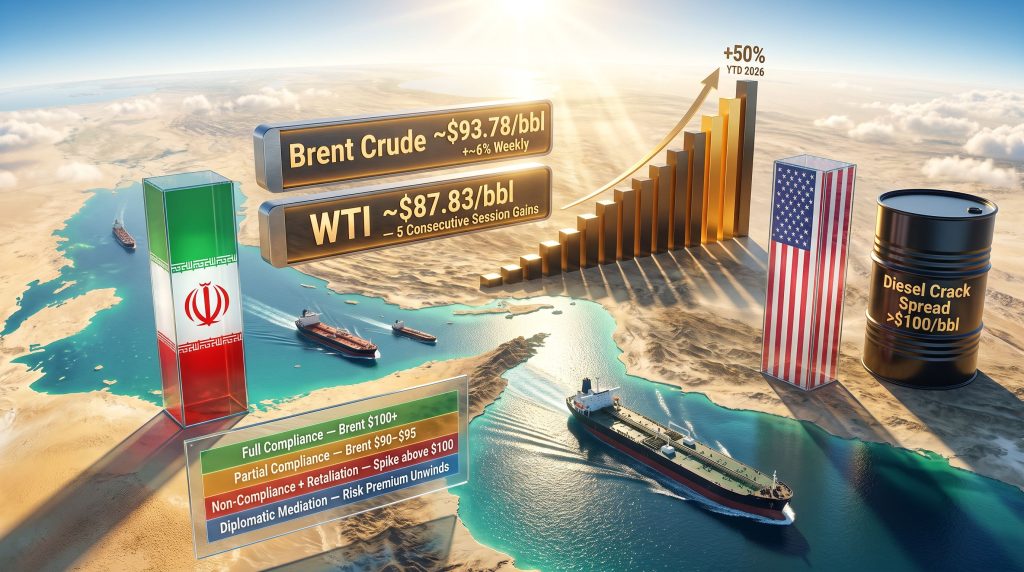
| Brent Crude | ~$93.78/bbl | +~6% weekly | Approaching $94 resistance |
| West Texas Intermediate | ~$87.83/bbl | 5 consecutive session gains | Multi-month high |
| Diesel Crack Spread | >$100/bbl | Record high | Unprecedented margin level |
| U.S. Retail Diesel | >$5.55/gallon | Highest since late May | Significant consumer pressure |
Crude oil has appreciated more than 50% year-to-date in 2026, with the primary catalyst being the sustained disruption of Middle Eastern energy export corridors following the outbreak of direct U.S.-Iran hostilities. Brent's approximately 6% weekly gain and WTI's five consecutive sessions of positive closes reflect genuine market anxiety about export capacity from one of the world's most strategically located producing regions.
Brent crude is approaching $94 per barrel while WTI trades near $87.83, representing a year-to-date rally exceeding 50% driven by Middle East supply disruptions, Strait of Hormuz control disputes, and escalating U.S. economic pressure measures targeting Iran's financial and energy infrastructure.
Secondary contributors to the rally include Russian supply constraints stemming from Ukrainian military strikes on refinery and port infrastructure, which have disproportionately tightened global diesel availability. A weakening U.S. dollar has provided an additional macroeconomic tailwind, since dollar-denominated commodities become more accessible to foreign buyers when the greenback loses relative value. On the week in question, the dollar was tracking toward its lowest weekly close since May, reinforcing the commodity price support from both supply-side and currency-side mechanics simultaneously.
The Sanctions Credibility Problem: Why Decades of Precedent Complicate the Market Narrative
One of the most analytically significant tensions in the current oil market concerns the actual incremental effectiveness of additional pressure measures against a target that has already adapted to maximum financial isolation. Arne Lohmann Rasmussen, chief analyst at AS Global Risk Management, has articulated the prevailing market scepticism: the dominant trading narrative is that Iran has endured sanctions pressure for approximately five decades without capitulating, and that new measures will primarily serve to extend the crisis timeline rather than resolve it.
This perspective carries substantial historical weight. Iran has developed sophisticated mechanisms for continuing crude exports under restrictive conditions:
- Shadow fleet operations involving vessels with obscured ownership structures and disabled transponders
- Crude transfers conducted at sea between vessels, bypassing port-based inspection and documentation
- Routing exports through intermediary jurisdictions that maintain trade relationships with both Iran and Western markets
- Payment systems operating outside the SWIFT financial messaging network
- Discounted pricing arrangements that make Iranian crude attractive to buyers willing to accept compliance risk
The market is therefore pricing not a near-term resolution scenario but rather prolonged conflict duration. This has meaningful implications for how risk premiums are structured into forward prices and how volatility surfaces across the crude options market. Consequently, understanding the geopolitical oil price factors at play becomes essential for any serious market participant.
China's Position: The Variable That Determines Everything
No single geopolitical factor carries more weight for the oil price outlook than how Beijing chooses to respond to U.S. secondary sanctions targeting Iranian crude trade. China is by a considerable margin the largest importer of Iranian crude oil, and its continued purchasing activity has been a primary mechanism allowing Tehran to sustain export revenues despite the existing sanctions architecture.
Beijing's public position has been consistent: unilateral sanctions are ineffective and the situation requires a negotiated diplomatic resolution. U.S. Treasury Secretary Scott Bessent has noted China's significant dependence on Middle Eastern energy flows and framed alignment with U.S. pressure as serving China's own economic interests. The argument is that supply disruptions harming the broader Middle East harm China as much as anyone.
The counterargument is equally powerful. Josh Lipsky, vice president of international economics at the Atlantic Council, has observed that it is genuinely unclear how Washington can meaningfully tighten Iran's financial isolation without generating substantial economic blowback from China, given the scale of commercial entanglement between the two nations. Indeed, the trade war impact on oil markets has made this bilateral tension a defining feature of the current price environment.
The scenario matrix below maps how China's response shapes the probable oil price trajectory:
| Scenario | China's Response | Likely Oil Price Impact |
|---|---|---|
| Full Compliance | Halts Iranian crude imports entirely | Brent could push toward $100+ as supply collapses |
| Partial Compliance | Reduces but maintains some Iranian trade | Moderate sustained premium; Brent holds $90–$95 range |
| Non-Compliance and Retaliation | Defies sanctions; escalates trade conflict | High volatility; potential spike above $100 then reversal |
| Diplomatic Mediation | China brokers Iran-U.S. talks | Sharp risk premium unwind; significant price pullback |
Reading Tehran's Internal Debate: Diplomatic Signals and Their Market Impact
A nuanced element of the current situation is the visible internal debate within Iranian leadership about how to navigate the conflict's trajectory. Iranian President Masoud Pezeshkian has publicly articulated a position favouring conflict resolution from what he characterises as a position of strength and national dignity. These statements represent a moderate faction within the Iranian political structure that views continued military and economic confrontation as unsustainable over the medium term.
Markets responded to these diplomatic signals with a brief retreat from session highs, illustrating an important structural feature of the current price environment: traders are actively balancing conflict escalation risk against resolution probability in real time. This dual-scenario pricing creates distinctive market behaviour.
The asymmetric price response dynamic is particularly important for market participants to understand:
- Escalation events produce sharp, immediate price spikes as supply-risk repricing occurs rapidly and with high conviction
- De-escalation signals produce more gradual, measured price retreats because markets require verification of diplomatic durability before unwinding risk premiums
- This asymmetry suggests the downside risk to prices upon genuine resolution may be structurally underpriced relative to the upside risk embedded in further escalation scenarios
The next major ASX story will hit our subscribers first
Diesel Markets and the Russia Dimension: Compounding Pressures Beyond Iran
The oil price environment would be significantly elevated even without the Iran narrative, because of what is occurring in refined product markets. Ukrainian military operations targeting Russian refinery and port infrastructure have created meaningful supply-side constraints specifically in middle distillate production. The consequence has been extraordinary: the diesel crack spread has surpassed $100 per barrel to reach a record level.
This figure deserves context. Crack spreads at this level indicate that refiners are capturing historically unprecedented margins from converting crude into diesel, which simultaneously signals severe physical tightness in middle distillate markets. The downstream transmission of this tightness is visible at the consumer level, with U.S. average retail diesel prices exceeding $5.55 per gallon according to American Automobile Association data, the highest reading since late May.
The implications extend across multiple sectors:
- Transportation and freight logistics operators face significant input cost increases with limited ability to immediately offset them
- Agricultural operations dependent on diesel-powered equipment experience compounding seasonal cost pressure
- Industrial and manufacturing sectors with energy-intensive processes see margin compression from elevated fuel costs
- Inflationary pass-through across supply chains becomes increasingly difficult for central banks to characterise as transitory
What This Means for Energy Investors and Market Participants
The sustained 50%+ crude rally has materially transformed the financial landscape for integrated energy producers, whose cash flow generation at current price levels significantly exceeds planning assumptions constructed in lower-price environments. Refining operations are experiencing exceptional profitability windows driven by record crack spreads, though this profitability is contingent on the continued physical tightness that could reverse sharply upon any genuine diplomatic breakthrough.
Furthermore, OPEC's market influence remains a critical background variable, as the group's production decisions could either amplify or partially offset the supply pressures generated by the Iran crisis. For investors attempting to position around this environment, several considerations are worth examining:
- Geopolitical risk premiums embedded in current prices introduce substantial volatility for any position built on a conflict resolution thesis
- The asymmetric price response dynamic means short volatility strategies in crude carry elevated tail risk
- Dollar weakness providing additional commodity support could reverse independently of geopolitical developments, creating a separate source of price sensitivity
- Downstream refining equities may offer differentiated exposure to the diesel margin environment compared to pure upstream producers
As reported by the New York Times, the broader impact on stocks, gas prices, and consumer sentiment underscores how deeply the Iran situation has penetrated the wider economic conversation.
Disclaimer: This article is intended for informational purposes only and does not constitute financial or investment advice. Commodity markets are subject to significant volatility, and all investment decisions should be made in consultation with a qualified financial professional.
FAQ: Understanding Oil Prices, Iran Sanctions, and the Strait of Hormuz
Why do oil prices rise on new Iran economic measures?
When new pressure measures raise the credible prospect of reduced Iranian crude reaching global markets, oil prices rise to reflect increased scarcity risk. The market prices in supply disruption probability even before any physical reduction in exports is confirmed.
How significant is Iran as an oil producer?
Iran is a material OPEC producer. Any meaningful reduction in its export capacity, whether through sanctions enforcement, naval restrictions, or infrastructure damage, removes supply from an already constrained global market. Iran's position as a significant producer means even partial export disruptions carry measurable price implications.
Why is the Strait of Hormuz so important to global oil prices?
Approximately one-fifth of the world's daily oil supply transits this narrow waterway. Any credible threat to navigational freedom through the strait, whether from military action, vessel attacks, or jurisdictional disputes, immediately elevates supply risk premiums across global crude benchmarks.
Could Brent crude reach $100 per barrel?
With Brent already approaching $94, five consecutive WTI session gains recorded, record diesel crack spreads, and Russian supply disruptions adding further tightness, a move toward $100 per barrel represents a plausible near-term outcome if diplomatic progress fails to materialise. Multiple supply-side risk factors are active simultaneously, providing structural support for elevated prices.
How does China's Iran relationship affect global oil prices?
Because China purchases Iranian crude in volumes that dwarf any other single buyer, Beijing's response to U.S. secondary sanctions pressure is the most consequential variable in the current price outlook. If secondary sanctions successfully pressure China to reduce purchases, significant Iranian export volumes could be removed from global markets, tightening supply further. The outcome of this standoff will likely determine whether oil prices rise on new Iran economic measures continue their current trajectory or begin to moderate.
Want To Identify The Next Major Commodity Discovery Before The Market Moves?
The geopolitical forces reshaping global energy markets underscore how quickly commodity dynamics can shift — and how critical it is to act on significant opportunities the moment they emerge. Discovery Alert's proprietary Discovery IQ model delivers real-time alerts on major ASX mineral discoveries across more than 30 commodities, ensuring subscribers are positioned ahead of the broader market — explore the historic returns major discoveries have generated and begin your 14-day free trial today.