August 21, 2026
The Hidden Mineral Wealth Buried Inside America's Most Contaminated Land
Beneath the surface of more than 1,300 federally designated Superfund sites across the United States lies a largely unacknowledged resource — millions of tonnes of mine waste containing metals and minerals that modern industry increasingly cannot do without. Tailings ponds, chat piles, slag heaps, and acidic drainage streams were once considered purely a liability, a toxic inheritance from a century of industrial mining. Today, a combination of technological progress, shifting supply chain priorities, and structured federal assessment programmes is forcing a fundamental reappraisal of what that waste is actually worth.
Mineral recovery at Superfund sites sits at a unique crossroads between environmental obligation and economic opportunity. Understanding why this matters requires appreciating both the scale of what has been left behind and the growing urgency around domestic critical minerals demand, particularly as the critical minerals demand tied to the energy transition continues to intensify.
When big ASX news breaks, our subscribers know first
Understanding the Feedstock: What Mine Waste Actually Contains
Not all mine waste is created equal. The five primary feedstock categories relevant to mineral recovery at Superfund sites each carry distinct recovery characteristics, processing requirements, and target mineral profiles.
| Waste Type | Description | Recovery Potential |
|---|---|---|
| Tailings | Fine-grained residue from ore processing | REEs, cobalt, lithium, copper |
| Waste Rock | Low-grade material removed during mining | Gold, zinc, uranium |
| Chat | Coarse mill waste from lead-zinc operations | Zinc, germanium, REEs |
| Slag | Smelter byproduct | Copper, nickel, antimony |
| Mining-Influenced Water (MIW) | Acid mine drainage and leachate | Cobalt, nickel, copper, REEs |
One detail that receives insufficient attention in mainstream coverage is the particular significance of mining-influenced water (MIW) as a mineral source. Acid mine drainage does not simply transport contamination — in highly acidic systems, it concentrates dissolved metals to levels that may approach or exceed economically recoverable grades.
At sites like Iron Mountain Mine near Redding, California, drainage acidity is so extreme that dissolved metal concentrations are measured in the grams-per-litre range rather than milligrams. This characteristic fundamentally changes the recovery economics compared to lower-grade conventional sources.
The minerals most commonly targeted across these feedstock categories include:
- Cobalt, nickel, and copper from historical tailings at legacy hardrock operations
- Zinc, germanium, and rare earth elements from chat and fine tailings
- Antimony, graphite, and lithium from select mineral processing residues
- Uranium from mining-influenced water at legacy uranium sites
- Gold from low-grade waste rock at historic gold mining operations
Germanium deserves particular mention. It is a byproduct metal almost exclusively recovered from zinc smelting operations, meaning that zinc-rich chat piles — such as those at the Tar Creek Superfund Site in Oklahoma — represent one of the few domestic contexts where germanium could realistically be recovered as a co-product. Given germanium's critical role in semiconductor manufacturing and defence-grade fibre optics, this positions certain Superfund waste streams as strategically significant beyond their face value. Furthermore, antimony's strategic importance in flame retardants and energy storage adds another compelling dimension to slag-based recovery streams.
How EMRTAI Works: The Public-Private Framework Assessing Recovery Technologies
The Environmental Monitoring and Remediation Technology Assessment Initiative (EMRTAI) is a public-private partnership funded and administered by the US Environmental Protection Agency. Its operational purpose is to formally evaluate technologies capable of extracting critical minerals from solid mine wastes and mining-influenced waters at legacy hardrock mine and mineral processing Superfund sites.
This is not a grant programme or a permitting pathway. EMRTAI functions as a structured technology assessment framework, selecting private-sector companies through a competitive process and subjecting their technologies to rigorous bench-scale and pilot-scale evaluation. The significance of this distinction is often missed: EMRTAI does not guarantee commercialisation or regulatory approval for recovery activities. It generates validated performance data that can inform future cleanup planning, policy development, and private investment decisions.
EMRTAI's core operational sequence:
- Private sector companies submit candidate technologies for consideration
- EPA selects technologies for formal assessment based on technical merit and relevance to Superfund waste streams
- Bench-scale testing evaluates recovery performance across multiple waste type categories
- Pilot-scale assessment validates results at larger processing volumes
- Findings are published to inform EPA remediation planning and broader industry awareness
The types of technologies under assessment span a wide methodological range:
- Beneficiation technologies using gravity separation, flotation, and magnetic methods to concentrate mineral-bearing fractions
- Chemical leaching systems applying solvent-based extraction to dissolve target metals from solid matrices
- Electrowinning and electrochemical recovery using electrical deposition to capture dissolved metals from MIW streams
- Cementation processes precipitating metals directly from acidic drainage
- Vitrification applying high-temperature treatment to immobilise and concentrate metal-bearing materials
- Advanced separation technologies including ion exchange, solvent extraction, and membrane filtration for REE and trace metal isolation
The Interagency Dimension: EPA, DOE, and DOI
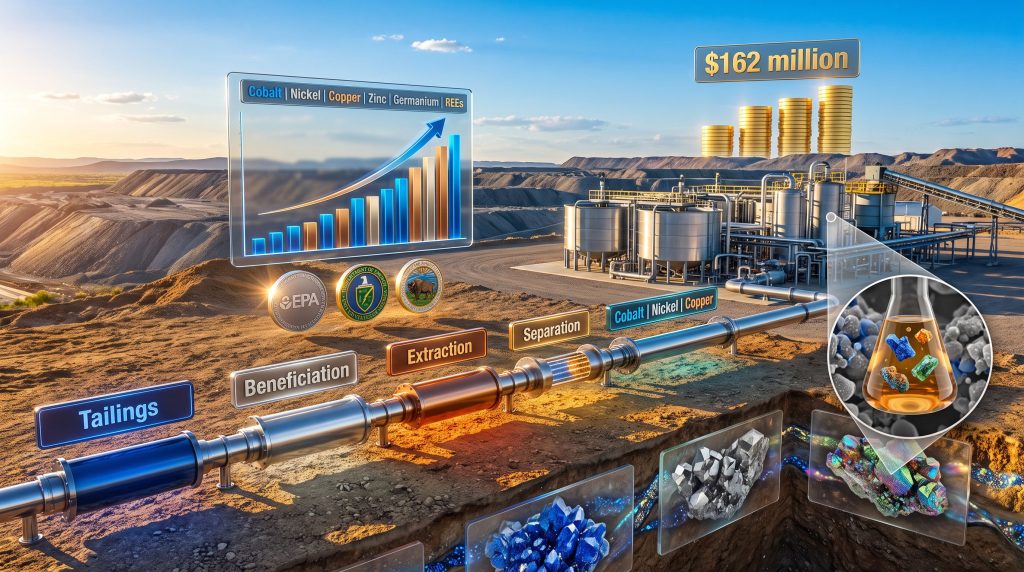
EMRTAI operates within a broader interagency context. The Department of Energy (DOE) and Department of the Interior (DOI) are active collaborators in evaluating recovery technologies and assessing the economic viability of treating legacy mine waste as a domestic mineral source. The DOE's separate commitment of $162 million toward domestic mineral processing projects signals the depth of federal interest in alternative sourcing strategies, though this funding is distinct from EMRTAI and targets different project categories.
This interagency alignment matters because it reflects a structural shift in how federal agencies conceptualise Superfund remediation — not purely as a cleanup obligation, but as a potential input to supply chain strategy. Whether that framing translates into meaningful regulatory flexibility remains to be seen.
The Treatment Train Model: Sequential Value Creation from Waste
Practitioners working in this space use the term treatment train to describe the sequential processing architecture that takes mine waste from raw feedstock to commercially recoverable mineral product. The model is significant because it is designed to integrate with — rather than replace — the primary environmental remedy at any given Superfund site. In addition, approaches such as urban mining of anthropogenic stocks share similar process logic, highlighting how secondary resource recovery is gaining traction across multiple sectors.
The Treatment Train Process:
- Site Characterisation — Geochemical sampling and analytical testing to quantify mineral concentrations across waste stream types
- Waste Classification — Categorising feedstocks by type and target mineral profile to determine appropriate processing pathways
- Beneficiation — Physical concentration of mineral-bearing fractions using gravity, flotation, or magnetic separation
- Extraction — Chemical or biological leaching to dissolve target metals from the concentrated feed material
- Separation and Purification — Solvent extraction, ion exchange, or precipitation to isolate individual mineral streams
- Alloying or Refining — Conversion of recovered metals into commercially saleable product forms
- Residual Waste Management — Responsible handling or further treatment of post-recovery residual materials
Important: The treatment train model is structured so that mineral recovery supplements rather than replaces the primary environmental remedy. Cleanup obligations remain the governing priority at all Superfund sites, and any recovery activity must be demonstrably consistent with the selected remediation approach.
How Recovery Can Offset Cleanup Costs
The economic logic underpinning federal interest in recovery is straightforward. When metals extracted from a contaminated site generate revenue, those proceeds can be directed toward funding remediation — reducing the financial exposure of responsible parties, federal agencies, and ultimately taxpayers. This cost-offset mechanism operates through several channels:
- Revenue from cobalt, nickel, or copper sales applied directly to site remediation budgets
- Reduced long-term monitoring expenditure where active extraction lowers total contaminant mass in place
- Accelerated site closure timelines where mineral recovery removes contaminated material more efficiently than passive treatment
The scale of any individual cost offset depends heavily on mineral concentrations, processing economics, and market pricing at the time of recovery — all of which carry considerable uncertainty across a project's lifecycle.
Real-World Examples: Where Mineral Recovery at Superfund Sites Is Already Operational
Madison County Mines, Missouri: Cobalt, Nickel, and Copper Recovery
The Madison County Mines Superfund Site in Missouri represents the most operationally advanced domestic example of mineral recovery integrated with Superfund remediation. According to the EPA's critical mineral recovery programme, a dedicated tailings reprocessing facility was constructed on-site to recover cobalt, nickel, and copper from historical tailings deposits, demonstrating that commercial-scale extraction from legacy mine waste is achievable rather than theoretical.
Engineering firm Worley has been engaged to support construction of the processing facility at this site — a detail that signals the project's seriousness and the involvement of major industrial infrastructure expertise. Cobalt's designation as a federally critical mineral, driven primarily by its role in lithium-ion battery cathode chemistry, elevates the strategic significance of this particular recovery effort beyond its immediate financial metrics.
Tar Creek, Oklahoma: Zinc, Germanium, and REE Potential
The Tar Creek Superfund Site is one of the most extensively documented contaminated sites in the country, and its chat piles represent one of the more compelling cases for mine waste mineral recovery in the United States. Millions of tonnes of coarse mill waste from historical lead-zinc operations contain documented concentrations of zinc, germanium, and rare earth elements.
The germanium angle is particularly noteworthy from a supply chain perspective. Global germanium supply is heavily concentrated in China, which accounts for the majority of refined production. Domestic recovery from chat piles at sites like Tar Creek could, at scale, represent a meaningful contribution to reducing that import dependency — though processing economics and waste heterogeneity remain significant technical hurdles. Furthermore, the broader implications for rare earth supply chains make this site of considerable strategic interest to policymakers.
Iron Mountain Mine, California: Extreme Acid Drainage as a Recovery Feedstock
Iron Mountain Mine near Redding, California is notable within the Superfund programme for generating some of the most acidic mine drainage ever recorded anywhere in the world — with pH values measured in the negative range under certain conditions. This extreme chemistry, while representing a severe environmental hazard, simultaneously concentrates dissolved metals to levels that may support commercial recovery from the drainage stream itself.
Electrowinning and cementation are the most applicable recovery technologies in this context, using the drainage's high dissolved metal content as a direct processing input rather than requiring additional leaching steps. Consequently, the in-situ leaching benefits explored in adjacent research also offer relevant technical parallels for sites where in-place dissolution of target metals is feasible.
What USGS Data Tells Us About the Scale of the Opportunity
The US Geological Survey has formally characterised mine waste sites as a dual-use asset class — simultaneously an environmental liability and a potential nontraditional source of critical minerals. As noted in recent USGS research publications, this framing has been influential in shaping federal policy, providing analytical grounding for EMRTAI and related programmes.
Demand dynamics driving interest in Superfund mineral recovery:
| Critical Mineral | Primary Application | Key Demand Driver |
|---|---|---|
| Cobalt | EV batteries, aerospace alloys | Electric vehicle adoption |
| Nickel | Battery cathodes, stainless steel | Energy storage expansion |
| Copper | Electrical infrastructure, EVs | Grid modernisation |
| Germanium | Semiconductors, fibre optics | Defence and technology sectors |
| REEs | Magnets, electronics, defence | Clean energy transition |
| Antimony | Flame retardants, batteries | Energy storage growth |
A point rarely discussed in mainstream analysis is that the economic viability of Superfund mineral recovery is inherently cyclical. When prices for cobalt or rare earth elements are elevated, marginal waste streams become economically attractive. When prices fall, the same streams may not justify processing costs. This commodity price sensitivity means that EMRTAI's technology validation work is particularly valuable — by establishing what is technically achievable at bench and pilot scale, it allows industry to make more informed decisions about when market conditions justify deployment.
The next major ASX story will hit our subscribers first
Regulatory Architecture: How CERCLA Shapes Recovery Activity
The Comprehensive Environmental Response, Compensation, and Liability Act (CERCLA) was not drafted with mineral recovery in mind, yet it governs all activity at Superfund sites. EPA has developed interpretive frameworks that permit recovery activities to proceed provided they are consistent with the selected cleanup remedy.
Key regulatory constraints any recovery operator must navigate:
- Recovery activities must not interfere with or compromise the primary cleanup remedy
- Responsible parties must obtain appropriate EPA approvals before conducting recovery operations
- Revenue generated from mineral recovery may be subject to cost recovery provisions under CERCLA
- Environmental monitoring obligations continue throughout any recovery operation, regardless of commercial activity
EPA guidance on Superfund reuse has specifically identified applicable recovery methods for metal-bearing soils, sludges, and sediments, including chemical leaching for copper, zinc, and gold; electrowinning for metals from acidic drainage; cementation for precipitating dissolved metals from MIW; and vitrification for high-temperature concentration of metal-bearing residues.
The regulatory complexity is not trivial. A private technology company seeking to assess or deploy recovery equipment at a Superfund site must navigate CERCLA liability provisions, state environmental requirements, EPA site-specific agreements, and potentially multiple responsible party arrangements simultaneously. This compliance burden is one reason the EMRTAI public-private structure has value — it provides a formal institutional pathway that otherwise does not exist.
Scaling Challenges and Technical Barriers to Commercial Recovery
Despite compelling site-level examples and growing federal interest, mineral recovery at Superfund sites faces structural challenges that temper short-term expectations:
- Waste heterogeneity is the most persistent technical obstacle. Unlike primary ore deposits, mine waste streams vary significantly in mineral concentration, particle size distribution, and contaminant profile across short spatial distances, complicating the development of standardised processing approaches.
- Pre-treatment requirements at heavily contaminated sites may add significant cost and complexity before any mineral recovery stream becomes viable.
- Permitting and chain-of-custody complexity creates project timelines that are difficult to reconcile with commodity market windows.
- Low-grade concentration risk remains real at sites where target mineral grades in waste streams fall below economically justifiable processing thresholds under current technology costs.
A critical but underappreciated reality in this space is that the treatment train concept works most cleanly on paper. In the field, waste characterisation at legacy sites is frequently incomplete, and geochemical surprises during processing can fundamentally alter projected recovery rates and economics. Thorough pre-feasibility sampling is not optional — it is the foundation on which any credible recovery business case must rest.
Frequently Asked Questions: Mineral Recovery at Superfund Sites
What is mineral recovery at Superfund sites?
Mineral recovery at Superfund sites refers to the identification and extraction of valuable metals and minerals from mine waste materials, conducted during or alongside an active environmental cleanup. Target minerals include cobalt, nickel, copper, zinc, germanium, and rare earth elements drawn from tailings, waste rock, chat, slag, and mining-influenced water.
Does mineral recovery replace Superfund cleanup?
No. Recovery is designed to supplement the primary environmental remedy, not replace it. EPA requires any recovery activity to be fully consistent with and supportive of the selected cleanup approach, with environmental protection remaining the governing obligation.
What is EMRTAI?
EMRTAI is the Environmental Monitoring and Remediation Technology Assessment Initiative, a public-private partnership funded by the EPA that formally evaluates technologies capable of recovering critical minerals from solid wastes and mining-influenced waters at legacy hardrock mine and mineral processing Superfund sites.
Can mineral recovery offset the cost of Superfund cleanup?
In principle, yes. Revenue from recovered minerals can be applied toward remediation costs, reducing financial burdens on responsible parties and federal agencies. This cost-offset dynamic is a central rationale for EPA's investment in EMRTAI, though actual offsets depend on processing economics, mineral prices, and site-specific conditions.
Which minerals are most commonly targeted?
The most frequently targeted minerals include cobalt, nickel, copper, zinc, germanium, rare earth elements, antimony, gold, lithium, graphite, and uranium, with the specific profile varying by site based on legacy operations and waste stream composition.
The Strategic Outlook: Redefining Legacy Waste as Domestic Supply
The convergence of critical mineral demand growth, federally mandated cleanup obligations, and advancing extraction technology is gradually shifting the analytical frame around America's legacy mine waste inventory. What was once categorised exclusively as an environmental liability is increasingly being evaluated through the parallel lens of resource opportunity.
Whether EMRTAI's technology assessments translate into commercially operational recovery programmes at scale will depend on several variables that remain unresolved: commodity price trajectories, technology cost reduction curves, regulatory evolution under CERCLA, and the willingness of private capital to accept the unique risk profile that Superfund recovery projects carry.
What is already clear is that the federal investment in structured technology assessment — combined with real-world operational examples at sites including Madison County Mines and ongoing research interest at Tar Creek and Iron Mountain — is building an evidence base that did not previously exist. That evidence base is the necessary precondition for any serious scaling of mineral recovery at Superfund sites across the US.
Readers seeking further context on US Superfund remediation programmes and critical mineral policy frameworks may find value in reviewing publicly available resources from the US Environmental Protection Agency's Superfund programme pages and the US Geological Survey's critical minerals research publications. This article contains forward-looking assessments regarding recovery economics, technology performance, and policy outcomes. These involve inherent uncertainty and should not be interpreted as financial or investment advice.
Want to Track ASX Mineral Discoveries With Real Strategic Significance?
Discovery Alert's proprietary Discovery IQ model delivers real-time alerts on significant ASX mineral discoveries — including those tied to critical minerals driving the energy transition — instantly translating complex data into actionable investment insights for traders and long-term investors alike. Explore Discovery Alert's dedicated discoveries page to understand how historic mineral discoveries have generated substantial returns, and begin your 14-day free trial today to position yourself ahead of the broader market.