August 21, 2026
Physical Aluminium Pricing in a Carbon-Constrained World
Europe's aluminium extrusion industry operates at the intersection of global commodity markets, regional logistics networks, and increasingly complex environmental regulation. For procurement teams, traders, and risk managers sourcing AA6063 extrusion billet into the Iberian Peninsula, the ability to reference an independent, structured price benchmark is not merely a convenience — it is a commercial necessity. The aluminium 6063 extrusion billet premium DDP Spain assessment, identified by the code MB-AL-0299, serves precisely this function, and its recent upgrade to weekly publication frequency signals a meaningful evolution in how the Spanish market is perceived by the broader European aluminium trading community.
When big ASX news breaks, our subscribers know first
What the MB-AL-0299 Benchmark Actually Measures
Specification Scope and Parameter Overview
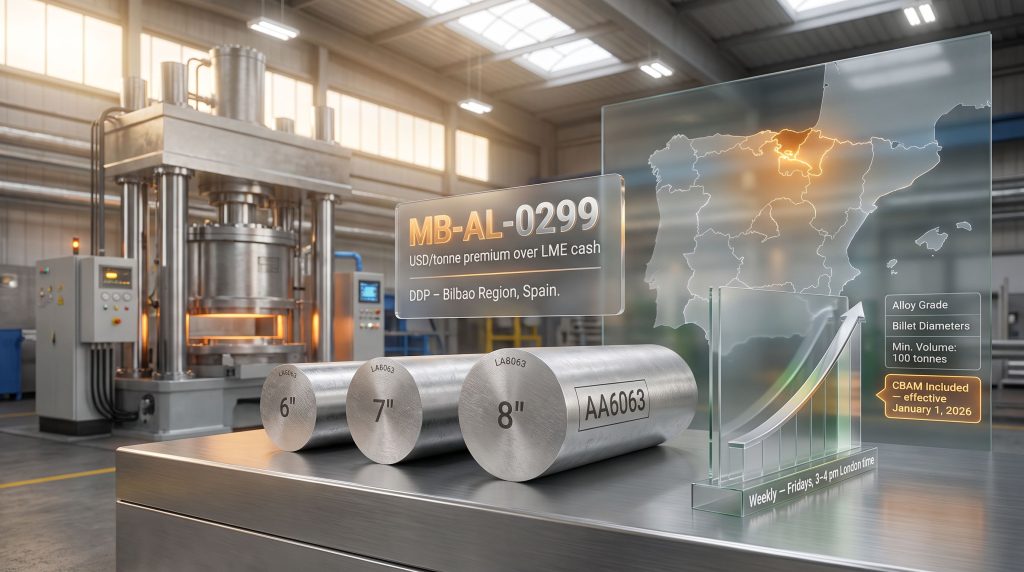
Before examining how this assessment functions within real supply chains, it helps to understand exactly what it captures. The benchmark is designed around a tightly defined set of commercial parameters that reflect genuine market practice rather than theoretical ideals.
| Parameter | Specification |
|---|---|
| Alloy Grade | AA6063 extrusion billet |
| Billet Diameters | 6 inch, 7 inch, 8 inch |
| Minimum Volume | 100 tonnes |
| Delivery Basis | DDP, Bilbao region, Spain |
| Price Basis | USD/tonne premium over LME cash |
| Forward Window | Within 3 months |
| Payment Terms | 60 days (other terms normalised) |
| Publication Frequency | Weekly, Fridays, 3:00–4:00 pm London time |
| CBAM Inclusion | Yes, effective January 1, 2026 |
Each parameter serves a deliberate purpose. The 100-tonne minimum reflects the practical lower bound of a commercially meaningful spot transaction in the Spanish billet market, filtering out micro-lots that would distort the price signal. The 60-day payment term standard ensures that financing costs embedded in different transaction structures do not create artificial premium disparities across reported deals. The three-month forward window captures near-term physical delivery rather than speculative future pricing.
Why Bilbao Is the Benchmark Delivery Hub
The selection of the Bilbao region as the designated delivery point is not arbitrary. Located in Spain's Basque Country, Bilbao hosts one of the most capable port and industrial logistics networks on the Iberian Peninsula. Its geographic positioning gives it natural access to both Spanish and southern French extrusion markets, while its established metals trading infrastructure makes it a genuinely representative reference point for the broader regional billet market. Assessments tied to operationally active delivery hubs carry greater market credibility than those linked to nominal or underutilised locations. You can review the aluminium 6063 extrusion billet premium DDP Spain commodity price directly via Fastmarkets for current benchmark data.
Understanding DDP: Why the Incoterm Defines the Premium's Meaning
The Full-Cost Price Signal
The DDP (Delivered Duty Paid) incoterm is the most comprehensive of the standard trade terms, placing maximum responsibility on the seller. Under DDP, the quoted price absorbs:
- Freight costs from origin to destination
- Marine or cargo insurance during transit
- Import customs clearance and associated documentation
- All applicable import duties and tariffs
- CBAM certificate costs (from January 1, 2026 onwards)
- Inland delivery to the named point within the Bilbao region
This contrasts sharply with CIF (Cost, Insurance and Freight) or FOB (Free on Board) assessments, where the buyer retains exposure to import duties, customs handling, and inland logistics costs. A DDP premium is therefore a more operationally complete cost signal — it tells a Spanish extruder precisely what they will pay to receive billet at their facility, without requiring additional landed-cost calculations.
The DDP structure effectively transfers the complexity of international logistics and customs management from buyer to seller, making it the preferred basis for procurement benchmarking in markets where buyers want cost certainty at the point of use.
Payment Normalisation and Its Commercial Logic
The specification anchors all assessed transactions to a 60-day payment baseline, with other terms normalised accordingly. This matters because payment terms represent an embedded financing cost. A seller accepting 90-day payment is effectively extending a 30-day credit facility to the buyer, which has a quantifiable cost at prevailing short-term interest rates. Without normalisation, premium comparisons across transactions with differing payment terms would produce misleading results. By standardising to 60 days — a common market practice in European aluminium trade — the benchmark preserves apples-to-apples comparability.
The Metallurgical Case for AA6063 as the Benchmark Alloy
Why 6063 Dominates European Extrusion Demand
AA6063 is a magnesium-silicon aluminium alloy whose chemistry is specifically optimised for the extrusion process. Its defining commercial advantages over alternative alloys include:
- Superior extrudability: Lower press force requirements and higher achievable extrusion speeds compared to higher-strength alloys like 6061
- Excellent surface quality: Anodises to a consistently high aesthetic standard, critical for architectural applications
- Good corrosion resistance: Performs reliably in outdoor and coastal environments without additional surface treatment
- Moderate strength-to-weight ratio: Adequate for structural profiles in construction and solar applications
These characteristics make AA6063 the default specification for architectural window and door profiles, curtain wall framing systems, solar panel mounting structures, automotive trim components, and consumer electronics enclosures. In European markets, where construction and infrastructure applications dominate extrusion demand, 6063 accounts for the majority of billet consumption by volume.
Billet Diameter and Press Compatibility
The benchmark covers 6-inch, 7-inch, and 8-inch diameter billets, which correspond directly to the most common press container sizes operating across European extrusion facilities. This is a technically important specification detail that non-specialists often overlook:
- 6-inch billets serve smaller, precision-oriented extrusion presses producing tight-tolerance profiles
- 7-inch billets represent the most widely deployed size across the European extrusion industry's mid-range production base
- 8-inch billets feed high-throughput presses producing large structural or architectural profiles
By encompassing all three diameters within a single assessment, MB-AL-0299 captures genuine market breadth. A benchmark restricted to a single diameter would reflect only a segment of the supply chain and potentially miss pricing dynamics specific to other press sizes.
LME Plus Premium: How the Two-Component Pricing Architecture Works
Separating the Global Signal from the Regional Reality
Physical aluminium is universally priced using a two-component structure. The first component is the LME aluminium cash price, which reflects global supply-demand fundamentals, energy input costs at major smelters, and financial market positioning. The second is the physical premium, which captures everything the LME cannot: regional logistics costs, local supply-demand imbalances, duty and regulatory costs, and spot availability.
The MB-AL-0299 premium is the second component, expressed in USD per tonne on top of LME cash. To illustrate the practical arithmetic:
| Component | Example Value |
|---|---|
| LME Aluminium Cash Price | $2,400/tonne |
| DDP Spain 6063 Billet Premium | $180/tonne |
| All-In Delivered Cost | $2,580/tonne |
The above figures are illustrative only and do not represent current market pricing. Aluminium prices fluctuate continuously based on market conditions.
Factors That Drive Premium Volatility
The DDP Spain premium is not static. Several structural and cyclical forces push it higher or lower relative to historical averages and other European delivery points:
- Import competition from Middle Eastern and Asian billet producers with cost-advantaged smelting capacity
- European casthouse operating costs, particularly natural gas and electricity prices that affect domestic billet production margins
- Spanish construction and infrastructure activity, which directly drives downstream extrusion demand from window, facade, and structural profile manufacturers
- CBAM certificate pricing, which varies with the EU Emissions Trading System (ETS) carbon price and the embedded carbon intensity of imported material
- LME warehouse positioning and aluminium warrant availability across European storage locations
- USD/EUR exchange rate movements, since the premium is denominated in USD while Spanish extruders typically operate in euros
Furthermore, the broader aluminium tariffs impact on global trade flows continues to shape regional premium dynamics across European delivery points.
CBAM Integration: A Structural Shift in European Aluminium Pricing
What CBAM Means for Aluminium Importers
The EU's Carbon Border Adjustment Mechanism represents one of the most consequential regulatory developments for aluminium trade flows into Europe in recent decades. The mechanism requires importers of carbon-intensive goods, including primary aluminium and extrusion billet, to purchase CBAM certificates corresponding to the embedded carbon emissions generated during production. The certificate cost is linked to the prevailing EU ETS carbon price, meaning it fluctuates alongside broader carbon market dynamics.
By embedding CBAM certificate costs directly into the MB-AL-0299 specification from January 1, 2026, the benchmark provides buyers with a true all-in cost signal rather than requiring separate regulatory cost estimation. This is a meaningful step forward in price transparency for a market where CBAM costs can represent a material portion of the physical premium. Understanding green transition raw materials policy is consequently becoming essential for aluminium procurement teams navigating these changes.
How Carbon Intensity Differentiates Supply Origins
A critical and often underappreciated dynamic within CBAM is that its cost impact varies dramatically depending on where and how the aluminium was produced. Smelters powered by hydroelectric energy generate substantially lower embedded carbon per tonne of aluminium than those relying on coal or gas-fired electricity grids. This creates a material cost differentiation at the point of import into the EU.
| Supply Origin | Typical Carbon Intensity | CBAM Cost Impact |
|---|---|---|
| Norway / Iceland (hydro-powered) | Very Low | Minimal certificate cost |
| Domestic EU production | ETS-covered | No CBAM obligation |
| North Africa (mixed grid) | Moderate | Moderate certificate cost |
| Middle East (gas-fired) | Moderate to High | Elevated certificate cost |
| Asia (coal-dominated grid) | High | Highest certificate cost |
Carbon intensity figures are indicative and vary by individual facility and production vintage. CBAM certificate costs are subject to EU ETS carbon price fluctuations and regulatory interpretation.
For Spanish extruders evaluating competing billet sources, CBAM effectively adds a carbon-adjusted cost layer that can shift the competitive ranking of supply origins in ways that pure freight or LME-premium comparisons would not reveal.
This dynamic introduces a new analytical dimension to billet procurement strategy. Sourcing decisions that previously turned primarily on freight economics and headline premium levels must now account for the embedded carbon cost of different origins — a calculation that favours hydroelectric-powered producers and domestically cast EU billet. In this context, low-carbon aluminium investment is attracting growing interest as European buyers seek to manage their CBAM exposure proactively.
The next major ASX story will hit our subscribers first
From Bi-Weekly to Weekly: What the Frequency Upgrade Signals
The Market Intelligence Case for Weekly Publication
The decision to increase MB-AL-0299's publication frequency from bi-weekly to weekly, effective August 21, 2026, followed a structured governance process. A formal proposal was published on July 16, 2026, initiating a one-month public consultation period. The formal decision was confirmed on August 13, 2026. While no written feedback was submitted during the official consultation window, informal engagement with market participants conducted prior to the formal proposal indicated broad support for enhanced price transparency. For further detail, Fastmarkets has published a dedicated methodology piece on the proposed frequency amendment for this assessment.
This pattern is common in commodity benchmark governance. Market participants frequently communicate preferences through direct engagement with the price reporting agency rather than formal written submissions, particularly where commercial sensitivity discourages public attribution of views.
The key drivers behind the frequency upgrade include:
- Sufficient transactional volume in the Spanish and broader Iberian billet spot market to support meaningful weekly price discovery
- Demand from extruders and traders for tighter price references that reduce the information gap between publication dates
- Alignment with the publication cadence of comparable European billet assessments, most of which already publish weekly
- Risk management requirements of market participants who use the benchmark as a reference in formula-priced contracts and hedging structures
In commodity markets, the frequency of an independent price assessment is a direct indicator of the market's transactional depth and participant confidence. Weekly publication for the aluminium 6063 extrusion billet premium DDP Spain signals that the Iberian market has reached a level of spot activity that warrants and sustains more granular price discovery.
How the DDP Spain Premium Fits Within the European Billet Benchmark Landscape
Regional Premium Differentials as Market Signals
The MB-AL-0299 assessment does not operate in isolation. It sits within a broader network of European physical aluminium billet assessments that collectively form a regional price map for the extrusion industry.
| Assessment Geography | Delivery Basis | Primary Demand Drivers |
|---|---|---|
| DDP Spain (Bilbao) | Duty-paid, delivered | Construction, solar, automotive trim |
| DDP Rotterdam | Duty-paid, delivered | Pan-European distribution and re-export |
| DDP North Germany | Duty-paid, delivered | Automotive, industrial profiles |
| DDP Italy | Duty-paid, delivered | Architectural, luxury goods sectors |
| FOB Middle East | Ex-works or port | Export-oriented smelting supply |
When the DDP Spain premium trades at a discount relative to Rotterdam, it typically reflects softer downstream demand from Iberian extruders, greater import availability in Spain, or competitive pressure from lower-cost origins with efficient logistics access to Bilbao. A premium above Rotterdam levels, by contrast, points to tighter local supply, stronger construction or solar sector pull, or disruptions limiting import availability into the Iberian market.
These inter-regional premium differentials function as real-time diagnostic signals for experienced traders and procurement analysts, offering insights into relative supply-demand balance across European sub-markets that aggregate LME pricing cannot provide. In addition, monitoring global steel market trends alongside aluminium premium movements can provide broader context on industrial metals demand across the continent.
How Market Participants Use MB-AL-0299 Operationally
Applications Across the Aluminium Value Chain
The weekly DDP Spain billet premium serves distinct but complementary functions for different categories of market participant:
For Extruders (Billet Buyers):
- Benchmarking spot purchase prices against an independent, third-party reference point
- Structuring formula-priced supply contracts where the purchase price is expressed as LME cash plus the published MB-AL-0299 premium
- Monitoring whether existing supplier pricing remains competitive against market consensus
For Billet Producers and Traders (Sellers):
- Calibrating offer levels to reflect current market conditions rather than bilateral negotiation dynamics alone
- Providing transparent pricing evidence to commercial counterparties in contract discussions
- Tracking regional demand signals through premium trend analysis over time
For Financial Market Participants:
- Informing basis trading strategies between LME futures positions and physical premium exposures
- Supporting risk management overlay construction for companies with aluminium price exposure in their cost base or revenue streams
Furthermore, initiatives such as aluminium operations repowering across major producers are reshaping the embedded carbon profiles of supply origins, which in turn affects how CBAM costs flow through into the premiums captured by benchmarks like MB-AL-0299.
What the 100-Tonne Minimum Threshold Reveals About Market Structure
The minimum transaction size of 100 tonnes embedded in the specification is a calibrated design choice rather than an arbitrary round number. It reflects the practical lower bound of a commercially representative spot transaction in the Spanish billet market. Transactions below this threshold tend to involve specialty buyers, small extruders, or atypical circumstances that would distort a benchmark designed to reflect mainstream market pricing. By excluding these micro-transactions while remaining accessible to a broad range of participants, the specification balances representativeness with practical market coverage.
Disclaimer: This article is intended for informational purposes only and does not constitute financial, investment, or procurement advice. Aluminium prices, premiums, and regulatory costs are subject to continuous market fluctuation. Readers should consult qualified market professionals and review current Fastmarkets methodology documentation before making commercial decisions based on benchmark price assessments.
Want to Stay Ahead of Major ASX Mineral Discoveries Before the Market Moves?
Discovery Alert's proprietary Discovery IQ model delivers real-time alerts on significant ASX mineral discoveries, transforming complex commodity data into actionable investment insights for traders and investors at every experience level — explore historic discoveries and their returns to understand the opportunity, then start your 14-day free trial at Discovery Alert to position yourself ahead of the market.