
August 21, 2026
The Hidden Fault Line Beneath India's Recycling Boom
Across the global metals industry, recycling has become the defining narrative of the decade. Governments, manufacturers, and investors have all pivoted toward circular economy frameworks, with secondary aluminium frequently cited as one of the most energy-efficient and commercially viable pathways to sustainable metal supply. Yet beneath this optimistic headline lies a structural contradiction that is now creating serious operational consequences for one of the world's fastest-growing recycling markets.
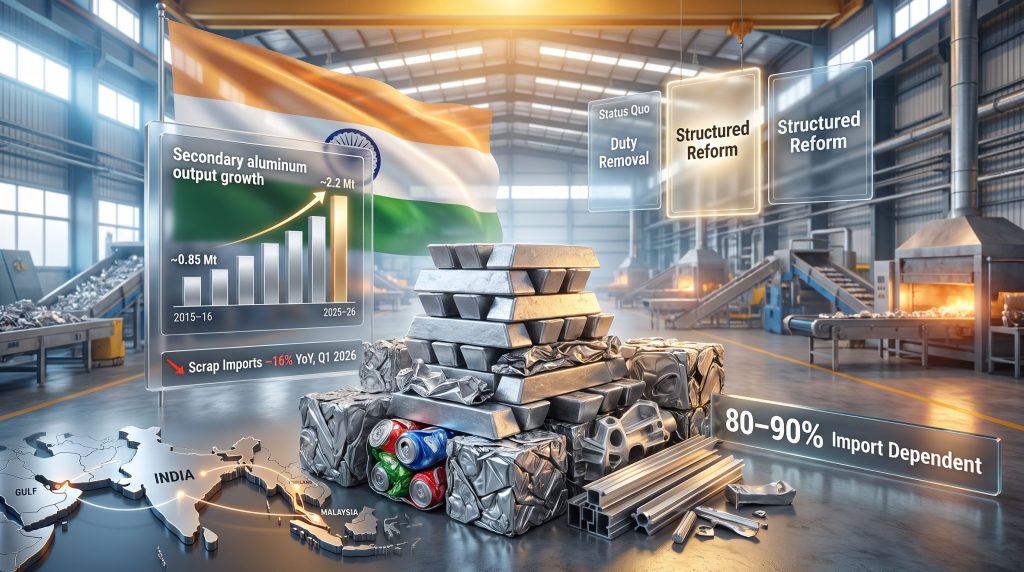
India's secondary aluminium sector expanded output from approximately 0.85 million tonnes in 2015-16 to nearly 2.2 million tonnes in 2025-26, according to industry estimates cited by the Material Recycling Association of India (MRAI). That represents growth of more than 150% in a single decade. The sector now accounts for roughly 35% of India's total aluminium consumption, a meaningful share by any measure. However, the raw material base feeding this expansion never kept pace. Today, 80-85% of all scrap feedstock consumed by Indian secondary producers comes from overseas, creating a dependency so deep that geopolitical tremors thousands of kilometres away can bring Indian recycling plants to a standstill.
This is the India aluminium scrap supply bottleneck in its full structural form, and 2026 has made its consequences impossible to ignore.
When big ASX news breaks, our subscribers know first
Why Domestic Scrap Generation Cannot Fill the Gap
Understanding the root cause of India's import dependency requires looking beyond the recycling sector itself and examining the consumption patterns of previous decades. Aluminium scrap is a downstream product of historical consumption. Vehicles, building materials, electrical goods, and packaging only return to the scrap stream when they reach the end of their useful lives, typically after 10 to 30 years depending on the application.
India's historical per-capita aluminium consumption has sat at approximately 3.3 kilograms per person annually, compared to a global average of roughly 16 kilograms per person. This five-fold gap means that India simply has far fewer aluminium-containing products nearing end-of-life at any given time. Furthermore, the arithmetic is straightforward but its consequences are severe: domestic scrap currently meets only 15-20% of secondary producers' raw material requirements, according to MRAI industry estimates.
| Metric | India | Global Average |
|---|---|---|
| Per-capita aluminium consumption (kg) | ~3.3 | ~16 |
| Domestic scrap coverage of secondary needs | 15-20% | Varies by market |
| Secondary aluminium share of national consumption | ~35% | ~35-40% |
| Import dependency for scrap feedstock | 80-85% | Much lower in mature markets |
The structural implication is significant. Even as India's current consumption rises rapidly, driven by automotive growth, infrastructure investment, and packaging expansion, the scrap that this consumption will eventually generate won't enter the recycling stream in meaningful volumes until the mid-2030s at the earliest. Collection infrastructure, sorting technology, and formalised recovery systems all need to develop in parallel, and none of these can be fast-tracked by market forces alone.
The Lag Problem: Why Capacity Growth Outran Raw Material Development
One of the less commonly discussed dynamics in secondary metals markets is the asymmetry between capacity investment timelines and feedstock development timelines. Building a secondary aluminium smelter or casting facility can take two to four years from decision to commissioning. In contrast, building the upstream scrap collection, sorting, and aggregation network required to feed that facility at scale can take 15 to 20 years, particularly in markets where informal sector collection dominates and organised recovery infrastructure is underdeveloped.
India's recycling sector made the investment decision without waiting for the feedstock base to mature. The result is processing capacity that significantly outstrips domestic raw material availability, a gap that can only be bridged through imports. This is not a failure of market logic at the individual firm level. Each facility made a commercially rational decision. However, the aggregate outcome is a sector with a systemic structural vulnerability built into its foundation.
Three Converging Forces Behind the 2026 Supply Crunch
The India aluminium scrap supply bottleneck reached acute levels in 2026 due to the simultaneous convergence of three distinct pressures, each of which would have been manageable in isolation but became compounding when combined.
Force 1: Gulf Export Restrictions
The Gulf region accounts for approximately 20% of India's total aluminium scrap imports. Both the UAE and Saudi Arabia have introduced export restrictions or taxes on recyclable materials in recent years, reducing outbound scrap volumes from a corridor that Indian recyclers had come to rely on. The motivations behind these measures are partly domestic, as Gulf nations seek to develop their own secondary metal processing industries, and partly revenue-driven. The effect on Indian importers has been a meaningful reduction in available supply from a geographically convenient sourcing region. Consequently, Indian aluminium recyclers have been urged to prioritise supply security amid these ongoing disruptions.
Force 2: Freight and Geopolitical Disruption
Beyond specific export restrictions, broader geopolitical instability across the Middle East has elevated freight costs, insurance premiums, and port transit times. These factors raise the landed cost of imported scrap independently of any tariff considerations, compressing recycler margins and complicating procurement planning. Indeed, increasing container costs and scrap availability concerns continue to weigh heavily on the broader aluminium industry.
Force 3: Volume Collapse in Early 2026
Aluminium scrap imports into India fell approximately 16% year-on-year in the first quarter of 2026, according to data from commodity analytics provider BigMint. Supply was expected to remain subdued through Q2 2026. Some Indian secondary aluminium facilities were reportedly operating 20-40% below their nameplate capacity due to feedstock shortages, with a number of producers approaching critically low inventory levels. This level of underutilisation represents a significant economic loss across the sector.
Gulf export restrictions + freight cost escalation
        ↓
Scrap import volumes fall 16% year-on-year (Q1 2026)
        ↓
Facility utilisation drops 20-40% below nameplate capacity
        ↓
Tighter domestic availability + elevated landed import costs
        ↓
Secondary aluminium production costs rise
        ↓
Cost pass-through to automotive OEMs, construction buyers, and industrial users
The 2.5% Duty Debate: Small Number, Large Consequences
At the centre of the policy response sits a seemingly modest figure: India's 2.5% basic customs duty on imported aluminium scrap. The tariff appears minor in isolation, but its real-world impact is considerably larger than the headline rate suggests, for reasons that are specific to the economics of recycling. Understanding these aluminium tariff impacts more broadly reveals how even small levies can reshape competitive landscapes in materials markets.
Secondary aluminium producers typically operate on thin processing margins. Their profitability is determined by the spread between scrap input costs and the price at which they can sell finished secondary metal. When input costs are elevated by a tariff applied to large volumes of imported feedstock, the compounding effect on working capital, procurement strategy, and overall margin can be substantial.
The Regional Competitiveness Dimension
The duty's impact is amplified by the competitive context across Asian recycling markets. Both Thailand and Malaysia currently offer duty-free access to imported aluminium scrap, creating a structurally lower cost environment for recyclers in those countries compared to their Indian counterparts.
| Country | Import Duty on Aluminium Scrap | Cost Position vs India |
|---|---|---|
| India | 2.5% basic customs duty | Baseline |
| Thailand | Duty-free | Cost advantage |
| Malaysia | Duty-free | Cost advantage |
This differential influences not just procurement costs but capital allocation decisions across the region. When an aluminium recycling company is evaluating where to build or expand capacity in Asia, the input cost environment is a primary variable. A sustained tariff disadvantage can gradually shift new investment away from India toward competing hubs, hollowing out the sector's long-term growth trajectory even if individual facilities remain viable in the short term.
The 2.5% duty may appear modest in isolation, but for recyclers operating on thin margins and processing large tonnages of imported feedstock, it creates a compounding cost disadvantage relative to regional competitors. This matters not just for today's operating costs but for where tomorrow's capacity gets built.
Industry Divisions: The Competing Policy Camps
The duty question has exposed a genuine and substantive disagreement between two segments of India's aluminium industry, each with legitimate concerns.
The Recycler Position (MRAI and ASMA)
The Material Recycling Association of India and the Aluminium Secondary Manufacturers Association have argued consistently that imported scrap should be treated as an industrial raw material rather than a finished product competing with domestic primary aluminium. Their case for duty elimination rests on three pillars:
- Imported scrap is a production input, not an end product
- The 2.5% tariff directly raises input costs for Indian recyclers relative to duty-free Asian competitors
- Supply security for the secondary sector requires reducing procurement friction, not adding to it
The Mines Ministry has reportedly recommended eliminating the 2.5% basic customs duty on aluminium waste and scrap, although the final authority on tariff decisions rests with the Department of Revenue.
The Primary Producer Position (Aluminium Association of India)
Primary aluminium producers, represented by the Aluminium Association of India, have taken a more cautious stance. Their position is not simply protectionist in nature. They have raised a quality and classification concern that deserves serious consideration.
The association has called for the duty to remain in place until a Bureau of Indian Standards (BIS) framework for aluminium scrap classification is formally notified and separate customs classifications are established for different scrap grades. The draft BIS standards would classify scrap according to aluminium content and set defined limits for:
- Metallic impurities and contaminants
- Non-metallic foreign material
- Moisture content
- Other specified impurity thresholds
Primary producers have also proposed a tiered approach under which verified, high-quality scrap could eventually access lower duties while lower-quality Grades 3-7 would face higher tariffs once quality safeguards are operational.
A Framework for Policy Resolution
A workable compromise that addresses both sets of concerns could be structured as follows:
- Duty-free access for independently certified, high-quality scrap meeting defined BIS grade thresholds
- Retained or elevated duties for lower-grade or unclassified material pending verification
- Mandatory testing and documentation at port of entry for all aluminium scrap categories
- Phased implementation tied to formal notification of BIS classification standards
- Dedicated customs codes for individual scrap grades to prevent misclassification of lower-quality material as premium product
Downstream Cost Transmission: Who Absorbs the Pressure?
The consequences of the India aluminium scrap supply bottleneck extend well beyond the recycling sector itself. Secondary aluminium is a critical upstream input for several major industries, and supply-driven cost increases migrate downstream with relatively short lags.
- Automotive casting: ADC12 and similar automotive casting alloys are among the most feedstock-sensitive grades, given their tight compositional requirements and dependence on consistent secondary aluminium supply. Indian auto component manufacturers are absorbing higher procurement costs at a time when the sector faces its own margin pressures.
- Construction and infrastructure: Secondary aluminium used in extrusion profiles, structural components, and architectural applications faces direct cost pass-through pressure as recycler input costs rise.
- Packaging: Recycled aluminium content in packaging supply chains may face margin compression or material substitution pressure if secondary metal costs remain elevated relative to primary alternatives.
- Electrical and industrial: Downstream buyers across cable, transformer, and industrial equipment manufacturing are contending with elevated input costs as recyclers pass through higher scrap procurement expenses.
An often underappreciated aspect of aluminium scrap quality is its compositional specificity. Different end markets require different alloy specifications, and not all scrap grades are interchangeable. A shortage of high-quality, well-sorted scrap suitable for automotive casting cannot simply be offset by sourcing additional lower-grade material. This quality dimension makes the supply constraint more severe than raw volume numbers might suggest.
The next major ASX story will hit our subscribers first
Building a Domestic Scrap Pipeline: The Multi-Decade Challenge
Reducing India's structural dependence on imported aluminium scrap is achievable in theory but requires a sustained, coordinated effort across multiple fronts simultaneously. Lessons from the battery recycling process in China and broader battery recycling breakthroughs demonstrate that formalised collection and processing infrastructure can be built at pace when policy and investment align cohesively.
| Development Area | Current Status | Required Action |
|---|---|---|
| Collection infrastructure | Fragmented, informal-sector dominated | Formalisation, aggregator networks, incentive structures |
| Sorting and grading technology | Limited mechanisation | Investment in automated sorting and quality verification |
| Municipal and industrial recovery | Ad hoc and inconsistent | Policy-mandated extended producer responsibility frameworks |
| Customs classification | Incomplete scrap grade taxonomy | BIS standard notification and customs code separation |
Extended Producer Responsibility (EPR) frameworks offer one of the most powerful structural levers available. India already operates EPR schemes for plastics and electronic waste, and these provide a policy template that could be adapted for aluminium-intensive products. Requiring manufacturers of vehicles, construction materials, and packaging to take financial responsibility for end-of-life aluminium recovery would create market-based demand signals for domestic scrap and incentivise investment in collection infrastructure.
Mandatory recycled content targets within specific industries could similarly accelerate the formalisation of domestic scrap supply chains. These approaches have been deployed effectively within critical minerals supply chains across European markets and represent proven mechanisms for closing the gap between consumption and recovery.
Three Scenarios for India's Secondary Aluminium Sector
Scenario 1: Status Quo Persists
The 2.5% duty remains in place as BIS standard development continues. Gulf supply disruptions partially ease but structural import dependency remains. Indian recyclers face margin compression, some new capacity investment migrates to Thailand and Malaysia, and domestic scrap recovery improves only incrementally through the late 2020s.
Scenario 2: Duty Removal Accelerates
The Department of Revenue moves to remove or suspend the duty in response to pressure from recyclers and the Mines Ministry recommendation. Indian recyclers gain cost parity with key regional competitors, procurement diversification toward US, European, and UK suppliers reduces Gulf exposure, and downstream cost pressures moderate.
Scenario 3: Structured Tiered Reform
BIS scrap classification standards are formally notified, enabling a quality-linked tiered duty framework. High-quality certified scrap enters duty-free while lower grades face defined tariff and inspection requirements. EPR frameworks for aluminium are introduced, accelerating domestic scrap formalisation. India strengthens its position as a competitive secondary aluminium hub rather than ceding ground to Southeast Asian rivals over the following decade.
Frequently Asked Questions
Why Does India Import 80-85% of Its Aluminium Scrap Requirements?
India's secondary aluminium sector expanded processing capacity far faster than the domestic scrap base could develop. With historical per-capita aluminium consumption at approximately 3.3 kg compared to a global average of 16 kg, far fewer products are reaching end-of-life and entering the scrap stream. This structural gap means imported material is essential feedstock for Indian recyclers and will remain so for at least another decade.
What Triggered the Acute Supply Crunch in 2026?
Three factors converged: export restrictions introduced by the UAE and Saudi Arabia on recyclable materials, geopolitical instability in the Middle East raising freight and insurance costs, and a resulting 16% year-on-year decline in aluminium scrap import volumes during Q1 2026. Some Indian facilities reportedly operated 20-40% below nameplate capacity as a consequence.
Why Does a 2.5% Duty Matter So Much for Secondary Aluminium Producers?
Secondary aluminium recyclers typically operate on narrow processing margins. A 2.5% tariff applied across large import volumes of essential feedstock creates a compounding cost burden that affects working capital, procurement decisions, and competitive positioning relative to duty-free recycling hubs in Thailand and Malaysia. In addition, aluminium industry leaders across the broader sector are increasingly scrutinising how such tariffs reshape regional investment flows.
What Are ADC12 Alloys and Why Are They Particularly Affected?
ADC12 is a widely used aluminium die-casting alloy with tight compositional specifications, heavily relied upon by India's automotive component manufacturing sector. It requires consistent, high-quality secondary aluminium feedstock that cannot easily be substituted with lower-grade scrap, making it especially exposed to both volume shortages and quality-related supply disruptions.
When Might Domestic Scrap Availability Improve Meaningfully?
Not before the mid-2030s at the earliest, based on current consumption trajectories and the inherent lag between aluminium consumption and end-of-life scrap generation. Meaningful improvement requires parallel investment in collection networks, sorting technology, and EPR policy frameworks that do not yet exist at the necessary scale.
Strategic takeaway for industry participants: The India aluminium scrap supply bottleneck is not a temporary logistics problem that will resolve itself as freight markets normalise. It is the visible consequence of a decade of capacity growth that structurally outpaced raw material base development. Durable solutions require simultaneous action on import policy, quality classification standards, and domestic scrap infrastructure investment. Any single-lever approach will fall short.
Want to Track the Next Major Metals Discovery Before the Market Moves?
Discovery Alert's proprietary Discovery IQ model delivers real-time alerts on significant ASX mineral discoveries — transforming complex commodities data across 30+ sectors into actionable insights for investors at every level. Explore historic discoveries and the returns they generated, then begin your 14-day free trial at Discovery Alert to position yourself ahead of the next major market opportunity.