August 21, 2026
The Aluminium Feedstock Problem That Nations Are Racing to Solve
Aluminium sits at the intersection of nearly every major industrial transition underway in the 2020s. It is lighter than steel, highly conductive, corrosion-resistant, and infinitely recyclable. Electric vehicle platforms depend on it for weight reduction. Solar panel frames, wind turbine components, defence systems, and consumer electronics all consume it in growing volumes. Yet the mineral that feeds the entire aluminium supply chain, bauxite, is geographically concentrated in a handful of countries, and the refining capacity to convert it into usable alumina is even more unevenly distributed.
This concentration creates genuine vulnerability for large industrial economies that consume aluminium at scale but lack domestic feedstock security. India is one of the most exposed. Its manufacturing ambitions, energy transition targets, and defence modernisation agenda all point toward rising aluminium demand. Furthermore, its ability to guarantee long-term bauxite and alumina supply through domestic sources alone is structurally limited. The result is a policy-driven push into international markets, and Coal India, the world's largest coal producer by volume, has emerged as one of the instruments of that strategy.
The company's reported interest in Coal India bauxite opportunities in Ghana is one of the most telling signals yet that India's mineral acquisition agenda is moving beyond lithium and rare earths and into the aluminium feedstock chain.
When big ASX news breaks, our subscribers know first
India's Structural Aluminium Vulnerability and the Policy Response
Why Domestic Supply Alone Cannot Meet India's Aluminium Trajectory
India is among the world's top five aluminium consumers, and domestic demand is growing across multiple sectors simultaneously. The country's electric vehicle push, solar energy rollout, and defence indigenisation programme all require expanded aluminium inputs. India does hold bauxite reserves, primarily in Odisha, Andhra Pradesh, and Jharkhand, but converting those reserves into reliable alumina supply at the scale required for long-term industrial growth presents logistical, regulatory, and capital investment challenges.
The gap between what India produces domestically and what its industrial trajectory demands is creating what policymakers increasingly describe as a feedstock security risk. This framing, borrowed from the energy security vocabulary of the oil era, reflects a broader recognition that critical minerals demand is the new oil and that countries without reliable access to them face economic and strategic exposure.
The National Critical Mineral Mission: Mandate, Scope, and Early Results
India's formal response arrived in January 2025, when the government approved its National Critical Mineral Mission. The framework establishes a multi-pillar strategy covering:
- Accelerated domestic exploration across underexplored geological terrains
- Investment in processing and refining infrastructure within India
- Recycling and recovery programs for end-of-life mineral inputs
- Active acquisition of mineral assets and offtake rights in foreign jurisdictions
The mission explicitly names bauxite as a priority mineral alongside lithium, cobalt, nickel, and rare earth elements. Critically, it authorises state-controlled enterprises to pursue overseas asset acquisition as a core instrument of mineral security, not merely as a commercial opportunity.
The most concrete early outcome of this overseas acquisition mandate has been an agreement to explore five lithium blocks covering 15,703 hectares in Argentina, establishing the template for sovereign mineral diplomacy that Coal India's Ghana evaluation now follows. Indeed, India's mineral security strategy continues to broaden in scope across multiple continents and commodities.
India's National Critical Mineral Mission functions as an active deployment mandate, not a passive policy aspiration. State enterprises are expected to identify, evaluate, and secure international mineral positions, with bauxite explicitly included in the target list.
Coal India's Transformation: From Coal Monopoly to Multi-Mineral Enterprise
The Scale of the Company Entering Ghana's Orbit
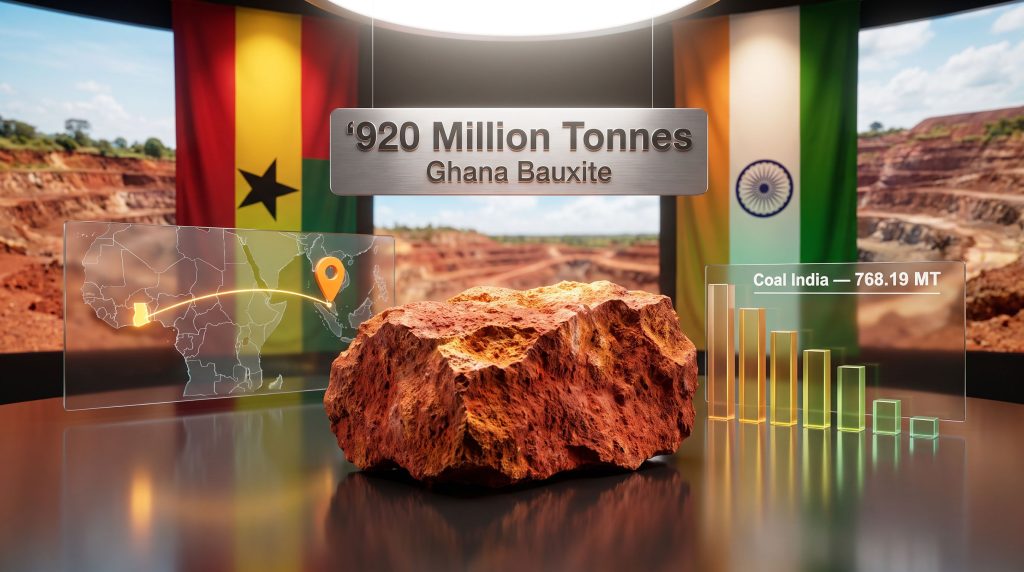
Understanding why Coal India's Ghana interest matters requires appreciating the scale of the entity involved. The company produced 768.19 million tonnes of coal during its 2025/26 financial year, a volume that no other coal producer on earth approaches. Its market capitalisation stood at approximately USD 26 billion (roughly ₹2.48 trillion) as of August 2026, giving it substantial balance sheet capacity to pursue acquisitions, joint ventures, or offtake arrangements without the capital constraints that limit smaller players.
Coal India is not a junior miner conducting speculative exploration. It is a state-backed industrial giant with the financial capacity to participate in large-scale mineral development projects, which makes its entry into the critical minerals space strategically significant rather than merely symbolic.
Diversification in Motion: From Odisha to Singapore to West Africa
The company's diversification trajectory has a visible logic. Its recent acquisition of an iron ore block in India's Odisha state was its first concrete step beyond coal within the domestic market. The planned Singapore trading office represents the international infrastructure layer that would underpin cross-border mineral activity. Ghana's bauxite sector is among the overseas opportunities being assessed through that emerging framework.
The Singapore office is particularly significant from an operational standpoint. The jurisdiction sits at the centre of Asian commodity trading flows, gives Coal India proximity to African, South American, and Asia-Pacific counterparties, and provides a neutral platform for deal structuring. According to recent reporting on Coal India's Singapore plans, the commodities under evaluation through this hub include:
| Mineral | Primary Target Regions | Strategic Purpose |
|---|---|---|
| Bauxite | Ghana, West Africa | Aluminium feedstock security |
| Lithium | Chile, Argentina, Australia | EV battery supply chain |
| Iron Ore | Odisha (India), Africa | Steel and manufacturing inputs |
| Rare Earth Elements | Multiple regions | Defence, electronics, clean energy |
Beyond Ghana, Coal India is simultaneously evaluating opportunities in Chile, Canada, and Australia, indicating that the Singapore hub is designed to support a genuinely diversified international mineral portfolio rather than a single bilateral engagement.
Ghana's Bauxite Endowment: What the Numbers Actually Mean
Scale, Geography, and the Quality Dimension
Ghana holds an estimated 920 million tonnes of bauxite across its principal deposit zones, according to figures from the Ghana Integrated Aluminium Development Corporation (GIADEC). Understanding global bauxite production dynamics helps contextualise why Ghana's reserves are attracting growing international attention. The country's primary bauxite geology is concentrated in four zones, each at different stages of development readiness:
| Deposit | Region | Operational Status | Notes |
|---|---|---|---|
| Awaso | Western Region | Active, ~1 million tonnes/year | Most developed; export-oriented |
| Nyinahin-Mpasaaso | Ashanti Region | Development stage | Partnered with Rocksure International |
| Kyebi (Kibi) | Eastern Region | Early exploration | Part of national resource base |
| Mount Ejuanema | Central Ghana | Early stage | Included in national estimates |
What is less commonly appreciated is the mineralogical character of Ghanaian bauxite. West African bauxite deposits, including Ghana's, are predominantly gibbsite-rich, meaning the aluminium hydroxide mineral gibbsite constitutes a large proportion of the aluminium-bearing content. This is commercially significant because gibbsite dissolves more readily than other aluminium hydroxide minerals such as boehmite or diaspore, allowing for refining at lower temperatures and pressures using the standard Bayer process.
In practical terms, gibbsite-rich bauxite is cheaper to refine and requires less energy per tonne of alumina produced, which enhances project economics for any investor considering downstream processing. Ghana's bauxite grades are generally considered high quality by international standards, with alumina content typically ranging between 40% and 50% Al₂O₃ at key deposit zones, and relatively low silica content, which reduces refining costs further.
The Value-Chain Inversion That Defines Ghana's Aluminium Challenge
Despite holding one of West Africa's largest bauxite resource bases, Ghana currently operates with a paradox at the heart of its aluminium industry. The Awaso mine exports approximately one million tonnes of raw bauxite annually, while the state-owned Volta Aluminium Company (VALCO) must import alumina from international markets to feed its smelting operations. Ghana mines the ore, ships it unprocessed, then purchases the refined intermediate product back from foreign refineries.
This value-chain inversion costs Ghana significant downstream economic benefit and represents exactly the kind of structural inefficiency that GIADEC was created to dismantle. However, recent developments in Ghana's bauxite sector suggest the country is actively restructuring its approach to foreign investment in this space.
Ghana's aluminium sector currently exports low-value raw ore and reimports high-value refined alumina to feed its own smelter. Resolving this inversion is the explicit mission of GIADEC and the primary condition that any foreign investor must engage with to be considered a credible partner.
GIADEC's Industrial Vision and the Non-Negotiable 30% Rule
Four Mines, Two Refineries, and a Transformed Export Profile
GIADEC's development blueprint envisions a fundamentally different Ghanaian aluminium industry. The plan targets four operational mines and at least two alumina refineries, shifting Ghana's export profile from raw ore to processed alumina and eventually supporting expanded domestic smelting. Key targets within this framework include:
- Scaling Awaso mine output from approximately 1 million tonnes per year to 5 million tonnes annually
- Constructing a refinery linked to Awaso capable of producing approximately 1.6 million tonnes of alumina per year
- Developing the Nyinahin-Mpasaaso deposit in partnership with Rocksure International as a combined mine-and-refinery project
- Integrating Metlen Energy & Metals (formerly Mytilineos) as a participant in a third project covering an estimated 300 million tonnes of bauxite, with potential output of up to 10 million tonnes annually and a dedicated refinery
Any new entrant, including Coal India, would need to position its capital within this established four-mine, two-refinery architecture. The sector already features defined development pathways and committed international partners, meaning Coal India is not arriving in an undeveloped frontier market but rather a strategically organised development programme.
The Structural Constraint Every Foreign Investor Must Understand
Perhaps the most important piece of regulatory knowledge for any party considering Ghana's bauxite sector is GIADEC's mandatory equity retention requirement. Under Ghanaian law and GIADEC's operating mandate, the corporation must retain a minimum 30% equity interest in any joint venture formed within the integrated aluminium industry.
This has several practical implications:
- Full acquisition of a Ghanaian bauxite asset by a foreign party is not legally permissible within this framework
- Every deal must be structured as a joint venture with GIADEC as a mandatory partner
- The deal architecture must accommodate Ghana's downstream processing objectives, not simply resource extraction
- Foreign investors cannot treat Ghana's bauxite as a raw material play without engaging with the refinery-building agenda
For Coal India specifically, this means any investment would need to align with Ghana's industrialisation priorities. A pure mining stake without downstream refinery participation is unlikely to satisfy Ghana's strategic criteria for new investment.
Three Possible Deal Structures for Coal India's Involvement
While no specific transaction has been confirmed and no Ghanaian counterparty has been publicly identified, the structural parameters of Coal India's potential involvement can be mapped across three distinct scenarios:
- Direct mining equity stake — an ownership interest in an existing or planned bauxite mine, providing Coal India with access to future ore production and the ability to direct shipments toward Indian refineries
- Integrated joint venture participation — involvement in a mine-plus-refinery development that aligns with GIADEC's value-addition mandate, potentially securing alumina offtake rights for India. The aluminium joint venture model has proven effective elsewhere in aligning investor and host-nation interests simultaneously
- Long-term offtake agreement without equity — a structured supply contract securing bauxite or alumina volumes over an extended period without requiring direct asset ownership, reducing capital exposure while meeting India's feedstock security objectives
Each structure carries different risk and return profiles. An equity stake in a mine provides resource control but requires capital deployment and exposes Coal India to operational risk in an unfamiliar jurisdiction. An offtake agreement is capital-light but provides no control over production decisions and leaves India exposed to contract renegotiation risk. The integrated joint venture model is the most complex but most likely to satisfy both parties' strategic objectives.
The next major ASX story will hit our subscribers first
India-Africa Mineral Diplomacy: The Competitive Context
How India's Approach Compares to Established Players
India's emerging model of state-enterprise-led mineral acquisition in Africa is frequently compared to China's long-established African resource strategy. The differences, however, are instructive:
| Dimension | India's Emerging Approach | China's Established Model |
|---|---|---|
| Primary vehicle | State-owned enterprise | State banks plus SOEs |
| Deal structure preference | Joint venture and offtake | Equity acquisition plus infrastructure |
| Policy anchor | National Critical Mineral Mission (2025) | Belt and Road Initiative |
| African engagement depth | Early-stage and developing | Deeply embedded across sectors |
| Value-addition alignment | Developing as a condition | Mixed track record |
India is arriving later to African mineral diplomacy than China, which means it faces a more competitive landscape. Nevertheless, it also has the opportunity to differentiate through deal structures that more genuinely align with host-country industrialisation priorities. Ghana's emphasis on downstream value addition may actually suit India's approach better than China's historic preference for raw material extraction.
What a Confirmed Deal Would Actually Signal
If Coal India were to formalise an investment in Ghana's bauxite sector, the implications would extend well beyond the bilateral transaction. It would represent India's first significant state-enterprise mineral asset position in West Africa, validating the National Critical Mineral Mission's overseas acquisition framework at a regional scale. The aluminium supply chain leaders already active in the region would consequently face new competitive dynamics.
Furthermore, a confirmed deal would introduce competitive tension into Ghana's aluminium development programme, potentially accelerating infrastructure timelines as GIADEC balances multiple international partners with competing priorities. For investors tracking India's critical mineral strategy, the Ghana evaluation is best understood as one data point within a multi-continent portfolio construction exercise.
Important disclaimer: This article contains forward-looking analysis, scenario projections, and interpretation of publicly available information. No confirmed investment, acquisition, or negotiation involving Coal India and any Ghanaian counterparty has been announced as of August 2026. Readers should not interpret this analysis as financial advice or as confirmation of any transaction.
Frequently Asked Questions: Coal India Bauxite Opportunities in Ghana
Has Coal India confirmed an investment in Ghana?
No. As of August 2026, Coal India's interest in Ghana's bauxite sector remains at a preliminary evaluation stage. No specific mine, deposit, or Ghanaian counterparty has been publicly identified, and no negotiations with Ghanaian authorities or GIADEC have been confirmed.
Why does Ghana's bauxite quality matter to potential investors?
Ghana's bauxite is predominantly gibbsite-rich, which makes it cheaper and less energy-intensive to refine using the standard Bayer process compared to deposits dominated by harder aluminium hydroxide minerals. This quality advantage strengthens project economics for any investor considering downstream refinery participation alongside mining.
What is the GIADEC 30% rule and why does it matter?
GIADEC is legally required to retain a minimum 30% equity interest in any joint venture within Ghana's integrated aluminium industry. This means full foreign acquisition is not possible, and all investment must be structured as a partnership with GIADEC that accommodates Ghana's downstream processing priorities.
What other countries is Coal India evaluating for minerals?
Beyond Ghana, Coal India is reportedly assessing mineral opportunities in Chile, Canada, and Australia across commodities including lithium, iron ore, rare earth elements, and bauxite. These Coal India bauxite opportunities in Ghana form just one strand of a considerably broader diversification strategy.
How does Coal India's Singapore office support the Ghana evaluation?
The proposed Singapore trading hub would serve as Coal India's international base for assessing mineral opportunities, conducting commodity trades, and building counterparty relationships across Africa, South America, and Asia-Pacific. Ghana's bauxite sector is consequently one of multiple opportunities being assessed through this framework.
Want to Track the Next Major Mineral Discovery Before the Market Does?
Discovery Alert's proprietary Discovery IQ model delivers real-time alerts on significant ASX mineral discoveries — from critical minerals like bauxite and lithium to the commodities powering the global energy transition — instantly converting complex data into actionable investment opportunities. Explore why historic mineral discoveries have generated extraordinary returns and begin your 14-day free trial today to position yourself ahead of the broader market.