
August 21, 2026
The Geography of Risk: How Gulf Chokepoints Are Forcing a Rethink of Oil Export Strategy
Every major crude oil export route in the world passes through at least one critical chokepoint. For decades, these narrow passages operated as predictable, if occasionally tense, arteries of global energy supply. The assumption embedded in decades of trade infrastructure was that disruptions would be temporary. What is unfolding in the Red Sea corridor in 2026 is challenging that assumption in structural ways that could permanently reshape how Gulf producers move their oil to market.
The physics of global oil logistics are unforgiving. Tankers cannot be rerouted through open ocean indefinitely without dramatic cost consequences. Pipelines take years and billions of dollars to build. And yet, within weeks of a declared Houthi blockade targeting Saudi crude shipments, a functioning multi-leg bypass corridor had emerged, threading through Egypt's pipeline infrastructure and re-emerging at a Mediterranean terminal most casual observers had never heard of. That terminal is Sidi Kerir, and Saudi oil exports via Sidi Kerir to evade Houthis has become one of the most consequential developments in global energy markets.
When big ASX news breaks, our subscribers know first
Why the Red Sea Became Untenable for Saudi Crude Exports
The Bab el-Mandeb Strait sits at the southern tip of the Red Sea, separating Yemen from Djibouti across a passage roughly 30 kilometres wide at its narrowest point. It has long been identified in energy security literature as one of the most vulnerable chokepoints in the global oil system, but for most of its history, the risk remained theoretical. That changed decisively when Houthi forces, backed by Iran, expanded their maritime campaign beyond Israeli-linked vessels to explicitly target Saudi crude carriers.
The Houthi blockade declaration of July 20 was the inflection point. Before that date, shipping operators had been navigating elevated risk with a mix of route changes, insurance premium increases, and convoy arrangements. After July 20, the risk calculus shifted categorically. Yanbu, Saudi Arabia's primary Red Sea export terminal, moved from a zone of elevated risk to an active target environment. The southern transit route through Bab el-Mandeb became operationally untenable for risk-averse operators, contributing to significant oil market disruption across global supply chains.
The Yanbu Terminal and Its Dual Strategic Role
Yanbu occupies a unique position in Saudi Arabia's export architecture. It is not simply a Red Sea port. It is also the western terminus of Saudi Arabia's East-West Pipeline, the overland crude corridor that connects the kingdom's Persian Gulf oil fields at Abqaiq and Ras Tanura to its Red Sea coast. This dual function made Yanbu the centrepiece of Saudi Arabia's initial bypass strategy at the start of the conflict, allowing Persian Gulf barrels to be redirected away from the Strait of Hormuz exposure and out through the Red Sea instead.
The irony of the current situation is significant. The same terminal that was activated as a Hormuz bypass has itself become a vulnerability. Houthi targeting of Yanbu-loading vessels has effectively forced Saudi Arabia to execute a second-order bypass, rerouting oil that had already been rerouted.
What Is the Sidi Kerir Route and How Does It Actually Work?
The solution that has emerged is architecturally elegant, if operationally complex. Saudi crude exits Yanbu aboard tankers and travels north through the Red Sea, a journey that keeps vessels away from the contested southern waters near Bab el-Mandeb. These shuttle tankers then discharge their cargoes at Ain Sokhna, Egypt's Red Sea port on the Gulf of Suez.
From Ain Sokhna, the crude enters the SUMED pipeline, a roughly 320-kilometre overland corridor that crosses Egyptian territory westward toward the Mediterranean coast. At the pipeline's western terminus sits Sidi Kerir, where crude is reloaded onto ocean-going tankers for final delivery to European and American buyers. According to Reuters reporting on Saudi Red Sea exports, this shift represents one of the most dramatic logistical pivots in recent energy history.
The four-stage movement breaks down as follows:
- Stage 1: Crude departs Yanbu on Saudi Arabia's Red Sea coast, loaded aboard shuttle tankers operating under higher-risk commercial terms.
- Stage 2: Tankers transit northward through the Red Sea, avoiding the Houthi-contested southern corridor, and arrive at Ain Sokhna.
- Stage 3: Cargo is discharged and injected into the SUMED pipeline for overland transit across Egypt.
- Stage 4: Crude re-emerges at Sidi Kerir on Egypt's Mediterranean coast, where it is loaded onto larger vessels for transatlantic or European delivery.
How the SUMED Pipeline Compares to Direct Suez Canal Transit
| Feature | SUMED Pipeline Route | Suez Canal Direct Transit |
|---|---|---|
| Red Sea exposure | Eliminated north of Suez | Partial exposure remains |
| Bab el-Mandeb risk | Completely bypassed | Not bypassed |
| Primary market served | Europe and United States | Flexible, multi-destination |
| Asia voyage impact | Significantly longer, higher cost | Shorter comparative route |
| Infrastructure dependency | Egypt pipeline capacity | Canal traffic and tariffs |
Why This Is a Workaround, Not a Permanent Substitution
The SUMED route carries inherent limitations that prevent it from fully replacing the direct Red Sea export corridor. Pipeline throughput capacity is finite and shared across multiple users. The Ain Sokhna terminal has physical constraints around berth availability and discharge rates. Furthermore, the economics of the multi-leg shuttle system add meaningful cost per barrel that ultimately flows through to buyers or compresses seller margins. As a sustained, large-volume alternative, the Sidi Kerir corridor faces a capacity ceiling.
Quantifying the Scale of the Rerouting Operation
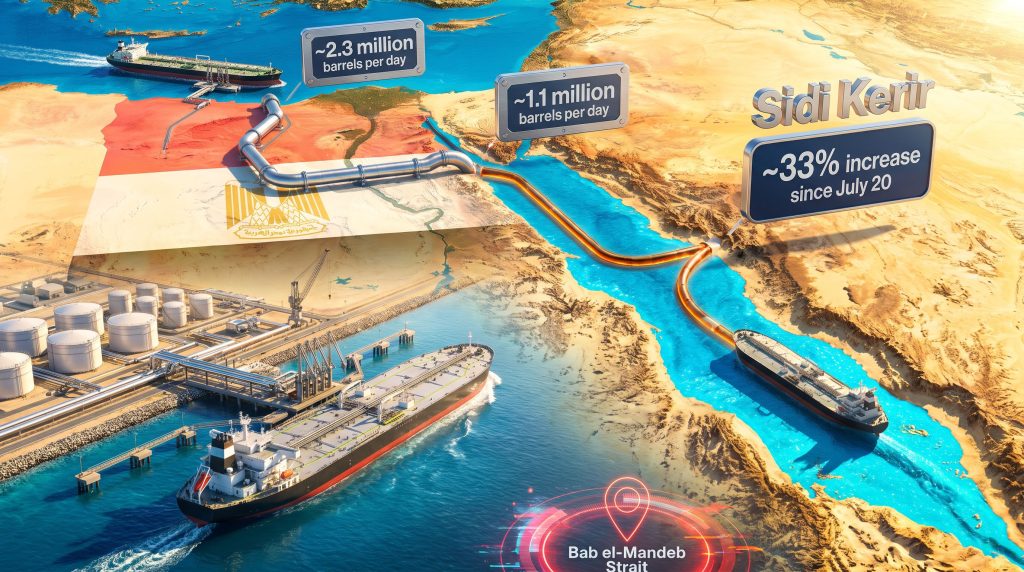
The volume data that has emerged from ship-tracking platforms reveals the operational intensity of what Saudi Arabia has assembled in a remarkably short timeframe. According to Kpler data, Saudi crude exports via the northern Red Sea corridor rose by approximately one-third following the July 20 blockade declaration, reaching an estimated 1.1 million barrels per day. These crude oil market update figures reflect just how rapidly the situation has evolved.
| Metric | Reported Figure |
|---|---|
| Northern corridor export volume increase | ~33% since July 20 |
| Estimated daily northern route throughput | ~1.1 million barrels per day |
| Sidi Kerir loadings peak (August) | ~2.3 million barrels per day |
| Total barrels transferred via shuttle tankers | ~16.3 million barrels |
| Tankers completing multiple Yanbu-Ain Sokhna runs | At least 4 vessels (2+ trips each) |
Bloomberg ship-tracking data identified at least four tankers that have completed the Yanbu-to-Ain Sokhna journey multiple times carrying crude cargoes, with shuttle operators including South Korea's Sinokor Group, Greece's Dynacom, and Norway's DHT Management AS identified among those active in the trade.
The Sidi Kerir terminal itself recorded peak loadings of approximately 2.3 million barrels per day in August, reflecting not only Saudi rerouted volumes but also other Mediterranean crude flows converging on the same export point.
The Risk Profile of Shuttle Tanker Operators
A notable feature of the emerging shuttle trade is that it has not attracted universal participation from the tanker market. Operators willing to conduct the Yanbu-to-Ain Sokhna leg must accept some residual Red Sea exposure, as Yanbu itself remains under threat. Freight market analysts at Vortexa have noted that tanker operators with elevated risk appetite are the ones driving the shuttle movements between Yanbu and Ain Sokhna, allowing Saudi Aramco's customers to take delivery at Sidi Kerir and entirely sidestep the security risks.
However, this selective participation has created a two-tier structure in the tanker market, with risk-premium freight rates applying to the shuttle leg while more conventional rates govern the Mediterranean reload segment.
The Gulf Bypass Playbook: Saudi Arabia and the UAE Running Parallel Strategies
What makes the current situation particularly revealing from an energy security perspective is that Saudi Arabia and the United Arab Emirates are simultaneously executing structurally similar bypass strategies in response to different but related threats. These developments are further reshaping broader geopolitical trade tensions that have been building across multiple regions.
The UAE has activated the Abu Dhabi Crude Oil Pipeline (ADCOP), an overland corridor that delivers Abu Dhabi crude from inland production fields to the port of Fujairah on the Gulf of Oman, completely bypassing the Strait of Hormuz. This infrastructure, originally constructed with exactly this threat scenario in mind, allows UAE exports to reach open ocean without transiting the narrow passage between Iran and the Arabian Peninsula.
The parallel is instructive:
- Both producers face hostile interdiction threats at different chokepoints.
- Both have activated overland pipeline infrastructure as the bypass mechanism.
- Both are absorbing higher per-barrel logistics costs to maintain export continuity.
- Neither bypass fully replicates the volume capacity or destination flexibility of the primary route.
The simultaneous activation of bypass infrastructure by two of the world's largest crude exporters represents an unprecedented stress test of Gulf energy resilience planning. The fact that both systems are functioning, even under capacity constraints, suggests decades of strategic infrastructure investment is delivering real operational value.
Who Wins and Who Bears the Cost
The Sidi Kerir routing creates a clear asymmetry in market outcomes that breaks down along geographic lines.
European and American buyers are the clear beneficiaries. Sidi Kerir sits on the Mediterranean, making it a natural and cost-efficient loading point for transatlantic voyages. For European refiners in particular, Saudi crude arriving at a Mediterranean terminal is logistically comparable to, or in some cases simpler than, their traditional Middle Eastern supply chains.
Asian buyers face the opposite situation. Saudi Arabia's largest crude customers by volume are concentrated in Northeast and Southeast Asia, where refineries in China, South Korea, Japan, and India absorb the bulk of the kingdom's exports. A tanker loading at Sidi Kerir bound for Asia cannot transit the Suez Canal southbound without re-entering the Red Sea and facing exactly the threats the bypass was designed to avoid.
The only viable alternative is sailing around the Cape of Good Hope in southern Africa, adding several weeks to the voyage and substantially increasing freight costs. Consequently, this dynamic has meaningful implications for Saudi Arabia's market share in Asia during the disruption period. Higher delivered costs erode the competitiveness of Saudi crude relative to Atlantic Basin grades or Russian volumes moving through alternative corridors.
The Freight Economics of the Cape Route
The round-Africa voyage adds approximately 10,000 to 12,000 nautical miles to a journey from the Mediterranean to major Asian refining hubs compared to the traditional Red Sea-to-Asia routing. At current VLCC day rates, this translates into freight cost increases measured in dollars per barrel that can meaningfully shift the economics of a given cargo, particularly for buyers operating on thin refining margins.
The next major ASX story will hit our subscribers first
What the Sidi Kerir Operation Reveals About Energy Geopolitics
The operational response to the Houthi blockade offers several insights that extend well beyond the immediate logistics story. Furthermore, understanding these dynamics requires considering how OPEC influence on oil production decisions intersects with the evolving security environment.
Infrastructure investment in bypass capacity has demonstrable strategic value. The SUMED pipeline exists because Egypt and its Gulf Arab partners invested in building it precisely for scenarios like this one. Its availability in 2026 is not accidental but the result of decades of energy security planning that is now paying dividends under live conflict conditions.
The tanker market is a critical but underappreciated layer of energy security. The willingness of specific shipping operators to accept elevated risk in exchange for premium freight rates is what makes the shuttle system function. Without risk-tolerant operators in the market, the SUMED bypass would be logistically stranded regardless of pipeline availability.
Conflict-era logistics patterns have a tendency to persist. Once shippers, refiners, and terminal operators establish new operational relationships and workflows, there is institutional inertia that slows the return to previous patterns even after the original threat subsides. Oil price movements throughout this period reflect that uncertainty, with Saudi oil exports via Sidi Kerir to evade Houthis now representing a structural rather than temporary feature of the market. The Sidi Kerir terminal may retain a structurally higher share of Saudi crude exports long after the Houthi threat diminishes.
Frequently Asked Questions
What is the Sidi Kerir oil terminal and why is it significant?
Sidi Kerir is a crude oil loading terminal on Egypt's Mediterranean coast that serves as the western end of the SUMED pipeline. It has gained strategic prominence as a reload point for Gulf crude that has been pumped overland across Egypt to avoid Red Sea security threats. Detailed analysis of Red Sea crude flows and alternative routes confirms the terminal's growing importance in global supply chains.
Why are Houthis targeting Saudi oil tankers at Yanbu?
Houthi forces in Yemen, operating with Iranian backing, declared a blockade on July 20 targeting Saudi-linked shipping, particularly vessels transiting the Bab el-Mandeb Strait. As Saudi Arabia's main Red Sea terminal, Yanbu became a direct focal point of the campaign.
How much extra time does the Sidi Kerir route add for Asian buyers?
Tankers loading at Sidi Kerir and bound for Asia must circumnavigate southern Africa, adding several weeks to the voyage and substantially increasing freight costs compared to the conventional Red Sea-to-Asia route.
What is the SUMED pipeline and how does it work in this bypass?
The SUMED pipeline runs approximately 320 kilometres across Egyptian territory, connecting Ain Sokhna on the Red Sea coast to Sidi Kerir on the Mediterranean. Crude is discharged from shuttle tankers at Ain Sokhna, pumped westward through the pipeline, and reloaded at Sidi Kerir for onward shipping.
Are all tanker operators participating in the shuttle route?
No. The Yanbu-to-Ain Sokhna shuttle leg involves residual Red Sea exposure and carries a risk premium. Only operators with higher risk tolerance have entered this specific trade, while others continue to use the Bab el-Mandeb route or have exited the trade entirely. CNBC's coverage of the Saudi Arabia and Iran oil crisis provides further context on how this two-tier market has developed.
How does this compare to the UAE's bypass approach?
The UAE has activated the Abu Dhabi Crude Oil Pipeline to move crude to the port of Fujairah on the Gulf of Oman, bypassing the Strait of Hormuz. Both strategies reflect a broader pattern of Gulf producers activating pre-built bypass infrastructure in response to active geopolitical threats. Indeed, Saudi oil exports via Sidi Kerir to evade Houthis and the UAE's Fujairah strategy together represent an unprecedented dual-bypass scenario in global energy markets.
Disclaimer: This article contains references to market data, shipping volumes, and analyst commentary for informational purposes. Figures sourced from Kpler and Bloomberg ship-tracking data reflect conditions as reported at the time of publication and may change. Nothing in this article constitutes investment advice. Readers should conduct independent research before making decisions related to energy commodities, shipping equities, or related financial instruments.
Want to Stay Ahead of the Next Major Resource Discovery?
Discovery Alert's proprietary Discovery IQ model delivers real-time alerts on significant ASX mineral discoveries — transforming complex data across more than 30 commodities into clear, actionable insights for investors at every level. Explore how historic mineral discoveries have generated substantial returns and begin your 14-day free trial today to position yourself ahead of the broader market.