
August 21, 2026
The Invisible Input That Could Break India's Energy Ambitions
Every major oil well drilled anywhere in the world depends on a substance most people have never heard of. Drilling-grade baryte, a dense barium sulphate mineral, is the workhorse of wellbore engineering. It is mixed into drilling fluids to generate the hydrostatic pressure needed to counteract subsurface formation pressures, preventing the catastrophic pressure reversals known as blowouts. Without sufficient baryte inventory, drilling programmes stall, and without drilling programmes, domestic energy ambitions remain precisely that: ambitions written on policy documents rather than barrels delivered to refineries.
For India, this is not a theoretical concern. India baryte reserves depletion is approaching a threshold that, if left unaddressed by export and extraction policy reform, could transform India from one of the world's leading baryte exporters into an import-dependent nation within the same decade it plans to dramatically expand offshore oil and gas exploration.
Understanding how this situation developed, and what it means for India's energy security, requires looking beyond the headline reserve numbers to the structural governance failures that have quietly accelerated the problem. Furthermore, India's LNG import tax structure underscores just how deeply intertwined energy policy and resource governance have become across multiple commodity sectors.
When big ASX news breaks, our subscribers know first
A Single Deposit Carrying an Entire Nation's Supply
The Mangampet deposit in Annamayya District, Andhra Pradesh, is not merely India's largest baryte producing site. It is effectively India's only commercial baryte producing site, accounting for an estimated 95% of total national production. This degree of geographic concentration is unusual even by the standards of mineral-dependent economies, most of which maintain at least a distributed portfolio of active deposits across multiple geological provinces.
Mangampet achieved global significance during the second half of the twentieth century, when India emerged as a dominant baryte exporter to oil and gas drilling markets across Asia, Europe, and North America. The deposit's high-grade material, relatively shallow extraction depths, and proximity to port infrastructure made it commercially attractive for decades.
What that success obscured was the rate at which the deposit's finite resource base was being consumed. Official reserve data now tells a stark story. Indeed, broader critical minerals demand projections globally reinforce just how precarious single-source dependencies can become during periods of accelerating energy transition.
Reserve Decline Data: What the Numbers Actually Show
| Metric | 2015 Estimate | 2024 Estimate | Change |
|---|---|---|---|
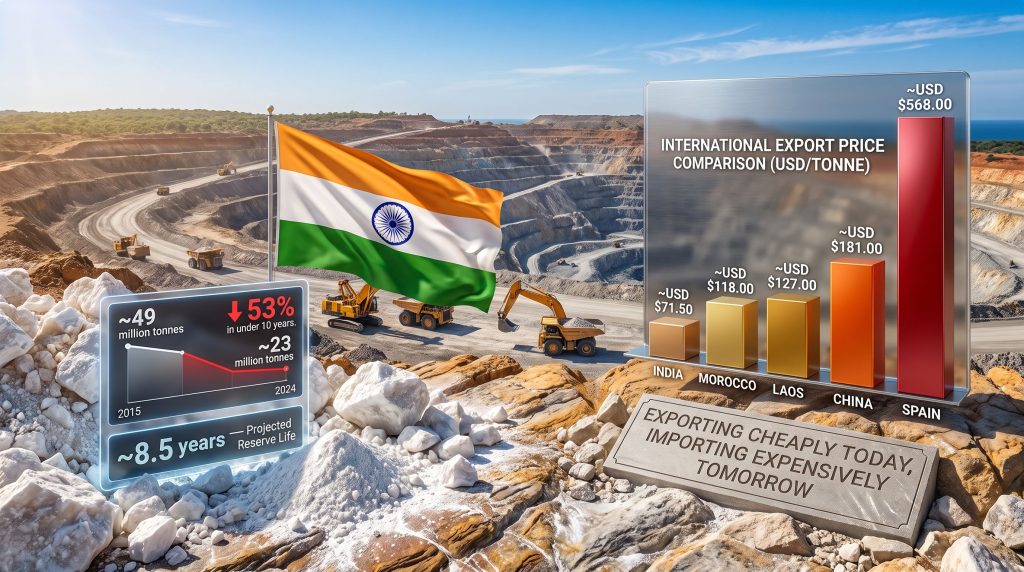
| Total Estimated Reserves | ~49 million tonnes | ~23 million tonnes | Down 53% |
| Annual Extraction Rate | Variable | ~2.7 million tonnes/yr | Critical pace |
| Projected Reserve Life | Extended horizon | ~8.5 years | Threshold breached |
| Grade A Reserves | Significant volume | ~1.8–2.0 lakh tonnes | Near exhaustion |
| Grade B Reserves | Moderate volume | ~9 lakh tonnes | Severely limited |
| Grade C Reserves | Minor proportion | ~35–45 lakh tonnes | Now dominant pool |
A 53% reduction in total reserves over less than a decade is among the most rapid drawdowns recorded for any critical drilling mineral in the Asia-Pacific region. At the prevailing extraction rate of approximately 2.5 to 3.0 million tonnes annually, remaining reserves face practical exhaustion within an 8 to 10 year window under central-case assumptions. More aggressive extraction scenarios compress this estimate to as few as 5 to 7 years; only the most conservative modelling extends it meaningfully beyond a decade.
The Grade Quality Collapse: Why Volume Figures Understate the Problem
Reserve tonnage figures, taken in isolation, substantially overstate the quantity of usable baryte remaining at Mangampet. The critical variable is grade quality, which determines whether extracted material can meet the 4.2 specific gravity minimum required for drilling-grade applications under American Petroleum Institute specifications.
Critical Insight: The specific gravity threshold for API-compliant drilling baryte is non-negotiable in engineering terms. Material that falls below 4.2 SG cannot perform the pressure-control function in wellbore fluids, regardless of its quantity. Grade quality is therefore not a refinement concern, it is a fundamental suitability question.
Grade A material, with the highest natural purity and the least requirement for processing before it meets drilling specifications, is now estimated at only 1.8 to 2.0 lakh tonnes at Mangampet. This is effectively a residual volume in the context of a deposit that once held tens of millions of tonnes of high-quality ore.
Grade B reserves at approximately 9 lakh tonnes provide a limited medium-term buffer, but their utilisation rate is accelerating as Grade A material is exhausted.
The 35 to 45 lakh tonne Grade C pool now constitutes the largest remaining category of reserves, but Grade C material requires beneficiation processing before it can be upgraded to drilling-grade specification. Beneficiation involves crushing, washing, heavy-media separation, and in some cases flotation, to concentrate barium sulphate content and remove silica and iron impurities. Without investment in this processing infrastructure at or near Mangampet, a substantial portion of the remaining reserve base is functionally inaccessible for the applications India most urgently needs to supply.
Exporting a Strategic Mineral at Bargain Prices
The depletion of Mangampet's reserves would be concerning under any circumstances, but the situation is made structurally worse by the pricing at which India's baryte enters international markets. Approximately 69% of India's annual baryte production is directed toward export rather than retained for domestic consumption. This proportion was established during a period of perceived reserve abundance and has not been revised to reflect current depletion realities.
More damaging than the volume of exports is the price at which they are transacted. According to a recent C-DEP report on baryte depletion, India's long-term energy security is now at measurable risk as a direct consequence of this underpriced export model.
How India's Baryte Export Price Compares Internationally
| Country of Origin | Average Export Price (per tonne) | Premium Over Indian Price |
|---|---|---|
| India (Mangampet) | ~USD $71.50 | Baseline |
| Morocco | ~USD $118.00 | +65% |
| Laos | ~USD $127.00 | +78% |
| China | ~USD $181.00 | +153% |
| Spain | ~USD $568.00 | +694% |
Source: UN Comtrade data for natural barium sulphate, most recent available reporting period.
Indian baryte is leaving the country at prices 39% to 87% below comparable international benchmarks depending on the reference market, and at a fraction of the price commanded by European processed baryte. Based on UN Comtrade trade flow data, analysts estimate this pricing gap generated an economic value loss exceeding ₹12,500 crore in a single year.
Why Is Indian Baryte Priced So Far Below International Benchmarks?
The underpricing is not simply a market outcome. It reflects identifiable structural causes that are amenable to policy correction:
- Absence of a minimum export price mechanism. India applies minimum export price floors to iron ore and certain other minerals but has not extended this instrument to baryte, leaving the market exposed to competitive price suppression among small-scale operators.
- Fragmented mining lease structures at Mangampet. Multiple small and medium lease holders extract and sell independently, creating a prisoner's dilemma dynamic where individual operators accept low prices rather than risk inventory accumulation.
- Limited downstream beneficiation and value-adding capacity. Indian baryte is largely exported as raw or minimally processed ore rather than as a beneficiated, specification-compliant product. Countries commanding premium prices, notably Spain, export processed baryte into high-value industrial and pharmaceutical markets.
- No strategic reserve pricing floor. Unlike energy commodities where strategic considerations influence pricing frameworks, baryte has been treated as a purely commercial export product without reference to long-term domestic supply requirements.
Warning: The combination of volume-dominant exports, low pricing, and accelerating grade degradation creates a compounding loss scenario. India is simultaneously depleting its highest-quality reserves fastest, receiving below-market compensation for the material exported, and consuming the capital that would otherwise fund beneficiation infrastructure.
India's Expanding Exploration Ambitions Are Increasing the Stakes
The reserve depletion problem does not exist in isolation. It is unfolding at precisely the moment India is committing to a significant expansion of domestic oil and gas exploration, creating a direct collision between supply trajectory and demand trajectory. In addition, Australia's resource and energy exports landscape illustrates how rapidly resource-dependent economies can find their strategic positions undermined when critical mineral governance lags behind extraction activity.
The Samudra Manthan Programme and Andaman Basin Development
India's Samudra Manthan programme is designed to accelerate exploration activity across frontier offshore basins that have remained largely undeveloped. The Andaman Basin is among the most significant targets, with geological estimates suggesting the basin could contain approximately 22 billion barrels of oil equivalent distributed across four largely unexplored formations.
Deepwater and ultra-deepwater drilling operations are particularly baryte-intensive. The hydrostatic pressure requirements in water depths exceeding 1,000 metres demand significantly higher mud weight, and therefore higher baryte loading per cubic metre of drilling fluid, compared with onshore or shallow-water wells. A single deepwater exploration well can consume several thousand tonnes of drilling-grade baryte across its drilling programme.
The demand amplification from offshore exploration expansion is therefore not linear relative to well count. Each deepwater well drilled in the Andaman Basin or comparable frontier settings will require materially more baryte than an equivalent onshore well, at exactly the time domestic supply is contracting.
Three Scenarios for India's Baryte Supply Future
Scenario 1: Business as Usual
Exports continue at approximately 69% of production. Domestic reserves are exhausted within 8 to 10 years. India transitions from net exporter to net importer. Offshore exploration input costs escalate as baryte must be sourced from Morocco, China, or other international suppliers at prices 2 to 8 times higher than current domestic costs.
Scenario 2: Export Restriction with Beneficiation Investment
Export allocations are reduced through minimum export price introduction and domestic priority quota mechanisms. Parallel investment in Grade C beneficiation infrastructure unlocks an additional 35 to 45 lakh tonnes of currently sub-specification material. Effective domestic supply life extends to a 15 to 20 year horizon. Revenue reduction from export volume reduction is partially offset by higher per-tonne realisation on reduced export volumes.
Scenario 3: Strategic Reserve Declaration with New Geological Exploration
Mangampet is formally protected under a strategic reserve extraction cap. A national geological survey programme targets alternative baryte occurrences in Rajasthan, Madhya Pradesh, and Telangana, where historical reconnaissance has identified minor baryte mineralisation warranting systematic evaluation. International supply agreements are established as contingency buffers. This pathway requires 5 to 7 years of lead time before meaningful alternative supply contribution is possible.
Can Other Minerals Replace Baryte in Drilling Applications?
A frequently raised question is whether mineral substitutes could insulate India's drilling programmes from baryte supply constraints. The honest answer is: partially, and at a cost.
Baryte Substitute Comparison for Drilling Applications
| Substitute Mineral | Drilling Suitability | Relative Cost | India Availability |
|---|---|---|---|
| Hematite | Moderate | Higher than baryte | Moderate |
| Ilmenite | Limited (specific conditions) | Higher than baryte | Available |
| Calcium Carbonate | Low (acid-soluble formations only) | Lower than baryte | High |
| Synthetic Alternatives | Emerging technology | Significantly higher | Very limited |
Hematite's higher density means less volume is required per unit of mud weight, but it is abrasive to drilling equipment and carries a materially higher per-tonne cost. Ilmenite performs acceptably in specific formation types but lacks baryte's chemical inertness and versatility across varied geological conditions.
No currently available substitute replicates baryte's combination of high specific gravity (4.2+ SG), chemical inertness, non-magnetic properties, and cost efficiency across the full range of drilling applications. Substitution is a risk mitigation tool, not a strategic solution.
A Policy Roadmap for Preventing Supply Crisis
Immediate Interventions (0 to 2 Years)
- Introduce a minimum export price for baryte aligned with Moroccan and Laotian international benchmarks as a floor, reducing the structural underpricing that currently erodes reserve value.
- Establish a domestic priority allocation quota that reserves a defined percentage of annual Mangampet production for domestic drilling programmes, particularly those supporting the Samudra Manthan offshore exploration push.
- Commission an independent reserve audit using current extraction rate assumptions and grade-adjusted utilisation modelling to establish a more precise depletion timeline than current headline figures convey.
Medium-Term Actions (2 to 5 Years)
- Fund beneficiation infrastructure at or near Mangampet capable of upgrading Grade C material to API-compliant drilling-grade specification, potentially unlocking the largest remaining reserve pool for domestic use.
- Restructure mining lease auction frameworks to reward value-optimised extraction over volume-maximised extraction, reducing the competitive price suppression dynamic among small lease operators.
- Develop a baryte-specific export tariff framework that calibrates export levies to current reserve levels, creating an automatic market signal that tightens as reserves contract.
Long-Term Structural Reform (5 to 10 Years)
- National baryte geological survey targeting historically identified minor occurrences in Rajasthan, Madhya Pradesh, and Telangana for systematic evaluation.
- Formal critical minerals classification for baryte within India's national critical minerals framework, bringing it under the same governance protocols applied to lithium, cobalt, and rare earth elements.
- International supply agreement establishment with Morocco and other stable baryte-producing nations as contingency supply chain insurance against domestic reserve shortfalls during the transition period.
The next major ASX story will hit our subscribers first
The Cautionary Precedent: What Happened to United States Baryte Self-Sufficiency
India is not navigating unprecedented territory. The United States was once a significant baryte producer, with active mining operations across Nevada, Georgia, and Missouri. Over approximately two decades, domestic reserve exhaustion and cheaper import competition shifted the US into near-total import dependency. American oil and gas operators now source drilling baryte primarily from China, India, and Morocco, exposing their supply chains to price volatility, logistics disruption, and geopolitical risk that did not exist when domestic supply was available.
The economic cost of that transition was not fully apparent until supply chain stress events demonstrated just how price-sensitive import-sourced baryte could be during periods of elevated drilling activity or logistics constraints. International baryte spot prices can reach 2 to 8 times higher than India's current domestic pricing depending on grade, source, and market conditions.
The strategic lesson is direct: the transition from self-sufficiency to import dependency in critical drilling minerals does not announce itself loudly. It occurs gradually through extraction rate continuation, reserve depletion, and the absence of policy intervention, until the structural vulnerability is exposed by a supply disruption or price spike that the economy was not prepared to absorb.
India Baryte Reserves Depletion: Frequently Asked Questions
What Is Baryte and Why Does India's Oil and Gas Sector Depend on It?
Baryte is barium sulphate, a dense mineral with a specific gravity typically exceeding 4.2 that is blended into drilling fluids to control subsurface formation pressures during oil and gas well drilling. It prevents wellbore instability and blowouts. Approximately 70% of global baryte consumption is directly tied to oil and gas drilling activity, making it a foundational input for any country pursuing domestic energy exploration.
How Rapidly Are India's Baryte Reserves Declining?
Official data shows a decline from approximately 49 million tonnes in 2015 to around 23 million tonnes in 2024, representing a 53% reduction in under a decade. At current extraction rates of approximately 2.7 million tonnes per year, the remaining reserve base faces exhaustion within roughly 8.5 years under central-case modelling. Furthermore, analysts warn that India's barytes reserves face compounding risk from the short-term gains being prioritised over long-term energy security.
Why Is Indian Baryte Exported So Cheaply Compared to Other Countries?
Indian baryte is exported at approximately USD $71.50 per tonne, against benchmarks of USD $118 (Morocco) and USD $181 (China). The gap reflects fragmented mining lease structures, the absence of a minimum export price mechanism, and limited downstream processing capacity that forces raw ore export rather than higher-value beneficiated product export.
What Would Happen to India's Oil Exploration Programme if Baryte Runs Short?
India's offshore exploration ambitions, including the Andaman Basin programme under Samudra Manthan, would face significantly higher input costs as drilling baryte would need to be imported at international prices potentially 2 to 8 times higher than current domestic costs. This would increase the cost per exploration well and potentially reduce the economic viability of marginal prospects.
Are There Minerals That Can Replace Baryte in Drilling?
Hematite and ilmenite serve as partial substitutes in specific drilling conditions but are generally more expensive and less versatile. No currently available substitute matches baryte's complete technical and economic profile for broad drilling application. Substitution represents partial mitigation only.
The Contradiction India Cannot Afford to Leave Unresolved
India's baryte situation presents a policy contradiction of genuine strategic consequence. The country is simultaneously accelerating domestic energy exploration objectives and depleting, at below-market prices, the principal mineral input those exploration programmes will require at scale.
India baryte reserves depletion is not an immutable geological fate. The reserve base exists. Grade C material remains in meaningful volume. Alternative deposit occurrences have been identified, however incompletely evaluated. The processing technology to upgrade sub-specification baryte is established and commercially available. The regulatory instruments needed, minimum export pricing, domestic priority quotas, extraction caps, all operate within existing legislative frameworks and do not require new legislation to implement.
What the situation requires is recognition that a critical minerals governance gap has opened between India's energy ambitions and its resource management framework, and that the window for cost-effective intervention is narrowing in direct proportion to the rate at which Mangampet's remaining reserves are extracted and exported. Consequently, Australia's own critical minerals strategy offers an instructive parallel, demonstrating how proactive governance frameworks can protect long-term resource value when implemented ahead of a supply crisis rather than in response to one.
Exporting a strategic drilling mineral cheaply today to generate short-term foreign exchange, while planning aggressive domestic drilling programmes that will require that same mineral at imported prices tomorrow, is a contradiction that will eventually resolve itself. The question is whether it resolves through deliberate policy action or through a supply crisis that forces the issue under far less favourable economic conditions. For broader context on where baryte sits within a shifting mining commodity outlook, the structural parallels with other critical drilling and energy transition minerals are increasingly difficult to ignore.
For further coverage of India's oil and gas exploration policy and critical minerals governance, ET EnergyWorld provides ongoing reporting through its energy sector vertical at energy.economictimes.indiatimes.com.
Want to Stay Ahead of the Next Major Critical Minerals Discovery?
Discovery Alert's proprietary Discovery IQ model scans ASX announcements in real time, instantly identifying significant mineral discoveries across baryte, critical minerals, and over 30 other commodities — transforming complex geological data into clear, actionable investment opportunities. Explore historic discoveries and their remarkable returns, then begin your 14-day free trial to position yourself ahead of the broader market.