
August 22, 2026
The Hidden Architecture of a Steel Supply Squeeze
Commodity markets rarely tighten overnight. What appears on the surface as a sudden price spike or an availability crunch is almost always the product of compounding structural forces that have been building quietly for months. The US hot-rolled coil market in 2026 is a textbook illustration of this dynamic, where US HRC mill outages and supply tightness has emerged from the convergence of depleted distributor inventories, deliberate mill behaviour, constrained import flows, and a heavy seasonal maintenance calendar — creating one of the more consequential supply environments the domestic flat-rolled sector has seen since the post-pandemic disruption of 2022.
Understanding the depth of this cycle requires looking beyond the outage schedule itself and examining the preconditions that made the market structurally fragile before a single furnace went offline.
When big ASX news breaks, our subscribers know first
Why the Market Was Already Vulnerable Before Outages Began
Three interlocking forces had already weakened the supply buffer in the US flat-rolled steel market before the fall-winter 2026 maintenance season arrived.
First, service centre inventory levels had been running well below historical norms throughout much of the year. Distributors that aggressively destocked during periods of price weakness found themselves with limited buffer capacity precisely when outage-related supply gaps began to materialise. This left buyers without the cushion that service centre stockpiles typically provide during seasonal supply disruptions.
Second, multiple producers made a deliberate strategic decision to reduce or eliminate their spot market participation. By prioritising contracted volumes and working through accumulated order backlogs, at least three mills were not offering hot-rolled coil on spot terms at the time market assessments were conducted. This is not a market accident but a calculated commercial posture that amplifies scarcity for buyers outside long-term supply agreements.
Third, import arrivals, while increasing in response to elevated domestic prices, had not reached volumes sufficient to function as a meaningful pressure release valve. The mechanics of global steel trade — including transit timelines, tariff-related cost friction from existing Section 232 measures, and logistics constraints at ports of entry — all conspire to slow the speed at which offshore tonnage can substitute for domestic spot material. Furthermore, the steel and aluminum tariffs introduced in recent years have added an additional layer of cost friction that import buyers must account for.
The core insight here is that US HRC mill outages and supply tightness in 2026 is not simply a maintenance story. It is the result of pre-existing structural fragility being compounded by a heavy and concentrated outage schedule.
Quantifying the Fall-Winter 2026 Production Loss
The Full Outage Schedule by Facility
Based on market participant polling and each facility's stated annual production capacity, planned maintenance outages across US flat-rolled steel producers between September and December 2026 are estimated to remove between 1,009,401 and 1,039,300 short tons of hot-rolled coil capacity from the domestic market. This represents one of the more significant seasonal supply withdrawals in recent memory.
| Mill | Month | Duration (Days) | Estimated Impact (Short Tons) |
|---|---|---|---|
| US Steel Gary | September | 21 | 361,498 |
| Nucor Hickman | September | 7 | 48,622 |
| Nucor Decatur | September | 6 | 41,676 |
| Nucor Gallatin | September | 7 | 31,710 |
| SDI Sinton | September | 3-5 | 4,530-7,550 |
| SDI Columbus | September | 3-5 | 28,086-46,811 |
| Cleveland-Cliffs Dearborn Hot Strip Mill | October | 21 | 120,816 |
| Nucor Crawfordsville | October | 14 | 80,332 |
| NLMK Portage | October | 10 | 30,201 |
| Big River Steel Works | October | 10 | 164,383 |
| NorthStar BlueScope | November | 6-7 | 48,925-57,079 |
| Nucor Berkeley | December | 7 | 48,622 |
| Total | Sep-Dec | — | ~1,009,401-1,039,300 |
Source: Fastmarkets, based on market participant polling and stated annual capacity data. Big River Steel Works capacity referenced from a December 2025 press release citing a combined capacity of 6 million short tons.
Why September Is the Critical Bottleneck
The September concentration of outages is arguably the most consequential feature of the entire schedule. Six separate facilities, spanning both electric arc furnace operations and the integrated blast furnace complex at US Steel Gary, are simultaneously reducing output during the same calendar month.
US Steel Gary's 21-day September outage alone accounts for approximately 35% of the total estimated production loss across the entire September-to-December period. This dominance reflects the sheer scale of the Gary works as an integrated producer, and introduces an asymmetry that matters enormously for restart timing.
A critical but frequently overlooked distinction exists between blast furnace and EAF restart dynamics. EAF facilities can typically return to full production within days of completing scheduled maintenance, as the electric furnace technology allows for relatively rapid ramp-up. Blast furnace restarts, by contrast, involve complex thermal management, refractory condition assessment, and gradual production acceleration that extends the effective supply gap well beyond the stated maintenance window. Consequently, the Gary outage's real-world impact on available market tonnage may outlast its scheduled duration.
Lead Times, Spot Availability, and the Mechanics of a Tight Market
How Lead Time Extension Signals Structural Pressure
One of the most reliable early-warning signals for HRC supply tightness is the progressive extension of mill lead times, which represent the period between order placement and scheduled delivery. At the start of 2026, domestic US Midwest HRC lead times were running at approximately 3-4 weeks — a level consistent with a reasonably liquid spot market.
By the time the spring 2026 outage wave, covering roughly 331,000 short tons of flat steel capacity across BlueScope, NLMK USA, Nucor, and Steel Dynamics facilities in the March-May period, had passed through the market, lead times had already doubled to 6-8 weeks. The fall-winter outage season has extended this further, pushing lead times to 8-12 weeks by the time the September schedule was fully in view.
For procurement professionals and supply chain managers, an 8-12 week lead time is not merely an inconvenience. It fundamentally disrupts just-in-time purchasing strategies, forces buyers to commit to volumes further in advance under conditions of pricing uncertainty, and creates a compounding problem where delayed orders generate further demand pressure as buyers attempt to secure forward coverage simultaneously.
The Spot Market Withdrawal Dynamic
The deliberate withdrawal of multiple producers from spot sales is a dimension of this supply cycle that deserves more analytical attention than it typically receives. When mills stop offering spot material, they are not reducing their output volume — but they are radically changing who can access it and under what terms.
Buyers with long-term supply contracts, typically larger automotive OEM suppliers, capital goods manufacturers, and major service centre chains, retain their contracted entitlements. Smaller distributors, independent fabricators, and end-users relying on spot purchasing find themselves effectively locked out of the primary market. This bifurcation creates acute short-term scarcity for one class of buyer while leaving contracted customers largely insulated, which explains why market-level pricing signals can sometimes diverge significantly from the experience of individual participants. The global tariff impact on steel has further complicated this dynamic by reshaping trade flows and import cost structures simultaneously.
HRC Pricing: Breaching the $1,200 Per Ton Threshold
A Price Level Not Seen Since 2022
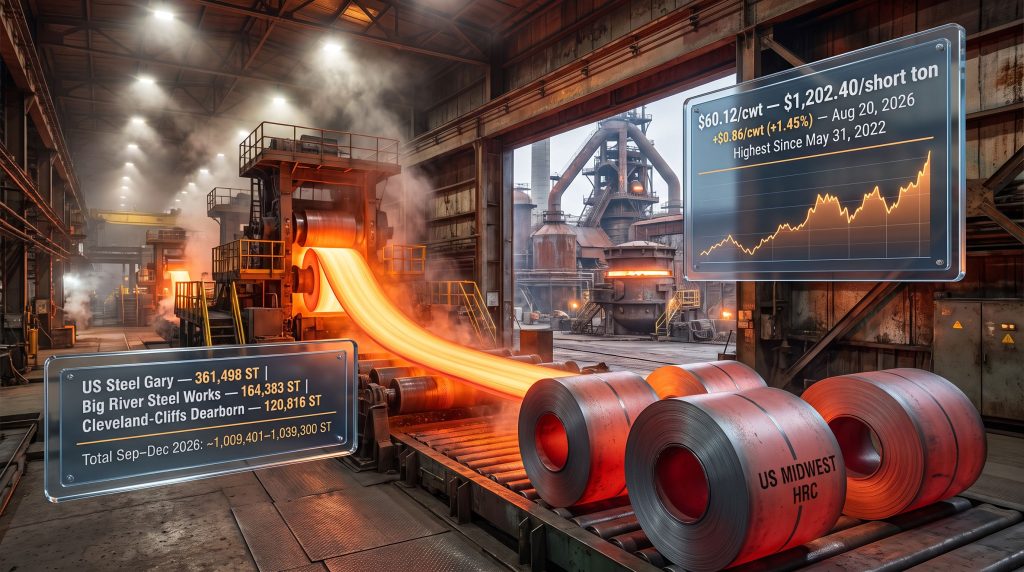
The cumulative effect of outage-driven supply reduction, low inventories, spot market withdrawal, and constrained imports produced a clear and measurable pricing outcome. As of August 20, 2026, Fastmarkets' daily steel hot-rolled coil index (fob mill US Midwest) was assessed at $60.12 per hundredweight ($1,202.40 per short ton), representing a week-on-week increase of $0.86 per cwt, or 1.45%, from $59.26 per cwt on August 13.
This price level is the highest recorded since May 31, 2022, when the index reached $60.76 per cwt during the peak of post-pandemic supply chain disruption and extraordinary demand recovery. The comparison is instructive: the conditions that drove prices to that 2022 level were extraordinary and widely recognised as temporary. The 2026 episode is being driven by a different and arguably more durable combination of structural supply constraints. In addition, understanding the broader global crude steel outlook helps contextualise why domestic US price movements are increasingly sensitive to international production shifts.
Price Snapshot: August 20, 2026
- HRC Index: $60.12/cwt ($1,202.40/short ton)
- Week-on-Week Change: +$0.86/cwt (+1.45%)
- Previous Assessment: $59.26/cwt (August 13, 2026)
- Last Comparable Level: May 31, 2022 ($60.76/cwt)
The $1,200 Psychological Ceiling and What Lies Beyond It
Market participants have long treated approximately $1,200 per short ton as an informal ceiling on domestic HRC pricing ambition. This threshold carries psychological weight precisely because it has historically functioned as a resistance level — a price point where buyer resistance, demand destruction risk, and import competitiveness have tended to converge.
The fact that this level has now been breached, even marginally, changes the psychological framing of the market. Buyers who had anchored their expectations around $1,200 as a ceiling must now recalibrate. Market participants noted that while this level had long been perceived as the upper boundary of where mills would push pricing, producers retain full discretion to seek further increases if demand conditions and supply constraints support it. Whether the current outage cycle provides sufficient justification for another leg higher will depend heavily on how quickly non-outage mills can absorb displaced demand and whether import arrivals accelerate meaningfully in October and November.
Imports: Incentivised but Structurally Limited
Why Import Relief Is Slower Than Price Signals Suggest
Rising domestic HRC prices create an obvious commercial incentive for buyers to pursue offshore supply. The widening gap between US domestic prices and imported material costs — after accounting for applicable tariffs and freight — should in theory attract significant import volumes. In practice, the structural limitations of the import channel constrain how quickly this adjustment can occur.
Several factors limit import effectiveness as a near-term supply offset:
-
Transit lead times from major export origins, including South Korea, Japan, Brazil, and European suppliers, typically run 4-10 weeks from order to port arrival, and longer to final delivery after customs clearance and inland logistics.
-
Section 232 tariff structures add meaningful cost friction to most offshore HRC supply, reducing the effective price competitiveness of imports and narrowing the arbitrage window that would attract high volumes.
-
Port and logistics capacity constraints limit how quickly large volumes of imported steel can move from vessel to warehouse to end-user. During periods of elevated import demand, scheduling backlogs at steel-receiving terminals can add weeks to effective delivery timelines.
-
Uncertainty around future trade policy can suppress import ordering even when current arbitrage conditions appear favourable, as buyers weigh the risk of higher tariffs at the time of arrival against the cost savings on offer at the time of order.
Market sentiment among distributors polled by Fastmarkets broadly reflects confidence that import volumes will not reach a scale sufficient to materially suppress domestic HRC pricing during the outage-intensive fall quarter. However, the broader tariffs and iron ore markets dynamic suggests that trade policy uncertainty is compounding the challenge for buyers seeking offshore relief.
The next major ASX story will hit our subscribers first
Downstream Exposure: Who Bears the Most Risk
Procurement Strategy Under Supply Pressure
The current environment demands a fundamentally different procurement posture from steel buyers across the downstream supply chain. The combination of 8-12 week lead times, limited spot availability, and elevated prices compresses the window for reactive purchasing to the point of near-impossibility for many buyers.
Key procurement implications for downstream industries:
-
Advance ordering necessity is no longer optional. Buyers relying on short-cycle or just-in-time purchasing face genuine material risk of supply gaps during Q4 2026.
-
Contract coverage has become a competitive differentiator. Buyers with long-term supply agreements are structurally insulated from spot market scarcity in ways that smaller, spot-reliant buyers are not.
-
Service centres that aggressively destocked now face the costly prospect of inventory rebuilding at cyclically elevated price levels, compressing margins precisely when restocking is most urgent.
-
Import sourcing offers partial relief for buyers with sufficient logistics capability and tariff tolerance, but timing mismatches between order and delivery limit its usefulness as a Q4 solution.
Downstream Sectors by HRC Dependency and Exposure
| Downstream Sector | HRC Dependency | Primary Exposure Category |
|---|---|---|
| Automotive | High | Stamped body panels, structural components |
| Capital Goods / Industrial Equipment | High | Machinery frames, fabricated structures |
| Non-Residential Construction | Moderate-High | Decking, purlins, structural sections |
| Appliances / Household Durables | Moderate | Enclosures, chassis components |
| Scrap and Recycling | Indirect | Scrap price correlation with HRC markets |
How 2026 Differs From Prior Seasonal Outage Cycles
The Amplifying Conditions That Make This Cycle Distinctive
Seasonal maintenance scheduling in the US steel industry follows a broadly predictable rhythm. Mills have historically concentrated non-essential maintenance during fall and early winter months, when construction and automotive demand patterns create a degree of natural demand softening. What distinguishes 2026 is not the scheduling of outages, but the market architecture into which they are falling.
Four amplifying conditions set this cycle apart from more typical seasonal maintenance periods:
-
Structurally low entering inventory levels across service centres mean there is far less buffer capacity available to absorb supply gaps than in a typical seasonal transition.
-
The concentration of large-capacity outages within a narrow window reduces the ability of non-outage facilities to absorb displaced demand. In a more staggered outage calendar, competing mills can often pick up incremental volumes. The September concentration largely eliminates this flexibility.
-
Upstream slab tightness has constrained integrated producers' ability to build pre-outage inventory buffers, meaning that the output gap begins immediately at outage commencement rather than being partially offset by pre-built stock.
-
The blast furnace nature of the largest single outage at US Steel Gary introduces restart timeline risk that does not apply to the EAF facilities also in the schedule, potentially extending the effective supply gap beyond the planned maintenance window.
Furthermore, the evolving steel and iron ore market conditions in China are adding another layer of complexity, as shifts in Chinese export volumes can alter the global supply balance that US buyers and importers must navigate.
Forward Outlook: Price Trajectory and Supply Recovery Scenarios
Factors That Could Sustain or Extend the Current Rally
The near-term pricing environment remains constructive for domestic HRC given the concentration of outage impacts, low inventory buffers, and limited import relief. According to industry analysts, the HRC futures curve has already repriced higher as market participants extend tightness expectations into Q3 and beyond. Several conditions could sustain or extend the current price rally beyond the outage period:
-
Blast furnace restart timelines at US Steel Gary extending beyond the planned maintenance window, prolonging the September supply gap into October.
-
Continued low service centre inventory levels requiring active restocking, supporting demand even as outage-affected mills return to production.
-
Demand stability across automotive, capital goods, and construction end markets, preventing the demand-side softening that would otherwise cap price upside.
-
Import volumes remaining below disruptive thresholds through Q4 2026, leaving domestic mills as the effective price-setters.
Conditions That Could Moderate Pricing
-
Accelerated import arrivals in October and November as offshore price differentials attract additional tonnage from key export origins.
-
Manufacturing sector weakness weighing on steel demand across rate-sensitive construction and durable goods sectors, reducing the rate of inventory consumption at service centres.
-
Non-outage mills increasing spot market participation following the September concentration, improving availability for spot buyers.
-
A service centre restocking surge creating a temporary demand air pocket once restocking is complete, generating a self-limiting ceiling on price momentum.
The medium-term capacity outlook is more balanced, with EAF expansions including Big River Steel Works' combined 6 million short ton capacity gradually adding to domestic supply. However, the timing mismatch between new capacity additions and the near-term outage-driven gaps means structural relief is unlikely to materialise quickly enough to alter Q4 2026 market conditions in any meaningful way.
Frequently Asked Questions: US HRC Mill Outages and Supply Tightness
What is causing HRC supply tightness in the US in 2026?
The tightness reflects a convergence of planned seasonal maintenance outages removing over 1 million short tons of capacity between September and December, mills withdrawing from spot sales to prioritise contracted volumes, low service centre inventory levels, and import flows that have increased but not reached volumes sufficient to offset domestic supply reductions.
How much HRC production is affected by fall-winter 2026 outages?
Market participant polling estimates a total production impact of between 1,009,401 and 1,039,300 short tons across 12 facilities scheduled for maintenance from September through December 2026, as reported by Fastmarkets.
What is the current US Midwest HRC price?
As of August 20, 2026, the Fastmarkets daily steel hot-rolled coil index (fob mill US Midwest) was assessed at $60.12 per hundredweight ($1,202.40 per short ton), the highest level recorded since May 2022. This level reflects the full weight of US HRC mill outages and supply tightness bearing down on a market that was already structurally vulnerable entering the maintenance season.
Which mills have the three largest outage impacts in the 2026 cycle?
-
US Steel Gary — 361,498 short tons (September, 21 days)
-
Big River Steel Works — 164,383 short tons (October, 10 days)
-
Cleveland-Cliffs Dearborn Hot Strip Mill — 120,816 short tons (October, 21 days)
Will imports reduce HRC prices during the outage period?
Market participants broadly expect import volumes to remain below the threshold required to meaningfully suppress domestic HRC pricing. Tariff structures, transit lead times, and logistics constraints limit the speed and scale at which offshore material can substitute for domestic spot supply during a concentrated outage window.
Disclaimer: This article contains forward-looking assessments, price projections, and market sentiment data sourced from industry polling conducted by Fastmarkets. All production impact estimates are based on market participant feedback cross-referenced against stated annual facility capacities and are subject to revision. Nothing in this article constitutes financial or investment advice. Past price levels are not indicative of future outcomes.
Want to Track the Commodity Ripple Effects of Steel Market Shifts?
Discovery Alert's proprietary Discovery IQ model scans ASX announcements in real time, instantly identifying significant mineral discoveries across iron ore, steel-linked commodities, and more than 30 other sectors — converting complex data into actionable investment insights before the broader market reacts. Explore how major resource discoveries have historically generated substantial returns on Discovery Alert's dedicated discoveries page, and begin your 14-day free trial today to position yourself ahead of the next significant market move.