August 22, 2026
The Geopolitical Anatomy of a Global Chokepoint
Every decade or so, the global energy system reveals a structural vulnerability so profound that markets, governments, and military planners are forced to confront it simultaneously. The Strait of Hormuz is not a new flashpoint, but the events of August 2026 have crystallised something that energy analysts have long understood in theory: the world's most critical petroleum corridor is only as stable as the military and diplomatic arrangements protecting it. Understanding the geopolitical oil price dynamics at play here is essential to grasping how fragile these arrangements truly are.
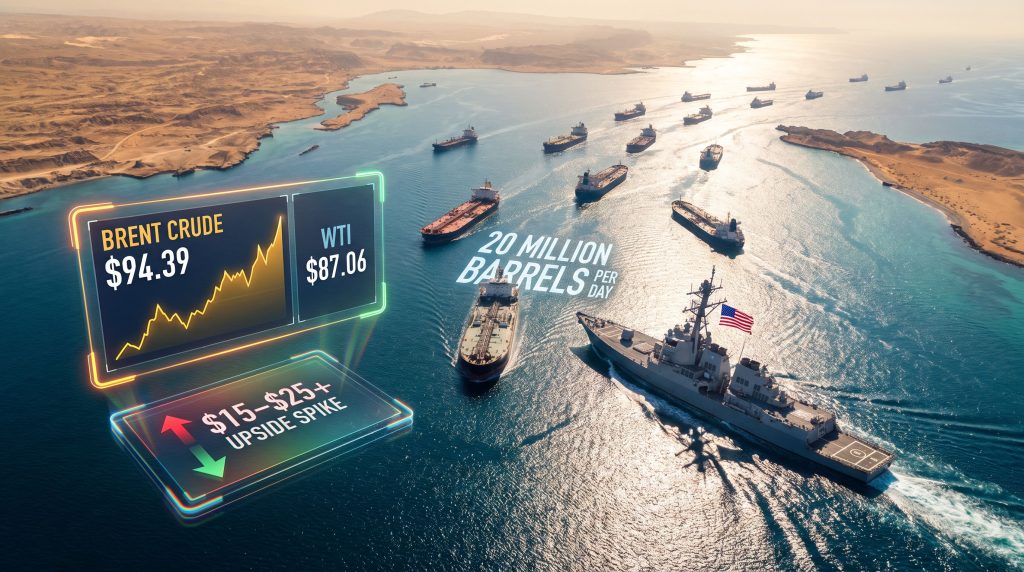
At its narrowest navigable point, the strait spans roughly 33 kilometres, connecting the Persian Gulf to the Arabian Sea. Under normal operating conditions, approximately 20 million barrels of oil and petroleum products transit this corridor each day, representing close to one-fifth of total global petroleum consumption. No other single maritime passage comes close to matching this throughput.
What makes the strait structurally irreplaceable is not merely volume, but geography. The oil-producing nations of Saudi Arabia, Iraq, the UAE, Kuwait, and Iran have no credible primary export alternative. Their petroleum reaches global markets through this single passage, which is why any instability in the region immediately registers as a supply-security event for energy importers across Asia, Europe, and beyond. For a broader crude market overview, the scale of what transits this corridor puts the stakes into sharp relief.
Why Pipeline Alternatives Cannot Bridge the Gap
A common misconception in public discourse is that overland pipeline networks could absorb the throughput if the strait were seriously disrupted. The numbers, however, tell a different story.
| Alternative Route | Operator | Maximum Capacity (bpd) | Key Limitation |
|---|---|---|---|
| Abu Dhabi Crude Oil Pipeline | ADNOC | ~1.5 million | UAE volumes only |
| Saudi Petroline (East-West Pipeline) | Saudi Aramco | ~5 million | Not universally accessible |
| Iraq-Turkey Pipeline (Kirkuk-Ceyhan) | SOMO | ~0.4-0.6 million | Frequently disrupted |
| Oman LNG Export Routes | OQ | Partial LNG only | Not applicable to crude |
Aggregating the maximum theoretical capacity across all available bypass infrastructure produces a ceiling of roughly 6 to 7 million barrels per day. Against the strait's normal throughput of 20 million barrels per day, this leaves an unbridgeable gap of 13 to 14 million barrels daily. No combination of currently available infrastructure can cover this shortfall within any operationally meaningful timeframe.
When big ASX news breaks, our subscribers know first
How the US Military Is Sustaining Oil Transit Operations
The operational reality of the current standoff is without clear historical precedent. US Energy Secretary Chris Wright publicly confirmed that on a single operational day, the US military moves 15 million barrels through Strait of Hormuz waterways, encompassing oil and petroleum products with direct military assistance. When combined with volumes routed through overland pipelines, total petroleum shipments departing the Gulf region approached 20 million barrels on that same day.
Wright also confirmed that the seven-day rolling average of oil departing the strait had climbed above 8 million barrels per day, crediting the sustained presence of the US Navy with maintaining the integrity of those flows. The significance of that attribution cannot be overstated: it represents an explicit acknowledgement that commercial tanker transit through a critical global waterway is currently dependent on active military coordination.
"Operational Clarification: US naval assets are not physically transporting crude oil. The military role involves navigational security, threat deterrence, and transit coordination that enables commercial tankers to move through the corridor without interdiction. The distinction matters for understanding the fragility of this arrangement."
The Mechanics of Nightly Tanker Transit
The operational structure enabling these flows involves a carefully managed transit regime:
- Commercial tankers are moving through a designated southern navigational lane
- Approximately 15 to 20 vessels transit the corridor each night under military coordination
- Daily export volumes under this assisted-transit arrangement average close to 10 million barrels
- Peak single-day performance has reached the 15 to 20 million barrel range under optimal conditions
This nightly convoy-style arrangement has echoes of historical precedents, most notably the US-led tanker reflagging operations during the 1980s Iran-Iraq War, when Kuwaiti tankers were reflagged under the American flag to deter Iranian interdiction. The current arrangement is operationally similar in principle, though far larger in scale and conducted without formal reflagging.
Comparing current flows to historical Hormuz throughput norms:
| Metric | Historical Norm | Current Military-Assisted Period |
|---|---|---|
| Daily throughput (strait) | ~20 million bpd | ~8-10 million bpd (7-day avg) |
| Peak single-day volumes | ~21-22 million bpd | ~15-20 million bpd |
| Pipeline supplement volumes | ~2-3 million bpd | Approaching ~5 million bpd |
| Iranian export contribution | ~2.5-3 million bpd | Sharply reduced |
Furthermore, ship traffic through Hormuz has fallen considerably in recent weeks as tensions between Washington and Tehran continue to escalate, underscoring just how precarious the current operational environment remains.
The Diplomatic Deadlock: Why Washington and Tehran Cannot Find Common Ground
The inability to reach a negotiated resolution reflects something more fundamental than tactical disagreement. The two sides are operating from structurally incompatible positions, and the current US approach has shifted decisively away from incremental engagement toward a multi-layered pressure strategy. In addition, oil market disruption risks stemming from broader geopolitical friction are amplifying the pressure on both sides to reach a resolution.
The three-pillar pressure framework being applied to Iran:
- Sanctions intensification – Expanded restrictions targeting Iranian petroleum exports, financial institutions, and third-party buyers of Iranian crude, with particular focus on Asian importers
- Naval interdiction posture – Sustained US naval presence functioning simultaneously as protection for commercial shipping and as a strategic signal to Tehran regarding the limits of its leverage
- Diplomatic isolation – Sustained efforts to constrain Tehran's access to bilateral energy arrangements with major importing nations
Tehran has maintained that it is willing to reach a negotiated outcome but has characterised the terms on offer as structurally unacceptable, particularly those touching on long-term restrictions to its nuclear programme and broader military capabilities. This framing allows Iran to maintain a public posture of diplomatic reasonableness while rejecting the substantive conditions Washington regards as non-negotiable.
"Strategic Tension: Iran's core leverage in this standoff derives from its geographic position along the strait's northern coastline and its asymmetric military capabilities, including fast-attack vessels, anti-ship missiles, and naval mine deployment. The sustained US naval presence directly neutralises that leverage but only for as long as the deployment remains politically and operationally sustainable."
What makes the current standoff particularly complex is that Iran retains meaningful escalation tools even under conditions of active US naval presence. A deliberate or even inadvertent incident involving Iranian and American forces could trigger a rapid escalation cycle that overwhelms the protective arrangements currently enabling commercial transit.
How Oil Markets Are Pricing Hormuz Risk
Energy markets have responded to the combination of improved physical flows and unresolved geopolitical tension with a pronounced risk premium embedded in benchmark crude prices. Brent crude closed the most recent trading week at approximately $94.39 per barrel, representing a weekly gain of 6.6%. West Texas Intermediate settled at $87.06 per barrel over the same period.
The behaviour of these prices reveals something important about how sophisticated energy traders are interpreting the situation. Despite evidence that more oil is physically exiting the Gulf than in earlier phases of the standoff, prices have continued to rise. This apparent paradox reflects a critical insight about market psychology in geopolitical risk events. Consequently, understanding oil's global importance to pricing dynamics has never been more relevant for investors and policymakers alike.
"Market Signal: Traders are not pricing current supply conditions. They are pricing the fragility of those conditions and assigning probability to future disruption scenarios. Improved flows maintained through military assistance are, paradoxically, a signal of structural vulnerability rather than stability."
Scenario analysis: How different diplomatic and military outcomes could reshape crude pricing:
| Scenario | Probability Assessment | Brent Price Implication |
|---|---|---|
| US-Iran diplomatic breakthrough | Low-Medium | $10-$15/bbl downside (risk premium unwind) |
| Status quo maintained (military-assisted flows) | Medium-High | Prices consolidate in $88-$96/bbl range |
| Renewed Hormuz disruption or escalation | Low-Medium | $15-$25+/bbl upside spike |
| Iranian export restoration under partial deal | Medium | $8-$12/bbl downside |
The dual dynamic creating sustained price pressure involves improving physical flows occurring simultaneously with growing market awareness that those flows are contingent on continued military engagement. Professional energy traders understand that the termination or degradation of the naval deployment, for any reason, would immediately shift the supply balance.
The Structural Fragility of Military-Dependent Energy Corridors
The current operational model represents something genuinely unusual in the history of global energy supply chains: the routine commercial transit of petroleum through a critical international waterway is contingent on the active deployment of a foreign military force. Energy security analysts have long identified this configuration as a systemic vulnerability, not a durable solution.
Four dimensions of structural risk in the current arrangement:
- Political sustainability – Domestic political dynamics in the United States can shift rapidly, altering the appetite for sustained naval deployments, particularly if the operation extends without a defined diplomatic horizon
- Escalation risk – Any incident involving US naval assets and Iranian military forces, even an unintended collision or missile proximity event, could trigger escalation that disrupts the very flows the deployment is protecting
- Commercial insurance and freight costs – Tanker operators and cargo insurers are applying elevated war-risk premiums to Gulf transits, increasing the effective landed cost of crude even when physical flows are maintained
- Buyer diversification acceleration – Major Asian importers, including China, India, South Korea, and Japan, are actively accelerating contingency planning to reduce structural dependency on Gulf petroleum supplies
The war-risk insurance dimension deserves particular attention because it operates largely below public awareness. Even when tankers are transiting successfully under military protection, underwriters pricing war-risk coverage for Gulf voyages are incorporating scenario probabilities that inflate premium costs substantially. These elevated insurance costs flow through to the effective delivered price of crude, creating an invisible but real cost layer on top of the benchmark price signals that dominate market reporting.
Iranian Export Decline and Its Effect on Global Supply Balances
The reduction in Iranian petroleum export volumes has removed a meaningful supply contribution from global markets at a structurally consequential moment. Iranian crude exports have fallen well below their recent recovery-era levels, with the combination of intensified US sanctions enforcement, buyer risk aversion among Asian refiners, and transit uncertainty compressing Tehran's ability to monetise its reserves.
Key supply-side variables interacting with the current disruption:
- Iranian export volumes are estimated to have declined by 1 to 2 million barrels per day from recent recovery peaks
- OPEC's market influence is central to whether members with meaningful spare capacity, particularly Saudi Arabia and the UAE, choose to offset Iranian losses or allow prices to remain elevated
- US shale producers receive a strong price signal incentivising accelerated output, but face infrastructure bottlenecks and capital discipline constraints that limit immediate response capacity
- Global strategic petroleum reserves, including the US Strategic Petroleum Reserve, have been significantly drawn down in recent years, reducing their available shock-absorption capacity
The OPEC+ dimension is particularly nuanced. Saudi Arabia and the UAE possess the technical spare capacity to partially offset Iranian losses, but doing so would relieve the price pressure that currently benefits their own fiscal positions. The absence of a coordinated SPR release or OPEC+ compensatory production increase suggests that major producers are, at minimum, not in a hurry to reduce the prevailing price level.
The next major ASX story will hit our subscribers first
The Long-Term Strategic Calculus: Structural Shifts Accelerating Beyond the Crisis
Perhaps the most consequential long-term effect of the current standoff will not be measured in disrupted barrels but in the strategic decisions being made in energy ministries and corporate boardrooms across Asia. The Hormuz crisis is accelerating several structural shifts in global energy trade that were already underway before the confrontation reached its current intensity.
Key structural transitions being accelerated by the current standoff:
- Strategic supply diversification – Major Asian importers, including Japan, South Korea, India, and China, are accelerating formal contingency frameworks to reduce exclusive Gulf dependency
- Alternative corridor investment – Renewed capital interest in East African LNG, expanded US Gulf Coast export infrastructure, and Central Asian pipeline networks is being driven by the current crisis
- Elevated persistent freight costs – War-risk insurance premium structures applied to Gulf-origin crude may persist for years after the immediate crisis resolves, permanently altering the competitive economics of Middle Eastern versus non-Middle Eastern supply
- Domestic energy transition arguments – Political arguments for accelerated domestic energy transition investment as a national security hedge are gaining traction in importing nations that have historically resisted them
"Forward-Looking Assessment: The resolution of the current US-Iran standoff, whether through diplomatic breakthrough or sustained military presence, will not eliminate the underlying structural vulnerability that the Strait of Hormuz represents. As long as global petroleum consumption remains at current levels, this chokepoint risk remains a permanent feature of the energy security landscape."
FAQ: Understanding the Strait of Hormuz and Its Energy Market Implications
How many barrels of oil transit the Strait of Hormuz under normal conditions?
Under pre-crisis conditions, approximately 20 million barrels of oil and petroleum products moved through the strait daily, representing roughly 20% of global petroleum consumption and an estimated 25 to 30% of globally traded liquefied natural gas.
Is the US military physically transporting crude oil through the strait?
No. US naval assets are providing security coordination, navigational protection, and deterrence operations. The physical movement of petroleum remains the responsibility of commercial tanker operators working within the protective framework the military presence creates.
What would a full closure of the Strait of Hormuz mean for oil prices?
A complete and sustained closure lasting more than two to four weeks would constitute the most severe single supply shock in modern energy market history. Analyst estimates suggest Brent crude could exceed $130 to $150 per barrel depending on the speed of strategic reserve releases and demand-destruction responses.
Why can't existing pipeline infrastructure replace Hormuz capacity?
Available bypass pipeline infrastructure has a combined maximum theoretical capacity of approximately 6 to 7 million barrels per day, compared to the strait's normal 20 million barrel per day throughput. The gap of 13 to 14 million barrels per day cannot be bridged by any currently available infrastructure.
Which countries face the greatest exposure to a prolonged Hormuz disruption?
- Japan – imports approximately 90% of its crude from the Middle East, with the majority transiting the strait
- South Korea – similarly concentrated Gulf crude dependency with limited short-term diversification capacity
- India – a major and growing importer of Gulf crude, actively pursuing diversification but still significantly exposed
- China – the world's largest crude importer, with significant Gulf exposure but also the most advanced diversification strategy, including expanded Russian pipeline supply
How long can the US military sustain its current Hormuz escort operations?
No publicly defined operational timeline exists. The sustainability of the deployment depends on a combination of strategic priorities, allied burden-sharing arrangements, domestic political support in the United States, and the trajectory of diplomatic engagement with Tehran. This unresolved question is precisely what keeps energy markets in a sustained state of risk-premium pricing.
Want to Know Which ASX Resource Stocks Could Benefit From Rising Oil-Driven Market Volatility?
Discovery Alert's proprietary Discovery IQ model scans ASX announcements in real time, instantly identifying significant mineral discoveries across more than 30 commodities — turning complex market signals into actionable investment opportunities at a time when energy security concerns are reshaping global capital flows. Explore historic examples of major discovery returns and begin your 14-day free trial today to position yourself ahead of the broader market.