August 22, 2026
The Global Oil Network Is Already Breaking — Hormuz Just Made It Visible
Every engineer knows that complex systems rarely fail at their weakest point in isolation. They fail because stress applied to one node propagates outward through every interconnected pathway simultaneously. The global maritime oil transit network is exactly such a system, and the near-closure of the Strait of Hormuz since late February 2026 has demonstrated this principle with brutal precision. The question worth examining now is not what happened to Hormuz — it is what happened to everything else, and why the aggregate picture is considerably more fragile than any individual chokepoint assessment suggests.
Understanding global oil chokepoints after Hormuz closure requires thinking in terms of displacement cascades rather than isolated events. When a single transit corridor handling roughly one-fifth of global oil and LNG flows contracts dramatically, the displaced volume does not disappear. It concentrates pressure on every remaining narrow passage simultaneously, compressing freight margins, inflating insurance spreads, and collapsing scheduling windows across multiple continents at once.
When big ASX news breaks, our subscribers know first
What the Volume Collapse Actually Means for the Rest of the System
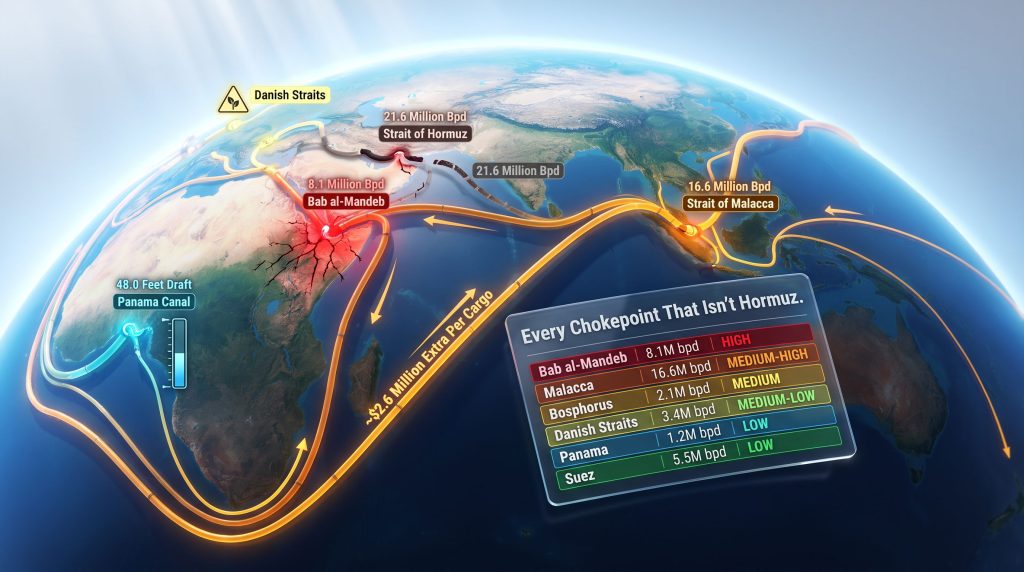
The Strait of Hormuz carried approximately 21.6 million barrels per day in the fourth quarter of 2025. By the second quarter of 2026, the U.S. Energy Information Administration recorded only 4.9 million bpd transiting the strait — a collapse of roughly 16.7 million bpd in under six months. Iran's parliament speaker Mohammad Baqer Qalibaf stated in June that management of the strait would not revert to its pre-war configuration, which represents one of the clearest forward guidance signals Tehran has issued on the subject.
The bypass architecture theoretically available to Gulf exporters cannot remotely absorb this displacement. Furthermore, crude oil price trends have reflected this structural shortfall in ways that extend well beyond a simple supply shock:
| Bypass Route | Operator | Estimated Capacity (bpd) | Capacity Gap vs. Pre-Closure Hormuz |
|---|---|---|---|
| Saudi East-West Pipeline (to Yanbu) | Saudi Aramco | ~5 million | ~16.6 million unmet |
| UAE Habshan-Fujairah Pipeline | ADNOC | ~1.5 million | Partial relief only |
| Combined Bypass Capacity | — | ~6.5 million | ~15+ million unaccounted |
The arithmetic is unambiguous. Even with both major overland bypass pipelines operating at full capacity, more than 15 million bpd of former Hormuz volume has no viable non-maritime alternative. That gap has to move through other sea lanes or it does not move at all, and the consequences of this structural shortfall are now visible across every major transit corridor on the planet.
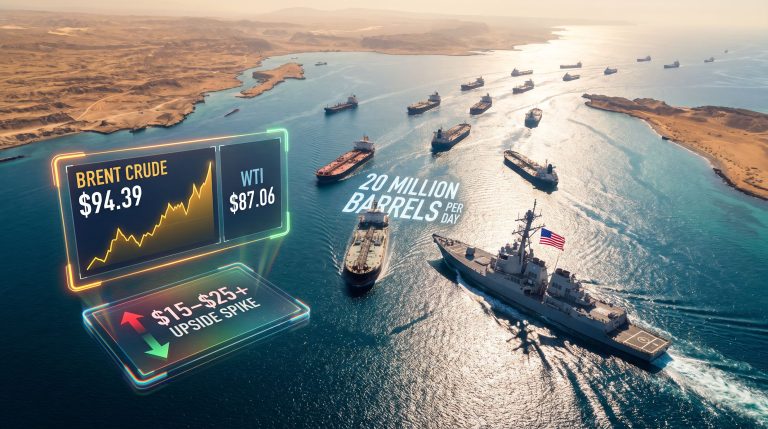
Brent crude settled around $91.62 and WTI around $85.56 as of mid-August 2026, with a meaningful component of that premium representing pure rerouting cost rather than any underlying shift in supply fundamentals.
Bab al-Mandeb: The Secondary Chokepoint That Doubled and Then Got Blockaded
Saudi Arabia's response to the Hormuz crisis was logistically decisive. Riyadh redirected its export machine approximately 800 miles westward, pivoting crude shipments away from Gulf loading terminals and through the East-West pipeline to Yanbu on the Red Sea coast. The results were remarkable in scale:
- Yanbu loading volumes escalated from approximately 240,000 bpd in mid-2025 to an estimated 3.5 million bpd by June 2026
- Bab al-Mandeb throughput climbed from 4.2 million bpd in the first half of 2025 to 8.1 million bpd in the second quarter of 2026
- The strait, an 18-mile passage between Yemen and Djibouti, effectively doubled its throughput in under a year
Then, on July 20, Houthi forces declared a maritime blockade of Saudi Arabia. The tactical mechanics of their enforcement are more sophisticated than early reporting suggested. Houthi-controlled territory sits approximately 100 kilometres from the strait itself rather than commanding the waterway directly, yet vessel tracking data shows the blockade is being enforced selectively based on crew nationality and vessel ownership rather than cargo content. Two Chinese-crewed tankers loaded with Saudi crude cleared the strait without incident in late July, illustrating the calibration logic at work.
Analytical note: This selective enforcement pattern represents a significant evolution in maritime chokepoint disruption tactics. Rather than attempting physical closure, Houthi forces are applying ownership-discriminating pressure that forces specific flag states and shipping companies into costly detour decisions while allowing others to transit freely.
The Cape of Good Hope bypass costs approximately $2.6 million per cargo in additional fuel and fees, adding 10 to 14 days and around 3,500 nautical miles. One Saudi cargo rerouted via the Cape was costed by Reuters at roughly $1.6 million in additional fuel plus $1 million in canal fees through Suez — and Suez itself carries constraints. The EIA has characterised the northern Suez-Sumed alternative as taking longer, costing more, and offering less capacity than direct transit, which is the technical way of stating that no good answer exists.
Traceable transits through Bab al-Mandeb fell to 200 in the week of August 3, the lowest weekly count recorded in a year, with a growing proportion of remaining traffic operating without transponders. This, consequently, exemplifies the broader oil market disruption now rippling outward from a single strategic theatre.
The Strait of Malacca: How Closing a Gulf Strait Throttles an Asian One
The Strait of Malacca is the world's largest oil chokepoint by volume, a fact that rarely appears in Hormuz-centric coverage. According to the EIA's analysis of world oil transit chokepoints, it narrows to 1.7 miles at the Phillips Channel near Singapore and carried 23.2 million bpd through the first half of 2025. Approximately 94,000 vessels transited in 2024, carrying roughly a quarter of all goods traded globally.
By the second quarter of 2026, that figure had contracted to 16.6 million bpd — a reduction of more than 6.5 million bpd without any physical event occurring in the strait itself. The explanation is structural: most crude crossing Malacca originates in the Persian Gulf and had previously transited Hormuz. Close Hormuz, and Malacca volumes contract automatically as a downstream consequence.
Why China's Energy Dependency Makes This Critical
China's vulnerability here is the central strategic exposure in the Indo-Pacific energy picture. Approximately 80 percent of China's imported crude travels through the Malacca Strait, a dependency so well understood that Beijing coined the phrase Malacca dilemma more than two decades ago. The US-China oil price impact from this bottleneck continues to shape diplomatic calculations at the highest levels. Three bypass options exist, all controlled by Indonesia:
| Bypass Route | Depth Suitability | VLCC Compatible | Additional Cost/Time | Controlling State |
|---|---|---|---|---|
| Sunda Strait | Shallow, volcanic hazard | No | Not viable for loaded VLCCs | Indonesia |
| Lombok Strait | Deep water | Yes | +7–8 days, ~$472,000/voyage | Indonesia |
| Ombai-Wetar Passage | Deep water | Yes | Extended routing, higher cost | Indonesia |
Indonesia's strategic position here is genuinely unusual. It controls a meaningful share of the primary route through its territorial waters, and it simultaneously controls both viable deep-water bypasses — a configuration no other littoral state in this analysis enjoys. Indonesia's finance minister tested this leverage in 2026 by floating a transit fee proposal, drawing direct comparisons to Iran's approach in Hormuz. Kuala Lumpur and Singapore rejected the proposal immediately and Jakarta withdrew it within days, but the episode signals that transit-fee nationalism is spreading as a concept.
Piracy compounds the picture. Incidents across the Malacca and Singapore straits reached 108 in 2025, a 74 percent increase and the worst total in 19 years. The incidents are predominantly opportunistic theft rather than strategic disruption, but they contribute to the insurance cost architecture that is already elevated across all major Asian transit corridors.
The Turkish Straits: Legally Open, Physically Stressed
The Bosphorus and Dardanelles together moved 4.1 million bpd in the second quarter of 2026, up from 3.7 million in the first half of 2025. More than 40,000 ships transited the Bosphorus in the previous year, threading a channel that narrows to 750 metres with Istanbul's 16 million residents on both banks.
The 1936 Montreux Convention guarantees free passage for commercial vessels in peacetime. Turkey's legal authority extends to warships and safety regulations — single-hull tankers have been barred since 2008, and nighttime restrictions apply to vessels over 200 metres — but the passage remains constitutionally open to merchant traffic. Turkey could not close it to commercial shipping under current treaty obligations even if it chose to.
Where the Real Constraints Lie
The constraint is not the strait. It is the infrastructure at the other end:
- Ukrainian drone strikes have targeted the Sheskharis terminal at Novorossiysk, which previously handled approximately 650,000 bpd and about a fifth of Russia's seaborne crude
- The terminal suspended operations from July 21 following sustained strike activity
- The Caspian Pipeline Consortium terminal nearby, which processes more than 80 percent of Kazakhstan's oil exports and close to 2 percent of world supply, absorbed sufficient damage to trigger Kazakhstani production cuts
- In early August, Turkey quietly began slowing transit permits for Novorossiysk-bound vessels — a technically Montreux-compliant step that nonetheless functions as policy signalling
Kazakhstan has the Baku-Tbilisi-Ceyhan pipeline as a genuine bypass, routing Caspian crude to Turkey's Mediterranean coast without touching the Black Sea. Russian crude loading at Black Sea ports has no equivalent alternative. There is no workaround. Canal Istanbul, the proposed $25 billion parallel waterway that would operate outside Montreux and give Ankara actual leverage over the corridor, remains unbuilt after a decade of discussion.
The Danish Straits: A 19th-Century Treaty Meets a 21st-Century Shadow Fleet
Approximately 60 percent of Russia's seaborne crude exits through three shallow channels between the Baltic and the North Sea — the Great Belt, the Øresund, and the Little Belt. All three are administered by Denmark, an EU and NATO member state with compelling strategic reasons to exercise influence over what passes through its waters.
The Copenhagen Convention of 1857, signed when Denmark was still extracting tolls from irritated maritime powers, guarantees free passage and prohibits Denmark from levying fees. The treaty predates the supertanker era by a century.
Regulatory note: The 1857 Copenhagen Convention created what is arguably the most anomalous jurisdictional situation in modern maritime law — an EU and NATO member state administering one of Europe's most strategically sensitive waterways under a 19th-century commercial framework that strips it of meaningful enforcement authority over sanctioned cargo.
The numbers illustrate the problem:
- Denmark's maritime authority recorded 292 voyages by EU-sanctioned tankers through its waters in 2025
- Approximately 175 shadow fleet tankers transit monthly, with an average fleet age of 17 years
- Vessels routinely operate with transponders disabled and carry insurance coverage inadequate for a significant spill event
- Volumes held relatively stable at 4.7 million bpd last quarter versus 4.9 million in the first half of 2025
Denmark's available enforcement tools reduce to environmental and port-state inspections at the Skagen anchorage and sulfur monitoring equipment installed on the Great Belt bridge. These measures are genuinely constrained — they can identify non-compliant vessels but provide limited basis for blocking their passage.
The latent risk here is not closure. It is a casualty event. A serious spill in a shallow, enclosed sea like the Baltic would generate cleanup costs measured in decades and environmental damage running into tens of billions of euros. The precedent exists: in December 2024, two shadow fleet tankers broke apart in a Black Sea storm and produced the worst spill the region had seen in this century. The Baltic's geography — shallower, more enclosed, and biologically more sensitive than the Black Sea — would amplify such an event considerably.
The next major ASX story will hit our subscribers first
Panama: The Chokepoint That Doesn't Need an Enemy
Every other corridor in this analysis faces a human adversary. Panama's binding constraint is the hydrological cycle, which has the advantage of being forecastable and the disadvantage of being unresponsive to negotiation.
The canal is a freshwater system operating 85 feet above sea level, fed by Gatun Lake. Every vessel transit drains tens of millions of gallons to sea through the lock system. Sustained rainfall replenishes the reservoir; prolonged drought triggers draft restrictions that reduce cargo capacity and eventually limit transit slots.
| Date | Maximum Draft Restriction | Gatun Lake Level |
|---|---|---|
| July 3, 2026 | 49.5 feet | Elevated |
| July 24, 2026 | 49.0 feet | Declining |
| August 15, 2026 | 48.5 feet | ~84 feet |
| August 26, 2026 | 48.0 feet | Approaching 84 feet |
| September 3, 2026 | 47.5 feet | Projected ~83 feet |
Maximum draft has been reduced five times since early July 2026. NOAA places the probability of a very strong El Niño event materialising by late 2026 at 81 percent. During the 2023–24 drought, daily transit slots fell from 36 to 24 and then to 18, draft limits dropped to 44 feet, Gatun Lake bottomed at 79.6 feet, and major carriers diverted to alternative routes.
What Metric Matters Most?
The critical metric to monitor is not draft depth — it is the daily transit slot count, currently holding at 36. Draft restrictions increase per-cargo costs. Slot reductions eliminate scheduling certainty and force carriers to reroute entirely, with Cape Horn adding approximately 8,000 nautical miles as the primary alternative.
Panama's cargo profile matters here. The canal handles primarily refined products and LPG rather than crude — predominantly U.S. Gulf barrels moving to Asian and Pacific South American markets. Fiscal 2025 generated 13,404 transits and $5.7 billion in revenue. The $1.6 billion Rio Indio reservoir project, which would provide meaningful drought buffering, will not be operational before 2031, leaving the current El Niño cycle entirely unmitigated by new infrastructure.
Comparative Vulnerability: Six Chokepoints Ranked Under Post-Hormuz Conditions
| Chokepoint | Current Volume (Q2 2026) | Closure Risk Level | Bypass Quality | Geopolitical Complexity | Environmental Fragility |
|---|---|---|---|---|---|
| Bab al-Mandeb | 8.1 million bpd | High (active blockade) | Poor (Cape adds 14 days) | Very High | Moderate |
| Strait of Malacca | 16.6 million bpd | Low (no active threat) | Limited (Lombok: +$472K) | Moderate-High | Moderate |
| Turkish Straits | 4.1 million bpd | Very Low (treaty-protected) | None for Russian crude | High (Ukraine conflict) | Low |
| Danish Straits | 4.7 million bpd | Very Low (treaty-constrained) | None for Baltic crude | Moderate (shadow fleet) | Very High |
| Panama Canal | 3.2 million bpd | Low-Moderate (weather) | Poor (Cape Horn: +8,000nm) | Low | Moderate |
| Suez Canal | 5.8 million bpd | Moderate (Red Sea risk) | Sumed pipeline (limited) | High | Low |
Systemic Implications: What the Chokepoint Premium Tells Us About Price Floors
The Brent and WTI premiums embedded in current pricing are not purely a Hormuz risk calculation. They reflect a distributed rerouting cost that is now structurally embedded across the entire maritime oil network. Jeff Currie, one of the most closely followed commodity analysts in the energy sector, has argued publicly that the more significant market stress lies not in crude benchmarks but in refined product markets — with diesel potentially reaching levels that would dwarf current crude price concerns.
Distillate stocks have been declining steadily, and the rerouting of crude through longer, more expensive pathways reduces refinery scheduling efficiency, compressing product availability independently of headline crude prices. In addition, the OPEC market influence on production decisions has become increasingly entangled with these logistical constraints, making coordinated responses far more difficult to calibrate.
Freight and insurance markets are functioning as leading indicators in this environment. Supertanker rates reached record highs as the Middle East supply disruption escalated, with the War Risk Insurance premium for vessels transiting the Red Sea and Persian Gulf approaching levels that make some voyages economically marginal regardless of cargo value.
Strategic petroleum reserve drawdown calculus becomes relevant when physical market stress — rather than price levels alone — triggers intervention thresholds. Consuming nations face a more complex decision than in previous disruption cycles because the stress is distributed across multiple corridors simultaneously rather than concentrated at a single point that a coordinated release could address.
The infrastructure investment gap underlying all of this is not new, but the Hormuz closure has made it impossible to ignore. The geopolitical oil logistics framing that analysts have long applied to individual chokepoints must now be applied to the entire network simultaneously. Pipeline bypass capacity has not kept pace with chokepoint risk accumulation over the past two decades, and the Saudi East-West pipeline and UAE Habshan-Fujairah pipeline's combined capacity of roughly 6.5 million bpd against a 21.6 million bpd Hormuz baseline reveals how inadequate that redundancy actually is under full-closure conditions.
The Taiwan Strait: The Scenario Nobody Wants to Model
The Taiwan Strait carries no meaningful independent oil volume, which is precisely why it rarely appears in chokepoint analyses. What it does carry is the routing architecture for crude moving from Malacca northward to Japan, South Korea, and northeastern China. A disruption scenario in the Taiwan Strait would not stress a single chokepoint — it would simultaneously impair the delivery endpoints for volumes already under pressure from Hormuz, Malacca, and Bab al-Mandeb.
The compounding effect would make every other stress scenario currently active look manageable by comparison. As the Brookings Institution's analysis of the Strait of Hormuz and global oil markets has noted, chokepoint crises rarely resolve in isolation — they interact with adjacent vulnerabilities in ways that amplify the aggregate impact.
Key Takeaways for Tracking the Post-Hormuz Chokepoint Landscape
The forward indicators that matter most across this system are not volume figures. They are availability ratios: bypass capacity relative to diverted flow, transit slot counts relative to demand, lake levels relative to minimum operational thresholds, and shadow fleet incident rates relative to inspection enforcement capacity.
- Hormuz's contraction from 21.6 million bpd to 4.9 million bpd created a displacement cascade that is now visible across five continents
- No single bypass route or pipeline combination can absorb the volume gap — the system is absorbing stress through distributed degradation, not substitution
- Bab al-Mandeb doubled its throughput and immediately faced an active selective blockade, creating the most acute near-term closure risk in the system
- Malacca's decline from 23.2 million to 16.6 million bpd is the clearest measurable downstream consequence of the Gulf closure visible in transit data
- The Danish Straits carry the highest latent environmental risk, where treaty constraints prevent effective oversight of an ageing shadow fleet in a biologically sensitive enclosed sea
- Panama's weather-driven draft restrictions introduce a non-geopolitical fragility layer that operates entirely independently of conflict dynamics and cannot be resolved through diplomatic channels
- The ratio of available bypass capacity to diverted flow is deteriorating across all major chokepoints simultaneously — this is the structural condition that global oil chokepoints after Hormuz closure will continue to reflect for the foreseeable future
This article contains forward-looking analysis, scenario modelling, and assessments of geopolitical risk. Such analysis involves inherent uncertainty and should not be construed as investment advice. Energy market conditions, transit volumes, and geopolitical situations can change rapidly and materially.
Want to Stay Ahead of the Next Major Resource Discovery Before the Market Catches On?
As geopolitical disruption reshapes global energy flows and commodity markets face mounting structural pressure, identifying transformative mineral discoveries early has never been more critical. Discovery Alert's proprietary Discovery IQ model delivers real-time ASX mineral discovery alerts, turning complex data across more than 30 commodities into clear, actionable insights — explore historic discoveries and their returns to understand the opportunity, then begin your 14-day free trial to position yourself ahead of the market.