July 21, 2026
The Hidden Physics of Gas Cap Reservoirs and Why They Get Left Behind
In offshore hydrocarbon development, the sequence of resource extraction is rarely arbitrary. Engineers and reservoir specialists routinely make deliberate choices about which fluids to produce first, and in giant carbonate fields across the Middle East, oil has almost always taken precedence. The gas sitting above the oil column in what geologists call the gas cap has historically been treated as a pressure-maintenance mechanism rather than a commercial resource in its own right. That logic made sense for decades. It no longer does.
The physics underlying gas cap reservoirs is worth understanding, because it explains why so many of the world's largest offshore fields have left enormous volumes of gas untouched for generations. A gas cap forms when lighter hydrocarbons migrate upward through porous rock and accumulate above the denser oil zone. This natural stratification creates reservoir pressure that drives oil toward producing wells. Producing the gas cap prematurely collapses that pressure support, potentially damaging oil recovery rates.
Managing both resources simultaneously requires sophisticated reservoir modelling, directional drilling precision, and carefully sequenced production schedules that were simply not economical or technically feasible in earlier eras.
That technical threshold has now shifted, and the ADNOC Umm Shaif gas cap development illustrates exactly what becomes possible when reservoir science, capital availability, and energy policy imperatives converge at the right moment.
When big ASX news breaks, our subscribers know first
What Makes the Umm Shaif Field Uniquely Complex to Develop
A Six-Decade Oil Producer Now Entering a New Extraction Phase
Discovered in 1958, Umm Shaif holds the distinction of being Abu Dhabi's longest continuously operating offshore field. For more than six decades, the asset has delivered oil production, earning its place as a foundational pillar of the emirate's hydrocarbon wealth. As recently as 2022, ADNOC committed $946 million toward sustaining and extending long-term oil production at the field, demonstrating that the oil column itself still commands significant commercial attention.
What has changed is the recognition that the gas accumulation overlying that oil column represents a discrete and now-developable resource. The target formations are the Khuff and Uweinat, two carbonate reservoir intervals that hold the bulk of the gas cap volume. These are not shallow, easily accessible reservoirs. Khuff carbonates in particular are among the deepest and highest-pressure gas-bearing formations in the Arabian Gulf, typically requiring specialised well designs, metallurgy resistant to hydrogen sulphide exposure, and completion strategies that can handle high bottomhole pressures and temperatures.
Why the Timing of This Investment Cannot Be Separated from Reservoir Physics
One of the less-discussed dimensions of the ADNOC Umm Shaif gas cap development is the reservoir pressure timeline. The Khuff and Uweinat formations are subject to natural pressure depletion, and modelling suggests that reservoir pressure in these intervals is forecast to decline materially before the end of 2028 if development action is not taken. This is not a commercial observation — it is a geological constraint.
A final investment decision in July 2026 positions the project to mobilise infrastructure, award contracts, complete drilling, and begin ramping production in a sequence that intercepts the remaining pressure window before it closes. Miss that window, and the economics of gas extraction change fundamentally because more compression infrastructure becomes necessary, well deliverability rates fall, and the cost per unit of gas produced rises. The urgency embedded in this FID is therefore partly geological, not just strategic.
Breaking Down the $6.2 Billion Capital Commitment
Infrastructure, Drilling, and the Role of Three EPC Packages
The financial structure of the ADNOC Umm Shaif gas cap development reflects the complexity of large-scale offshore gas projects. Furthermore, the commodity price impact on project economics makes the capital allocation decisions all the more significant. The total $6.2 billion final investment decision is allocated across two primary categories:
| Investment Component | Allocated Capital | Scope |
|---|---|---|
| Offshore EPC Contracts (x3) | $5.1 billion | Large-scale offshore infrastructure packages |
| Drilling Program | $365 million | 14-well campaign over 18 months |
| Total Project FID | $6.2 billion | Full Umm Shaif Gas Cap development |
The three engineering, procurement, and construction contracts totalling $5.1 billion represent the backbone of the project's physical infrastructure. In offshore gas development, EPC contracts of this scale typically encompass wellhead platforms, processing topsides capable of handling raw gas separation and dehydration, subsea pipeline systems, gas compression modules, and the interconnecting infrastructure needed to route product from the wellhead to an export terminal.
At Umm Shaif, that export pathway already exists in the form of established pipeline infrastructure connecting to Das Island, which meaningfully reduces greenfield construction risk and capital outlay compared to a standalone development.
The 14-Well Drilling Campaign: Execution Model and Cost Logic
The $365 million drilling program is structured around a 14-well campaign to be executed by ADNOC Drilling across an 18-month window using three existing rigs. Several aspects of this design are worth noting:
- Using existing rigs eliminates the lead time and day-rate premium associated with procuring new drilling assets in a tight market
- An integrated drilling services model, where ADNOC Drilling provides both the rig and associated services under a single contract, compresses coordination costs and reduces the interface risk between multiple contractors
- The 18-month execution window is aggressive for a 14-well deepwater-capable programme, implying continuous rig operations with minimal downtime between wells
- The per-well economics work out to approximately $26 million per well, which is competitive for high-pressure carbonate gas wells in the Arabian Gulf
Production Targets and What 600 MMcfd Actually Means
Contextualising Output Against UAE National Consumption
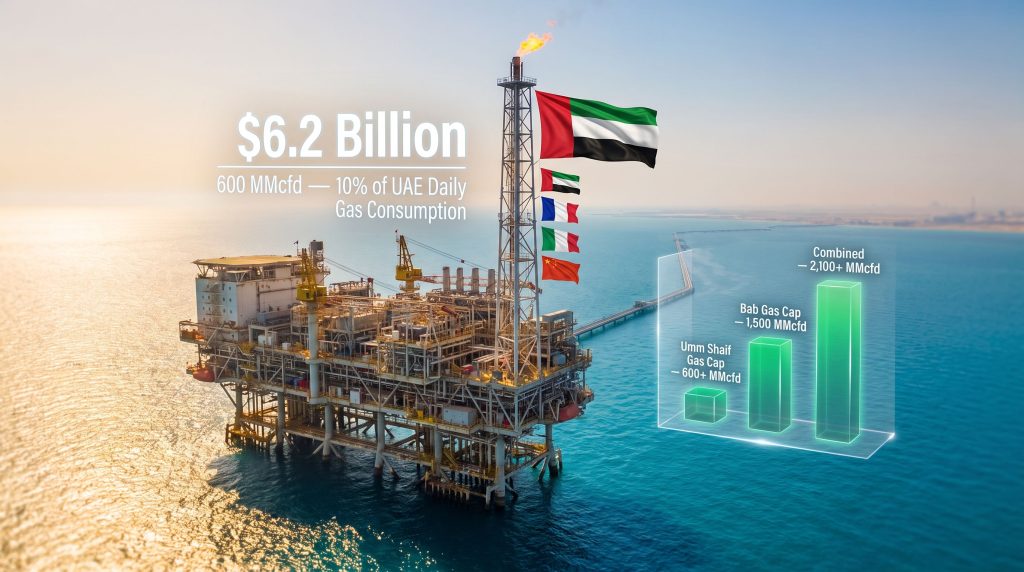
The development is projected to deliver more than 600 million standard cubic feet per day of natural gas, along with associated gas liquids that include approximately 50,000 barrels per day of condensate. The gas volume alone is equivalent to roughly 10% of the UAE's current total daily gas consumption, which provides immediate context for why this project matters beyond ADNOC's corporate strategy.
The UAE has historically faced a structural domestic gas deficit. Despite sitting atop vast hydrocarbon reserves, the country has relied on gas imports, most notably through the Dolphin Pipeline from Qatar, to meet industrial, power generation, and desalination demand. Each new increment of domestic gas production reduces that import dependency and improves the UAE's energy trade balance. Consequently, projects of this nature are central to how global energy markets are reshaping supply relationships across the Gulf region.
Associated Condensate: The Underappreciated Revenue Stream
Gas cap developments in carbonate reservoirs frequently yield significant volumes of natural gas liquids alongside the dry gas stream. At Umm Shaif, the associated condensate production of around 50,000 barrels per day is commercially significant in its own right. Condensate commands pricing closer to light crude than to pipeline gas, and it can be exported through existing liquid handling infrastructure at Das Island. For a project of this scale, condensate revenue provides a meaningful hedge against periods of lower gas pricing, improving overall project economics and payback timelines.
The International Consortium Behind the Development
Partner Structure and Strategic Rationale
| Partner | Headquarters | Role in Project |
|---|---|---|
| ADNOC | Abu Dhabi, UAE | Operator |
| TotalEnergies | Paris, France | International equity partner |
| Eni | Rome, Italy | International equity partner |
| CNPC | Beijing, China | International equity partner |
The composition of this consortium is not incidental. TotalEnergies brings deep carbonate reservoir expertise and a track record in high-pressure, high-temperature gas development across the Middle East and North Africa. Eni contributes offshore development capabilities and is a strategic buyer of Middle Eastern gas for European markets. CNPC's participation reflects China's ongoing effort to secure upstream gas equity stakes across producing regions, providing long-term supply optionality for a market that is aggressively expanding LNG import infrastructure.
For ADNOC, the consortium structure achieves multiple objectives simultaneously. It distributes capital risk across creditworthy international partners, embeds technical expertise into the project governance structure, and creates commercial relationships with end-market buyers in Europe and Asia. In addition, the role of geopolitical supply diversification is clearly evident in the deliberate selection of partners spanning three continents.
The presence of both European and Chinese equity partners in a single offshore gas project signals that ADNOC is deliberately positioning Umm Shaif as a geopolitically diversified supply asset, not merely a domestic production increment.
How Umm Shaif Fits Within ADNOC's Broader Gas Architecture
The Bab Gas Cap Concession: A Parallel and Larger Development
The Umm Shaif gas cap development does not exist in isolation. The Supreme Council for Financial and Economic Affairs recently awarded the concession agreement for the Bab Gas Cap, a separate and significantly larger development targeting 1.5 billion cubic feet per day of natural gas and associated liquids. TotalEnergies holds an equity position in this concession as well, creating an interesting overlap with its Umm Shaif participation.
The combined production potential of these two projects is substantial:
| Gas Development Project | Expected Output | Target Timeline |
|---|---|---|
| Umm Shaif Gas Cap | 600+ MMcfd | 2030 |
| Bab Gas Cap | 1,500 MMcfd (1.5 Bcfd) | TBC |
| Combined Portfolio Contribution | 2,100+ MMcfd | Post-2030 |
A combined output exceeding 2.1 billion cubic feet per day from these two projects alone would represent a transformational shift in the UAE's domestic gas supply position.
The LNG Export Dimension: Abu Dhabi Global Market
Earlier in 2026, ADNOC launched a global LNG marketing and trading platform operating under the Abu Dhabi Global Market brand. This platform is targeting 47 million tonnes per year of combined marketable LNG capacity by 2035. The upstream gas volumes being unlocked at Umm Shaif and Bab are the feedstock that makes this export ambition credible. Indeed, shifts in global LNG supply dynamics make this kind of upstream investment increasingly critical to long-term market positioning. Without significant new upstream gas supply, an LNG marketing platform has no molecules to trade.
This upstream-to-LNG linkage reveals the deeper strategic logic of the Umm Shaif FID. It is not simply about meeting domestic demand or reducing import reliance, though it achieves both. It is about building the gas supply base that underpins ADNOC's ambition to compete as a global LNG major alongside Qatar, Australia, and the United States.
Gas Demand Growth from Industrial and Digital Infrastructure
An often-overlooked driver of UAE gas demand is the rapid expansion of energy-intensive infrastructure within the country itself. Data centre construction accelerated by artificial intelligence workloads, industrial free zone expansion, and desalination capacity growth are all adding to baseline gas consumption. Furthermore, energy transition demand patterns are reshaping how nations balance fossil fuel investment with long-term decarbonisation commitments. Domestic supply additions at Umm Shaif directly address this growing load, reducing the risk that import dependency constrains the UAE's broader economic development ambitions.
The next major ASX story will hit our subscribers first
Frequently Asked Questions: ADNOC Umm Shaif Gas Cap Development
What is the Umm Shaif Gas Cap development?
It is a major offshore gas project targeting the natural gas accumulation that sits above the oil-producing zones in the Umm Shaif field, located offshore Abu Dhabi. The project will develop the Khuff and Uweinat carbonate formations to produce gas and associated condensate. ADNOC's official announcement provides the full scope of the investment decision.
How much will ADNOC invest in the Umm Shaif Gas Cap project?
The total final investment decision value is $6.2 billion, comprising $5.1 billion in offshore EPC contracts and a $365 million drilling programme.
When will the Umm Shaif Gas Cap produce first gas?
Production is targeted to begin by 2030, following the completion of infrastructure construction and the 14-well drilling campaign.
Which companies are partners in the Umm Shaif Gas Cap project?
ADNOC operates the project. Equity partners include TotalEnergies of France, Eni of Italy, and China National Petroleum Corporation.
What is the difference between EPC contracts and drilling contracts in offshore development?
EPC contracts cover the engineering, procurement, and construction of fixed infrastructure such as platforms, topsides, pipelines, and processing facilities. Drilling contracts cover the physical drilling and completion of production wells. Both are essential, but EPC typically represents the larger capital outlay in offshore gas projects because of the scale and complexity of fixed facilities.
What is the difference between the Umm Shaif Gas Cap and the Bab Gas Cap projects?
Umm Shaif is an offshore field development targeting over 600 MMcfd with a 2030 production target and a $6.2 billion FID. Bab is a separate concession targeting 1.5 Bcfd. Both are part of ADNOC's integrated gas growth strategy, and TotalEnergies participates in both. Industry analysis of contractor activity across both projects highlights the scale of engineering work being mobilised.
What Investors and Industry Observers Should Watch Through to 2030
Key Milestones and Risk Factors
For those tracking this project, the critical execution indicators over the next four years include:
- EPC contract mobilisation timelines and any cost escalation signals from offshore fabrication yards
- ADNOC Drilling rig deployment schedules and any delays in well spud dates
- Reservoir performance data from early wells intersecting the Khuff and Uweinat intervals
- Progress on the Bab Gas Cap concession and whether TotalEnergies confirms its equity stake formally
- Offtake agreements linked to the Abu Dhabi Global Market LNG platform that would commercialise Umm Shaif gas volumes in export markets
The convergence of a geological pressure deadline, a multi-billion-dollar committed capital base, established export infrastructure, and an internationally diversified partner consortium makes the ADNOC Umm Shaif gas cap development one of the most structurally compelling offshore gas projects sanctioned in 2026.
The broader implication extends beyond the UAE. As global gas demand continues to grow, particularly across Asia and parts of Europe seeking supply diversification, the race to monetise legacy fields with undeveloped gas accumulations is accelerating. Umm Shaif is not a unique geological situation. Dozens of producing fields across the Arabian Gulf, West Africa, and Southeast Asia contain similar untapped gas caps. ADNOC's decision to commit capital at scale to a reservoir discovered 68 years ago is a signal to the entire industry that the era of the gas cap is finally arriving.
Disclaimer: This article contains forward-looking statements and production forecasts based on publicly available information and ADNOC announcements as of July 2026. Actual production outcomes, capital costs, and timelines may differ materially from projections due to technical, geological, regulatory, and commercial factors. This article does not constitute investment advice.
Want to Stay Ahead of the Next Major Resource Discovery?
Discovery Alert's proprietary Discovery IQ model delivers real-time alerts on significant ASX mineral discoveries, instantly translating complex resource data into actionable investment insights for both short-term traders and long-term investors — explore the historic returns major discoveries have generated and begin your 14-day free trial today to position yourself ahead of the broader market.