July 21, 2026
The Compute Problem Hiding Inside Every Autonomous Mining Machine
Before a single autonomous haul truck can navigate a mine site without human intervention, engineers must solve a problem that rarely makes headlines: where does the computing power actually live, and how does it survive the environment long enough to be useful? This is the central engineering challenge behind One Stop Systems rugged computers mining OEM order, confirmed at US$2.2 million in mid-2026.
The answer is more complex than it might appear. Modern autonomous mining vehicles are essentially mobile data centres on tracks. They carry sensor arrays that generate continuous streams of point cloud data from LiDAR units, radar return signals, high-resolution camera feeds, and positioning system outputs. All of that information must be fused, interpreted, and acted upon in milliseconds.
There is no tolerance for latency, and there is certainly no tolerance for hardware failure caused by a dust storm, a temperature spike, or the percussive vibration of a 300-tonne truck rolling across broken ground. This is precisely the engineering challenge that specialist ruggedized compute suppliers exist to solve, and it is why this order carries significance well beyond its headline dollar figure.
When big ASX news breaks, our subscribers know first
Why Standard Data Centre Hardware Cannot Enter a Mine
The computing infrastructure that powers cloud platforms, enterprise networks, and even most industrial facilities was never designed for the conditions found on a working mine site. The gap between what commercial-grade servers can tolerate and what autonomous mining equipment demands is wide enough to constitute a genuine market barrier.
Consider the environmental conditions that define the operating envelope of a typical autonomous haul truck or underground loader:
-
Vibration and shock: Heavy equipment transmits continuous vibration from engine operation, terrain irregularities, and load impacts. Standard server chassis are not engineered to maintain drive integrity or board-level component reliability under sustained mechanical stress.
-
Thermal extremes: Open-cut mines in Australia, Chile, and West Africa regularly see ambient temperatures exceeding 45°C. Underground operations create different but equally demanding thermal profiles. Air-cooled servers that rely on filtered intake air fail progressively in these environments.
-
Dust and particulate ingress: Mining environments generate silica dust, coal particulates, and explosive atmosphere conditions. Any compute enclosure with open airflow paths is a liability.
-
Spatial constraints: Equipment cabinets on mining vehicles are compact and purpose-built. The physical form factor of onboard compute hardware must conform to tight dimensional envelopes, typically measured in rack units.
Standard enterprise servers address none of these requirements adequately. The ruggedized compute segment exists precisely because this gap is real, persistent, and commercially significant. Furthermore, as mining automation trends continue to accelerate through the mid-2020s, the demand for hardware capable of surviving these environments is growing rapidly.
One Stop Systems' $2.2 Million Order: What the Numbers Actually Mean
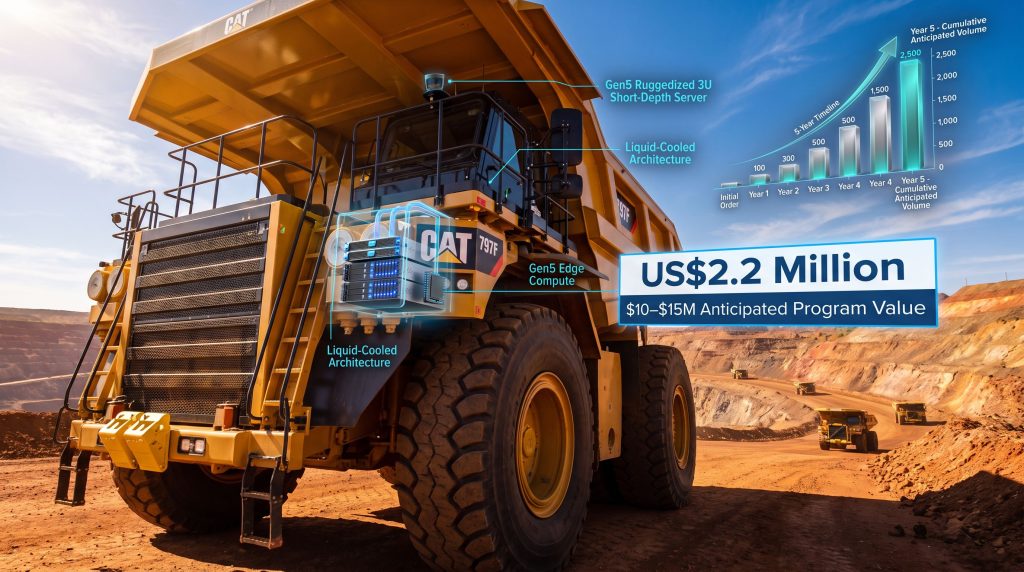
One Stop Systems, headquartered in Escondido, California, designs and manufactures compute platforms for demanding industrial and defence environments. In mid-2026, the company confirmed receipt of a US$2.2 million firm production order from an undisclosed manufacturer of autonomous mining and construction equipment.
The product at the centre of the order is the company's Gen5 ruggedized, 3U, liquid-cooled, short-depth server (SDS) — a purpose-built edge compute platform engineered specifically for high-density AI inference workloads in mobile industrial environments.
The key financial parameters of the program are summarised below:
| Parameter | Detail |
|---|---|
| Confirmed Order Value | US$2.2 million |
| Product | Gen5 ruggedized, 3U, liquid-cooled short-depth server |
| Application | Autonomous mining and construction equipment |
| Delivery Window | Q3 2026 through Q3 2027 |
| Anticipated Five-Year Program Value | US$10 million to US$15 million |
| Order Confirmation Status | US$2.2M confirmed; balance represents anticipated pipeline |
Disclaimer: The US$10 million to US$15 million figure represents management's anticipated cumulative program value over five years and should not be treated as confirmed revenue. Actual orders may differ materially from projections.
The customer relationship was first disclosed in February 2026, and the subsequent confirmation of the production order value provides investors and industry observers with a tangible measure of how that relationship has progressed from initial engagement to commercial deployment.
From Prototype Testing to Production: Why Does This Transition Matter?
In the industrial compute supply chain, the journey from prototype to production order is not a formality. OEM customers running autonomous equipment programs subject compute platforms to rigorous qualification processes that can span twelve to twenty-four months. Hardware must demonstrate sustained reliability across the full environmental envelope before it is cleared for integration into commercially deployed vehicles.
The confirmation of One Stop Systems rugged computers mining OEM order therefore signals something specific: the Gen5 SDS platform has survived that qualification process and been cleared for integration into vehicles entering commercial operation. This is the critical inflection point that separates pilot-stage supplier relationships from durable, multi-year commercial partnerships.
"The transition from prototype validation to firm production order in industrial compute supply is rarely a linear process. It requires consistent hardware performance across environmental stress tests, software integration milestones, and often independent safety certification reviews. Suppliers that clear these hurdles become structurally embedded in their customers' production architecture."
The Technical Architecture of Autonomous Mining Compute
Understanding why ruggedized edge servers are non-negotiable in autonomous mining platforms requires a working knowledge of how these vehicles process information. In addition, the rapid advancement of AI-powered mining efficiency across the sector has made the demands on onboard compute hardware even more intense.
Sensor Fusion at the Edge
An autonomous haul truck operating on a large open-cut mine typically carries a sensor suite that includes:
-
Multiple LiDAR units generating three-dimensional point clouds of the surrounding environment at refresh rates measured in tens of hertz
-
Radar systems providing reliable obstacle detection in dust, fog, and low-visibility conditions where LiDAR performance degrades
-
High-resolution camera arrays feeding machine vision algorithms responsible for object classification, lane adherence, and proximity detection
-
GNSS and inertial navigation systems providing centimetre-level positioning data for path planning and geofence compliance
-
Vehicle telemetry sensors monitoring drivetrain health, payload weight, tyre pressure, and fuel consumption in real time
All five data streams must be synchronised, processed, and acted upon simultaneously. The compute platform performing this work cannot afford latency introduced by a round trip to a remote cloud server. Every meaningful decision in autonomous vehicle operation happens at the edge, onboard the vehicle itself.
Why Liquid Cooling Is the Only Viable Solution
The GPU-accelerated compute required to run modern sensor fusion and machine vision algorithms generates substantial thermal output under sustained load. In a sealed equipment cabinet on a mining vehicle, managing that heat without relying on filtered airflow requires a fundamentally different thermal architecture.
Liquid-cooled closed-loop systems circulate coolant directly across heat-generating components, transferring thermal energy away from the compute stack without requiring any exchange with the external environment. This approach eliminates the two primary failure modes that afflict air-cooled compute in mining environments: dust ingress through filter media, and thermal throttling caused by elevated ambient air temperatures.
| Cooling Architecture | Suitability for Mining Autonomous Vehicles | Primary Limitation |
|---|---|---|
| Air-cooled (standard) | Low | Dust ingress, filter maintenance, thermal ceiling |
| Liquid-cooled (closed loop) | High | Higher unit cost, integration complexity |
| Conduction-cooled | Moderate | Limited scalability for high-density AI inference |
The Gen5 SDS platform's liquid-cooled architecture directly addresses this constraint, which explains why it has been selected for integration into commercial autonomous equipment rather than a competing air-cooled alternative.
OSS's Strategic Pivot: From Defence Pedigree to Mining Sector Growth
One Stop Systems built its engineering reputation in defence and aerospace markets, where ruggedized compute requirements are defined by military specification standards. MIL-STD-810 covers environmental stress testing for temperature, vibration, shock, and humidity. MIL-STD-461 addresses electromagnetic interference. Hardware designed and qualified to these standards carries an implicit performance guarantee that is directly transferable to the demands of autonomous mining platforms.
This technical heritage is not incidental to the company's mining sector expansion strategy. It is the foundation of it. Mining OEMs evaluating compute suppliers for autonomous vehicle programs are not looking for vendors with mining-specific experience alone. They are looking for suppliers with demonstrated hardware reliability under sustained environmental stress — a qualification that defence-grade compute manufacturers possess by definition.
The deliberate expansion into commercial industrial markets, including mining, oil and gas, agriculture, and commercial robotics, represents a strategy of applying proven technical capabilities to sectors where autonomous operations are accelerating and ruggedized compute supply remains limited. Consequently, the role of data-driven mining operations in shaping procurement decisions has never been more pronounced.
The Broader Autonomous Mining Market: Where Does the Industry Stand in 2026?
The autonomous mining equipment sector has moved well past the pilot program phase at the world's largest mining operations. Caterpillar's autonomous haulage system has accumulated billions of operating tonnes across multiple sites. Komatsu's FrontRunner platform operates large autonomous fleets at iron ore operations in Western Australia. Epiroc and Sandvik have deployed autonomous underground loaders and drill rigs at hard rock mines across multiple continents.
The commercial deployment curve is now broadening beyond the tier-one operators that pioneered these systems. Mid-tier and emerging market operators are increasingly incorporating autonomy into fleet procurement decisions, driven by a convergence of factors:
- Labour cost pressures in remote and technically demanding operating environments
- Safety regulation in jurisdictions where vehicle-pedestrian interaction rules are tightening
- Productivity benchmarks that autonomous systems consistently outperform manned equivalents on
- ESG reporting requirements that increasingly incorporate injury frequency rates and fatality statistics as investor-facing metrics
Each additional vehicle deployed within an autonomous fleet requires its own onboard compute stack. As fleet penetration increases across the industry, the aggregate demand for ruggedized edge compute hardware scales proportionally. This is the structural growth dynamic that gives the mining sector's autonomous equipment buildout its multi-decade demand characteristics. Furthermore, the broader shift to mining transport transformation with electric and autonomous vehicles is intensifying the need for high-performance onboard compute platforms.
The next major ASX story will hit our subscribers first
Competitive Moats and Revenue Visibility in Ruggedized Compute
Ruggedized compute is not a commodity hardware segment. The engineering barriers, certification requirements, and qualification timelines that define this market create durable competitive advantages for suppliers that successfully complete OEM integration programs.
A new entrant seeking to displace an incumbent ruggedized compute supplier in an autonomous mining OEM program faces a challenging proposition:
- Design and manufacture hardware that meets the OEM's environmental and performance specification
- Complete independent certification to relevant industrial and safety standards
- Complete the OEM's internal qualification process, typically spanning twelve to twenty-four months
- Demonstrate sustained reliability in field testing before commercial deployment clearance
The time and capital investment required to clear all four stages is substantial. Once a supplier has cleared them, the switching cost for the OEM customer is equally high. This dynamic creates supply relationships that, once established through successful field validation, tend to persist across multiple platform generations.
The anticipated US$10 million to US$15 million five-year program value associated with this mining OEM relationship is best understood in this context. It is not simply a revenue forecast. It is a measure of the commercial depth of a supplier relationship that has already survived the qualification process and entered production deployment.
Sector Diversification as Strategic Risk Management
For ruggedized compute businesses that developed their capabilities serving defence markets, commercial industrial expansion is simultaneously a growth strategy and a risk management exercise. Defence procurement cycles are subject to budget volatility, programme delays, and geopolitical uncertainty. Mining, agriculture, and commercial robotics operate on different procurement rhythms with different demand drivers.
A compute supplier with meaningful revenue exposure across defence, mining, oil and gas, and agriculture is substantially less exposed to single-vertical procurement disruption than one dependent on a single government customer base. The mining OEM program represents one component of this diversification strategy, but its commercial significance extends beyond its direct revenue contribution. However, it is worth noting that the role of AI in mining continues to reshape what OEMs expect from their compute supply partners.
Frequently Asked Questions
What Is the One Stop Systems Mining OEM Order?
One Stop Systems received a confirmed US$2.2 million production order from an undisclosed manufacturer of autonomous mining and construction equipment. The order covers delivery of the company's Gen5 ruggedized, liquid-cooled, short-depth server across a delivery window spanning Q3 2026 to Q3 2027.
What Product Is Being Supplied Under the Mining OEM Order?
The Gen5 ruggedized, 3U, liquid-cooled, short-depth server is a purpose-built edge compute platform designed for high-density AI inference workloads in environments subject to vibration, thermal stress, dust, and spatial constraints typical of autonomous heavy equipment.
What Is the Total Anticipated Value of the Mining OEM Program?
OSS anticipates cumulative program orders of between US$10 million and US$15 million over a five-year period. Only the initial US$2.2 million represents a confirmed firm order. The broader program value is a management estimate and should not be treated as contracted revenue.
Why Does Autonomous Mining Equipment Require Ruggedized Computers?
Autonomous vehicles operating in mining environments must process continuous sensor data from LiDAR, radar, and camera systems in real time, under conditions of extreme vibration, temperature variation, dust exposure, and physical shock. Standard commercial computing hardware is not engineered to maintain reliability under these conditions.
Why Is Liquid Cooling Used in Mining Edge Servers?
Liquid-cooled architectures allow high-density GPU compute to operate within sealed enclosures without relying on filtered airflow, eliminating a critical failure point in dusty mining environments while maintaining thermal performance under sustained AI inference workloads.
What Other Markets Does OSS Serve Beyond Mining?
The company serves industrial OEM customers across defence, aerospace, oil and gas, agriculture, and commercial robotics sectors, with ruggedized edge compute platforms tailored to each application's environmental and performance requirements. For further context on the company's market positioning, OSS's broader profile provides useful background on its capabilities and customer base.
What This Order Signals About Mining Automation's Trajectory
A single US$2.2 million production order does not define a market trend in isolation. What it does represent is a data point within a much larger pattern: autonomous mining equipment programs that began as technology demonstrations at flagship operations in the early 2010s are now driving commercial procurement decisions at OEMs building their next generation of autonomous platforms.
The hardware suppliers embedded in those programs are being pulled forward by the commercial momentum of the OEMs they serve. As autonomous fleet penetration broadens beyond the tier-one operators that pioneered these systems, the demand for validated, production-ready ruggedized compute platforms will continue to grow with it.
For industry observers tracking the technology procurement landscape within mining, the convergence of AI inference capability, liquid-cooled ruggedized hardware engineering, and large-scale autonomous fleet deployment is emerging as one of the defining technology dynamics of the mid-2020s decade. The compute suppliers that have already cleared OEM qualification in this environment — as One Stop Systems rugged computers mining OEM order demonstrates — are well positioned to benefit as that dynamic accelerates.
This article is intended for informational purposes only and does not constitute financial advice. Projections and anticipated program values referenced herein are based on company disclosures and should not be relied upon as forecasts of actual future revenue. Readers should conduct independent due diligence before making any investment decisions.
Want to Track the Next Major Mineral Discovery Before the Market Moves?
Discovery Alert's proprietary Discovery IQ model scans ASX announcements in real time, instantly identifying significant mineral discoveries and turning complex data into actionable investment insights — visit the Discovery Alert discoveries page to explore historic examples of exceptional returns, and begin your 14-day free trial to position yourself ahead of the broader market.