July 21, 2026
The Infrastructure Prize Hidden Inside Brazil's Most Complex Mining Deal
Integrated mine-to-port logistics chains rarely change hands in a single transaction. The capital requirements are enormous, the regulatory complexity is multi-layered, and the interdependencies between individual assets mean that incomplete execution at any point collapses the entire value thesis. Yet that is precisely what is taking shape in Brazil's northeast, where Mota-Engil and ERG mining and infrastructure assets in Brazil have moved into advanced negotiations over a package that, if transferred successfully, would represent one of the most consequential infrastructure ownership shifts in Brazil's recent history.
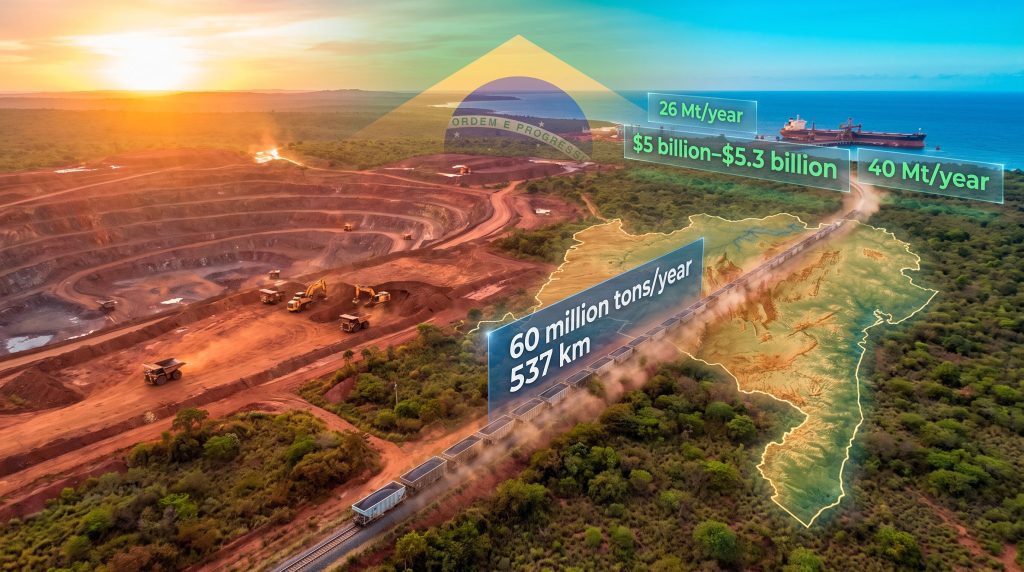
The deal centres on Bahia Mineração (Bamin), ERG's Brazilian corporate vehicle, which holds three interlocking assets: the Pedra de Ferro iron ore mine near Caetité, the FIOL West-East Integration Railway concession stretching 537 kilometres across Bahia state, and the planned Porto Sul deep-sea maritime terminal at Ilhéus. Understanding why these parties are at the table requires understanding why this particular combination of assets has remained underdeveloped for so long, and what has changed to make completion credible now.
When big ASX news breaks, our subscribers know first
Why Bahia's Mineral Corridor Has Remained Underdeveloped
Brazil's iron ore export infrastructure is heavily concentrated in two corridors. The Carajás system in Pará, operated by Vale, connects one of the world's richest iron ore deposits to the deep-sea Ponta da Madeira terminal via the 892-kilometre Carajás Railway. In the southeast, the MRS Logística network links Minas Gerais production regions to the port of Tubarão. These two systems handle the overwhelming majority of Brazil's 400-plus million tonnes of annual iron ore exports.
Bahia sits in a structural gap between these established corridors. The state holds significant mineral resources, including Pedra de Ferro's iron ore body, but has lacked the railway and port infrastructure needed to move bulk commodities to global markets competitively. Without a dedicated export route, ore from Bahia's interior must travel longer distances via road or connect to logistics systems not designed for bulk mineral volumes.
The FIOL railway was conceived precisely to close this gap. Designed to run west to east across Bahia, connecting mineral-producing hinterlands to a purpose-built coastal terminal, it represents the logistical backbone without which Pedra de Ferro cannot scale and Porto Sul cannot function. The three assets are not independent projects bundled together for convenience. They are a sequenced infrastructure system where each component's commercial value is conditional on the others being completed and operational.
What the Three-Asset Package Actually Represents
| Asset | Location | Designed Capacity | Current Status |
|---|---|---|---|
| Pedra de Ferro Iron Ore Mine | Caetité, Bahia | 26 million metric tons/year | Early-stage (~1-2 Mt/year) |
| FIOL Railway (Stage 1 Concession) | West-East Bahia Corridor | 60 million tons/year | 537 km; final stretch incomplete |
| Porto Sul Maritime Terminal | Ilhéus, Bahia | Up to 40 million tons/year | Planned; construction pending |
The gap between Pedra de Ferro's current output of roughly 1-2 million metric tons per year and its nameplate capacity of 26 million metric tons annually illustrates the scale of what remains unfinished. Reaching that target requires not just mine expansion capital but functional rail and port infrastructure capable of handling the resulting export volumes. The capital investment to bridge that gap, across all three assets simultaneously, is estimated at $5 billion to $5.3 billion, a threshold that has historically deterred all but the most strategically motivated buyers.
Pedra de Ferro: Iron Ore Quality and the Grade Advantage
One detail that receives less attention than the logistics challenges is the underlying quality of Pedra de Ferro's ore body. Brazilian iron ore deposits in Bahia's Espinhaço mountain range tend to produce high-grade hematite with relatively low levels of problematic impurities — characteristics that make the product attractive to steel mills seeking to optimise blast furnace efficiency and reduce emissions per tonne of steel produced.
As steelmakers globally face increasing pressure to cut carbon intensity, the premium for high-grade, low-alumina iron ore has become a structural rather than cyclical feature of the seaborne market. Furthermore, this gives Pedra de Ferro a quality argument that supports long-term offtake interest from Asian buyers, particularly in markets where environmental compliance costs are rising. Consequently, iron ore price trends in the high-grade segment are likely to remain favourable for producers capable of meeting exacting steel mill specifications.
FIOL: Why the Railway Is the Transaction's True Prize
Among the three assets, the FIOL concession carries the most durable long-term value. Freight railway concessions in Brazil generate income through haulage fees charged to any shipper using the corridor, not just the concession holder's own cargo. This toll-road economics model means that once FIOL is operational, it can generate revenue from agricultural exporters, industrial mineral producers, and general freight shippers across Bahia's hinterland, in addition to iron ore from Pedra de Ferro.
The concession's designed capacity of 60 million tons per year significantly exceeds what Pedra de Ferro alone could supply even at full production. This is not an accident of engineering. It reflects the corridor's intention to serve as a multi-commodity logistics artery for Brazil's northeast. For Mota-Engil, owning this concession is not primarily about iron ore exposure. It is about capturing recurring infrastructure revenue from a captive corridor serving a mineral and agricultural-rich region with no competing rail alternative.
The incomplete final stretch of FIOL is simultaneously the deal's most significant risk and its most significant opportunity. Whoever completes it controls access to one of Brazil's few undeveloped integrated export corridors. For context, iron ore export advantages in established corridors demonstrate how decisive logistics infrastructure can be in determining long-run competitiveness.
ERG's Strategic Exit: Why a Global Resources Giant Is Selling
ERG is one of the world's largest producers of cobalt and chromium, with a portfolio centred on Kazakhstan, the Democratic Republic of Congo, and other core geographies. Brazil was always a geographic outlier within that portfolio, acquired during a period when the integrated Bamin package appeared to offer large-scale iron ore upside at a moment of strong commodity sentiment.
The years that followed brought a succession of financing gaps, construction delays, regulatory complexity, and ultimately the cascading capital constraints that followed Russia's invasion of Ukraine in 2022. For a company with significant exposure to Eurasian banking relationships and capital markets, mobilising the $5-plus billion needed to complete a Brazilian infrastructure programme became structurally difficult regardless of the underlying asset quality. According to reporting on the Bamin acquisition process, divestiture of Bamin allows ERG to concentrate resources on its core commodity positions while transferring the completion risk to a buyer better positioned to execute in the Brazilian context.
Mota-Engil's Strategic Pivot: From Builder to Owner-Operator
Mota-Engil's interest in this transaction reflects a deliberate shift in its business model. Traditional EPC contracting, where a company builds infrastructure under a fixed-fee or cost-plus arrangement and then hands over the keys, generates project-by-project revenue without creating recurring asset income. Infrastructure ownership, by contrast, generates long-duration cash flows from operational assets that continue paying returns for the life of the concession.
Mota-Engil has precedent for this model. Its African operations include railway infrastructure in countries such as Mozambique and Angola, where the company has moved beyond pure construction into operational involvement. The FIOL and Porto Sul assets represent a much larger version of the same strategic logic, applied to a market where Mota-Engil already has substantial operational presence. In addition, Mota-Engil and ERG mining and infrastructure assets in Brazil align well with the company's long-stated ambition to build recurring concession income.
That presence is significant. Mota-Engil's recent award of the R$6.8 billion Santos-Guarujá immersed tunnel PPP in São Paulo state demonstrates the company's capability to structure, win, and execute complex Brazilian infrastructure concessions. Existing relationships with major Brazilian mining operators also provide a commercial platform for developing FIOL's third-party freight business.
The CCCC Dimension: Financing Enabler or Regulatory Complication?
China Communications Construction Co. (CCCC), which holds a minority stake in Mota-Engil, introduces a dimension that goes beyond conventional project finance. Chinese infrastructure financing models — typically involving combinations of shareholder capital and development bank lending tied to construction contracts — have been deployed extensively across African and Latin American resource corridors. The presence of a Chinese-affiliated shareholder potentially unlocks financing structures unavailable through Western capital markets alone.
However, Brazilian regulators and federal officials are increasingly attentive to foreign ownership of strategic transport concessions. The ANTT, Brazil's National Land Transportation Agency, must approve any transfer of the FIOL concession, and that approval process will almost certainly involve scrutiny of the ultimate ownership structure and financing arrangements behind the transaction. The broader iron ore market tariffs environment also adds geopolitical complexity to any Chinese-affiliated financing structure at this scale.
| Financing Pathway | Key Mechanism | Risk Level | Strategic Fit |
|---|---|---|---|
| CCCC-backed project finance | Shareholder capital + Chinese development bank debt | Medium | High |
| BNDES participation | Brazilian domestic infrastructure financing | Low-Medium | High |
| International project finance syndication | Multilateral + commercial bank debt | Medium-High | Medium |
| Phased equity raise via asset monetisation | Minority stake sales in individual assets | Medium | Medium |
Regulatory Hurdles Between Signing and Completion
ANTT's approval of the concession transfer is the single most consequential near-term milestone for this transaction. Brazilian concession transfer processes are not rubber stamps. The agency typically attaches conditions related to investment commitments, construction completion milestones, and operational performance standards. A buyer perceived as lacking the financial capacity to deliver on those commitments faces a much harder approval pathway.
Beyond ANTT, the environmental licensing status of both Pedra de Ferro and Porto Sul represents a parallel risk track. Brazilian environmental licencing for large-scale mining and port infrastructure projects has historically been a source of multi-year delays, particularly in ecologically sensitive coastal regions. Ilhéus, where Porto Sul would be built, sits near the Atlantic Forest biome, one of Brazil's most environmentally protected ecosystems. Any licensing complications at Porto Sul would directly affect the corridor's timeline and commercial viability.
The next major ASX story will hit our subscribers first
Three Scenarios for the Deal's Outcome
Scenario 1: Full corridor activation. ANTT approves the concession transfer, CCCC and BNDES provide complementary financing, and Mota-Engil executes a phased construction programme completing FIOL and Porto Sul within a seven-to-ten year timeframe. Pedra de Ferro scales toward its 26 Mt/year nameplate capacity, and Bahia emerges as Brazil's third major iron ore export corridor.
Scenario 2: Infrastructure completion without full mine ramp-up. FIOL and Porto Sul are completed as third-party logistics infrastructure, attracting multiple shippers across iron ore, agricultural commodities, and industrial minerals. Pedra de Ferro operates at sub-capacity as an anchor customer while the corridor builds a diversified revenue base. Mota-Engil generates infrastructure returns without full commodity price exposure.
Scenario 3: Deal restructuring or collapse. Regulatory rejection, financing shortfall, or adverse due diligence findings prevent completion on current terms. ERG's ability to find an alternative buyer for the integrated package is constrained by the same $5 billion-plus capital requirement that has deterred others. The corridor's development timeline extends further, and the assets remain in a holding pattern.
The probability distribution across these three scenarios is not uniform. Scenario 2 may represent the most commercially rational near-term outcome, with Scenario 1 as the long-duration upside case and Scenario 3 as the tail risk that neither party currently considers likely given the advanced stage of negotiations.
What Completion Would Mean for Brazil's Export Competitiveness
A fully operational FIOL-Porto Sul corridor would alter the geography of Brazil's iron ore logistics in ways that extend well beyond Bahia. Ilhéus sits at a latitude that meaningfully reduces sailing distances to Asian steel markets compared to ports in Brazil's southeast. For Capesize bulk carriers transporting iron ore to China or Japan, port latitude translates directly into voyage economics. A lower-latitude Atlantic port serving a competitive ore body could capture freight cost advantages that compound at scale over millions of tonnes per year.
The corridor's multi-commodity potential further expands the strategic logic. Brazil's centre-west agricultural frontier, already one of the world's most productive soybean and corn growing regions, currently relies on congested road and river routes to reach Atlantic export terminals. A functional FIOL railway with Porto Sul as its terminus could attract significant agricultural freight volumes, transforming the corridor's revenue base and reducing unit infrastructure costs for all users.
Furthermore, the deal's outcome will be closely watched by participants in the China steel and iron ore market, given that Chinese steel mills represent the most likely destination for any scaled-up Pedra de Ferro output. Moreover, the push towards green iron production globally means that high-grade Brazilian ore, with its lower impurity profile, could command a structural premium as decarbonisation targets tighten. According to analysis of the broader Bamin transaction context, Mota-Engil and ERG mining and infrastructure assets in Brazil could ultimately redefine how the country's northeast integrates into global commodity supply chains.
This article is analytical and informational in nature. It does not constitute financial or investment advice. The transaction between Mota-Engil and ERG remains subject to due diligence, regulatory approval, and final agreement, and outcomes described as scenarios represent analytical projections rather than confirmed outcomes. Readers should conduct independent research before making any investment or business decisions related to the companies or assets discussed.
Want to Track the Next Major Mineral Discovery Before the Market Moves?
Discovery Alert's proprietary Discovery IQ model scans ASX announcements in real time, instantly identifying significant mineral discoveries and turning complex data into actionable investment insights — explore historic discoveries and their returns to understand what early positioning can mean, then begin your 14-day free trial at Discovery Alert to secure your market-leading edge.